

Best Attachment Theory Books: Comparing “Attached,” “Wired for Love,” and “Hold Me Tight”
Understanding why you keep falling into the same relationship patterns choosing emotionally unavailable partners, feeling anxious when your partner pulls away, shutting down during conflict can feel like trying to solve a puzzle without seeing the picture on the box. Fortunately, attachment theory offers that picture. It explains how early relational experiences shape the way you connect, communicate, and respond to intimacy as an adult. Moreover, this attachment theory book comparison examines three foundational texts that help readers understand these patterns and choose the right resource for their relationship stage.
But when you’re standing in front of dozens of attachment theory books, the question isn’t just “Should I read about this?” Rather, it’s “Which book will actually help me understand my patterns, and which matches where I am right now single and dating, in a committed relationship, or trying to repair something that’s breaking?” A thorough attachment theory book comparison can guide that choice.
Three books have become foundational in the popular understanding of adult attachment: Attached: The New Science of Adult Attachment and How It Can Help You Find and Keep Love by Amir Levine and Rachel Heller, Wired for Love: How Understanding Your Partner’s Brain and Attachment Style Can Help You Defuse Conflict and Build a Secure Relationship by Stan Tatkin, and Hold Me Tight: Seven Conversations for a Lifetime of Love by Sue Johnson. Each offers a distinct lens on attachment, serves different readers at different relationship stages, and brings unique clinical expertise to the conversation.
Attachment theory has moved from academic psychology into mainstream conversation quickly enough that the quality of what gets written about it varies considerably. These three books represent the more rigorous end of that spectrum, each grounded in clinical practice and research rather than in trend. The comparison here is built around one practical question: which of these will actually be useful to you, given where you are right now.
This attachment theory book comparison walks through what each book offers, who it’s written for, and how to choose based on your current situation and goals.
Understanding Attachment Theory: Why These Books Matter

What Attachment Theory Explains About Relationship Patterns
Attachment theory, originally developed by psychologist John Bowlly and researcher Mary Ainsworth, describes how early experiences with caregivers shape our expectations about closeness, safety, and emotional availability in relationships. Specifically, these patterns often categorized as secure, anxious, avoidant, or disorganized influence how we seek connection, respond to conflict, and regulate emotions when intimacy feels threatened.
In adults, attachment patterns show up in dating choices, communication styles, and the ways relationships either thrive or unravel. According to research from the National Institute of Health on attachment in adults, attachment styles are relatively stable but not fixed. With self-awareness, intentional practice, and often therapeutic support, patterns can shift toward greater security.
How Reading About Attachment Fits Into Personal Growth
Books about attachment offer frameworks for recognizing patterns you may have been repeating unconsciously for years. Additionally, they help you understand why certain relationship dynamics feel familiar even when they’re painful. They also explain why some people trigger anxiety while others feel safe.
Reading alone doesn’t change attachment patterns that requires practice, reflection, and often relational work with a partner or therapist. However, books provide language, context, and starting points. They can validate your experiences, normalize struggles, and offer tools for beginning the work of change. This connects to broader patterns discussed in emotional intelligence in relationships understanding yourself is foundational to connecting with others.
What to Expect from These Three Foundational Authors
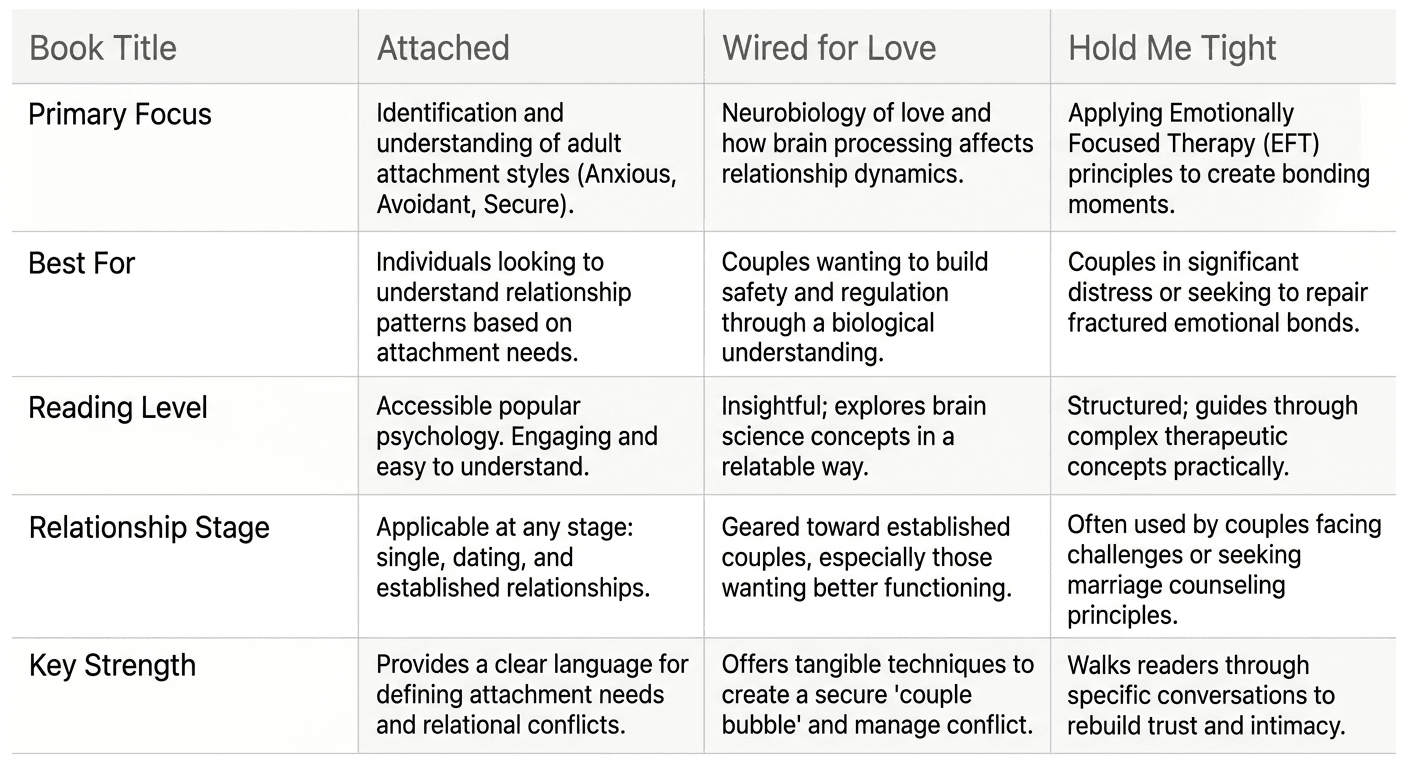
Each of these authors brings a different clinical background and writes for a slightly different audience:
- Amir Levine and Rachel Heller (Attached) offer an accessible, dating-focused introduction to attachment styles, grounded in psychiatry and journalism.
- Stan Tatkin (Wired for Love) integrates neuroscience and attachment theory for couples, emphasizing how the brain shapes relational responses.
- Sue Johnson (Hold Me Tight) draws on Emotionally Focused Therapy (EFT), a research-backed couples therapy model, to guide emotional reconnection.
Understanding their approaches helps you choose the book that matches your learning style, relationship stage, and immediate needs in this attachment theory book comparison.
One honest observation about all three books worth holding as you read through this comparison: each presents attachment styles as more stable and more category-driven than the research fully supports. The secure, anxious, avoidant, and disorganized distinctions are genuinely useful organizing frameworks, but lived attachment behavior is considerably more context-dependent than any single-style description captures. Someone can be avoidant with one partner and anxious with another. Styles shift across life stages, relationships, and therapeutic work. Using these books as lenses for self-examination rather than as diagnostic labels produces more useful insight and fewer unfair conclusions about yourself or your partners.
“Attached: The New Science of Adult Attachment and How It Can Help You Find and Keep Love”
Core Approach and Key Concepts
Attached is the most accessible and widely read introduction to adult attachment theory. Levine, a psychiatrist and neuroscientist, and Heller, a writer, present attachment styles secure, anxious, and avoidant as recognizable patterns that influence dating and partner selection.
Importantly, the book emphasizes that attachment needs are biological and legitimate, not signs of neediness. It reframes anxious behavior (seeking reassurance, fearing abandonment) and avoidant behavior (valuing independence, withdrawing under stress) as predictable responses rooted in how the nervous system learned to regulate connection and distance.
The central premise: understanding your attachment style and choosing partners whose attachment behavior complements rather than triggers yours can increase relationship satisfaction and reduce suffering.
Who This Book Is Written For
Attached was designed for people who are single, dating, or in early-stage relationships and trying to understand recurring patterns. It’s particularly helpful if you:
- Keep choosing partners who are emotionally unavailable
- Feel anxious or insecure in relationships even when your partner seems interested
- Notice that your relationships follow similar trajectories (intense start, gradual withdrawal, painful ending)
- Want practical guidance on identifying secure partners and avoiding incompatible dynamics
The book focuses less on repairing long-term relationships and more on preventing painful patterns from repeating. This aligns with principles discussed in intentional dating and building meaningful connections.
Strengths: Clarity, Practical Scenarios, and Dating Focus
Attached is clear, jargon-free, and full of real-world dating scenarios. It doesn’t require prior knowledge of psychology. Furthermore, the authors provide checklists, red flags, and actionable advice how to recognize an avoidant partner early, how to communicate your needs without apologizing for them, how to assess whether someone is capable of the closeness you want.
The book validates anxious attachment as a legitimate response rather than something to be ashamed of. In addition, it offers practical tools for recognizing when a relationship triggers your insecurity versus when a partner’s behavior is genuinely inconsistent.
Limitations: What It Doesn’t Cover Deeply
Attached is an introduction, not a comprehensive guide. It simplifies attachment into three main categories, which can feel overly rigid for readers whose patterns don’t fit neatly. Moreover, it focuses heavily on partner selection and less on how to heal your own attachment wounds or deepen an existing relationship.
The book also doesn’t address trauma, childhood abuse, or complex relational histories in depth. If your attachment patterns stem from significant early trauma, Attached offers a helpful starting point but isn’t sufficient on its own.
Best For: First-Time Readers and Singles Navigating Dating
If you’re new to attachment theory and trying to understand why your dating life feels frustrating or repetitive, Attached is an excellent first book. Similarly, it’s valuable for people who want practical, immediately applicable guidance rather than deep theoretical exploration.
“Wired for Love: How Understanding Your Partner’s Brain and Attachment Style Can Help You Defuse Conflict and Build a Secure Relationship”
Core Approach and Key Concepts
Wired for Love integrates attachment theory with neuroscience, particularly polyvagal theory and brain science. Tatkin, a psychologist and developer of the Psychobiological Approach to Couple Therapy (PACT), explains how the nervous system responds to threat, safety, and connection in relationships.
The book emphasizes that much of what happens in couple conflict stems from automatic, unconscious brain processes. Understanding how your partner’s nervous system works what triggers their fight, flight, or freeze responses can help you stop personalizing their reactions and start responding in ways that create safety.
Tatkin introduces the concept of a “couple bubble,” a secure relational space where both partners prioritize protecting each other’s sense of safety and connection.
Who This Book Is Written For
Wired for Love was written for people in committed relationships who want to understand the neuroscience behind their conflicts and build more secure relational habits. It’s especially helpful if you:
- Find yourself stuck in repetitive conflict cycles (the same fight, different trigger)
- Want to understand the biological underpinnings of attachment responses
- Are drawn to scientific explanations and brain-based frameworks
- Are in couples therapy or considering it and want a companion resource
- Want practical exercises to do with your partner
This is not a dating book. Instead, it assumes you’re already in a relationship and willing to work collaboratively on changing patterns. Understanding these dynamics connects to broader themes in couple communication that heals and connects.
Strengths: Brain Science, Couples Focus, and Practical Exercises
Tatkin’s integration of neuroscience makes abstract attachment concepts concrete. Understanding that your partner’s withdrawal isn’t rejection but a nervous system response to perceived threat can shift how you approach conflict.
The book includes exercises designed for couples to practice together how to check in during stress, how to repair after disconnection, how to create rituals that reinforce safety. These tools are actionable and grounded in clinical practice.
Tatkin’s tone is direct and practical. He doesn’t romanticize relationships but treats them as skill-based endeavors where partners can learn to regulate each other’s nervous systems and co-create security.
Limitations: Complexity and Assumed Relationship Context
Wired for Love is more complex and less accessible than Attached. The neuroscience sections can feel dense if you’re not comfortable with scientific language. Additionally, it assumes both partners are willing to engage with the material, which isn’t always realistic.
If you’re single, dating, or in a relationship where your partner isn’t interested in self-examination, Wired for Love may feel less immediately useful. It’s designed for mutual work, not individual insight.
Best For: Committed Couples and Science-Minded Readers
If you’re in a committed relationship, value scientific explanations, and want practical tools for changing conflict patterns, Wired for Love offers depth and precision. It’s particularly valuable for couples already in therapy or those who want to understand the “why” behind their relational responses.
“Hold Me Tight: Seven Conversations for a Lifetime of Love”

Core Approach and Key Concepts
Hold Me Tight draws from Emotionally Focused Therapy (EFT), a research-backed couples therapy model developed by Sue Johnson. EFT has been studied extensively and shows high success rates for helping couples reconnect emotionally and repair distressed relationships.
Johnson’s approach focuses on identifying negative interaction cycles patterns where one partner pursues and the other withdraws, or both partners criticize and defend and replacing them with vulnerable, emotion-focused conversations that rebuild trust and intimacy.
The book is structured around seven conversations, each addressing a different aspect of attachment and emotional connection: recognizing destructive patterns, identifying raw emotions beneath conflict, revisiting painful moments, sharing fears and needs, forgiving injuries, creating rituals of connection, and sustaining closeness over time.
Who This Book Is Written For
Hold Me Tight was written for couples who are struggling experiencing distance, frequent conflict, betrayal, or emotional disconnection and want a roadmap for repair. It’s especially helpful if you:
- Feel stuck in cycles where one partner pursues closeness and the other withdraws
- Want to understand the emotions driving conflict beneath surface arguments
- Are recovering from infidelity, breach of trust, or emotional injury
- Are in couples therapy using EFT and want a companion guide
- Want conversation scripts and structured dialogues to practice with your partner
This book focuses on repair and reconnection, not prevention or partner selection. It addresses patterns discussed in emotional safety as the foundation of intimacy.
Strengths: Emotional Depth, Conversation Scripts, and Therapeutic Guidance
Johnson writes with warmth and empathy, validating the pain couples feel when connection is lost. The conversational scripts offer concrete language for expressing vulnerability, which many people struggle to do during conflict.
The book’s structure seven specific conversations makes the work feel manageable. Each chapter includes real-life couple examples, reflective questions, and exercises designed for partners to complete together.
Hold Me Tight is particularly strong at helping readers understand that anger, criticism, and withdrawal are often protests against disconnection rather than lack of love. Reframing conflict as an attachment cry can shift how partners respond to each other.
Limitations: Focus on Repair Over Prevention
Hold Me Tight assumes you’re already in a relationship that’s worth saving. Consequently, it’s less useful if you’re single, dating, or trying to understand whether a relationship is healthy enough to invest in repairing.
The book also requires both partners to engage. If one person is unwilling to participate in the conversations or dismisses the framework, the exercises become difficult to implement.
Best For: Couples in Distress and Those Seeking Emotional Reconnection
If your relationship is struggling and you want a structured, emotionally grounded approach to repair, Hold Me Tight is an excellent choice. It’s particularly valuable for couples in EFT-based therapy or those willing to do vulnerable, guided conversations together.
Side-by-Side Attachment Theory Book Comparison: Which Book Fits Your Needs?
Reading Level and Accessibility
| Book | Reading Level | Accessibility |
|---|---|---|
| Attached | Very accessible | Clear, jargon-free, fast-paced |
| Wired for Love | Moderate to complex | Scientific language, requires focus |
| Hold Me Tight | Accessible to moderate | Warm tone, structured, emotionally engaged |
Attached is the easiest to read. In contrast, Hold Me Tight balances accessibility with depth. Meanwhile, Wired for Love requires more patience with neuroscience concepts.
Relationship Stage Focus (Single, Dating, Committed, Struggling)
| Book | Best Relationship Stage |
|---|---|
| Attached | Single, dating, early relationships |
| Wired for Love | Committed relationships |
| Hold Me Tight | Committed relationships, especially struggling |
Attached is front-loaded for partner selection in this attachment theory book comparison. By comparison, Wired for Love and Hold Me Tight were designed for established couples.
Theoretical Depth vs. Practical Application
| Book | Theory | Practice |
|---|---|---|
| Attached | Moderate | High (checklists, dating advice) |
| Wired for Love | High (neuroscience-integrated) | High (exercises for couples) |
| Hold Me Tight | Moderate (EFT framework) | Very high (conversation scripts) |
All three balance theory and practice, but Wired for Love offers the most scientific depth. On the other hand, Hold Me Tight offers the most structured emotional exercises.
Exercises, Tools, and Actionable Takeaways
- Attached: Checklists for identifying attachment styles, red flags for avoidant partners, communication scripts for expressing needs
- Wired for Love: Couple exercises for nervous system regulation, creating a “couple bubble,” repairing after conflict
- Hold Me Tight: Seven structured conversations with reflective questions, real-world couple examples, scripts for vulnerable sharing
All three provide actionable tools in this attachment theory book comparison. However, the type of tool differs: Attached focuses on decision-making, Wired for Love on nervous system co-regulation, and Hold Me Tight on emotional reconnection.
How to Choose Based on Your Situation and Goals
If You’re Single and Want to Understand Your Dating Patterns
Start with Attached. It will help you recognize why certain people feel irresistible even when they’re inconsistent. Furthermore, you’ll understand why you might feel anxious with partners who seem available. You’ll also learn how to identify secure partners who can meet your attachment needs.
If You’re in a Healthy Relationship and Want to Deepen Understanding
Wired for Love offers tools for maintaining and strengthening connection before conflict patterns become entrenched. It’s preventive and skill-building, ideal for couples who want to understand the neuroscience of their bond.
If Your Relationship Is Struggling and You Want Tools for Repair
Hold Me Tight provides a structured, emotionally grounded path for reconnection. If you’re stuck in cycles of criticism and withdrawal, or recovering from betrayal, Johnson’s seven conversations offer a roadmap for healing.
If You’re Healing from Past Relationships and Building Self-Awareness
Any of the three can support healing in this attachment theory book comparison. Nevertheless, Attached is the most accessible starting point for understanding your patterns. Pair it with therapy if your attachment wounds stem from trauma or significant childhood neglect. Understanding building emotional regulation skills can complement your reading.
Recommended Reading Order and Complementary Resources
Should You Read All Three? Why Multiple Perspectives Help
Each book offers a different perspective on attachment. Attached helps you recognize patterns. Meanwhile, Wired for Love explains the neuroscience. Finally, Hold Me Tight guides emotional repair. Reading multiple books deepens understanding and offers varied tools.
If you’re committed to understanding attachment thoroughly, reading all three over time provides a well-rounded foundation.
Suggested Progression Based on Relationship Journey
If single or dating:
- Attached (understand your patterns and choose partners wisely)
- Wired for Love (once in a committed relationship, deepen understanding)
- Hold Me Tight (if relationship struggles emerge)
If in a committed relationship:
- Wired for Love or Hold Me Tight (depending on whether you’re preventing conflict or repairing it)
- Attached (to understand how your patterns formed)
If recovering from a breakup:
- Attached (understand what went wrong and what to look for next)
- Therapy or healing-focused workbooks alongside reading
Companion Workbooks and Online Resources
Some authors offer workbooks, online courses, or workshops:
- Stan Tatkin offers PACT training and workshops for couples
- Sue Johnson has EFT-based resources and therapist directories for finding EFT practitioners
- Amir Levine and Rachel Heller’s website includes additional articles and tools
These can deepen the work but aren’t required to benefit from the books.
When to Pair Reading with Therapy or Couples Counseling
Books are educational tools. In contrast, therapy offers personalized guidance, emotional processing, and accountability. If you’re dealing with trauma, abuse, severe anxiety, complex family-of-origin issues, or relationship patterns that feel deeply entrenched, working with a qualified therapist alongside reading will be far more effective than reading alone.
EFT-trained therapists are particularly well-suited to work with Hold Me Tight. Similarly, PACT-trained therapists align with Wired for Love. For guidance on professional support options, review therapy cost comparison resources.
Frequently Asked Questions About Attachment Theory Books
Can these books really change my relationship patterns?
Books can increase self-awareness and provide tools. However, changing attachment patterns requires sustained practice, reflection, and often relational work with a partner or therapist. Reading alone is a starting point, not a complete solution. Many people find that books help them recognize patterns they’ve been repeating unconsciously, which is the first step toward change.
Do I need to read these with my partner?
It depends on the book and your relationship. Attached is valuable to read individually. In contrast, Wired for Love and Hold Me Tight were designed for couples to engage with together, though you can benefit from reading them alone and applying insights where possible. If your partner isn’t interested, reading individually can still shift your responses and create space for healthier dynamics.
What if I disagree with my “attachment style”?
Attachment styles are patterns, not fixed personality types. People don’t fit neatly into categories, and context matters you might be anxious with one partner and avoidant with another. If a description doesn’t resonate, that’s okay. Use the frameworks as tools for reflection, not rigid labels.
Are these books enough, or do I need therapy too?
For some people, books provide sufficient insight and tools. For others especially those dealing with trauma, abuse, severe anxiety or depression, or deeply entrenched patterns therapy is essential. Books complement therapy but rarely replace it. If you’re unsure, consult with a therapist about whether reading is enough or if professional support would help.
Which format is best physical book, Kindle, or audiobook?
This depends on personal preference. Physical books allow for highlighting and note-taking. Meanwhile, Kindle offers portability and search functionality. Audiobooks work well for commuters or people who process information better auditorily. However, Hold Me Tight and Wired for Love include exercises that may be easier to engage with in physical or digital text formats than audio.
Final Considerations and Important Information
Making the Most of What You Read
Reading about attachment is most effective when paired with reflection, journaling, and conversation with a partner, therapist, or trusted friend. Notice patterns as you read. Ask yourself which scenarios feel familiar. Practice the exercises. Give yourself time to integrate new awareness before expecting immediate change.
When Books Should Be Paired with Professional Support
If you’re dealing with trauma, abuse (past or present), suicidal thoughts, severe anxiety or depression, substance use, or relationship violence, please work with a qualified therapist. Books can support healing, but they are not substitutes for professional care.
If you’re in crisis, contact the 988 Suicide and Crisis Lifeline (call or text 988) or go to your nearest emergency room.
About Our Book Recommendations and Affiliate Relationships
LubDubSmile may earn a commission if you purchase through links in this article, at no additional cost to you. Our attachment theory book comparison draws from content analysis, clinical evidence, and editorial judgment, not promotional arrangements. We recommend these books because they represent foundational, well-regarded perspectives on adult attachment, not because of affiliate earnings.
Understanding the Limits of Self-Help Resources
These books offer valuable frameworks for understanding attachment. Nevertheless, they are educational resources, not substitutes for therapy. Attachment styles are not fixed labels and can evolve with self-awareness, healthy relationships, and intentional work. No book can fully capture individual complexity.
Decisions about staying in or leaving relationships should consider many factors beyond attachment theory safety, values alignment, mutual respect, and long-term goals. When in doubt, consult with a therapist or counselor.
Full Citations:
- Levine, A., & Heller, R. S. F. (2010). Attached: The New Science of Adult Attachment and How It Can Help You Find and Keep Love. TarcherPerigee.
- Tatkin, S. (2011). Wired for Love: How Understanding Your Partner’s Brain and Attachment Style Can Help You Defuse Conflict and Build a Secure Relationship. New Harbinger Publications.
- Johnson, S. (2008). Hold Me Tight: Seven Conversations for a Lifetime of Love. Little, Brown Spark.
This content is for educational purposes and does not substitute for professional psychological or therapeutic help.