
What Emotional Maturity Actually Looks Like in Marriage After 35
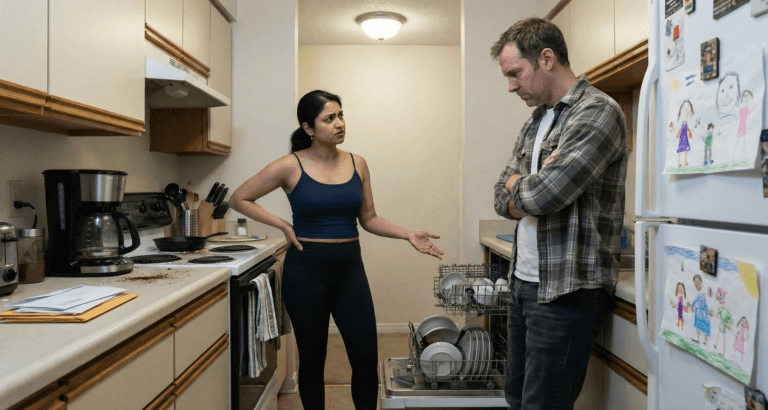
Some of the most unsettling moments in a long-term marriage aren’t the explosive fights or dramatic betrayals. They’re the quiet Tuesday evenings when you realize you’ve been together for fifteen years and still respond to conflict like you did at twenty-five shutting down, keeping score, or needing to win arguments that don’t actually matter. Understanding emotional maturity in marriage after 35 requires looking honestly at patterns that persist despite years together. Emotional maturity in marriage isn’t about how many anniversaries you’ve celebrated. It’s about how you’ve grown through the years in between.
If you’re past thirty-five and reflecting on your relationship patterns, you’re likely asking more sophisticated questions than you did in your twenties. Not just “Are we happy?” but “Are we growing?” Not “Do we fight too much?” but “Do we fight productively?” The middle chapters of a marriage demand a different kind of self-awareness one that acknowledges the gap between who you thought you’d become and who you actually are when your partner forgets something important or when life stress turns you both brittle.
Why Emotional Maturity Matters More Than Age or Years Together
The Difference Between Getting Older and Growing Up
You can be fifty and still sulk when you don’t get your way. You can be married twenty years and still punish your partner with silence when you’re hurt. The passage of time creates opportunities for growth, but it doesn’t guarantee it. What distinguishes emotionally mature couples from those simply aging together is intentionality the willingness to examine patterns, take responsibility for your own emotional responses, and choose repair over righteousness.
Research from The Gottman Institute, which has studied thousands of couples over decades, consistently shows that relationship longevity isn’t predicted by absence of conflict or compatible personalities. According to research from the Gottman Institute on relationship success, it’s predicted by how couples navigate disagreement, repair after rupture, and maintain curiosity about each other’s inner lives even when it would be easier to make assumptions.
What Emotional Maturity Isn’t (Debunking Common Misconceptions)
Emotional maturity in marriage doesn’t mean you’ve transcended annoyance or frustration. It doesn’t mean you never snap at your partner or have moments of petty resentment. It’s not about achieving some zen-like state where nothing bothers you.
Mature couples still fight. They still feel disappointed. They still have moments when they question whether they married the right person. What changes is what happens next whether you can step back from your reactivity, take responsibility for your part, and choose connection over being right.
It also isn’t about losing yourself in the relationship or always prioritizing partnership over individual needs. Emotional maturity in marriage actually requires maintaining a clear sense of self knowing what you need, what you feel, and what you’re responsible for versus what belongs to your partner. This connects to broader themes discussed in emotional intelligence in relationships.
Why 35+ Is a Pivotal Time for Relationship Reflection
By mid-life, most of us have accumulated enough experience to recognize our patterns. You’ve had the same fight enough times to see the script. You’ve watched friends divorce and wondered what you could learn from their struggles. You could have possibly navigated significant challenges health scares, career upheavals, parenting conflicts, loss of parents that revealed how you and your partner handle stress.
This accumulation of experience creates a choice point. You can keep cycling through familiar patterns, or you can use what you’ve learned to grow. The question isn’t whether you’ve struggled. It’s whether you’ve learned anything from the struggling.
How Life Experience Creates Opportunities for Maturity (When Integrated)
Life after thirty-five often presents relationship challenges that require more sophisticated emotional tools than early marriage: one partner’s career flourishes while the other’s stagnates; parenting demands shift as children age; retirement planning reveals different visions for the future; aging or illness introduces vulnerability neither of you anticipated; individual growth creates temporary distance that feels threatening.
These transitions don’t automatically create maturity, but they do create opportunities to develop it if you’re willing to reflect on what’s happening rather than just react to it.
What Emotional Maturity Looks Like in Daily Interactions
Taking Responsibility for Your Own Emotional State
When you come home after a terrible day, emotional maturity in marriage looks like recognizing you’re on edge and communicating that to your partner rather than expecting them to intuit it or manage it for you. It’s saying “I’m really stressed and might be reactive tonight” instead of snapping when they ask a simple question and then blaming them for not reading the room.
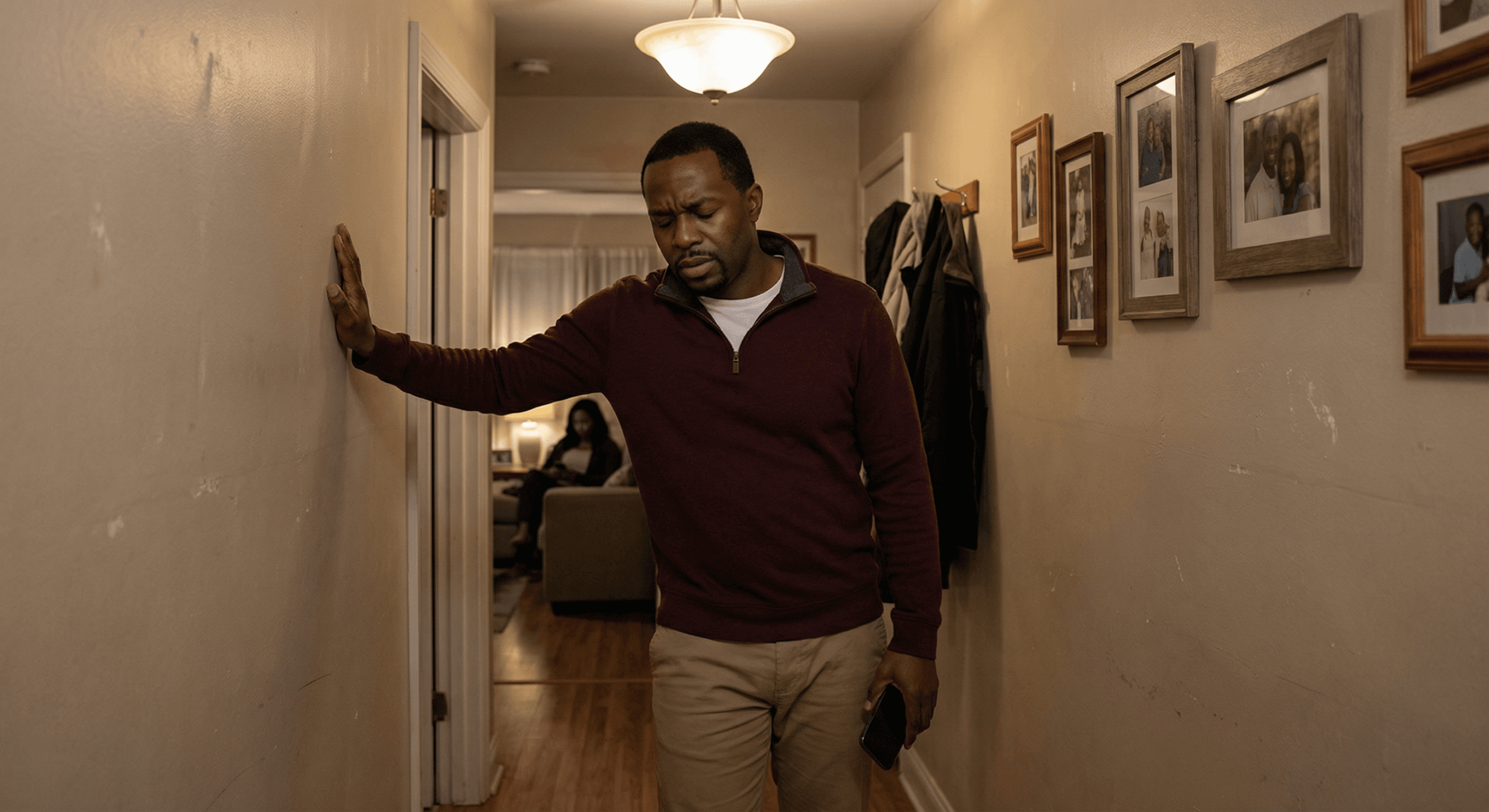
Mature partners recognize their moods belong to them. They don’t expect their spouse to constantly monitor and accommodate their emotional weather. They can self-soothe take a walk, take space, take a breath before engaging in difficult conversations. This aligns with practices discussed in building emotional regulation skills daily.
This doesn’t mean suppressing feelings. It means taking ownership of them. “I’m anxious about this medical test and it’s making me short-tempered” is very different from “You’re annoying me” when what you’re actually feeling is free-floating anxiety that has nothing to do with your partner.
Choosing Repair Over Being Right
Picture this: You’re mid-argument about who was supposed to call the plumber. Your partner insists they told you to handle it. You’re certain they said they would. You could keep litigating who’s correct, pulling up text messages as evidence, or you could notice that the real issue isn’t who’s right it’s that you’re both feeling unsupported and overwhelmed.
Emotional maturity in marriage often shows up as the ability to say “I don’t think we’re actually fighting about the plumber” or “Can we pause? I want to understand what you’re really upset about.” It’s prioritizing connection over winning, even when you’re pretty sure you’re right.
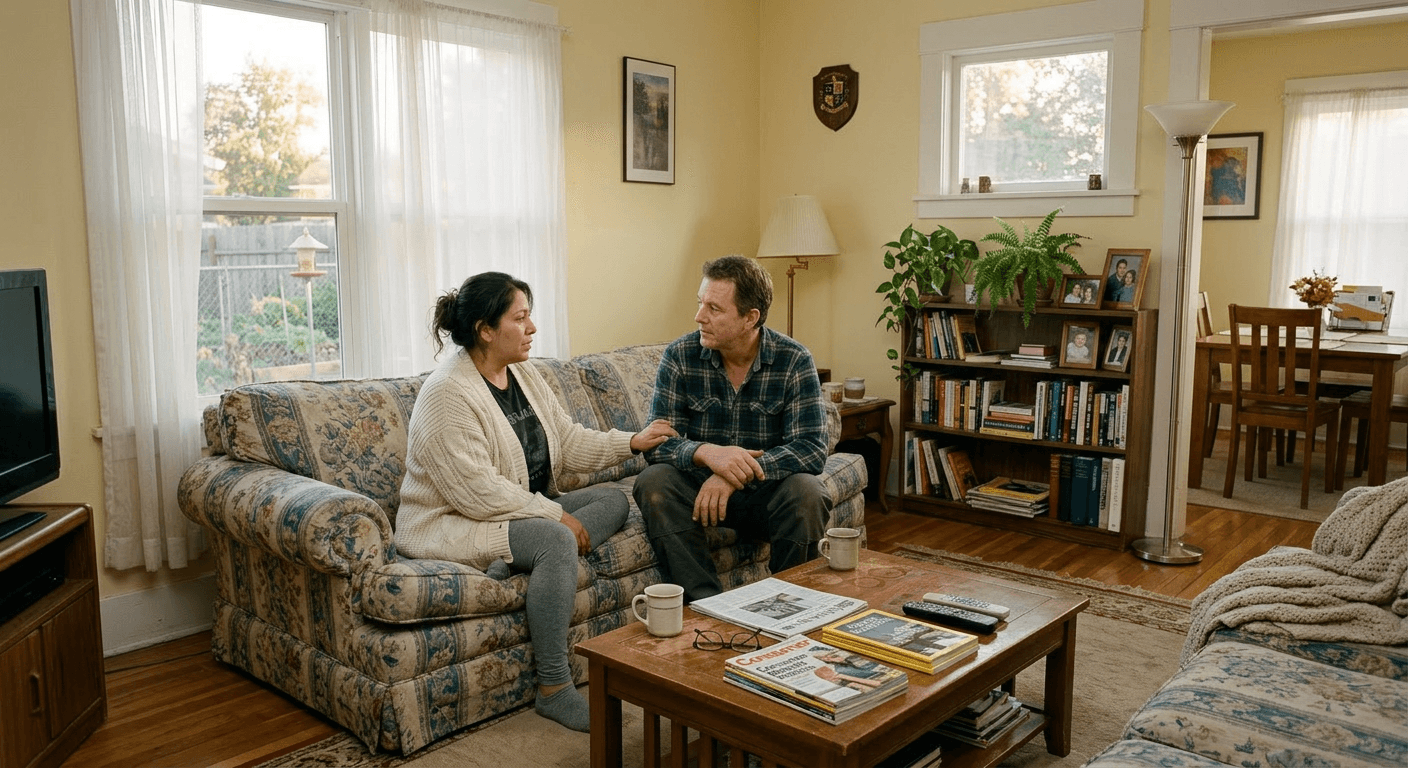
It also looks like genuine apologies ones that don’t include “but” or “if.” “I’m sorry I snapped at you. I was stressed about work and took it out on you” without immediately pivoting to what your partner did wrong. Mature couples can hold themselves accountable without needing to balance the ledger in the same breath.
Holding Space for Difficult Emotions (Yours and Theirs)
When your partner is upset about something, the emotionally immature response is to immediately fix it, dismiss it, or make it about you. The mature response is to tolerate the discomfort of their distress without rushing to resolution.
This might look like sitting quietly while they process disappointment instead of offering solutions. It might mean validating their frustration even when you see the situation differently: “I can see why that felt dismissive to you” doesn’t require you to agree that you were actually being dismissive. It just means you’re acknowledging their experience as real.
Similarly, maturity means being able to sit with your own difficult emotions without needing your partner to make them go away. You can be disappointed without requiring them to fix it. You can be anxious without demanding constant reassurance.
Communicating Needs Directly Without Resentment
How many arguments in long-term marriage are actually about unstated expectations? You’re annoyed your partner planned a weekend away with friends without checking first, but you haven’t clearly communicated that you need advance notice about schedule changes. You’re hurt they didn’t acknowledge your work accomplishment, but you didn’t actually tell them it mattered to you.
Emotional maturity in marriage looks like asking clearly for what you need: “I’d appreciate a heads-up before you make weekend plans so we can coordinate” instead of silent resentment. It means accepting that your partner can’t read your mind and that hinting or punishing isn’t effective communication. These patterns are explored in couple communication that heals and connects.
It also means being able to hear “no” without personalizing it. If you ask for something and your partner can’t meet that need right now, maturity is negotiating rather than withdrawing in hurt. “I need more quality time together” might be met with “I’m slammed at work this month, but I can commit to weekly date nights starting in three weeks.” Can you work with that, or do you need it to mean they don’t care about you?
How Emotionally Mature Couples Handle Conflict
Staying Engaged When It Would Be Easier to Withdraw
Stonewalling shutting down and refusing to engage is one of what researcher John Gottman identifies as the “Four Horsemen” that predict relationship breakdown. It’s also one of the most common immature conflict patterns, especially for people who experienced volatile households growing up and learned that withdrawal feels safer than engagement.

Emotional maturity in marriage conflict looks like staying in the conversation even when you want to leave. It doesn’t mean forcing yourself through conversations when you’re too activated to think clearly that’s different. It means not using withdrawal as punishment or protection when things get uncomfortable but still workable.
Sometimes it’s saying “I need twenty minutes to calm down, but I’m coming back to finish this conversation” and then actually doing it. It’s recognizing the difference between healthy pausing and avoiding.
Fighting About the Real Issue, Not Surface Symptoms
You’re arguing about the dishwasher again. But if you’re emotionally mature enough to pause and reflect, you might realize the dishwasher is standing in for feeling unseen, unappreciated, or unsupported. Maybe the real issue is that you feel like you carry the household’s mental load. Maybe it’s that you’re anxious about an upcoming work presentation and picking a fight feels safer than acknowledging vulnerability.
Mature couples can identify what they’re actually fighting about. “I don’t think this is really about dishes. I think I’m feeling disconnected from you and don’t know how to say that” is harder to say than criticizing how your partner loads the dishwasher, but it’s far more productive.
Recognizing Patterns Without Weaponizing Them
After years together, you know your partner’s triggers and patterns. Emotional maturity in marriage means using that knowledge with care, not as ammunition. It’s the difference between “You always shut down when we talk about money because you’re conflict-avoidant” (weaponizing) and “I’ve noticed money conversations are hard for you. What would help make this easier to talk about?” (curious and collaborative).
You can notice patterns “We seem to have this same fight every few months” without using them to prove your partner is fundamentally flawed. Pattern recognition becomes useful when it leads to curiosity about what’s driving the pattern, not just evidence that you’re right to be frustrated.
Knowing When to Pause and When to Push Through
Not every difficult conversation needs to happen immediately. Sometimes the emotionally mature choice is recognizing that you’re both too tired, too activated, or too hurt to be productive right now. “I want to talk about this, but I don’t think either of us is in a good place. Can we revisit tomorrow morning?” is often wiser than forcing resolution.
The key is actually following through. Pausing can become avoiding if you never circle back.
Circling Back After Cooling Down
Many couples are good at the argument part. Fewer are good at the repair part. Emotional maturity in marriage shows up in what happens after the fight can you check in once you’ve both calmed down? Can you acknowledge hurt without relitigating who was more wrong? Can you repair the disconnection even if you didn’t fully resolve the issue?
Sometimes repair looks like “I’m sorry I raised my voice. That wasn’t fair, even though I was frustrated.” Sometimes it’s a hand on the shoulder or a text that says “Still love you, even when we’re struggling.” It’s the recognition that protecting the relationship matters more than being justified in your anger.
Emotional Maturity in Navigating Life Transitions Together
When Careers Shift and Ambitions Evolve
At twenty-five, you might have had aligned career ambitions. At forty-five, one of you might be hitting professional stride while the other is burning out and dreaming of a complete change. Emotional maturity in marriage looks like holding both realities without making one person’s growth the villain in the other’s story.

Can you genuinely celebrate your partner’s promotion even when your own career feels stalled? Can you support their desire to downshift professionally even when it impacts household income? Can you negotiate these competing needs without resentment or martyrdom?
Parenting Partnerships: From Active Parenting to Launching
The transition from hands-on parenting to launching adult children often reveals different ideas about identity, purpose, and what comes next. One partner might be ready to reclaim independence and pursue long-delayed interests. The other might be grieving the loss of the parenting role and not yet sure who they are without it.
Mature couples can hold space for different timelines and emotional responses to the same transition. They can talk about what this change means for their relationship more time together, different routines, renegotiating how they spend weekends without assuming their partner should feel the same way they do.
Handling Illness, Aging, and Vulnerability
Health challenges whether sudden or gradual change relationship dynamics in ways that demand maturity. Can the person who’s always been self-sufficient accept help without shame? Can the caretaking partner offer support without resentment or martyrdom? Can you both acknowledge fear and sadness without needing the other to make it okay?
Research published in Health Psychology indicates that how couples navigate illness together often reflects their underlying emotional patterns whether they can be vulnerable, ask for what they need, and accept limitations without blame.
When Individual Growth Creates Temporary Distance
Sometimes one partner enters therapy, discovers new interests, or experiences personal growth that creates temporary distance. They’re changing, and change can feel threatening to the stability of the relationship. Emotional maturity in marriage looks like tolerating the discomfort of growth rather than trying to pull your partner back to familiar patterns.
It also means the growing partner can communicate about their process without making their spouse feel abandoned or inadequate: “I’m working through some things in therapy and I might seem distant. It’s not about you, and I’m staying committed to us while I sort this out.”
Renegotiating Roles and Expectations Over Time
The marriage you’re in at forty-five isn’t the marriage you had at thirty. If you’re still operating from expectations set fifteen years ago about who does what, how you spend time, what you prioritize you’re going to feel friction.
Emotionally mature couples periodically renegotiate. They can say “This arrangement isn’t working for me anymore” without it being an indictment, they can hear “I need something different now” without taking it as betrayal. They recognize that growth means change, and relationships that don’t evolve become brittle.
Signs of Emotional Maturity That Might Surprise You
Being Able to Be Happy When Your Partner Succeeds (Even If You’re Struggling)
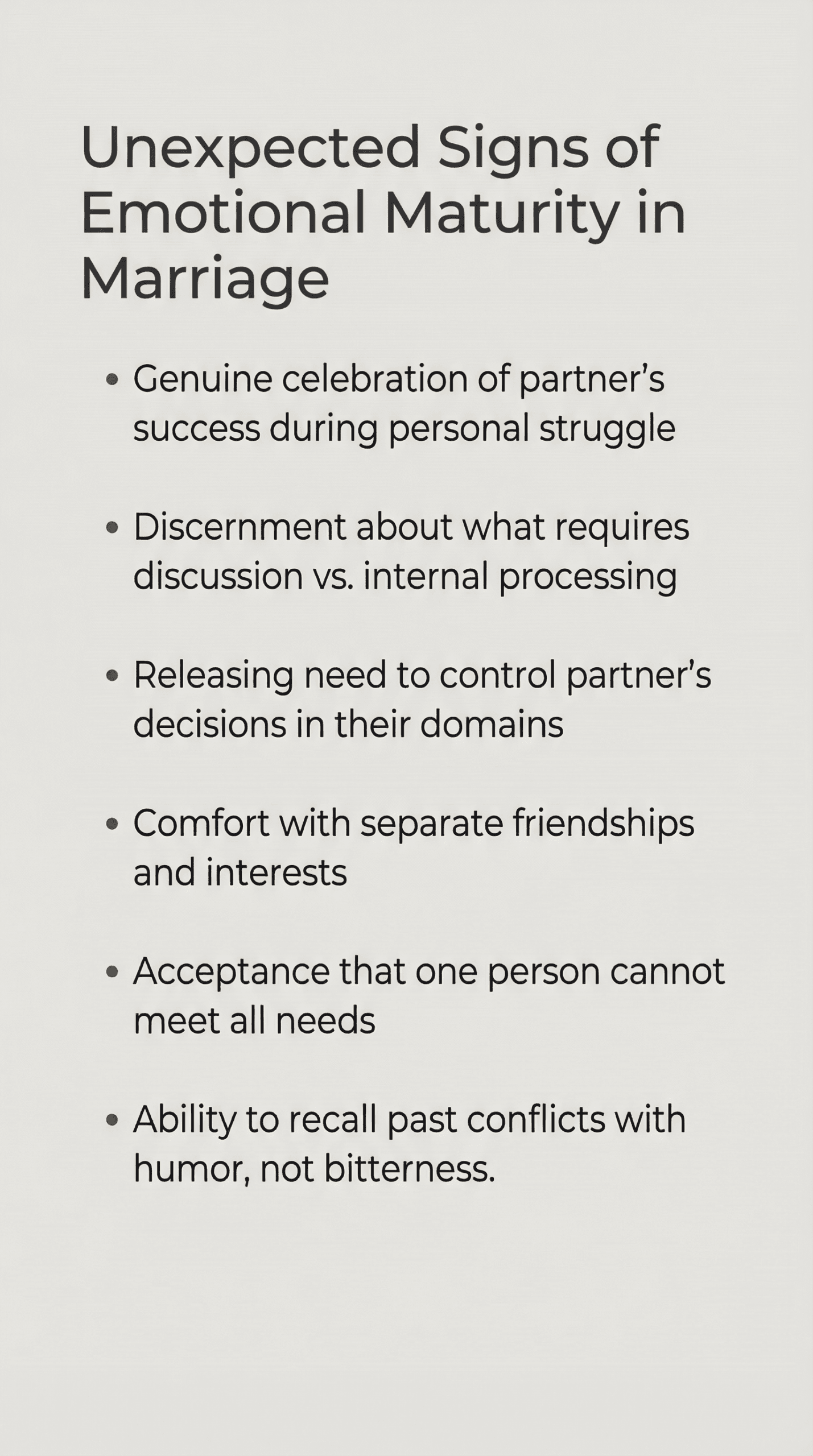
Your partner gets the recognition, opportunity, or win you’ve been wanting. Emotional maturity in marriage is being able to celebrate with them genuinely, even while you’re privately disappointed about your own situation. It’s not making their success about your struggle. It’s not diminishing their joy to manage your envy.
This doesn’t mean suppressing your feelings. It means handling them separately. You can be proud of your partner and sad about your own circumstances. Those don’t cancel each other out, but maturity means not letting one poison the other.
Not Needing to Share Every Thought or Feeling Immediately
Early in relationships, we often mistake constant sharing for intimacy. Emotional maturity in marriage sometimes looks like discernment recognizing that not every passing thought, anxiety, or frustration needs to be voiced. You can feel annoyed without needing to announce it. You can process some things internally without it being secrecy.
This is different from hiding or suppressing important feelings. It’s about distinguishing between “this matters and needs to be discussed” and “I’m having a feeling that will probably pass.”
Trusting Your Partner’s Choices Without Micromanaging
If your partner wants to handle something their way even if it’s not how you’d do it can you let them? Emotional maturity often looks like releasing the need to control outcomes, especially in areas that don’t directly impact you.
“I would have done it differently, but your way works too” is a surprisingly mature statement. So is “That’s your decision to make” about things that genuinely are.
Maintaining Individual Friendships and Interests Without Guilt
Mature couples don’t need to do everything together. They can have separate friendships, hobbies, and interests without it threatening the relationship. Also, they can spend Saturday differently one with friends, one on a solo hike without needing the other’s validation or feeling abandoned.
They also don’t make their partner feel guilty for wanting time alone or with others. “Have fun with your friends” without passive-aggressive commentary or sulking is a small but meaningful marker of security.
Accepting That You Won’t Meet All of Each Other’s Needs
No one person can be everything to another person best friend, passionate lover, intellectual companion, adventure partner, emotional support, co-parent, financial partner. Emotional maturity in marriage includes accepting limitations yours and your partner’s without taking them as personal failure.
Your partner might get intellectual stimulation from colleagues, emotional support from friends, adventure from a hiking group. That’s not a deficit in your marriage. It’s healthy differentiation. This connects to patterns explored in emotional safety as the foundation of intimacy.
Laughing About Past Fights Instead of Relitigating Them
Can you look back at fights from years ago and laugh at how seriously you took something that now seems minor? Can you reference old conflicts with humor rather than bitterness?
“Remember when we almost divorced over the thermostat?” is very different emotional territory than “You never listen to me, just like that time with the thermostat five years ago.” Mature couples can metabolize conflict into shared history rather than accumulated resentment.
Common Immature Patterns That Persist (Even in Long Marriages)
Stonewalling or Giving the Silent Treatment
Refusing to engage, walking away mid-conversation, or using silence as punishment are patterns that can persist for decades if they’re not consciously addressed. They often develop as protective mechanisms if you grew up in a volatile household, shutting down might have kept you safe. But what protected you then damages connection now.
These patterns are worth reflecting on, not as evidence you’re a bad person, but as information about what you might need to work on.
Bringing Up Past Mistakes During Unrelated Conflicts
“Oh, like the time you forgot my birthday in 2019?” in the middle of a disagreement about vacation planning is a sign that old wounds haven’t been resolved. Emotionally mature couples address issues when they happen and then let them go. They don’t stockpile grievances for future ammunition.
If you find yourself regularly reaching into the past to prove current points, it’s worth asking what hasn’t been forgiven or repaired.
Expecting Your Partner to Read Your Mind
“If you loved me, you’d know what I need” is a deeply immature framework that persists in many long-term relationships. Your partner isn’t psychic. They’re also not you—what seems obvious to you might not occur to them.
Maturity means using your words, even when you wish you didn’t have to.
Using Affection, Sex, or Attention as Reward/Punishment
Withholding affection when you’re upset, using sex as leverage, or withdrawing attention to make a point are manipulative patterns that some couples fall into without consciously recognizing it. Emotional maturity in marriage means not weaponizing intimacy.
Making Unilateral Decisions That Affect Both of You
Deciding you’re moving for a job opportunity, making major purchases, or committing to family obligations without discussing them with your partner even when you’re pretty sure they’ll agree shows a lack of respect for partnership. Mature couples collaborate on decisions that impact both lives.
Comparing Your Marriage to Others’ Highlight Reels
“Why can’t we be like them?” based on another couple’s social media or surface appearance is a recipe for dissatisfaction. Emotional maturity in marriage includes recognizing that you don’t know what happens inside anyone else’s marriage. You only see what they choose to show.
The Role of Self-Awareness in Relational Maturity
Understanding Your Attachment Style and How It Shows Up
Research on adult attachment, building on foundational work by psychologists John Bowlby and Mary Ainsworth, demonstrates that our early relational experiences shape how we approach intimacy, conflict, and closeness in adult partnerships. Understanding whether you tend toward anxious attachment (fearing abandonment, seeking constant reassurance), avoidant attachment (valuing independence, uncomfortable with too much closeness), or secure attachment (comfortable with both intimacy and autonomy) can illuminate patterns that otherwise feel confusing or personal.
If you pursue connection when anxious while your partner withdraws, you’re not necessarily incompatible you might be enacting different attachment patterns under stress. Recognizing this creates opportunities for compassion rather than blame. For deeper exploration, see our attachment theory book comparison.
Recognizing What You Brought from Your Family of Origin
The marriage you watched growing up whether functional, dysfunctional, or absent taught you something about relationships. Maybe you learned that conflict means the relationship is ending. You might have learned that you have to stay cheerful to keep people from leaving. Maybe you learned that your needs don’t matter as much as keeping peace.
These lessons show up in your marriage now, often unconsciously. Emotional maturity in marriage includes examining what you absorbed and deciding what to keep and what to unlearn.
Knowing Your Emotional Triggers and Communicating Them
If being interrupted feels like erasure because you were talked over as a child, that’s useful information to share with your partner. If financial stress activates deep scarcity fears from growing up poor, naming that helps your spouse understand why budget conversations feel so fraught.
Maturity isn’t about not having triggers. It’s about knowing them and communicating about them so your partner isn’t navigating blind.
Being Honest About Your Own Contributions to Problems
It’s easy to see what your partner does wrong. It’s harder to acknowledge your part in recurring patterns. If you’re always criticizing and they’re always defending, you’re both contributing. If you pursue and they withdraw, the pursuit reinforces withdrawal and the withdrawal intensifies pursuit.
Mature couples can step back and ask “What am I doing that makes this pattern worse?” without needing to prove the other person is more wrong.
Doing Your Own Work (Therapy, Reflection, Growth)

Your partner can’t fix what’s yours to heal. If you’re carrying unprocessed grief, untreated anxiety, unresolved trauma, or unexamined patterns from childhood, those will impact your marriage regardless of how perfect your partner is.
Emotional maturity in marriage includes taking responsibility for your own psychological health through individual therapy, serious self-reflection, or whatever growth work helps you become more conscious and less reactive. For guidance on seeking support, see when to seek professional support for anxiety.
How to Cultivate Greater Emotional Maturity in Your Marriage
Starting with Yourself, Not Waiting for Your Partner to Change
The only person you can actually change is yourself. If you’re waiting for your partner to become more emotionally mature before you work on your own patterns, you’re guaranteeing stagnation.
Start where you have control: your reactions, your communication, your willingness to repair, your capacity to self-soothe. Often, when one partner shifts their patterns, the entire dynamic changes not because you’re manipulating change, but because relationships are systems where one person’s shift inevitably affects the whole.
Seeking to Understand Before Being Understood
When conflict arises, the mature impulse is curiosity before defense. “Help me understand what’s happening for you” before “Here’s why you’re wrong about this.” It’s asking questions to genuinely learn your partner’s perspective, not just waiting for your turn to rebut.
This doesn’t mean abandoning your own perspective. It means trying to hold both yours and theirs as simultaneously real.
Building Tolerance for Discomfort and Uncertainty
Much of emotional immaturity stems from inability to tolerate uncomfortable feelings so we avoid, defend, attack, or shut down to make the discomfort stop. Growing maturity means increasing your capacity to sit with difficulty without needing to make it go away immediately.
This is a practice, not a personality trait. The more you intentionally stay present with discomfort in conversations, in conflict, in your own difficult emotions the more capacity you build.
Practicing Curiosity About Your Partner’s Inner World
After years together, it’s easy to assume you know everything about your partner. Emotional maturity in marriage means maintaining curiosity: What are they thinking about lately? What are they worried about? What are they excited about? What’s their inner experience of the same situations you’re both navigating?
Regular check-ins that aren’t about logistics “How are you feeling about the changes at work?” or “What’s been on your mind lately?” maintain connection and prevent the assumption that you already know everything worth knowing.
When Individual or Couples Therapy Can Accelerate Growth
Self-awareness and intentionality can create significant growth, but sometimes patterns are so entrenched or blind spots so pervasive that professional support accelerates progress in ways self-help can’t match. Individual therapy helps you understand your own patterns, triggers, and contributions. Couples therapy can help you see the system you’ve created together and develop new ways of interacting.
Therapy isn’t just crisis intervention. Many couples use it as a growth tool regular tune-ups to address patterns before they calcify or to navigate transitions more skillfully. If you find yourselves having the same fights repeatedly with no resolution, or if one partner is growing while the other feels stuck, professional support can provide frameworks and accountability that reading or reflection alone might not. For cost guidance, see our therapy cost comparison.
What Emotional Maturity Doesn’t Mean
It Doesn’t Mean Never Fighting or Feeling Frustrated
Emotionally mature couples absolutely fight. They get frustrated, annoyed, disappointed, and angry. What distinguishes them isn’t the absence of conflict but what they do with it how they repair, how they take responsibility, how they stay engaged rather than withdrawing or attacking.
If you’re measuring maturity by whether you’re still having conflicts, you’re using the wrong metric.
It Doesn’t Mean Losing Your Individual Identity
Maturity in marriage doesn’t require merging into “we” to the exclusion of “I.” You can be emotionally mature and still maintain strong boundaries, individual interests, and separate friendships. In fact, healthy differentiation knowing where you end and your partner begins is a marker of maturity, not a threat to it.
It Doesn’t Mean Always Putting the Relationship First
Sometimes your individual needs, growth, or wellbeing need to take priority, even if it’s temporarily uncomfortable for your partner or the relationship. Emotional maturity in marriage includes being able to say “I need to prioritize this right now” without guilt or defensiveness. You can hear your partner say the same without taking it as abandonment.
It Doesn’t Mean You’ve “Arrived” and Growth Is Done
Emotional maturity in marriage isn’t a destination. Even the most mature couples will have moments of reactivity, selfishness, or defensive patterns especially under stress. The goal isn’t perfection. It’s increasing your capacity to notice when you’re in an immature pattern and choose differently more often than not.
Growth is ongoing. You’ll continue learning new things about yourself, your partner, and your relationship for as long as you’re together.
It Doesn’t Guarantee You’ll Stay Together Forever
Emotional maturity in marriage supports relationship health, but it doesn’t guarantee compatibility or longevity. in some instance two emotionally mature people realize they want fundamentally different things. Sometimes growth pulls people in different directions. Sometimes love isn’t enough.
Maturity gives you the best chance at a healthy relationship, but it doesn’t promise a specific outcome. What it does offer is the capacity to navigate whatever comes including potential separation with more grace, honesty, and respect than you’d otherwise manage.
Frequently Asked Questions About Emotional Maturity in Marriage
Can you develop emotional maturity if you didn’t have it earlier in the marriage?
Absolutely. Emotional maturity in marriage isn’t fixed or age-dependent. People develop greater capacity for self-awareness, emotional regulation, and relational skills throughout their lives often specifically because they recognize patterns they want to change.
If you look back at how you handled conflict ten years ago and cringe, that’s evidence of growth. Many couples become more mature together by consciously working on patterns, often with support from therapy, books, or intentional reflection. Growth is possible at any age and any stage of marriage.
What if one partner is growing and the other isn’t?
This is one of the more painful dynamics in long-term relationships. When one partner is actively working on themselves in therapy, reading, practicing new communication patterns and the other isn’t, it can create temporary distance and frustration.
Sometimes the growing partner’s changes eventually invite the other to grow as well. Sometimes they don’t. What matters is that you can’t force your partner’s growth, and trying to do so often backfires. You can share what you’re learning, invite them into the process, and be clear about what you need. But ultimately, each person decides their own relationship to growth.
If the gap becomes unbridgeable if core patterns persist that make the relationship unsustainable that’s information worth taking seriously, possibly with professional support to navigate.
Is it normal to feel like we’re mature in some areas and immature in others?
Completely normal. Most people and most couples have areas of relative strength and areas of ongoing struggle. You might be excellent at direct communication but terrible at managing reactivity. Your partner might be great at repair but struggles with vulnerability.
Maturity isn’t all-or-nothing. It’s a collection of capacities that develop unevenly. What matters is whether you’re growing overall, not whether you’ve mastered every dimension.
How do you know if immaturity is fixable or a fundamental incompatibility?
This is one of the harder discernments in long-term relationships. Some patterns are about emotional skills that can be developed with awareness and effort. Others reflect fundamental differences in values, needs, or visions for life that no amount of maturity will resolve.
If the core issue is how you fight or communicate, that’s often workable. If the core issue is that you want fundamentally different things from life, maturity might help you navigate that respectfully, but it won’t make you compatible.
Professional support particularly couples therapy can help clarify which dynamics are about skills versus compatibility, and whether the relationship can evolve in ways that work for both people.
Does emotional maturity naturally come with age, or does it require conscious work?
Age and experience create opportunities for maturity, but they don’t guarantee it. You’ve likely met seventy-year-olds who are still reactive, defensive, and emotionally rigid. You’ve also seen thirty-year-olds who demonstrate remarkable self-awareness and relational skill.
What age offers is accumulated experience you’ve seen patterns play out, you’ve experienced consequences, you’ve had opportunities to reflect. But whether that experience translates into growth depends on whether you examine it. Emotional maturity in marriage requires some level of conscious work: reflection on patterns, willingness to take responsibility, and practice in choosing differently than your default reactions.
Moving Forward: Growth at Any Stage
The Ongoing Nature of Emotional Development
If you’re reading this hoping for a checklist that proves you’ve achieved emotional maturity in marriage, you’ll be disappointed. Maturity isn’t a state you reach and maintain effortlessly. It’s a practice you return to, sometimes daily choosing awareness over reactivity, connection over being right, curiosity over assumption.
Some days you’ll handle difficulty with grace. Other days you’ll revert to old patterns, especially under stress. That’s not failure. It’s being human. What matters is the overall trajectory: Are you learning from repeated patterns? Are you taking more responsibility than you did five years ago? Can you repair more skillfully? Do you stay engaged in difficulty more often than you shut down?
Progress isn’t linear. But it is possible, at any age and any stage of marriage.
Resources for Deepening Relational Maturity
For couples wanting to deepen their understanding and practice of emotional maturity in marriage, several resources can support that work:
Books that offer research-based frameworks:
- The Seven Principles for Making Marriage Work by John Gottman and Nan Silver provides practical, research-backed guidance on relationship patterns that support long-term health
- Hold Me Tight by Dr. Sue Johnson explores attachment in adult relationships and offers exercises for building secure connection
- The Dance of Anger by Dr. Harriet Lerner examines how to use anger productively in relationships rather than destructively
Online platforms for couples therapy:
For couples who want professional support in developing more mature patterns, several online therapy platforms now offer specialized couples counseling. This makes it more accessible than traditional in-person therapy. These can be particularly helpful for identifying blind spots and practicing new communication patterns with guided support.
Courses and programs:
Some couples find structured programs helpful The Gottman Institute offers workshops and online courses on relationship skills. Various platforms offer courses on attachment theory, communication, and conflict resolution. These work best when both partners engage, though individual work on your own patterns can still shift the relationship dynamic.
These resources support growth but aren’t substitutes for the ongoing practice of awareness and choice. Use what resonates, and recognize that growth happens through consistent application, not just consumption of information.
When Professional Support Can Help
While self-directed growth through reading, reflection, and intentional practice can create significant change, there are situations where professional support particularly couples therapy becomes especially valuable:
- When you’re cycling through the same conflicts repeatedly with no resolution or progress
- When communication has broken down to the point that you can’t have productive conversations without escalation
- When there’s been a significant breach of trust (affair, major deception) that you’re trying to repair
- When one or both partners is dealing with individual mental health challenges (depression, anxiety, trauma) that impact the relationship
- When you’re navigating major transitions (job loss, health crisis, empty nest) and finding yourselves stuck in destructive patterns
- When you want to grow but don’t know where to start, or when self-help efforts haven’t created meaningful change
Therapy isn’t an admission of failure. It’s a tool for growth one that offers outside perspective, structured frameworks, and accountability that self-directed work sometimes can’t provide. Many healthy couples use therapy periodically as a tune-up or growth accelerator, not just during crisis.
Important Considerations
This article offers perspectives and frameworks for understanding emotional maturity in marriage, but it’s educational content, not therapeutic intervention. If your relationship involves patterns of emotional, verbal, or physical abuse, or if you’re in significant distress, please consult a qualified therapist who specializes in couples work.
Individual and cultural variation: Emotional maturity in marriage manifests differently across individuals, cultures, and relationships. These patterns reflect common themes in Western psychological research and practice, but they’re not universal standards. What constitutes “mature” communication or conflict resolution varies across cultural contexts. What works in one relationship might not suit another.
Emotional maturity supports relationship health but doesn’t guarantee specific outcomes. Even emotionally mature couples sometimes grow apart, discover fundamental incompatibilities, or face circumstances that make staying together unsustainable. Maturity gives you the best chance at navigating your relationship with honesty, respect, and care whatever that relationship’s future holds.
Emotional maturity in marriage after thirty-five shows up in how you handle conflict, repair after fights, and take responsibility for your patterns not in how many years you’ve been together. Mature couples still argue and struggle, but they choose connection over being right, stay curious about each other’s inner world, and do their own growth work instead of waiting for their partner to change. You don’t need to reach some threshold of wisdom to benefit from practicing better communication, seeking to understand before defending, or bringing past hurts to therapy instead of arguments. Growth is possible at any stage, for anyone willing to look honestly at their patterns and make different choices.
This content is for educational purposes and does not substitute for professional psychological or therapeutic help.