


CDC Reinforces National Measles Response Through State Collaboration and Expanded Field Support
The Centers for Disease Control and Prevention (CDC) has launched an intensified, collaborative effort with the health departments of South Carolina and North Carolina to contain and prevent ongoing measles outbreaks. Announced on 9 March 2026, the federal response deploys expert teams from CDC’s Epidemic Intelligence Service (EIS), enhanced genomic and laboratory testing, and expanded technical resources to help states control transmission and restore high vaccination coverage.
Partnership Rooted in State Collaboration
At the request of the South Carolina Department of Public Health, CDC disease detectives from the EIS are working side by side with local teams, conducting field investigations, contact tracing, and epidemiologic modeling. Their work includes linking data from both Carolina states to clarify transmission chains and possible cross-border exposures.
An experienced CDC epidemiologist has already been embedded with South Carolina’s public-health agency, coordinating daily updates and technical workshops with county officials. Teams in Atlanta and Raleigh are also reviewing case definitions and classification tools to ensure consistent criteria nationwide.
Response Components: Science and Support in Motion
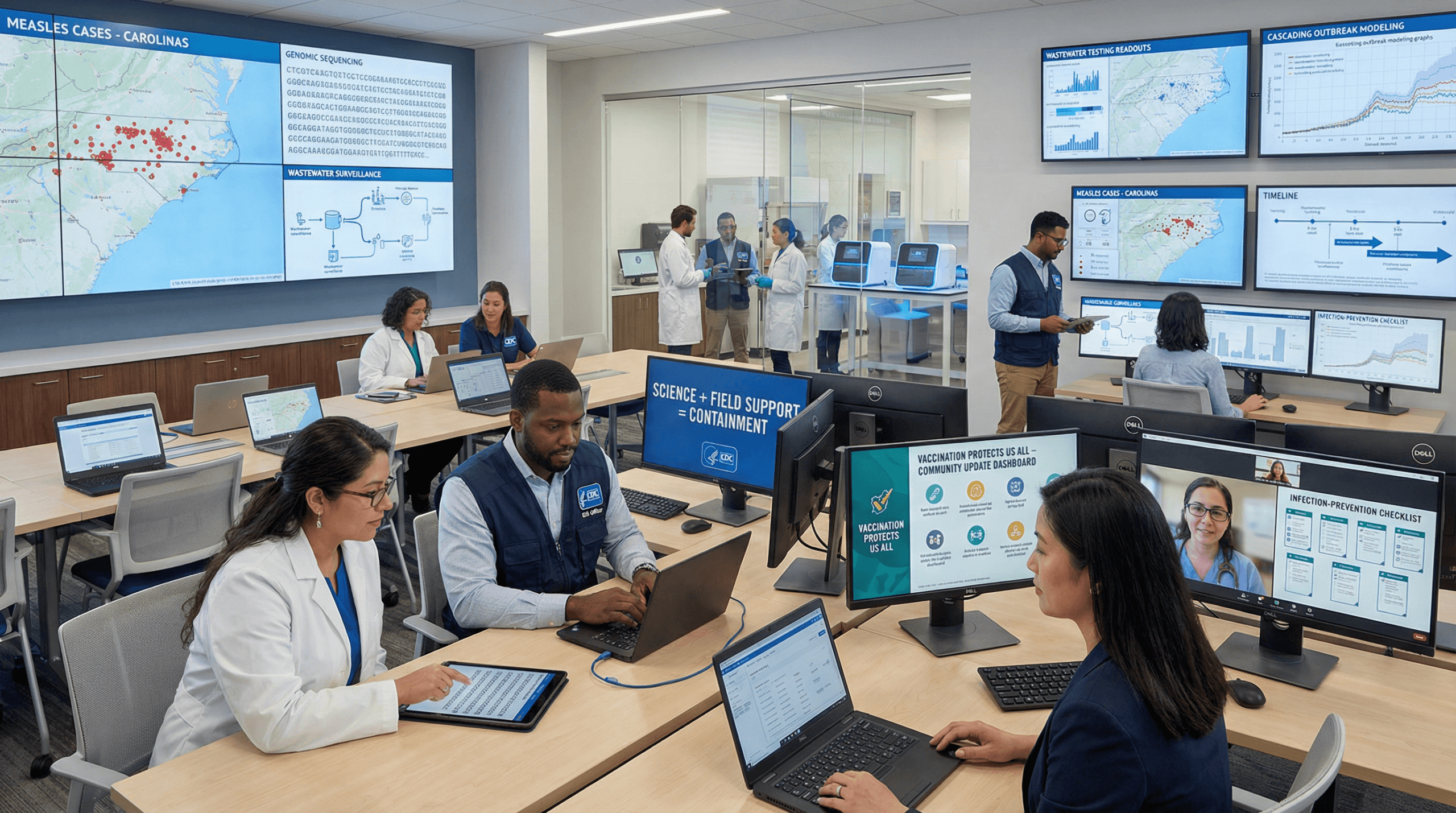
To help state and local agencies deal with surging workloads, Centers for Disease Control and Prevention has rolled out a comprehensive suite of resources that includes:
- Deployment of Epidemic Intelligence Service officers and subject-matter experts on site
- Advanced laboratory and genomic sequencing capacity to confirm cases and trace sources
- Expanded wastewater surveillance to detect and map community spread
- Real-time outbreak modeling and data dashboards to guide public messaging
- Assessment of infection-prevention procedures in schools and health-care facilities
- Strategic communication and community-outreach materials to address vaccine hesitancy
- Emergency vaccine allocations and funding for rapid response costs
These efforts are supported by resources from the CDC Foundation, ensuring that public-health leaders on the ground can adapt their response plans as outbreak conditions evolve.
Trust, Transparency, and Teamwork
Acting CDC Director Jay Bhattacharya underlined that successful measles containment depends on public trust and clear communication. During a national webinar attended by more than 2,000 state and local officials, he highlighted CDC’s role as both advisor and partner.
“Trust is the foundation of public health, earned through openness, honesty, and guidance by the best available evidence,” Bhattacharya said. “As we work with partners to contain measles, we are listening and offering the full range of tools including vaccine supplies that states may need.”
The webinar also showcased lessons from recent outbreak management efforts, emphasizing rapid diagnosis, effective isolation, and vaccination for non-immune contacts. CDC officials affirmed they will release timely situation reports to keep governors, health departments, and the public informed.
Prevention Remains the Core Strategy
CDC continues to promote Measles, Mumps, and Rubella (MMR) vaccination as the most powerful tool for prevention. In a public message, Dr Bhattacharya reiterated that high-coverage immunization stops outbreaks before they start. The agency summarized key evidence:
- Benefits far outweigh risks: Serious side effects of the MMR vaccine are extremely rare.
- High coverage creates community protection: When a large majority is vaccinated, infants and immunocompromised individuals are shielded from infection.
- Vaccination reduces outbreak magnitude: Each percentage-point increase in coverage significantly lowers secondary transmission.
The CDC is developing additional communication campaigns to dispel myths surrounding vaccination and to equip clinicians with up-to-date talking points for parents. Partner organizations such as the American Academy of Pediatrics and the Association of State and Territorial Health Officials will help amplify these efforts through community webinars and training modules.
The focus on evidence-based vaccination guidance aligns with broader principles of preventive checkups taking proactive steps to protect health before problems emerge.
Understanding the Challenge
Although measles was declared eliminated in the United States in 2000, resurgent cases linked to travel and declining vaccination rates have threatened that status. The virus is one of the most contagious pathogens known a single case can infect 90 percent of unvaccinated contacts. Even small lapses in coverage can trigger large clusters if they reach households or schools with immunization gaps.
The current outbreaks in the Carolinas underscore the need for continuous public-health readiness and cross-state coordination. Rapid sequencing of samples will help differentiate between imported and domestically acquired strains, a key metric for maintaining U.S. elimination verification.
Epidemiologists also note that complacency after the pandemic years has slightly reduced childhood MMR coverage in some districts. Restoring that coverage is an urgent priority to prevent further outbreaks throughout 2026.
State and National Implications
Local and State-Level Impact: Strengthening U.S. Communities
Across the United States, the CDC’s intensified collaboration represents a new model for protecting communities at the local level. The agency’s direct involvement with South Carolina and North Carolina is serving as a blueprint for other states seeking to reinforce their readiness.
The focus is on community resilience ensuring that every county and city health department, school district, and health-care system can respond quickly when measles is suspected. CDC field officers embedded with state teams provide real-time guidance for outbreak investigation, laboratory confirmation, and contact tracing, while local clinicians receive up-to-date protocols for infection control and post-exposure vaccination.
Community engagement is central. Faith leaders, parent-teacher organizations, and local employers are partnering with public-health educators to share accurate vaccine information in schools, workplaces, and neighborhood events. Tailored outreach campaigns are targeting undervaccinated ZIP codes, ensuring that families understand where to obtain free MMR doses and how herd immunity protects infants and immune-compromised individuals.

By placing federal tools directly in the hands of local professionals, the initiative reinforces public trust and demonstrates that national preparedness begins in everyday American communities from rural health clinics in the Midwest to urban pediatric networks along the coasts. The lessons emerging from the Carolinas show how embedded partnerships and timely communication can keep small outbreaks from becoming regional emergencies.
This approach to building community-level connection between health systems and residents strengthens trust and compliance with public-health measures.
National Policy Relevance
Nationally, the expanded measles response reflects the CDC’s broader strategy to modernize public-health collaboration following lessons from COVID-19. The agency is moving toward a model of co-governance with states, where real-time data sharing and localized decision making replace one-way directives.
The effort demonstrates how the federal system can mobilize surge capacity without usurping state authority, preserving both flexibility and accountability. It also shows the value of pairing modern surveillance tools such as genomic sequencing and wastewater analysis with community trust-building to strengthen public immunization networks.
Regional and Cross-Border Implications
Measles does not stop at state lines. The Carolinas’ experience is prompting neighboring jurisdictions to audit their own coverage rates and update outbreak response plans. CDC’s regional offices are coordinating information exchange across the Southeast to ensure consistency in reporting and resource allocation.
Cross-border collaboration is equally important internationally. The United States is sharing its laboratory data with the Pan American Health Organization as part of a continental effort to identify importation corridors and support vaccination drives throughout the Western Hemisphere.
Global Significance
At the global level, the U.S. response adds momentum to WHO’s goal of eliminating measles and rubella in every region. The CDC’s rapid mobilization model illustrates how high-income countries can use their resources to protect population health at home while contributing data to global eradication efforts. The Carolinas deployment is also a training site for EIS officers who may later assist in international responses through WHO’s Global Outbreak Alert and Response Network (GOARN).
Much like Chile’s recent leprosy elimination, sustained surveillance and community trust prove essential to maintaining disease elimination status.
Communication and Trust as Cornerstones
CDC is enhancing public communication in parallel with technical interventions. Web-based dashboards now display state vaccination progress and case counts in near real time. Infographics and multilingual videos emphasize how routine MMR coverage protects entire communities. By pairing data transparency with consistent messaging, the agency aims to rebuild confidence in vaccines after pandemic-era controversies.

Transparent communication about health data helps reduce anxiety and misinformation principles that also apply when people encounter concerning results like elevated blood pressure numbers.
A Unified Approach for 2026 and Beyond
The measles response in the Carolinas illustrates how CDC is translating its National Preparedness Framework into practice: federal scientific strength embedded within state operations, rapid deployment of diagnostic and communication support, and continuous engagement with community leaders. Lessons learned from these partnerships will shape responses to future outbreaks whether of measles, influenza, or emerging pathogens ensuring that collaboration remains at the center of U.S. public health practice.
“The goal,” Dr Bhattacharya said, “is to make sure every community from large cities to small rural towns has the information, vaccines, and partnership support it needs to stay measles-free.”
Summary
CDC and state partners are intensifying joint actions to control measles outbreaks in South and North Carolina. Epidemic Intelligence Service officers and experts are on the ground, backed by advanced lab and analytic resources. MMR vaccination remains the cornerstone of prevention; CDC continues to highlight its safety and effectiveness. The response demonstrates a new federal-state partnership model built on trust, transparency, and evidence-based collaboration. Outcomes in the Carolinas will inform future national and global strategies against measles and other vaccine-preventable diseases.
Centers for Disease Control and Prevention (2026). CDC Reinforces National Measles Response Through State Collaboration.
This content is for educational purposes and does not substitute for professional psychological or therapeutic help.