
eHarmony vs. Match: Pricing and Matching Algorithm Comparison
Choosing a paid dating platform is both a financial decision and an emotional investment. For adults seeking serious, long-term relationships whether you’re re-entering the dating world after divorce, prioritizing marriage over casual connections, or simply exhausted by swipe culture the question isn’t just about cost. It’s about which approach to matching aligns with how you want to meet someone. Understanding the dating platform comparison between eHarmony and Match requires looking at matching philosophy, user control, and what you’re actually paying for beyond the monthly subscription fee.
eHarmony and Match represent two fundamentally different philosophies in online dating. Both are established, reputable platforms with decades of history and millions of users. Both require paid subscriptions to communicate. Both claim to facilitate serious relationships. But the way they match you, the level of autonomy they offer, and what you’re actually paying for differ significantly.
At LubDubSmile, we cover dating platforms the same way we cover any wellness tool: by separating what the evidence supports from what the marketing claims. Both platforms have helped real people find real relationships. Neither can manufacture chemistry, compatibility, or timing. This guide is built around the distinction that actually matters in choosing between them, which is not which one is objectively better, but which one fits how you think, decide, and engage.
This dating platform comparison walks through their pricing structures, explains how their matching algorithms actually work, and helps you assess which platform might align better with your dating style and goals.
How eHarmony and Match Approach Online Dating Differently
The Philosophy Behind eHarmony’s Compatibility Matching System
eHarmony operates on the premise that compatibility can be assessed upfront through psychological profiling. You complete an extensive questionnaire covering personality traits, values, lifestyle preferences, and relationship goals. The platform’s algorithm analyzes your responses across 32 dimensions of compatibility rooted in personality psychology and relationship research and curates a select group of matches daily based on predicted long-term compatibility.
You cannot browse freely. You don’t search by location or filter by height. The algorithm decides who you see, and you decide whether to engage. The philosophy is guided, intentional, and data-driven: fewer matches, higher compatibility potential.
Match’s Browse-and-Search Model Explained
Match takes a hybrid approach. You build a detailed profile, set your preferences, and receive algorithm-generated “Daily Matches.” But you also have full freedom to search, filter, and browse thousands of profiles on your own terms. You can sort by newest users, last active, or algorithmic compatibility score. You control who you message and when.
Match’s algorithm learns from your behavior who you view, message, and respond to and adjusts future recommendations accordingly. It doesn’t limit your access. The philosophy is exploratory, user-driven, and flexible: high volume, high autonomy.
What “Algorithm-Driven” Really Means in Practice
Both platforms use algorithms, but in different ways. eHarmony’s algorithm acts as a gatekeeper, pre-screening matches based on deep personality analysis. Match’s algorithm acts as a recommender, surfacing high-probability matches while still letting you explore independently.
Neither algorithm can predict chemistry, timing, or real-world compatibility with certainty. Both facilitate introductions based on stated preferences and behavioral patterns. The difference in this dating platform comparison is whether you want the platform to narrow your options for you or provide tools to narrow them yourself. This preference connects to broader patterns discussed in emotional intelligence in relationships knowing your communication and decision-making style matters.
eHarmony Pricing Breakdown: Plans, Features, and What You’re Paying For
Subscription Tiers and Monthly Costs
eHarmony’s pricing is structured around subscription length. Longer commitments reduce the monthly cost significantly:
- 6-month plan: ~$65/month (billed as one payment of ~$390)
- 12-month plan: ~$45/month (billed as one payment of ~$540)
- 24-month plan: ~$35/month (billed as one payment of ~$840)
Premium Plus or Extra tiers add features like profile boosts, read receipts, and detailed personality reports. These typically add $10–$20/month to the base price.
eHarmony frequently offers promotional discounts (often 50% or more off introductory rates). The price you see advertised may be lower than standard rates if you’re a new user.
What’s Included at Each Price Point
All paid plans include:
- Daily curated matches based on compatibility scoring
- Unlimited messaging with matches
- Full access to profile photos
- “What If?” feature (additional matches outside your core preferences)
- Compatibility score breakdowns by dimension
- Secure call feature (call matches without sharing your number)
- Video date feature (in-app video chat)
Premium tiers add visibility boosts, message read receipts, and more detailed personality analysis.
Free vs. Paid Features: What You Can and Can’t Do
With a free eHarmony account, you can:
- Complete the compatibility quiz
- Receive daily matches
- See blurred profile photos
- Send “smiles” or icebreakers
You cannot read or send full messages without a paid subscription. Essentially, the free version lets you test the interface and see that matches exist. Communication requires payment.
Payment Structure, Auto-Renewal, and Cancellation Terms
eHarmony charges the full subscription amount upfront (e.g., $390 for six months) and auto-renews unless you cancel. You can cancel anytime, but refunds are limited to a 3-day window. Refunds typically only apply if you haven’t initiated contact with anyone. If you cancel mid-subscription, you retain access through the end of your paid term.
Match Pricing Breakdown: Plans, Features, and What You’re Paying For
Subscription Tiers and Monthly Costs
Match pricing also scales by commitment length:
- 1-month plan: ~$45–$50/month
- 3-month plan: ~$35/month (billed as ~$105 total)
- 6-month plan: ~$20–$25/month (billed as ~$120–$150 total)
- 12-month plan: ~$18–$20/month (billed as ~$216–$240 total)
Match Premium adds advanced features like incognito browsing, message priority, and enhanced search filters for an additional ~$5–$10/month.
Match offers a 6-month guarantee: if you don’t meet someone within six months, you receive an additional six months free. Conditions apply, including maintaining an active, complete profile.
What’s Included at Each Price Point
All paid Match plans include:
- Unlimited browsing and searching of profiles
- Unlimited messaging
- Daily algorithm-curated matches
- “Reverse Match” and “Mutual Match” tools
- Likes, favorites, and messaging priority
- Mobile app access with all features
- Profile verification option
Premium plans add incognito mode (browse without being seen) and read receipts.
Free vs. Paid Features: What You Can and Can’t Do
With a free Match account, you can:
- Create a full profile with photos
- Browse and search profiles
- Receive Daily Matches
- Send “likes” and “winks”
You cannot send or read full messages without a paid subscription. Like eHarmony, Match’s free version is functional for exploration but requires payment for communication.
Payment Structure, Auto-Renewal, and Cancellation Terms
Match bills upfront for the subscription term and auto-renews unless canceled. You can cancel anytime, and your access continues through the end of the paid period. Refunds are generally not available once the subscription period begins.
Side-by-Side Dating Platform Comparison: Where Your Money Goes
Cost Per Month Across Subscription Lengths
For the most comparable tier (standard paid plans):
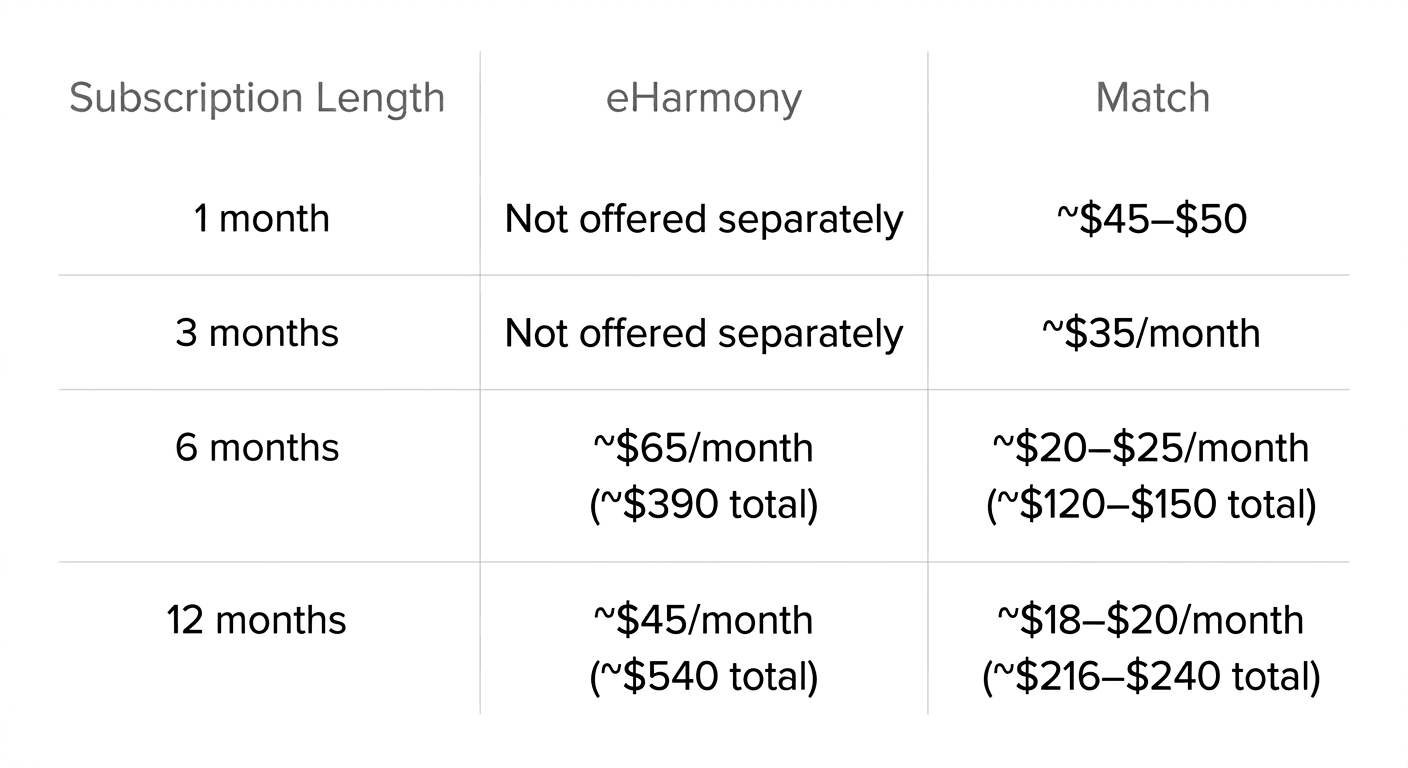
At first glance, Match appears significantly cheaper, especially for six- and twelve-month plans. However, pricing alone doesn’t account for what you’re receiving or how the platforms function. This dating platform comparison must weigh cost against matching philosophy and user experience.
Discounts for Longer Commitments
Both platforms heavily discount longer subscriptions. eHarmony’s 24-month plan drops to ~$35/month. Match’s 12-month plan can go as low as $18/month. Promotional pricing for new users can reduce these rates further, sometimes by 50% or more.
If you’re confident you’ll use the platform actively for an extended period, longer commitments offer better per-month value. However, committing for two years upfront carries risk if the platform doesn’t feel right within the first few weeks.
Hidden Costs or Add-On Features to Know About
Neither platform has hidden fees, but both offer upsells:
- Premium tiers add $10–$20/month for enhanced visibility and features
- Profile boosts (temporary visibility increases) may be available as one-time purchases
- Match Events (in-person singles meetups) are included for Match members in select cities, but travel and participation are at your own expense
There are no per-message fees. Switching matches is free on both platforms.
How the Matching Algorithms Actually Work
eHarmony’s 32 Dimensions of Compatibility: What It Measures
eHarmony’s compatibility model was developed by clinical psychologist Dr. Neil Clark Warren. It’s grounded in personality psychology, particularly the Big Five personality traits. The 80+ question quiz evaluates you across 32 dimensions, including:

Emotional and personality traits: Emotional stability, mood management, adaptability, intellect, curiosity
Social and relational style: Communication style, conflict resolution approach, affection preferences, social orientation (introversion vs. extroversion)
Core values and lifestyle: Family goals, spirituality, career ambition, financial attitudes, work-life balance
Physical and romantic attraction: Appearance preferences, romantic style, sexual compatibility indicators
The algorithm doesn’t just match on similarity. It balances similarity on core values and life goals with complementarity on traits where differences might strengthen a relationship (e.g., one partner organized, one spontaneous). Each match receives a compatibility score, often displayed as a percentage, with breakdowns by category.
The system is proprietary. The exact weighting of each dimension isn’t publicly disclosed. You receive curated matches typically three to fifteen per day, depending on your location and the size of the user pool.
Match’s Algorithm and Daily Recommendations
Match’s algorithm works differently. It’s preference-based and behavior-informed rather than personality-driven. When you set up your profile, you specify what you’re looking for: age range, distance, education, lifestyle habits, relationship goals. You also indicate deal-breakers (must-haves or must-not-haves).
The algorithm generates Daily Matches by:
- Comparing your stated preferences to other users’ profiles
- Applying bi-directional compatibility (you meet their criteria and they meet yours)
- Learning from your behavior (who you view, message, skip, or favorite)
- Prioritizing active users and recent profile updates
Match assigns compatibility percentages. These are based on preference alignment and behavioral signals, not deep personality assessment. The algorithm is adaptive it adjusts recommendations as you interact with the platform.
Importantly, Match doesn’t restrict you to algorithmic matches. You can search freely, filter by dozens of criteria, and message anyone who meets your basic preferences.
User Control: Who Decides Who You See?
This is the core philosophical difference in this dating platform comparison:
- eHarmony: The algorithm decides. You see only the matches it curates. You cannot browse or search independently.
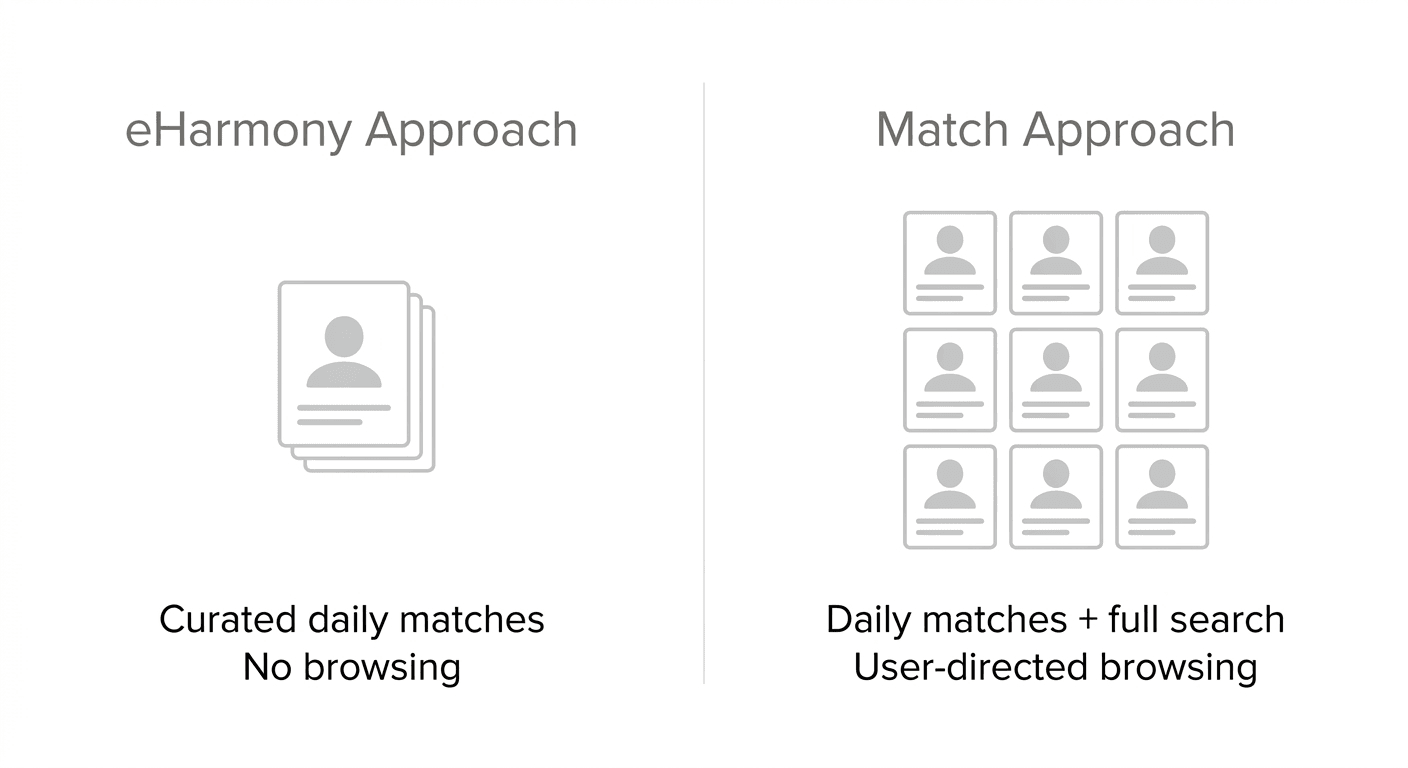
Understanding different matching approaches helps determine which dating platform comparison suits your preferences. - Match: You decide. The algorithm offers suggestions, but you control the search. You can ignore Daily Matches entirely and browse thousands of profiles on your own.
If you trust data-driven curation and want decision-making support, eHarmony’s approach may feel reassuring. If you prefer autonomy and want to explore broadly, Match’s flexibility may suit you better. Understanding your preference here connects to broader relationship patterns explored in intentional dating and building meaningful connections.
The autonomy question described here is worth thinking through carefully before choosing a platform, because it is not simply a preference about browsing style. Research on decision-making and relationship formation suggests that high-volume choice environments can paradoxically reduce satisfaction and commitment, a phenomenon sometimes called the paradox of choice. When options are abundant, people have a harder time committing to any single one and are more likely to second-guess the choices they make. eHarmony’s restricted curation is, in part, a structural response to this problem. Match’s open browsing puts the curation responsibility on the user. Neither approach is categorically superior, but the one that matches how you handle choice under emotional stakes is worth knowing before you invest.
Does More Data Mean Better Matches?
eHarmony collects more upfront data via its extensive quiz. Its compatibility model is more psychologically complex. But more data doesn’t automatically translate to better real-world compatibility. Personality alignment is only one factor in relationship success. Timing, chemistry, communication skills, life circumstances, and shared experiences matter enormously. No algorithm can measure those in advance.
Match’s behavioral learning approach has its own strengths. By observing who you actually engage with (not just who you say you want), it can surface patterns you might not articulate in a questionnaire. According to research from the Pew Research Center on online dating, both structured and exploratory approaches can lead to successful relationships. Individual preferences matter more than platform features.
Both approaches have merit. Neither guarantees results.
User Experience and Time Investment: What to Expect on Each Platform
eHarmony’s Guided Communication vs. Match’s Open Messaging
eHarmony uses a structured communication process. When you match, you start with icebreakers (preset questions), then move to open-ended prompts, and finally unlock free messaging. This is optional you can skip to open messaging but it’s designed to ease conversation anxiety and encourage meaningful exchange before casual small talk.
Match has no communication structure. Once you match or choose to message someone, you can say anything. This offers more freedom but also more pressure to craft an engaging opening message. Principles from couple communication that heals and connects apply here authenticity and clarity matter more than clever openers.
Profile Setup: Questionnaire Length and Depth
eHarmony’s compatibility quiz takes 20 to 40 minutes. It’s comprehensive, sometimes repetitive, and requires focused attention. Some users find it clarifying; others find it tedious.
Match’s profile setup takes 10 to 15 minutes. You fill in demographic details, preferences, interests, and write a bio. It’s quicker but less guided.
Daily Match Volume and Browsing Freedom
eHarmony delivers a small batch of curated matches daily. In less populated areas, this might mean three to five profiles. In major cities, it could be fifteen. You cannot request more or browse beyond what you’re given.
Match offers high volume. You can browse thousands of profiles if you want. Daily Matches provide a starting point, but you’re not limited. This can be empowering or overwhelming, depending on your tolerance for choice.
Mobile App Experience and Usability
Both platforms offer well-designed mobile apps. eHarmony’s app emphasizes the questionnaire and match review process. Match’s app includes full search and filtering functionality, making it easy to browse on the go. User reviews for both apps are generally positive, with occasional complaints about notifications or interface updates.
Which Platform Fits Your Dating Goals and Style?
When eHarmony May Be a Better Fit
Consider eHarmony if you:
- Prefer structure and guidance over open-ended exploration
- Want a psychologically informed matching process
- Trust algorithmic curation and don’t need to browse freely
- Are willing to invest more financially for a curated experience
- Value depth of compatibility assessment over volume of options
- Are re-entering dating after a long relationship and want support
- Have limited time and prefer fewer, higher-intent matches
When Match May Align Better with Your Approach
Consider Match if you:
- Want control over who you contact and when
- Prefer exploring a large pool rather than waiting for curated matches
- Value flexibility in how you search and filter
- Want a lower monthly cost, especially for six- or twelve-month plans
- Are comfortable with high-volume browsing and self-directed outreach
- Prefer behavior-based learning over personality-based assessment
- Want the option to attend in-person Match Events in your city
Considerations Beyond Price: Time, Control, and Patience
Price is one factor in this dating platform comparison. But consider also:
- Time: eHarmony requires a significant upfront time investment (the quiz) and ongoing patience (limited daily matches). Match requires ongoing active effort (searching, messaging, filtering).
- Control: Do you want the platform to narrow options for you, or do you want full autonomy?
- Patience: Are you willing to wait for curated matches, or do you want immediate access to a broad pool?
Success on either platform depends significantly on your engagement, openness, profile quality, and communication skills. The algorithm facilitates introductions; you create the connection. Understanding building emotional regulation skills daily can help you manage the emotional ups and downs of online dating.
Frequently Asked Questions About eHarmony and Match
Can I try either platform for free before paying?
Yes, both offer free accounts that let you create a profile, complete assessments, and see that matches exist. However, you cannot send or read messages without a paid subscription. The free experience is limited to exploration and interface testing.
Do these platforms actually lead to long-term relationships?
Both platforms report high numbers of marriages and long-term relationships among their users. eHarmony claims responsibility for a significant percentage of marriages that began online. Match reports similar success metrics. However, these are self-reported platform statistics, not independently verified research. Research confirms that online dating is now one of the most common ways couples meet, but success varies widely by individual effort, location, and circumstances.
What happens if I don’t get matches?
On eHarmony, if you’re in a less populated area or have very specific preferences, daily match volume may be low. You can adjust preferences or use the “What If?” feature to see additional profiles. On Match, you can always search and browse independently. Lack of algorithmic matches doesn’t limit your access.
Both platforms allow you to update preferences, refresh your profile, or reach out to customer support if you’re experiencing matching issues.
Can I pause or cancel my subscription anytime?
You can cancel either subscription at any time. You’ll retain access through the end of your paid period. However, neither platform offers pause functionality or prorated refunds mid-subscription. Match’s 6-month guarantee provides an additional six months free if you meet certain activity requirements and don’t find someone. This offers some protection for engaged users.
Summary
eHarmony and Match are both reputable, established platforms serving adults seeking serious relationships. This dating platform comparison shows that the meaningful difference isn’t just price it’s philosophy. eHarmony curates for you, using deep compatibility analysis to narrow your options intentionally. Match gives you the tools and recommendations, but you drive the search.
If you value psychological profiling, structured communication, and guided decision-making, eHarmony’s higher cost may feel justified. If you want autonomy, high volume, and behavioral learning at a lower monthly rate, Match may align better with how you prefer to date.
Neither platform can guarantee matches or relationship outcomes. Success depends on your profile quality, engagement level, communication skills, timing, and openness. Consider your dating style, time availability, and tolerance for choice alongside cost and features in this dating platform comparison. Those navigating post-divorce dating or complex relationship patterns may benefit from exploring emotional safety in relationships alongside online dating efforts.
Pricing Disclaimer: While pricing are current, platforms frequently offer promotions; verify current rates and terms directly before subscribing.
Algorithm Disclaimer: While both platforms use proprietary matching technology, no algorithm can guarantee compatibility or relationship success. Individual experiences vary widely.
This content is for educational purposes and does not substitute for professional relationship or mental health counseling.