
Employee Mental Health Benefits Guide: Understanding EAP Coverage
Employee mental health benefits represent one of the most underused resources in the American workplace and one of the least understood. You’ve probably seen it mentioned in your onboarding packet, referenced in a benefits email, or listed somewhere in your HR portal. Employee Assistance Program. EAP. Free confidential counseling. But when you actually needed it during a difficult divorce, an anxiety spiral at 2 AM, a conflict with your manager that was making you dread Monday mornings did you know how to use it? Did you trust that your employer wouldn’t find out?
Most employees don’t. According to the Employee Assistance Society of North America (EASNA), EAP utilization rates typically hover between 3% and 10% of eligible employees annually despite the fact that roughly 97% of large employers offer some form of EAP. The benefit exists. The funding is already there. But confusion about what employee mental health benefits cover, skepticism about confidentiality, and uncertainty about how to access support keep millions of employees from using mental health resources that cost them nothing out of pocket.
This guide explains what EAP actually provides, how to access it, what your employer can and cannot see, when it’s the right tool, and when you need more. Verify your specific coverage directly with your HR department or EAP provider before making decisions about your care. This article provides educational information, not legal or benefits advice.
What Is an EAP and What Does It Actually Provide?
EAP Defined: Beyond the HR Brochure
An Employee Assistance Program is a benefit your employer pays for that gives employees and often their family members free, confidential access to short-term counseling, mental health support, and a range of practical assistance services. Third-party organizations administer EAPs rather than employers directly, which is a critical structural feature for confidentiality.
EAPs originated in the 1940s as workplace alcohol treatment programs. Over decades, they expanded into comprehensive assistance programs covering mental health, family issues, financial stress, legal concerns, and more. Today, EAPs help employees resolve personal and professional problems that may affect work performance, wellbeing, and attendance before those problems escalate into serious crises or chronic conditions.
The defining features of most employee mental health benefits through EAP include:
- Employer-paid: You pay nothing out of pocket for the sessions your program includes
- Third-party administered: Your employer contracts with an outside EAP company, creating separation between your employer and your personal information
- Short-term focused: EAP targets brief, solution-focused intervention rather than long-term treatment
- Broad scope: Covers more than mental health often includes financial, legal, and work-life services
The Difference Between EAP and Regular Health Insurance Mental Health Benefits
EAP and insurance-covered mental health therapy are fundamentally different systems that serve complementary purposes.
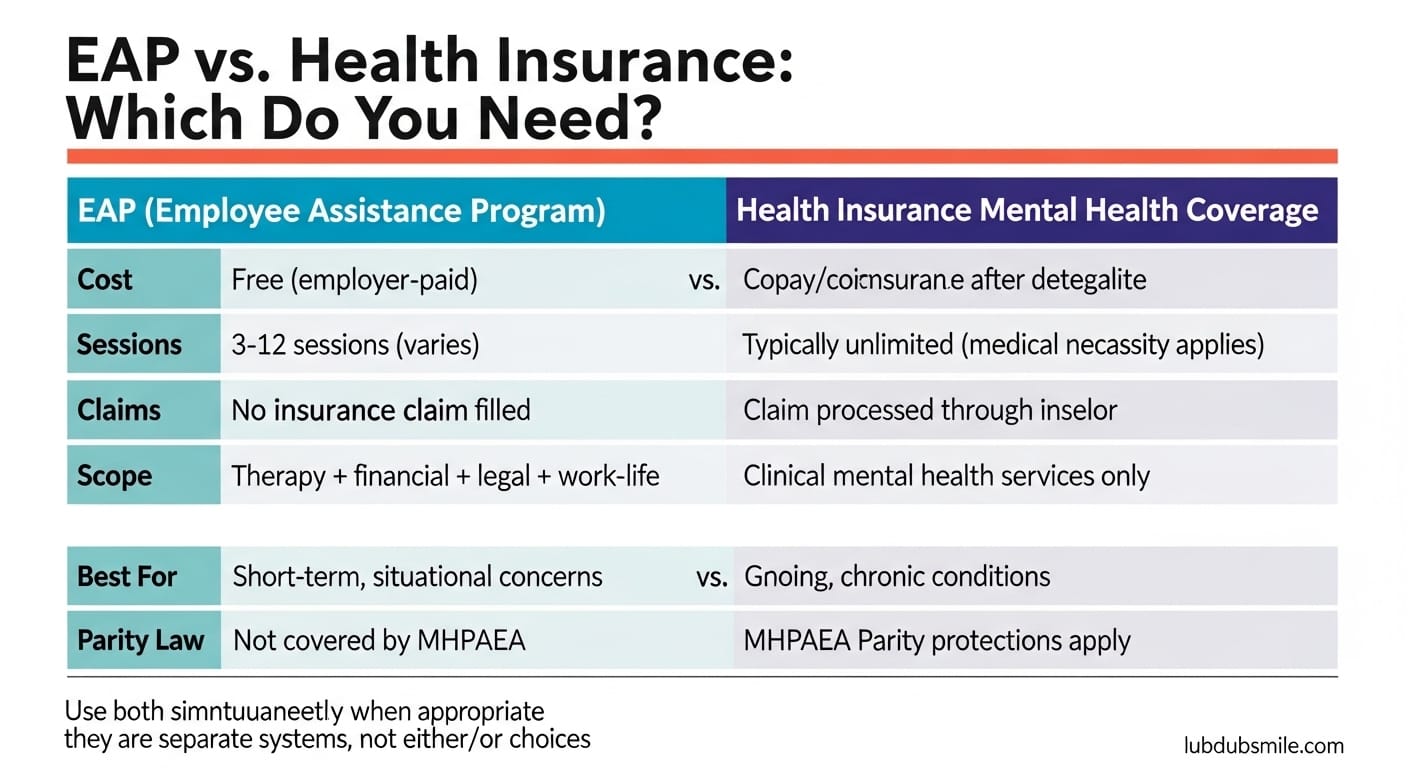
EAP employee mental health benefits:
- Free to you (your employer pays the cost)
- Limited sessions (typically 3–12 per issue or per year)
- No insurance claim filed (doesn’t affect deductible, premium, or claim record)
- A separate administrative system from your health insurance
- Short-term, solution-focused intervention
- Broader scope (includes financial, legal, work-life services)
Health Insurance Mental Health Benefits:
- Your plan’s cost-sharing applies (deductible, copay, coinsurance)
- Generally unlimited sessions (your plan requires medical necessity review)
- Your insurance processes the claim (creates a claims record)
- Mental health parity laws regulate coverage (coverage must equal medical/surgical benefits)
- Ongoing, comprehensive mental health treatment
- Restricted to clinical mental health services
Neither option is inherently superior each serves different purposes and situations. Understanding the distinction helps you choose the right tool for your specific needs.
What Services Most EAPs Cover
While EAP programs vary by employer, most include the following core services as part of employee mental health benefits:
Mental health counseling:
- Individual therapy sessions with counselors or therapists who hold licenses
- Professional assessment and referral for ongoing mental health needs
- Crisis intervention and support
- Stress, anxiety, and depression support
- Grief and loss counseling
- Workplace conflict and performance stress
Financial and legal consultation:
- Free consultations with financial counselors or advisors
- Legal consultations with attorneys (typically one free session per issue)
- Debt management information and referrals
- Estate planning basics
- Tax guidance referrals
Work-life and wellness services:
- Childcare and eldercare resource referrals
- Work-life balance coaching
- Wellness program referrals
- Nutrition and health coaching (some programs)
- Online resources, self-help tools, and app access
Manager and HR consultation:
- Consultation services for managers addressing team member concerns
- Organizational assessment and crisis response support
- Workplace training on mental health topics
Not all EAPs include all of these. Smaller employers may have more limited programs. Verify your specific program’s services by calling your EAP provider or reviewing your benefits documentation.
Financial, Legal, and Wellness Services Often Included
One of the most underutilized aspects of employee mental health benefits through EAP is its non-therapy services. Many employees don’t realize that EAP often provides:
- Free legal consultations: A 30–60 minute consultation with an attorney in your state, covering issues like landlord disputes, family law questions, estate planning, or employment concerns at no cost
- Financial counseling: Sessions with financial counselors who hold certifications, addressing debt, budgeting, divorce financial planning, or retirement basics
- Eldercare and childcare resources: Referrals and assistance finding childcare, eldercare facilities, or in-home care options
- Identity theft assistance: Some EAPs include identity theft support and counseling
These services are often as valuable as the therapy sessions but rarely appear in benefits communications. Ask your EAP provider specifically what non-therapy services your employee mental health benefits include.
Who Is Eligible (You, Your Family, and Household Members)
Most EAPs extend coverage beyond the employee to include:
- Spouse or domestic partner
- Dependent children (age limits vary, typically up to 18–26 depending on program)
- Household members (some programs include anyone living in your home, even if not a legal dependent)
- Parents (some programs include parents and in-laws, even if they don’t live with you)
This is a frequently overlooked aspect of employee mental health benefits. If your spouse is struggling with anxiety, your teenager is experiencing school-related stress, or your parent is going through a difficult transition, they may qualify for your EAP sessions without consuming your own session allocation.
Verify eligibility specifics with your EAP provider family eligibility structures vary significantly across programs.
How Many Sessions Does EAP Cover?
Why Session Numbers Vary So Much
EAP session limits are not regulated or standardized. Your employer negotiates coverage directly with the EAP vendor, and session limits are one of the primary variables in that negotiation. A Fortune 500 company with a generous benefits philosophy may offer 12 sessions per issue; a small employer with a basic EAP may offer 3.
Industry averages suggest most employee mental health benefits through EAP provide between 3 and 12 sessions per issue or per year, with 6 sessions representing the most commonly reported average. However, this average obscures enormous variation. Never assume average session numbers apply to your program.
Typical Session Ranges Across Common EAP Programs
While specific employer programs vary, general patterns in the industry include:
- Budget/basic programs: 3 sessions per issue or per year
- Standard programs: 5–6 sessions per issue or per year
- Enhanced programs: 8–12 sessions per issue or per year
- Premium/comprehensive programs: May offer 12+ sessions with broader service access
Some programs structure sessions “per issue” meaning each distinct presenting problem may qualify for its own session allocation. Others structure sessions per year regardless of how many separate issues you bring. This distinction matters significantly if you have multiple concurrent stressors.
The only reliable way to know your session limit: Call your EAP provider directly and ask specifically how many sessions your employee mental health benefits include and how those sessions are counted.
How Sessions Are Counted (Per Issue vs. Per Year)
Per-issue counting: Your EAP provides sessions for each distinct problem or concern. If you experience work stress (one issue) and also go through a divorce (a separate issue), each might qualify for its own session allocation.
Per-year counting: A single pool of sessions (e.g., 6 sessions) applies to all issues across the calendar or benefit year, regardless of how many distinct problems you present.
Per-household counting: Some EAPs provide sessions per household rather than per individual. If you and your spouse each want to use sessions, they may draw from a shared pool.
Understanding how your employee mental health benefits count sessions before you start helps you use them strategically. Ask your EAP intake coordinator:
- “Are sessions counted per issue or per year?”
- “Does my family share my session allocation or do they have separate sessions?”
- “Do sessions reset annually, and if so, when?”
What Happens When You Reach Your Session Limit
When you reach your EAP session limit, you have several options:
- Transition to insurance-covered therapy: Your EAP therapist can refer you to an in-network therapist your health insurance covers. You’ll begin paying your normal cost-sharing (copay, coinsurance) but can continue mental health treatment without interruption.
- Continue with the same therapist privately: If you’ve built a strong relationship with your EAP therapist and they maintain a private practice, you may be able to continue at their private rates.

Employee mental health benefits work best when you plan the transition from EAP session limits to insurance-covered care before the gap arrives. - Access community mental health resources: Federally Qualified Health Centers (FQHCs) provide sliding-scale therapy based on income. Community mental health centers offer similar services.
- Request additional EAP sessions: In some cases, particularly for complex situations, EAP therapists can request clinical extensions. This isn’t guaranteed but is worth asking about before your last session.
- Use additional EAP services: Non-therapy services (financial counseling, legal consultation) may carry separate session allocations from mental health counseling sessions.
Transitioning from EAP to Insurance-Covered Therapy
The transition from EAP to insurance-covered therapy is one of the most important and most often poorly handled aspects of employee mental health benefits. Best practices for a smooth transition:
Raise the transition conversation early: Don’t wait until your last EAP session to discuss what comes next. By session three or four, mention to your EAP therapist that you’d like to plan for continuity of care if additional sessions are appropriate.
Ask for a warm handoff: Your EAP therapist may be able to directly refer you to a colleague in your insurance network, potentially sharing clinical information (with your consent) to avoid starting over.
Request a clinical summary: Ask your EAP therapist for a brief clinical summary you can share with a new provider your presenting concerns, what therapeutic approaches the therapist employed, and their recommendations.
Verify your insurance network beforehand: Before your EAP sessions end, call your insurance company to understand your mental health benefits and find in-network providers in your area.
The Confidentiality Question (What Your Employer Can and Cannot See)

How HIPAA Protects Your EAP Information
The Health Insurance Portability and Accountability Act (HIPAA) applies to EAP providers and protects the privacy of your health information, including mental health counseling records. Under HIPAA:
- Your EAP provider cannot share your individual health information with your employer
- Your EAP records remain separate from your employee file
- Your employer cannot access your counseling session details, diagnoses, or treatment information
- Sharing your information requires your explicit written consent
HIPAA’s protections extend to the content of your counseling sessions, your reason for seeking services, and the fact that you receive specific types of clinical care. This protection is real and legally defensible. EAP providers who violate HIPAA face significant regulatory penalties.
What EAP Providers Can Never Share with Employers
Without your explicit written authorization, your EAP provider cannot share with your employer:
- That you accessed counseling services at all
- Your reason for seeking services
- What was discussed in your sessions
- Any diagnosis or clinical finding
- Your therapist’s observations or recommendations
- Your attendance or session dates
- Any personal identifying information from your sessions
This protection extends to your HR department, your manager, and your employer’s leadership none of whom can access your individual employee mental health benefits usage.
The Limited Exceptions to Confidentiality
Confidentiality is not absolute. Mental health professionals including EAP counselors follow ethical and legal standards that require disclosure in specific circumstances:
Duty to warn: If you express a credible, specific threat of serious harm to an identifiable third party, your therapist may have a legal obligation to warn that person and/or notify law enforcement. This varies by state.
Mandatory reporting: Mental health providers must report suspected child abuse, elder abuse, or dependent adult abuse to appropriate authorities. If disclosed information indicates abuse, the provider must report it.
Court orders: A valid court order can require disclosure of EAP records. This is uncommon but represents a genuine exception to confidentiality.
Imminent danger to self: If you express clear suicidal intent with a specific plan and immediate means, your therapist may take protective action (contacting emergency services or a contact you designate) even without your consent.
These exceptions exist to protect safety yours and others’. For the vast majority of employees using employee mental health benefits to discuss work stress, relationship problems, anxiety, grief, or everyday mental health concerns, these exceptions are not relevant, and your sessions remain fully confidential.
Aggregate Reporting: What Employers See (And Don’t See)
While your employer cannot see individual information, EAP vendors typically provide employers with aggregate, de-identified utilization reports. These reports show:
- How many employees (or what percentage) used EAP services during a period
- General categories of presenting concerns (e.g., “work-related stress” or “family issues” as categories, not individual cases)
- Overall program utilization and satisfaction metrics
These aggregate reports help employers assess whether the EAP investment serves employees. They contain no individual identifying information your employer cannot identify you or any specific employee from these reports.
What this means practically: your employer knows that some percentage of their workforce uses EAP. They do not know whether you specifically have used your employee mental health benefits, and they cannot find out through normal EAP channels.
Practical Steps to Protect Your Privacy When Using EAP
While EAP confidentiality is legally protected, these practical steps can further protect your privacy:
- Use your personal phone to contact EAP, not a work phone or work computer
- Access EAP resources from personal devices, not equipment your employer provides
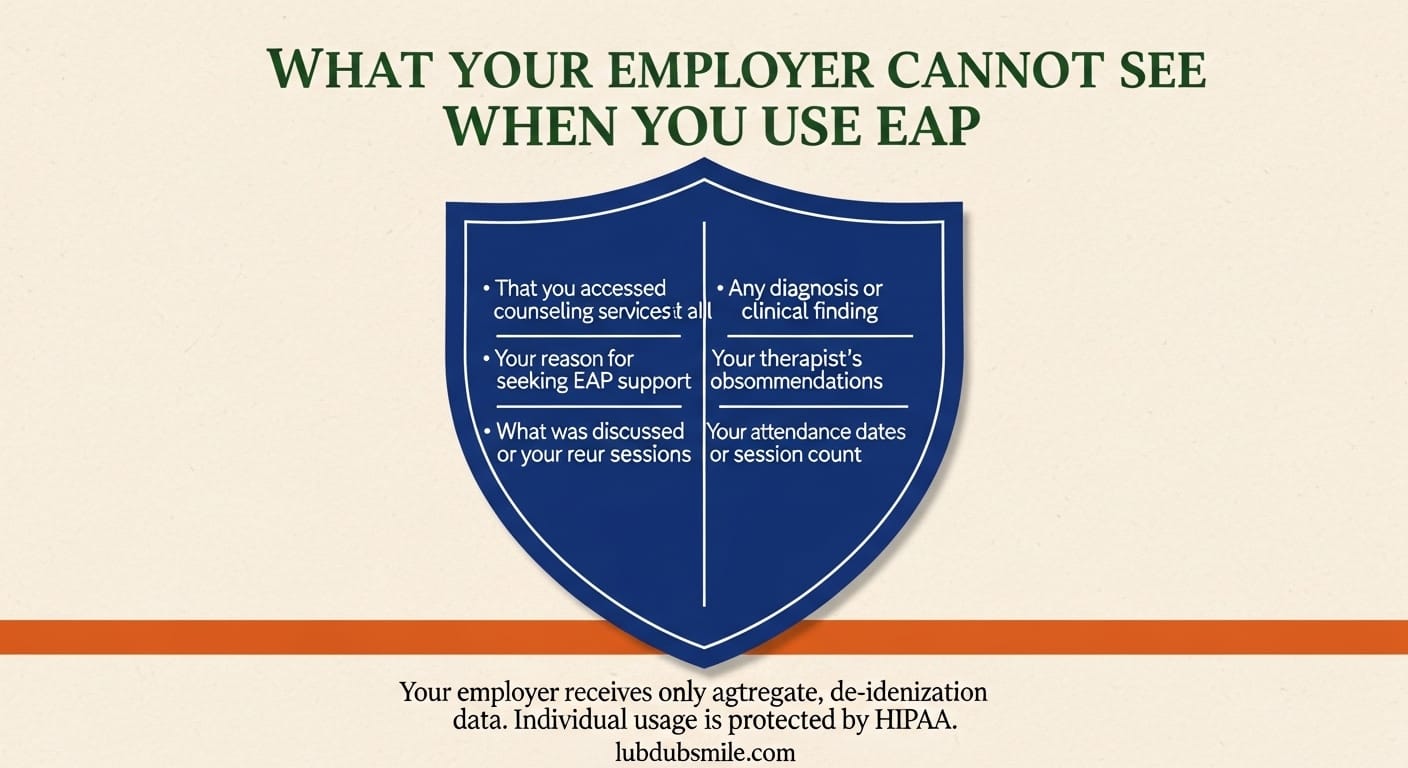
Employee mental health benefits through EAP are protected by HIPAA employers receive only aggregate utilization data, never individual records. - Avoid mentioning EAP use at work unless you choose to it’s your private choice
- Review your EAP’s privacy practices by asking the provider how your data is stored and what security protocols they use
- Understand your consent forms before signing EAP intake may include authorization forms; read what you’re consenting to
How to Access Your Employee Mental Health Benefits
Finding Your EAP Provider Information
Many employees don’t know who their EAP provider is. Find this information through:
- HR portal or benefits website: Look for “EAP,” “Employee Assistance,” or “Mental Health Support” sections
- Your benefits summary or enrollment materials: EAP typically appears alongside health insurance and other benefits
- Pay stub or benefits card: Some employers list EAP provider information on these
- Your HR department: Simply email or call HR and ask: “Who is our EAP provider, and how do I contact them?”
- Your employer’s intranet: EAP information often appears in benefit sections
Common EAP providers include Magellan Health, Optum (formerly United Behavioral Health), ComPsych, Cigna EAP, Aetna Resources For Living, and numerous regional vendors that focus on specific industries or populations.
The Intake Process: What to Expect When You Call
When you call your EAP for the first time, the intake process typically involves:
Initial screening: A brief conversation (usually with an intake coordinator who has received specific training for this role, not a therapist) to understand what you’re seeking help with and what type of services would be most helpful.
Eligibility verification: They’ll confirm your eligibility (employee status, and if applicable, which family members qualify for employee mental health benefits).
Service matching: Based on your presenting concern, the coordinator will match you with available services counseling, financial consultation, legal referral, etc.
Appointment scheduling: For counseling, they’ll either schedule your first appointment directly or connect you with an EAP-affiliated therapist who will reach out to you.
Information you’ll need to provide: Your name, employer name, and contact information. You will not need to provide your insurance information for EAP services.
What to say if you’re uncertain: Simply saying “I’m going through a stressful time and want to talk to someone” is sufficient to begin the process. You don’t need a specific diagnosis or clearly defined problem.
Scheduling Your First Appointment
After intake, appointment timelines vary significantly by program and provider availability:
- Urgent or crisis situations: Most EAPs maintain 24/7 crisis lines and can provide same-day or next-day crisis counseling
- Standard appointments: Routine counseling appointments are typically available within 3–10 business days
- Telehealth: Many EAPs now offer video sessions that may be available more quickly than in-person appointments
If wait times are longer than you can manage, say so. Ask specifically: “Is there anything available sooner?” or “Do you have video sessions with shorter wait times?”
EAP Phone, Video, and In-Person Options
Most modern employee mental health benefits through EAP offer multiple modalities for accessing counseling:
In-person sessions: Traditional face-to-face therapy at an affiliated provider’s office. May have longer wait times in some areas.
Video telehealth sessions: Conducted via a secure video platform. Often accessible sooner and more convenient for busy schedules. Your therapist’s licensing requirements determine which states permit this modality.
Phone sessions: An audio-only format that works well for brief check-ins or when video isn’t accessible.
Text and online resources: Many EAPs offer online self-help tools, wellness assessments, digital CBT programs, and app access as a supplement to or initial step before counseling.
All modalities carry equal confidentiality protections and fall within your EAP benefit. Choose based on your preference, schedule, and current mental health needs.
Using EAP After Hours and on Weekends
Almost all EAPs maintain a 24-hour phone line for crisis support and urgent mental health concerns. Mental health professionals not just intake coordinators staff these lines and are available nights, weekends, and holidays.
While you typically can’t schedule new counseling appointments at 2 AM, many EAP portals and apps allow you to browse available appointment times and submit scheduling requests around the clock. Digital tools, self-help modules, and wellness assessments that most EAP portals offer are accessible anytime.
If you’re experiencing a mental health crisis at any hour, call your EAP’s 24/7 line or call/text 988 (Suicide and Crisis Lifeline). Do not wait for business hours.
What to Do If EAP Has Long Wait Times
If your EAP cannot schedule you within a reasonable time for non-crisis needs:
- Ask about telehealth availability: Video sessions often have shorter wait times than in-person
- Ask about self-scheduling tools: Some EAPs have portals where you can see and book appointments directly
- Request a different geographic area or provider network: If your local providers are fully booked, some EAPs can connect you with providers in adjacent areas who offer telehealth
- Use online EAP resources while waiting: Digital mental health tools, self-guided programs, and online coaching that many employee mental health benefits programs include
- Contact HR: If wait times are consistently excessive, HR has contractual leverage with the EAP provider to address access problems
- Access the crisis line for urgent needs: Even if routine appointments have wait times, crisis support should be immediately accessible
What EAP Does Well (And Where It Falls Short)
When EAP Is an Excellent Option
EAP counseling as part of your employee mental health benefits works particularly well for:
Acute situational stress: A specific stressful life event job loss, workplace conflict, difficult life transition, relationship crisis that requires short-term support and coping strategies.
Early intervention: Addressing mental health concerns before they become serious or chronic. Catching anxiety, mild depression, or stress that relates to specific circumstances early and developing coping skills is an excellent use of short-term EAP counseling.

Initial assessment and referral: If you’re unsure whether you need mental health support or what kind, an EAP session provides professional evaluation and can direct you to appropriate resources.
Financial and legal concerns: EAP provides valuable professional consultation for financial stress and legal questions at no cost services that would otherwise cost hundreds of dollars.
Grief, loss, and adjustment: Processing grief, adapting to major life changes, and managing loss often respond well to short-term focused counseling.
Relationship and communication support: Brief couples counseling or communication coaching for non-chronic relationship concerns.
Mental Health Conditions EAP Can Effectively Support
Short-term EAP counseling within employee mental health benefits may effectively address:
- Adjustment disorders and situational stress responses
- Mild to moderate anxiety that relates to specific circumstances
- Acute grief and bereavement
- Work-life balance concerns and burnout prevention
- Mild depression with identifiable situational triggers
- Relationship communication challenges
- Parenting stress and family transitions
- Workplace conflict resolution
The key characteristic: conditions where short-term, solution-focused intervention can meaningfully address the concern within the available session limit. Understanding burnout recovery can help you determine whether your situation calls for EAP support or more comprehensive care.
When EAP Sessions Are Likely Not Enough
Be honest with yourself and with your EAP counselor if your needs extend beyond what short-term counseling can address. Employee mental health benefits through EAP typically fall short for:
Chronic or severe mental health conditions: Major depressive disorder, bipolar disorder, generalized anxiety disorder, PTSD, eating disorders, OCD, and other conditions that require ongoing, comprehensive treatment will not receive adequate care in 3–12 sessions.
Active substance use disorders: While EAP can provide initial assessment and referral, ongoing addiction treatment typically requires more intensive, longer-term, and more specialized care than EAP provides.
Complex trauma: Trauma processing particularly complex or developmental trauma requires extended therapeutic relationships and treatment approaches that clinicians have developed specifically for trauma. Short-term counseling cannot safely or adequately provide this.
Active suicidal ideation or self-harm: While EAP crisis lines can provide immediate support, individuals with active suicidal ideation need comprehensive psychiatric and safety support beyond EAP scope.
Psychiatric medication management: EAP counselors are typically therapists who hold licenses, not psychiatrists or prescribers. Medication evaluation, prescription, and management require medical providers outside the standard EAP framework.
Using EAP as Bridge to Longer-Term Care
One of the most valuable uses of employee mental health benefits is as a bridge to longer-term care. Even if your needs exceed EAP’s scope, those initial sessions can:
- Provide immediate support while you navigate insurance coverage and find an in-network therapist
- Conduct professional evaluation that informs what type of ongoing treatment is most appropriate
- Provide a clinical summary and a warm referral to a longer-term provider
- Help you understand your insurance benefits and how to use them effectively
- Stabilize an acute situation while you arrange comprehensive care
Think of EAP as triage and bridge valuable and important, but not the complete solution for complex needs. Exploring telehealth therapy platform options can help you identify what comes next when EAP sessions end.
Employee Mental Health Benefits: EAP vs. Health Insurance
When to Use EAP First
Consider starting with employee mental health benefits through EAP when:
- Your concern is situational and likely short-term
- You want immediate free access without insurance cost-sharing
- You want to avoid an insurance claims record for your concern
- You need financial or legal consultation alongside mental health support
- You want initial evaluation before committing to ongoing therapy
- Your concern is work-related and brief intervention is appropriate
When to Go Directly to Insurance-Covered Therapy
Go directly to insurance-covered therapy (bypassing EAP or using EAP concurrently) when:
- You know you need ongoing therapy for a chronic condition
- Your EAP has long wait times and your needs are urgent (non-crisis)
- Your specific therapeutic need may receive better matching in a broader insurance network
- You’ve already exhausted your EAP session limit
- You prefer not to use EAP sessions for a concern that clearly requires long-term treatment
Understanding your mental health parity rights can help you advocate for insurance coverage when your employee mental health benefits through EAP reach their limit.
Using Both: How EAP and Insurance Can Work Together
EAP and insurance are not mutually exclusive. You can:
- Use EAP for initial evaluation and short-term support while simultaneously finding an in-network therapist through insurance
- Use EAP for financial counseling while using insurance for ongoing mental health therapy
- Use EAP crisis line services anytime, regardless of whether you’re in ongoing insurance-covered therapy
- Use EAP for legal consultation while using insurance for your mental health needs
Using both simultaneously doesn’t create conflicts in most cases they’re separate benefit systems that address different needs and session types.
Open Enrollment Considerations for Mental Health Coverage
Annual open enrollment is an opportunity to align your health insurance and employee mental health benefits with your anticipated needs:
- Review your EAP coverage: Has your employer changed EAP providers? What are the current session limits and included services?
- Assess your insurance mental health coverage: What are your in-network copays for mental health? Does your deductible apply before mental health coverage begins?
- Consider your likely needs: If you know you’ll need ongoing therapy, choose a plan with lower mental health cost-sharing even if the premium is slightly higher
- Review network adequacy: Are there sufficient in-network mental health providers in your area?
- Ask HR: Are there changes to mental health benefits this year?
EAP for Specific Situations
Workplace Stress, Burnout, and Performance Issues
Workplace stress and burnout are among the most common reasons employees access employee mental health benefits. EAP works particularly well for these concerns because:
- The concern is often situational and responds well to short-term intervention
- EAP counselors receive specific training in work-related stress and organizational dynamics
- Using EAP for work concerns is exactly what it was built to address
- EAP manager consultation services can provide separate guidance to supervisors who are navigating team concerns
If you’re struggling with burnout, workplace conflict, performance anxiety, or difficult manager relationships, EAP is an appropriate and valuable first resource.
Importantly, your EAP sessions remain confidential. Your manager cannot find out you called EAP to discuss concerns about your workplace situation.
Relationship and Family Problems
Employee mental health benefits through EAP typically cover:
- Individual counseling for relationship concerns
- Brief couples counseling (your program’s specific offerings vary verify with your provider)
- Family therapy (limited, varies by program)
- Parenting support and resources
- Divorce adjustment counseling
- Eldercare consultation and referrals
If you’re going through relationship difficulties, separation, co-parenting challenges, or family conflict, EAP provides free initial support. For complex or ongoing couples therapy needs, insurance or private pay may provide more comprehensive coverage.
Grief and Loss
Grief counseling is one of the most appropriate uses of employee mental health benefits through EAP short-term counseling. Whether you’ve lost a family member, friend, or colleague, experienced a pregnancy loss, or are grieving another significant loss, EAP can provide:
- Individual grief counseling sessions
- Psychoeducation about grief processes
- Coping strategy development
- Referrals to grief support groups or ongoing bereavement counseling if needed
Substance Use and Addiction
EAP originated around substance use support, and most programs retain specific expertise in this area. EAP can provide:
- Evaluation of substance use patterns and severity
- Motivational interviewing and initial intervention
- Referrals to appropriate treatment (outpatient, intensive outpatient, residential) based on clinical evaluation
- Support for family members of individuals with substance use disorders
EAP is generally not sufficient as standalone treatment for substance use disorders that require medically supervised detoxification, intensive outpatient, or residential treatment. Its value in addiction contexts is primarily evaluation, initial support, and connecting individuals to appropriate higher levels of care.
Crisis Situations and Immediate Access
For mental health crises, the EAP 24/7 crisis line is your first point of contact within your employee mental health benefits system. Mental health professionals who staff most EAP crisis lines can:
- Provide immediate telephone crisis counseling
- Conduct safety evaluations
- Help develop safety plans
- Connect you with appropriate emergency resources
- Arrange urgent follow-up counseling
Critical: EAP crisis support is not a substitute for emergency services when safety is at immediate risk. If you or someone you know is in immediate danger:
- Call 911 or go to your nearest emergency room
- Call or text 988 (Suicide and Crisis Lifeline) available 24/7, nationwide
- Text HOME to 741741 (Crisis Text Line)
Do not navigate an EAP intake process during an acute safety emergency. Use 988 or 911 first.
Manager Referrals: Voluntary vs. Mandatory EAP
Managers may suggest or refer employees to EAP in two distinct ways:
Voluntary informal suggestion: A manager mentions EAP as a resource during a supportive conversation. This is a suggestion, not a requirement. The employee has full discretion to access or not access employee mental health benefits. Voluntary referrals carry no employment consequences.
Formal mandatory referral (Management Referral): In specific circumstances typically involving workplace safety concerns, performance problems that relate to potential substance use, or behavioral incidents a manager or HR may formally require EAP participation as part of a return-to-work or performance improvement plan.
Your rights regarding mandatory referrals:
- You have the right to understand why a mandatory referral is being made
- EAP confidentiality still applies the employer typically receives only confirmation that you attended (not session content)
- Mandatory referrals must comply with ADA and other employment protections
- If you believe a mandatory referral is inappropriate or discriminatory, consult an employment attorney
The distinction between voluntary and mandatory referrals matters. Most employee mental health benefits use is entirely voluntary, and most employees never face mandatory referrals.
Rights and Protections You Should Know
Your Right to Use EAP Without Employer Retaliation
Employees have legal protections against retaliation for using mental health benefits. Using your employee mental health benefits:
- Cannot serve as grounds for termination, demotion, or negative performance evaluation
- Cannot factor into employment decisions
- Receives HIPAA protection from employer access
If you believe you’ve experienced retaliation for seeking mental health support, document the timeline and contact an employment attorney or the Equal Employment Opportunity Commission.
ADA Protections and Mental Health Conditions
The Americans with Disabilities Act (ADA) protects employees with mental health conditions that substantially limit major life activities. ADA protections include:
- Protection against discrimination that relates to a mental health condition
- The right to reasonable accommodation (schedule flexibility, modified duties, leave)
- Protection during the hiring process
- A requirement that employers engage in the “interactive process” when employees request accommodations
Mental health conditions including depression, anxiety disorders, PTSD, and bipolar disorder may qualify as disabilities under the ADA. Employees don’t need to disclose their specific diagnosis to request accommodation they need to communicate that they have a health condition that requires accommodation.
Consult the EEOC or an employment attorney for guidance specific to your situation.
FMLA and Mental Health Leave
The Family and Medical Leave Act (FMLA) gives qualifying employees at qualifying employers up to 12 weeks of unpaid, job-protected leave per year for serious health conditions, including serious mental health conditions. FMLA may apply when:
- A serious mental health condition (depression, anxiety, PTSD, etc.) requires inpatient care or continuing treatment by a healthcare provider
- Intermittent leave is needed for mental health treatment appointments or episodes
FMLA eligibility requires:
- Working for an employer with 50+ employees
- Having worked for the employer for at least 12 months
- Having worked at least 1,250 hours in the past 12 months
Contact your HR department or the U.S. Department of Labor’s Wage and Hour Division for FMLA guidance. EAP counselors can also help connect you with appropriate resources for mental health leave planning.
Filing Complaints If EAP Rights Are Violated
If you believe your employee mental health benefits rights have been violated:
- HIPAA violations: File a complaint with the HHS Office for Civil Rights
- ADA violations: File a complaint with the EEOC
- FMLA violations: File a complaint with the DOL Wage and Hour Division
- Employment retaliation: Consult an employment attorney; many offer free initial consultations
- EAP quality or access complaints: Contact your HR department (who has contractual leverage with the EAP vendor)
Getting the Most From Your Employee Mental Health Benefits
Preparing for Your First EAP Session
Your first EAP session is most productive when you arrive with some clarity about:
- Your primary concern: What’s bringing you to seek support right now?
- What you’re hoping for: Are you looking for coping strategies? A listening ear? Professional guidance on a decision? Evaluation and referral?
- Your availability: When can you realistically schedule sessions? What modality works best (in-person, video, phone)?
- Your session awareness: How many sessions does your program provide?
You don’t need to arrive with a prepared speech or clear psychiatric diagnosis. Honest, open communication about what you’re experiencing is sufficient.
Being Specific About Your Needs When Requesting Services
When calling EAP intake, being specific improves your match quality:
- Instead of: “I need to talk to someone”
- Try: “I’m going through a divorce and experiencing significant anxiety I’m looking for counseling support and possibly referrals to legal and financial resources”
Specificity helps intake coordinators match you with the right service type, identify therapists with relevant specialty experience, and set accurate expectations for session scope.
Requesting a Specific Therapist Type or Specialty
EAP networks include therapists with varying specialties and approaches. You can request:
- A therapist with a specialty in a specific concern (trauma, grief, workplace stress, couples)
- A therapist of a specific gender or cultural background
- A therapist who uses a specific therapeutic approach (CBT, DBT, trauma-informed approaches, EMDR)
- A therapist who speaks a specific language
Not all requests can always receive accommodation within EAP network availability, but asking increases the likelihood of a meaningful match for your employee mental health benefits sessions.
Asking About Referrals Before Your Sessions End
One of the most valuable conversations to have in your final or second-to-last EAP session:
“Given what we’ve worked on and what I still need, what would you recommend for continued care?”
A good EAP therapist will:
- Provide honest clinical evaluation of whether your needs have received adequate attention
- Recommend continuing care if appropriate
- Offer specific referrals to in-network providers or community resources
- Provide a clinical summary for continuity of care
Don’t let your last session arrive without this conversation having happened.
Using Other EAP Services Beyond Therapy
Maximize your employee mental health benefits value by using services you may not have considered:
- Schedule that legal consultation before you actually need a lawyer in crisis
- Use financial counseling if you’re stressed about debt, budgeting, or life transitions
- Access childcare/eldercare resources if you’re managing caregiving demands
- Explore digital wellness tools that your EAP portal offers
- Use manager consultation services if you’re a supervisor trying to support a struggling team member
These services are already part of your employee mental health benefits. Not using them means leaving real value behind.
If You Don’t Have EAP (Or EAP Isn’t Enough)
Checking If You Have EAP You Don’t Know About
Before assuming you don’t have employee mental health benefits through EAP, verify:
- Check your benefits portal: EAP is often listed under “employee assistance” or “wellness” rather than “mental health”
- Ask HR directly: “Do we have an EAP? Who is the provider and how do I contact them?”
- Check your pay stub: Some employers list EAP provider contact information there
- Review onboarding materials: EAP information is often included in new employee paperwork
Many employees discover they’ve had EAP coverage for years without knowing. Checking costs nothing.
Insurance-Covered Mental Health Options
If you don’t have EAP or have exhausted your sessions, health insurance mental health coverage is typically your primary next option. Under the Mental Health Parity and Addiction Equity Act, your insurance must cover mental health benefits comparably to medical/surgical benefits.
Key steps:
- Call your insurance member services and ask for a mental health provider directory
- Ask about your specific cost-sharing (copay, deductible, coinsurance)
- Verify provider network adequacy in your area
- Ask whether your plan requires a referral for mental health services
If you believe your insurance applies mental health coverage more restrictively than medical coverage, our companion article on mental health parity rights can help you understand and advocate for your coverage.
Sliding Scale and Community Mental Health Options
When insurance is insufficient or unavailable:
Federally Qualified Health Centers (FQHCs): Provide mental health services on sliding-scale fees that reflect your income. Find locations at findahealthcenter.hrsa.gov. FQHCs must see patients regardless of ability to pay.
Community mental health centers: Publicly funded mental health services in most counties. Often offer sliding-scale fees and serve individuals without insurance or with limited insurance.
University training clinics: Therapy that graduate students provide under close clinical supervision at significantly reduced rates. Quality is generally high due to the supervision structure.
Open Path Collective: A network of therapists who offer sessions at reduced rates ($30–$80) for individuals without adequate insurance coverage.
NAMI HelpLine: NAMI (nami.org, 1-800-950-6264) can connect you with local mental health resources appropriate to your situation.
Federal and State Mental Health Resources
- SAMHSA National Helpline: 1-800-662-4357 (free, confidential, 24/7 information and referral service)samhsa.gov
- 988 Suicide and Crisis Lifeline: Call or text 988 for crisis support
- State mental health authority: Each state has a public mental health agency; contact your state’s department of health for local resource referrals
- Medicaid: If you qualify based on income, mental health services are included in your benefits
Open Enrollment: Advocating for Better Mental Health Benefits
If your workplace mental health benefits are inadequate:
- Provide feedback to HR during benefits review periods: HR departments respond to employee benefit feedback, especially when multiple employees raise similar concerns
- Ask about EAP expansion: Employers can negotiate higher session limits with EAP vendors; employee advocacy can influence this decision
- Request mental health parity review: Ask HR or benefits administrators to confirm that your insurance plan complies with the Mental Health Parity and Addiction Equity Act
- Use employee surveys: Many employers conduct benefits satisfaction surveys; mental health coverage is a valid topic to raise
Frequently Asked Questions
Will my manager know I used EAP?
No. Under standard EAP structure, your manager has no access to information about your individual EAP use. EAP providers follow HIPAA and contractual confidentiality obligations that prohibit sharing individual employee information with employers.
Your employer receives only aggregate, de-identified utilization data (e.g., “15% of employees accessed EAP services this year”). They cannot identify which employees used employee mental health benefits, for what concerns, or how many sessions each employee completed.
The only exception: if you’re subject to a formal management referral (a specific, documented performance or safety-related process), your employer may receive confirmation that you attended but not the content of your sessions.
Can I use EAP for couples or family therapy?
This varies by program. Many EAPs allow sessions for couples counseling, though the sessions often still count toward the employee’s individual session limit. Some programs provide separate session allocations for family members.
Verify with your EAP provider:
- “Can my sessions go toward couples counseling?”
- “Is my spouse/partner separately eligible for their own session allocation?”
- “Do you have therapists with experience in couples work?”
Family therapy involving children or other household members may also be available depending on program structure.
What if I don’t like the EAP therapist I’m matched with?
You can request a different therapist. EAP networks include multiple providers, and therapeutic fit matters significantly for outcomes.
When requesting a change:
- Contact your EAP intake coordinator (not the therapist directly)
- You don’t need to provide detailed explanation “I’d like to try a different therapist” is sufficient
- Specify what you’re looking for differently (specialty, gender, approach, modality)
Sessions you completed with a therapist you didn’t connect with still count toward your session limit in most programs. Address fit concerns quickly rather than continuing sessions that aren’t productive.
Does EAP cover medication management?
Standard EAP counseling does not include psychiatric evaluation or medication management. EAP counselors are typically therapists who hold licenses (LPCs, LCSWs, etc.), not psychiatrists or prescribers.
If you need psychiatric evaluation or medication management, your EAP counselor can:
- Provide referral to a psychiatrist or psychiatric nurse practitioner through your insurance network
- Help you understand how to access psychiatric services through your health insurance
- Coordinate care with a prescriber you’re already working with
Some comprehensive employee mental health benefits programs maintain relationships with prescribers for crisis-level medication consultation ask your EAP coordinator whether your program offers this.
Can I use EAP if I’m considering leaving my job?
Yes. EAP is available for any life concern during your period of employment, including career transition stress, decision-making support, and the anxiety that often accompanies major job changes.
Using employee mental health benefits to discuss whether to leave your job, how to manage the stress of a job search, or how to navigate a career transition is entirely appropriate and within scope.
Note that EAP access typically ends when employment ends (unless your employer specifically extends it as part of a separation package). This is a practical reason to use EAP sessions before your departure if you’re actively considering leaving.
What happens to my EAP access if I’m laid off?
Standard employee mental health benefits access typically ends when employment ends. However:
- Many employers extend EAP access for 30–90 days following a layoff as part of severance or transition support ask HR whether this applies to you
- COBRA does not extend EAP access (EAP is not a health insurance plan that COBRA covers)
- Severance packages sometimes specifically include EAP extension review your severance terms
- New employer EAP: Once you’re employed elsewhere, your new employer’s employee mental health benefits (if they offer them) become available
If you’re facing layoff and haven’t used your EAP sessions, consider accessing them before your departure date especially for career transition counseling and financial consultation.
Is EAP available for part-time employees?
This varies significantly by employer. Some EAPs extend to all employees regardless of status (full-time, part-time, seasonal). Others restrict employee mental health benefits access to full-time employees or those working above a certain hour threshold.
Part-time employees should verify EAP eligibility directly with HR rather than assuming they qualify or don’t. If you’re part-time and EAP isn’t available, community mental health resources, FQHCs, and sliding-scale options remain accessible.
Important Information and Resources
Understanding the Limits of This Guide
This article provides general educational information about employee mental health benefits and Employee Assistance Programs. EAP programs are not standardized coverage, session limits, eligible services, and family eligibility vary substantially by employer and EAP vendor.
This guide cannot:
- Tell you how many sessions your specific EAP provides
- Confirm which services your specific program includes
- Provide legal advice about your employment rights
- Substitute for direct verification with your EAP provider or HR department
This guide can:
- Help you understand how employee mental health benefits generally work
- Identify the right questions to ask your HR department and EAP provider
- Help you understand confidentiality protections and their limits
- Help you assess when EAP is and isn’t the right tool for your needs
Crisis Resources for Immediate Support
If you’re experiencing a mental health crisis, access support immediately:
- 988 Suicide and Crisis Lifeline: Call or text 988 (24/7, free, confidential)
- Crisis Text Line: Text HOME to 741741
- Your EAP 24/7 crisis line: Number on your EAP card or benefits portal
- Emergency services: Call 911 or go to your nearest emergency room for immediate safety emergencies
- SAMHSA National Helpline: 1-800-662-4357 (free, 24/7 information and referral)
Do not navigate intake processes during an acute safety crisis. Call 988 or 911 first.
Verifying Your Specific EAP Coverage
To verify your actual employee mental health benefits:
- Contact HR and ask: “Who is our EAP provider, and what does our program cover?”
- Call your EAP provider directly and ask: “How many sessions am I entitled to, how are they counted, who is eligible, and what services are included?”
- Review your benefits documentation during open enrollment
- Check your employer’s HR portal for EAP provider contact information
These three steps take less than 30 minutes and give you authoritative information about your specific coverage.
When to Seek Legal or HR Guidance
Consult an employment attorney or contact relevant agencies if:
- You believe you’ve experienced retaliation for using employee mental health benefits
- You’re facing a mandatory EAP referral and are uncertain of your rights
- You need ADA accommodation guidance for a mental health condition
- You’re navigating FMLA for mental health leave
- You believe your employer has violated HIPAA related to your EAP information
Key resources:
- EEOC: eeoc.gov (ADA and employment discrimination)
- DOL Wage and Hour Division: dol.gov/agencies/whd (FMLA)
- HHS Office for Civil Rights: hhs.gov/hipaa (HIPAA violations)
- NAMI: nami.org (workplace mental health navigation and resources)
Your mental health is worth the investment of understanding and using the employee mental health benefits you’ve already earned through your employment. EAP may not be the complete solution for every need, but for millions of employees, it’s a valuable, free, and confidential first step toward support that too few people actually use.
Summary
Employee mental health benefits through EAP give employees free, confidential access to short-term counseling, financial consultation, and legal guidance that most never use primarily because they don’t understand what their program covers, how many sessions they have, or that HIPAA legally prevents their employer from accessing individual usage data and the most important action any employee can take is to call their EAP provider before a crisis occurs, ask specifically how sessions count and who qualifies, and treat EAP as the bridge it is rather than the destination, transitioning to insurance-covered therapy when needs exceed what short-term counseling can address.
NOTE: EAP programs vary significantly by employer and provider. Verify your specific coverage directly with your HR department or EAP provider before making decisions about your care. If you are in crisis, call 988 or 911 immediately.
This content is for educational purposes and does not substitute for professional psychological or therapeutic help.







I’m so thankful for this clear breakdown because it helped me finally understand how to actually use my company’s EAP to support my mental health.
We’re so glad this empowered you to take advantage of those benefits! Navigating workplace resources can be tricky, so it’s wonderful to know this guide made the process easier for you.
Warmly,
The LubDubSmile Team