

Telehealth Therapy Across States: A Licensure and Compact Access Guide
Telehealth therapy across states has become one of the most pressing access challenges in American mental health care and one of the least understood. You’ve been seeing your therapist for two years. The relationship works. You’ve made real progress. Then you relocate for work, follow a partner to a new city, or receive military orders and suddenly discover that your therapist may not legally continue your telehealth sessions. Not because they lack qualifications. Not because you’ve done anything wrong. Simply because they hold a license in one state and you now live in another.
This barrier affects military families who move every two years, college students returning home between semesters, remote workers splitting time between states, and anyone in rural areas trying to access providers in other states via telehealth. The rules governing telehealth therapy across states are complex, discipline-specific, rapidly evolving, and genuinely consequential. This guide explains how therapy licensure reciprocity works, which interstate compacts exist and what they cover, how the pandemic changed and then reversed telehealth access, and what steps you can take to protect your mental health care continuity.
We have heard from enough readers navigating care disruptions after a move, a semester break, or a military reassignment to know that this is not an abstract regulatory problem. It is a personal one, and it arrives at the worst possible moments, often mid-treatment, often without warning. Our approach to this guide is practical rather than exhaustive. The licensing landscape is genuinely complex, and no single article can substitute for direct verification with your therapist and the relevant licensing boards. What we can do is give you the framework to ask the right questions, understand the answers, and protect the continuity of care you have worked hard to build.
Why Telehealth Therapy Across States Is Complicated
How State Licensing Works for Mental Health Professionals
Each state independently licenses mental health professionals not the federal government. Every state establishes its own licensing requirements, standards, and oversight through state licensing boards. A professional counselor (LPC) in Virginia holds a Virginia license that authorizes practice within Virginia’s borders. That license does not automatically confer legal authority to practice in any other state.

This creates a regulatory patchwork across 50 states, each with different requirements for education, hours of supervised clinical work, examination scores, and continuing education. While many states align their requirements with national standards, the actual license to practice remains state-specific and this creates the central challenge of telehealth therapy across states.
Why Your Therapist Can’t Automatically Follow You Across State Lines
When your therapist provides therapy via telehealth, the question of where the therapy “takes place” matters enormously for licensing purposes. Most states follow the rule that therapy takes place in the state where the client physically sits during the session not where the therapist sits.
This means that when you move from California to Texas, your California therapist potentially practices in Texas the moment they conduct a telehealth session with you in your new state. Unless your therapist holds a Texas license, carries a Texas compact credential, or falls under a specific exception, that session may violate Texas licensing law.
This isn’t a technicality easily ignored. Therapists who conduct telehealth therapy across states without proper authorization risk license discipline, civil liability, and malpractice insurance complications. Most professional therapists take these rules seriously, which is why many will proactively raise the issue when clients relocate. Understanding when to seek professional support helps you navigate these moments of care disruption constructively.
The Governing Principle: Client Location Determines Licensure
The governing principle in most states is straightforward: the client’s physical location during a session determines which state’s licensure requirements apply. However, genuine variation exists in how states interpret this rule, and some states have enacted specific telehealth provisions that modify this standard.
Some states follow a “location of the provider” standard or have specific exceptions for telehealth. Others require the provider to carry a license in both the provider’s state and the client’s state. Understanding which standard applies requires checking the specific state laws of both your state and your therapist’s state of practice. This variation is exactly why blanket statements about the legality of telehealth therapy across states are unreliable and why verification with licensing boards remains essential.
How the Pandemic Changed (and Then Complicated) the Licensing Question
Before the COVID-19 pandemic, most therapists operated primarily in person, and cross-state licensing issues arose relatively infrequently. Telehealth existed but represented a small percentage of mental health care delivery.
The pandemic transformed this landscape overnight. States issued emergency orders that suspended out-of-state licensing requirements for mental health providers so therapists could continue seeing clients who had relocated. For roughly two to three years, many clients experienced telehealth therapy across states without licensing barriers creating an expectation that collided with the return of pre-pandemic rules in most states.
Understanding what changed and what reverted is critical to accurately assessing your current options.
Why This Matters for Your Mental Health Care Continuity
Disrupting an ongoing therapeutic relationship carries real clinical consequences, and for many people the uncertainty of navigating a care gap compounds the anxiety and overwhelm they were already managing when they began therapy in the first place. Research the Journal of Clinical Psychology published suggests that therapeutic alliance the quality of the relationship between therapist and client is one of the strongest predictors of therapy outcomes. Forcing clients to abandon therapists they trust due to administrative barriers can delay care, discourage individuals from engaging with a new therapist, and in some cases contribute to deterioration of mental health.
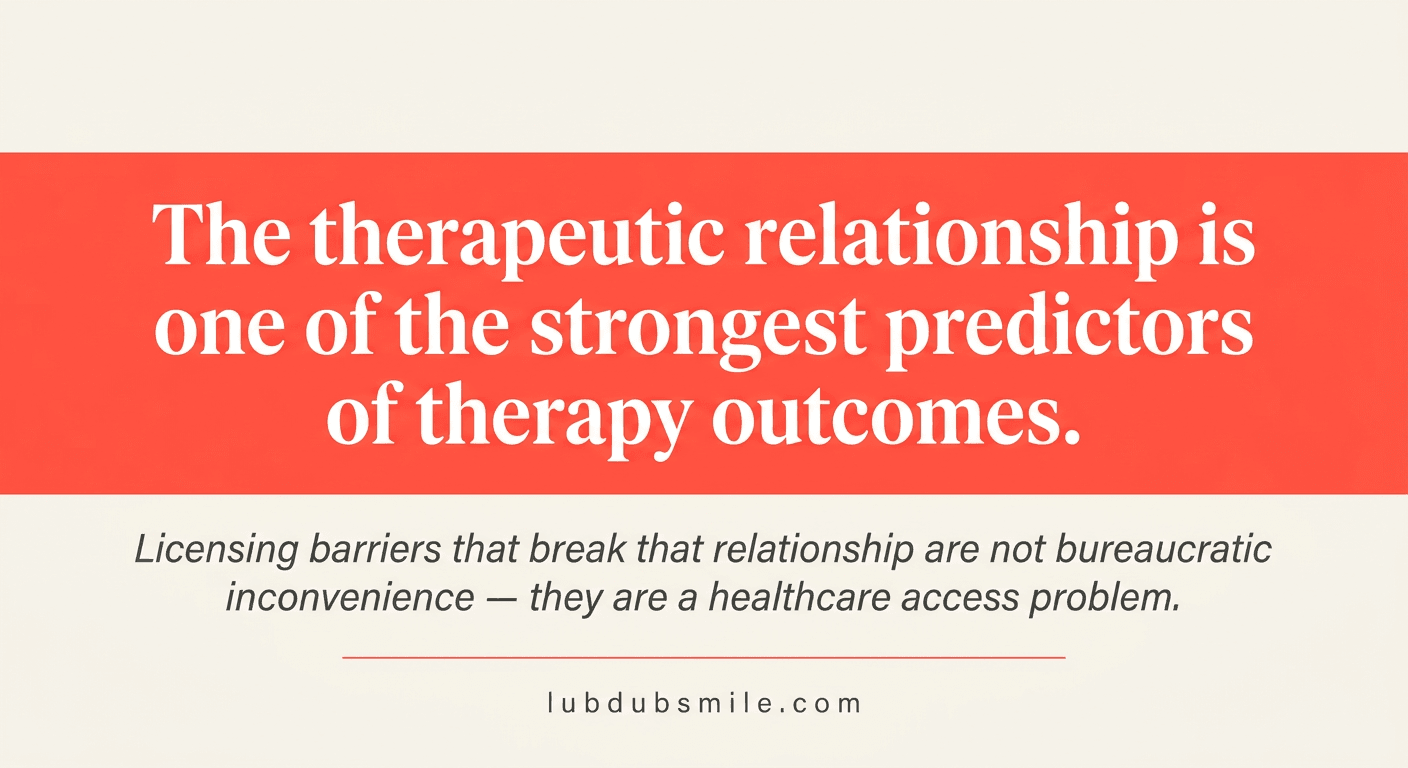
This regulatory complexity isn’t just bureaucratic inconvenience. For people mid-treatment, managing serious mental health conditions, or living in communities where providers are scarce, licensing barriers create genuine healthcare access harm. Licensing barriers are one layer of the access picture. Understanding your rights under mental health parity law adds another, and knowing both helps you advocate more effectively when a care transition puts your coverage at risk.
Interstate Compacts: The Main Pathway for Telehealth Therapy Across States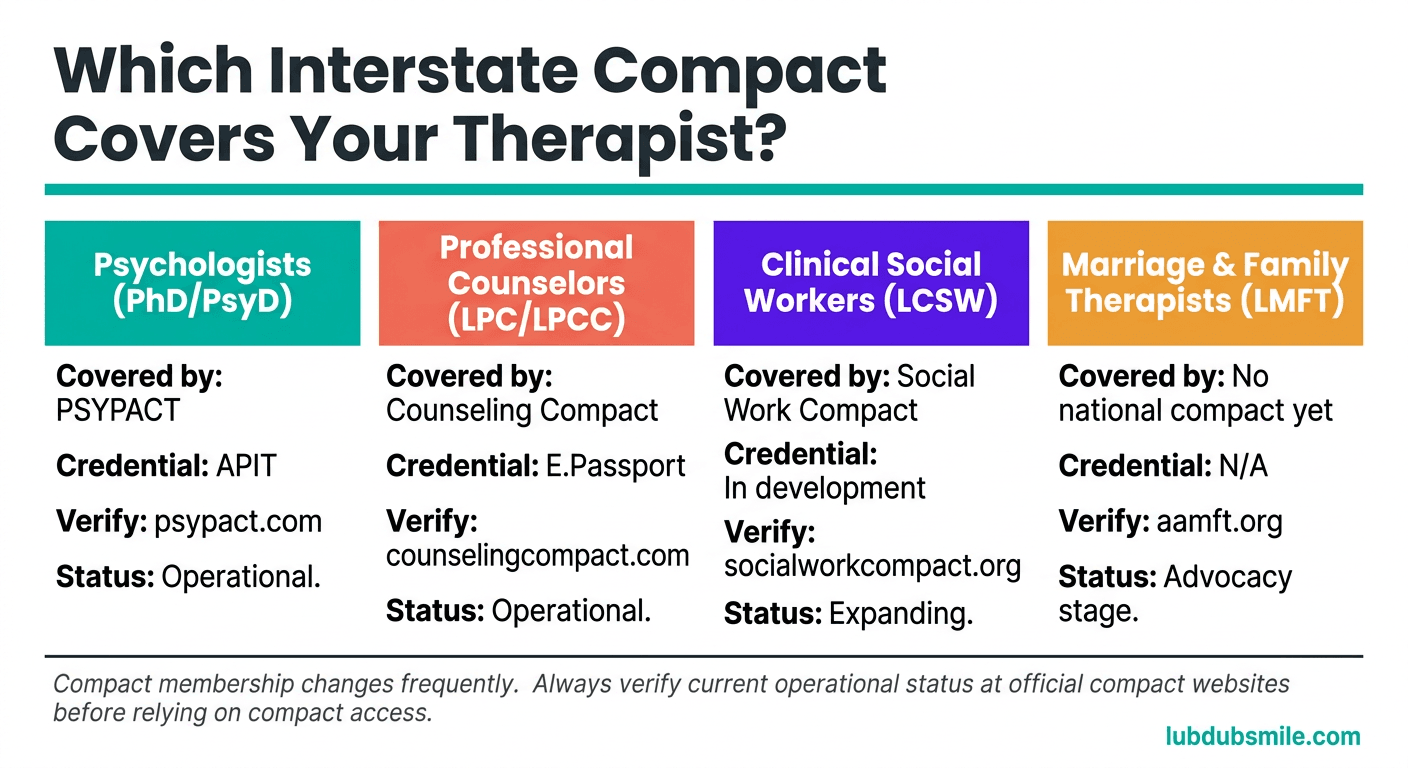
What an Interstate Compact Actually Is
An interstate compact is a legal agreement between states that creates a pathway for professionals who hold licenses in good standing to practice across participating state lines without obtaining full individual licensure in each state. States enact compacts through legislation in each participating state and typically create a centralized organization to administer the compact.
For telehealth therapy across states, compacts generally work by:
- Requiring therapists to hold a license in good standing in their “home state” (where they primarily practice)
- Granting those therapists the ability to obtain a compact credential that allows practice in other member states
- Establishing shared standards and disciplinary authority across member states
- Creating a verification system that states and clients can use to confirm a therapist’s compact credentials
Compacts are not automatic therapists must apply for compact credentials, meet eligibility requirements, and maintain compliance with compact rules. Both the therapist’s home state and the client’s state must be members for the compact to apply. If either state has not joined, the compact does not provide authorization for telehealth therapy across states.
The Counseling Compact: States and Coverage
The Counseling Compact covers professional counselors (LPCs) and their equivalent titles across states (LPCC, LCPC, etc.). It allows eligible counselors to obtain an E.Passport a compact credential authorizing practice in other member states.
As of January 2026, the Counseling Compact has legislation in the following states:
Alabama, Arkansas, Colorado, Connecticut, Delaware, Florida, Georgia, Idaho, Illinois, Indiana, Kansas, Kentucky, Louisiana, Maine, Maryland, Michigan, Minnesota, Mississippi, Missouri, Montana, Nebraska, Nevada, New Hampshire, New Jersey, New Mexico, North Carolina, North Dakota, Ohio, Oklahoma, Oregon, Pennsylvania, South Carolina, South Dakota, Tennessee, Texas, Utah, Vermont, Virginia, Washington, West Virginia, Wisconsin, Wyoming
Verify current membership at: counselingcompact states continue to join and implementation timelines vary.
Important caveats for telehealth therapy across states under the Counseling Compact:
- Some states have passed compact legislation but have not yet begun operational implementation
- Counselors must apply for an E.Passport; holding a license in a compact state does not automatically grant compact practice rights
- Counselors who face pending disciplinary actions or who hold licenses with restrictions may be ineligible
- Title variations (LPC vs. LPCC vs. LCPC) generally qualify, but verify with compact administration
The Psychology Interjurisdictional Compact (PSYPACT): States and Coverage
PSYPACT covers psychologists and allows those who qualify to practice telepsychology (via telehealth) across member states and, under some circumstances, engage in temporary in-person practice.
For telehealth specifically, PSYPACT requires psychologists to obtain an Authority to Practice Interjurisdictional Telepsychology (APIT) a credential the PSYPACT Commission issues.
As of January 2026, PSYPACT member states include:
Alabama, Arizona, Arkansas, Colorado, Connecticut, Delaware, District of Columbia, Florida, Georgia, Idaho, Illinois, Indiana, Kansas, Kentucky, Maine, Maryland, Michigan, Minnesota, Missouri, Nebraska, Nevada, New Hampshire, New Jersey, New Mexico, North Carolina, North Dakota, Ohio, Oklahoma, Oregon, Pennsylvania, Rhode Island, South Carolina, Tennessee, Texas, Utah, Virginia, Washington, West Virginia, Wisconsin, Wyoming
Verify current membership at: psypact the PSYPACT member state list updates regularly.
Important caveats:
- Psychologists must apply for and obtain an APIT credential; holding a license in a PSYPACT state does not automatically authorize telehealth therapy across states
- PSYPACT covers telepsychology (telehealth); separate temporary authorization (TIDP) applies to in-person practice
- Psychologists must maintain a license in good standing in their home state
- Some states that have joined PSYPACT have specific implementation timelines before full operation begins
The Social Work Compact: Current Status and States
The Social Work Compact, covering clinical social workers (LCSWs) and other social workers who hold licenses, has states passing legislation as of January 2026.
The compact is newer than the Counseling Compact and PSYPACT, meaning fewer states have reached full operational status. This is an area where information currency is especially critical the landscape is changing rapidly, and what was true at publication may have changed by the time you read this.
Verify current membership and implementation status at: socialworkcompact
Marriage and Family Therapy: Where Compact Stands
As of January 2026, no operational nationwide interstate compact exists for marriage and family therapists (LMFTs). Advocates have discussed legislation and the American Association for Marriage and Family Therapy (AAMFT) has actively pushed for an MFT compact, but no formally operational compact exists at the national level.
LMFTs seeking to provide telehealth therapy across states must pursue individual state licensure in each state where they practice, explore state-specific endorsement or reciprocity provisions, or seek temporary practice permits where available. This represents a significant gap in the compact framework LMFTs have fewer options than counselors or psychologists.
Verify current status at: aamft for the most recent advocacy updates.
It is worth stating plainly what the compact system represents and what it does not yet fully deliver. For counselors and psychologists in well-represented states, compact credentials have meaningfully expanded access and protected care continuity in ways that individual state endorsement never could at scale. That is genuine progress. But the absence of an operational compact for marriage and family therapists, the uneven implementation timelines even within compact member states, and the complete exclusion of U.S. territories from all existing compact frameworks mean that the system still leaves significant populations without a reliable pathway. Compacts are the right direction. They are not yet a complete solution, and readers making care decisions deserve that honest accounting alongside the practical guidance.
What Compact Membership Means for You
If your therapist holds compact credentials (E.Passport for counselors, APIT for psychologists) and you are in a compact member state:
- Your therapist may legally continue your telehealth sessions without obtaining full individual licensure in your state
- The compact provides a legal authorization pathway under both states’ laws
- Your therapist must follow both their home state’s regulations and the compact’s rules
- If your therapist accumulates disciplinary issues in any member state, the compact authority may lapse
If your therapist does not hold compact credentials (even if they practice in a compact member state):
- The compact does not automatically protect your telehealth therapy across states
- Your therapist may still need to obtain individual licensure in your state or apply for compact credentials
- Beginning this process before you relocate is strongly advisable
How to Check Current Compact Membership
Why Compact Membership Lists Change
States join compacts through legislation, but legislation passes at different times and administrative setup must follow before implementation begins. A state may have passed compact legislation but not yet be operationally accepting compact practitioners.
This means that a list of compact states accurate in 2024 may be incomplete or partially outdated in 2026. The most reliable information for telehealth therapy across states comes from the compact organizations themselves, not from secondary sources.
How to Verify Current Status Directly
Counseling Compact: Visit counselingcompact.com and check the current member state map and implementation status.
PSYPACT: Visit psypact.com for the current member state list and APIT application information.
Social Work Compact: Visit socialworkcompact.org for current membership and operational status.
For your therapist’s specific compact credentials: Ask your therapist directly whether they hold compact credentials (E.Passport or APIT), not just whether they practice in a compact state.
What Pending Membership Means for Access
States where legislators have introduced but not yet passed compact legislation, or where states have passed compact legislation but have not yet completed implementation, do not yet provide compact practice authority. A therapist cannot use the compact in a state where implementation hasn’t begun, even if the state’s legislature has passed the compact bill.
Verify operational status not just legislative passage with the compact organization before relying on a compact for telehealth therapy across states.
Other Pathways for Cross-State Therapy Access
Licensure Endorsement and Individual State Applications
Outside of compacts, therapists can seek individual licensure in additional states through endorsement a process where a state accepts a therapist’s existing licensure and experience in lieu of requiring them to meet all original requirements from scratch.
Endorsement is not automatic reciprocity. Most states have their own endorsement requirements, which may include verification of education and clinical hours, additional examinations or state-specific ethics requirements, background checks, and fees with processing time.
Timeline for endorsement varies widely: some states process applications in weeks; others take months. Planning ahead of a relocation ideally 3–6 months in advance gives your therapist the best chance of maintaining telehealth therapy across states through continuity of care.
Temporary Practice Permits and Emergency Provisions
Some states offer temporary practice permits allowing out-of-state therapists to practice in the state for a short period while their full license application moves through the process. Not all states offer these, and where they exist, duration and eligibility requirements vary.
Emergency provisions may allow temporary cross-state practice during public health emergencies that authorities have formally declared, but these are not reliable ongoing pathways they depend on emergency declarations being in effect. Contact the specific state’s licensing board to determine whether temporary permits are available.
Military and Federal Facility Exceptions
Military OneSource and the Department of Defense provide mental health services to military families that operate under federal rather than state jurisdiction in some contexts, partially addressing the licensing barrier.
Section 703 of the NDAA created provisions allowing healthcare professionals who hold licenses including mental health providers and who accompany their service member as dependents to practice in any state. This applies to providers, not patients.
VA providers operate under federal employment and can conduct telehealth therapy across states under specific VA telehealth authority the VA MISSION Act of 2018 granted, though this applies to VA providers serving veterans, not private therapists.
Military families seeking care from private therapists still face standard state licensing requirements unless their therapist holds compact credentials.
Border State and Contiguous State Provisions
Some states have enacted specific provisions recognizing licenses from bordering states, particularly in geographic areas where practitioners and clients commonly cross state lines. These are state-specific and not universal they require verification with both states’ licensing boards.
Jurisdiction-Specific Exceptions Worth Knowing
Washington D.C.: The District operates as a federal district with its own licensing board. The District has joined PSYPACT and other compacts as an independent jurisdiction. Verify current participation at each compact’s official site.
U.S. Territories: Puerto Rico, Guam, U.S. Virgin Islands, and other territories have not joined interstate compact agreements. Therapists who hold licenses in the 50 states cannot use compact credentials to practice in territories.
International: No equivalent compact exists for international cross-border practice. Therapists who hold U.S. licenses and practice with clients abroad face complex international regulatory questions beyond the scope of this guide.
Telehealth-Specific Rules After the Pandemic
What Changed During the Public Health Emergency
The COVID-19 Public Health Emergency (PHE), which authorities declared in January 2020 and renewed multiple times until May 11, 2023, triggered emergency actions that dramatically expanded telehealth therapy across states:
- Most states issued executive orders or emergency regulations that suspended out-of-state licensing requirements for mental health providers
- CMS expanded Medicare telehealth coverage, including audio-only services
- CMS suspended geographic restrictions on Medicare telehealth

Telehealth therapy across states is a recurring, practical challenge for military families who navigate it with pragmatic efficiency.
For millions of Americans, this created a multi-year period of telehealth access that operated outside normal licensing constraints and created expectations about telehealth therapy across states that may no longer hold legal validity.
Which Pandemic Flexibilities Ended (and When)
The federal PHE ended May 11, 2023. Many state-level emergency provisions had already ended earlier, with most states winding down emergency telehealth orders in 2021 or 2022.
What ended in most states:
- Emergency authorization that previously allowed out-of-state therapists to practice without in-state licensure
- Waivers that suspended specific telehealth requirements
- Some states’ temporary removal of in-person requirements for initial evaluations
Federal legislation extended some Medicare telehealth flexibilities through the Consolidated Appropriations Acts into 2024 and in some cases 2025, but these extensions affect Medicare billing they do not override state licensing requirements.
Critically: If your therapist was continuing sessions under pandemic-era flexibility and hasn’t addressed the licensing question, that flexibility has almost certainly ended. This warrants an immediate conversation with your therapist about their current licensure status in your state.
Permanent Telehealth Expansions Some States Adopted
Some states used the pandemic as an opportunity to pass permanent telehealth expansions:
- Several states passed permanent telehealth parity laws requiring insurance to cover telehealth services at equivalent rates to in-person care
- Some states reduced requirements for telehealth initial evaluations on a permanent basis
- A handful of states simplified their cross-state licensing provisions permanently
These permanent expansions vary significantly by state and don’t uniformly address the underlying licensing barrier for telehealth therapy across states.
Federal Telehealth Policy and How It Intersects with State Licensing
Federal telehealth policy (primarily through Medicare, Medicaid, and the MISSION Act for veterans) addresses payment and coverage, not the underlying state licensing requirement. Medicare can authorize a therapist to bill for telehealth services, but that therapist must still carry a license in the client’s state.
Both regulatory systems operate in parallel:
- State licensing law determines whether a therapist may legally provide telehealth therapy across states
- Federal and insurance rules determine whether and how those services receive payment
Therapists must satisfy both requirements for legitimate, compensable telehealth therapy.
What This Means for Specific Situations
You’re Moving to a New State and Want to Keep Your Therapist
Immediate steps:
- Tell your therapist you’re moving as early as possible ideally 3–6 months before your move
- Ask your therapist directly whether they hold compact credentials (E.Passport or APIT) for your new state
- Identify your therapist’s license type (LPC, LCSW, PhD/PsyD, LMFT) to determine which compact applies
- Check whether both your current state and new state are compact members for your therapist’s discipline
- Discuss licensure endorsement if no compact pathway exists can your therapist apply for licensure in your new state?
Even when compact access exists, your therapist must have applied for and obtained compact credentials. Don’t assume that your therapist practicing in a compact state means they automatically have authority for telehealth therapy across states.
You’re a Military Family Navigating PCS Moves
Military families face this challenge repeatedly and acutely. Each Permanent Change of Station (PCS) move may require re-establishing mental health care from scratch if your therapist doesn’t hold compact credentials.
Practical strategies:
- Prioritize compact-credentialed therapists from the start: When beginning therapy at a new duty station, ask whether the therapist holds compact credentials for multiple states. A counselor or psychologist who holds E.Passport or APIT credentials covering many states provides more portable telehealth therapy across states.
- Use Military OneSource: Military OneSource provides free, confidential counseling through providers that organizations have specifically vetted to serve military families, addressing the licensing barrier for short-term support during transitions.
- VA resources for veterans: Veterans who have VA healthcare can access VA telehealth providers that federal authority empowers to serve across state lines under the MISSION Act.
- Plan ahead: Contact your current therapist several months before PCS orders are finalized to assess continuity options.
Military families managing the combined pressure of relocation, family adjustment, and care continuity planning may also find our practical guide to self-care strategies during high-pressure life stages a useful companion resource during transitions.
You’re a College Student Going Home for Summer
Many college students begin therapy at their university counseling center or with a local therapist near campus. When returning home for summer or winter break, the licensing question becomes relevant for telehealth therapy across states.
Key considerations:
- University counseling center: These centers typically employ therapists who hold licenses only in the state where the university sits, and those therapists may not be able to see you when you’re physically in another state. University counseling centers often have explicit policies about this ask proactively before you leave.
- Private therapist near campus: The same licensing rules apply. Ask your therapist directly whether they hold compact credentials for your home state.
- Planning suggestion: Before the end of each semester, have a brief conversation with your therapist about your home state, their licensure status there, and what your plan is for maintaining care or taking a planned break during the break.
You Travel Frequently Between States for Work
Remote workers and frequent business travelers who regularly spend time in multiple states face ongoing licensing ambiguity in telehealth therapy across states.
The core question: Which state are you “located in” for licensing purposes during the session?
If you’re traveling for work and conduct a telehealth session from a hotel room in a state where your therapist doesn’t hold a license, you may fall in a gray area. Most therapists rely on the client’s primary residence state for licensing purposes, but technically, the state where you physically sit during the session may be what matters legally.
Practical approaches:
- Discuss this directly with your therapist and clarify their policy
- Consider whether you can schedule sessions during times when you’re in your home state
- Ask whether your therapist holds compact credentials in states you frequently visit
You Live in a Rural Area with Limited Local Providers
Rural areas face significant mental health provider shortages. According to HRSA (Health Resources and Services Administration), more than 60% of rural Americans live in mental health professional shortage areas. For rural residents, accessing telehealth therapy across states may be a practical necessity, not a preference.
Key pathways:
- Compact-credentialed therapists in bordering or distant states: If your state participates in the relevant compact, therapists anywhere in the country who hold compact credentials can see you legally
- Federally Qualified Health Centers (FQHCs): FQHCs provide sliding-scale mental health services and may have telehealth capacity with providers who hold licenses in your state
- State-specific rural telehealth programs: Some states have enacted specific rural telehealth provisions to expand access; check with your state’s department of health or Medicaid agency
Understanding the signs that stress has crossed into something more serious is important context for any adult weighing whether to navigate the access barriers described here. Our coverage of burnout and when professional support becomes necessary is a useful reference for rural residents deciding whether the effort of cross-state access is genuinely warranted for their situation.
You’re Mid-Treatment and Concerned About Care Continuity
If you’re actively mid-treatment particularly managing a serious mental health condition licensing barriers carry the highest clinical stakes for telehealth therapy across states.
Proactive steps:
- Raise the issue now with your therapist, before a move or disruption happens
- Ask for a clear timeline on what happens to your care if your therapist cannot legally continue
- Request a warm handoff if continuity isn’t possible your therapist connecting you with a colleague in your new state
- Ask your therapist for a clinical summary of your treatment history in case you need to share it with a new provider
- Build a safety plan if you’re managing serious mental illness or active risk, so you have clear resources during any care transition
While working through the logistics of care continuity, investing in emotional regulation skills that can be practiced independently may also help stabilize your day-to-day wellbeing during the gap between providers.
What to Ask Your Therapist (and Yourself)
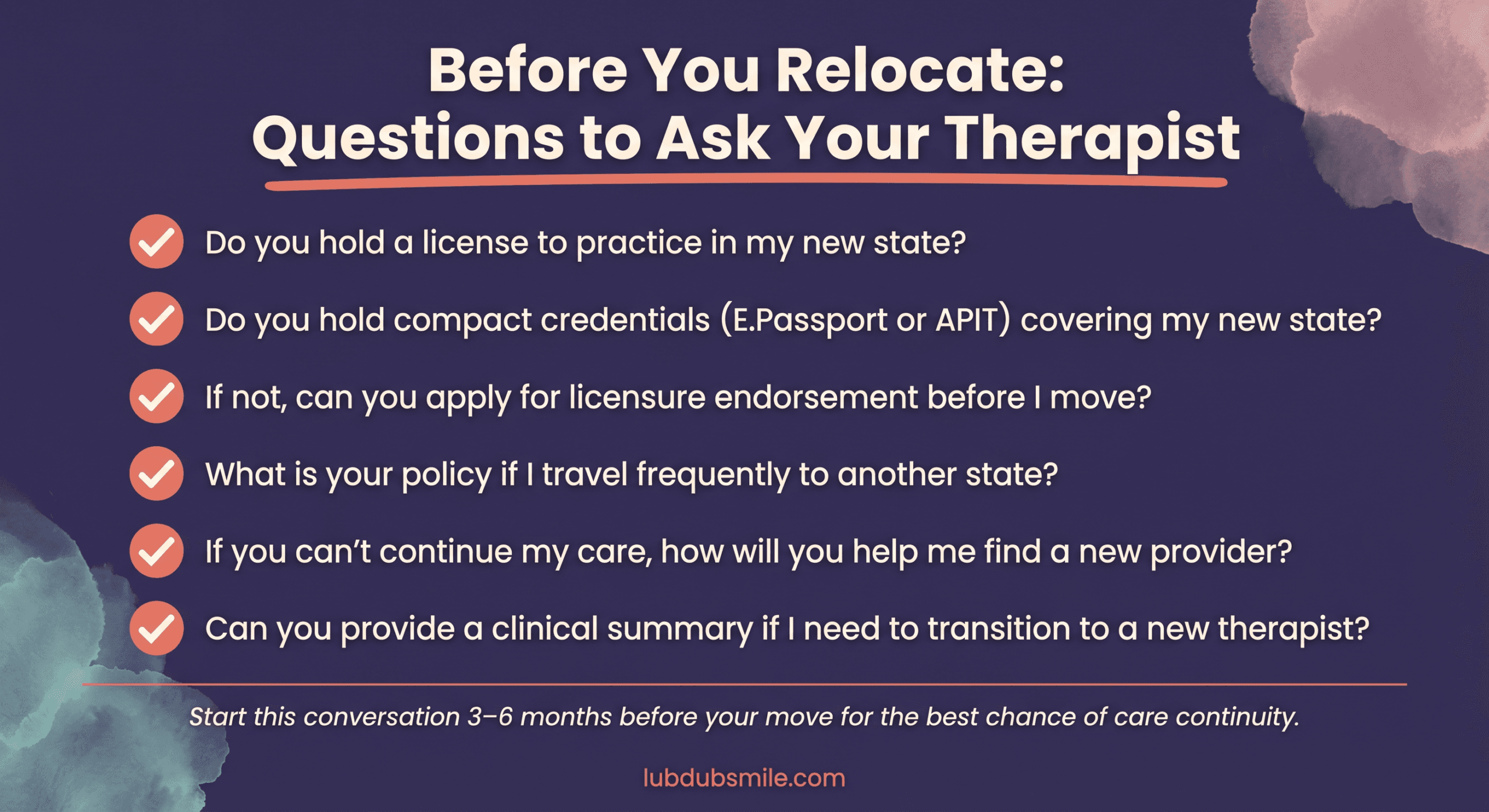
Questions to Ask Your Current Therapist Before Relocating
Bring these questions to your therapist proactively:
- “I’m moving to [state]. Do you hold a license or compact credentials there?”
- “Which compact do you hold credentials for, if any, and does it cover [new state]?”
- “If you can’t continue seeing me in [new state], what process do you follow for connecting me with a new therapist?”
- “How far in advance do I need to let you know about my move for us to plan care continuity properly?”
- “If I travel frequently to [state], can we still have sessions when I’m there?”
How to Verify Your Therapist’s Licensure in Your New State
You don’t have to rely solely on your therapist’s self-report. You can verify through multiple channels:
- Through your new state’s licensing board: Most states maintain online license verification tools where you can search for your therapist’s name and confirm whether they hold a valid license in that state
- Through compact organizations: PSYPACT and the Counseling Compact maintain practitioner lookup tools on their websites where you can search for therapists who hold compact credentials
- By asking for the license number: If your therapist says they hold a license in your new state, ask for the license number and verify it directly with the state board
What to Do If Your Therapist Cannot Continue Across State Lines
If licensing barriers prevent continuation of telehealth therapy across states:
- Ask for a referral: Your therapist likely knows colleagues or can access professional networks in your new state
- Request a clinical summary: A summary of your treatment history, presenting concerns, and therapeutic approach helps a new therapist start from context rather than from scratch
- Plan a termination session: A proper clinical termination (even if premature) is better than abrupt disconnection; it consolidates progress and provides emotional closure
- Search for therapists who hold compact credentials in both your previous and new state this provides flexibility if you spend time in both locations
- Contact your insurance: Your insurer’s behavioral health network can help identify therapists who hold in-network status and in-state licenses in your new area
For those who need to find a new provider quickly, our comparison of telehealth therapy platforms covers the major options in terms of cost, format, and how different platforms handle licensure verification, which is directly relevant when searching across state lines.
Finding Telehealth Therapy With Cross-State Licensing

How to Search for Compact-Credentialed Therapists
When beginning new therapy or planning for transitions, actively seeking therapists who hold compact credentials provides flexibility for the future.
Search strategies:
- PSYPACT practitioner directory: psypact.com maintains a directory of psychologists who hold APIT credentials
- Counseling Compact E.Passport search: The Counseling Compact website allows you to search for therapists who hold compact credentials
- Ask directly during consultation: When interviewing potential therapists, ask: “Do you hold compact credentials? Which states does your compact authorization cover?”
- Telehealth platforms: Some telehealth platforms specifically highlight compact credentials verify credential claims independently
Using Licensing Board Directories
Every state maintains a public licensing board directory where you can verify whether a specific therapist holds an active, current license in that state. These directories provide the most authoritative verification available.
Find state licensing board directories through:
- Your state’s official government website (search “[state] mental health licensing board”)
- The Association of State and Provincial Psychology Boards (ASPPB) at asppb.net for psychologist verification
- The National Board for Certified Counselors (NBCC) at nbcc.org for counselor verification
Questions to Ask a New Telehealth Therapist About Licensing
When starting with a new telehealth therapist, ask:
- “Do you hold a license to practice in my state, and can you verify that for me?”
- “Do you hold compact credentials, and if so, which states do they cover?”
- “If I travel to another state for work or family, how do you handle the licensing question for telehealth therapy across states?”
- “What is your policy if I relocate in the future?”
Accessing Therapy in Underserved and Rural States
For those in states with few local providers:
- Federally Qualified Health Centers (FQHCs): Provide mental health services on sliding-scale fees. Find locations at findahealthcenter.
- State telehealth programs: Many states operate state-funded telehealth programs for rural residents contact your state’s department of health
- Medicaid telehealth: Medicaid in most states now covers telehealth mental health services; contact your state’s Medicaid agency for current telehealth provisions
- 988 Suicide and Crisis Lifeline: For crisis situations, 988 provides immediate support regardless of state location
Discipline-Specific Considerations
Psychologists (PhD/PsyD): PSYPACT and State Licensing
PSYPACT allows psychologists who qualify to conduct telehealth therapy across states. Key specifics:
- Must apply for and obtain APIT credentials through PSYPACT Commission
- Must maintain a license in good standing in their home state
- Home state must be a PSYPACT member
- Client’s state must be a PSYPACT member
- APIT covers telepsychology specifically; in-person temporary practice requires separate TIDP authorization
- Cannot use PSYPACT when practicing from a state that has not joined, even if the client is in a member state
Verify PSYPACT status at: psypact.com
Professional Counselors (LPC/LPCC): Counseling Compact
LPCs and equivalent titles (LPCC, LCPC, LMHC varies by state) access telehealth therapy across states through the Counseling Compact. Key specifics:
- Must apply for E.Passport through the Counseling Compact
- Must hold a license in good standing in their home state
- Both home state and client’s state must be Counseling Compact members
- Title variations across states generally qualify, but verify with compact administration
- Counselors practicing in states that haven’t joined the compact cannot access compact benefits
Verify Counseling Compact status at: counselingcompact.com
Clinical Social Workers (LCSW): Social Work Compact
The Social Work Compact targets LCSWs as its primary discipline, but it sits in earlier stages of development and implementation than the counseling or psychology compacts. LCSWs should verify current compact status directly with the compact organization rather than relying on secondary sources for information on telehealth therapy across states.
LCSWs practicing in states where the compact hasn’t yet reached operational status must pursue individual state licensure endorsement for cross-state practice.
Verify Social Work Compact status at: socialworkcompact.org
Marriage and Family Therapists (LMFT): Current Landscape
As of January 2026, no operational nationwide interstate compact exists for LMFTs. LMFTs seeking to provide telehealth therapy across states must:
- Apply for individual licensure in each state where they practice
- Explore state-specific endorsement provisions
- Seek temporary practice permits where states offer them
The AAMFT has actively advocated for an MFT interstate compact. Monitor aamft.org for legislative developments.
Psychiatrists and Prescribers: Different Rules Apply
Psychiatrists hold medical degrees (MDs or DOs) and fall under different licensing structures than non-prescribing therapists. Key differences:
- State medical boards not mental health licensing boards issue psychiatric licenses
- The Interstate Medical Licensure Compact (IMLC) covers physicians, including psychiatrists, across member states
- The federal government administers DEA registration, but most states require separate controlled substance registration
Verify IMLC status at: imlcc.org
Nurse practitioners and physician assistants practicing psychiatry have their own compact mechanisms (APRN Compact and PA Compact respectively). Consult the prescriber directly about their multi-state prescribing authorization for telehealth therapy across states.
Resources for Navigating Licensure and Access
Official Compact Organization Websites
- Counseling Compact: counselingcompact.com member state list, E.Passport application, practitioner lookup
- PSYPACT: psypact.com member state list, APIT application, practitioner directory
- Social Work Compact: socialworkcompact.org current implementation status
- Interstate Medical Licensure Compact (for psychiatrists): imlcc.org
State Licensing Board Directories
- Association of State and Provincial Psychology Boards: asppb.net psychologist license verification
- National Board for Certified Counselors: nbcc.org counselor certification and license verification
- State government websites: Search “[state name] [discipline] licensing board” for direct verification
Federal Telehealth Resources
- SAMHSA Telehealth Resources: samhsa mental health and substance use telehealth information
- Health Resources and Services Administration (HRSA): hrsa.gov rural health and provider shortage information, FQHC finder
- CMS Telehealth: cms.gov Medicare telehealth coverage information
Mental Health Access Organizations and Hotlines
- 988 Suicide and Crisis Lifeline: Call or text 988 (available regardless of state location)
- Crisis Text Line: Text HOME to 741741
- National Alliance on Mental Illness (NAMI): nami.org mental health access information and helpline (1-800-950-NAMI)
- Mental Health America: mhanational.org mental health resources and access information
- Military OneSource: militaryonesource counseling services for military families with specific provisions addressing geographic mobility
When to Consult a Healthcare Attorney
Consider consulting a healthcare attorney if:
- Your therapist believes they have legal authority for telehealth therapy across states and you want independent verification
- You’re a therapist trying to determine your specific legal obligations in a complex situation
- An insurer has denied your coverage for telehealth therapy on licensure grounds and you want to challenge the denial
- A licensing board has initiated a complaint or inquiry related to cross-state practice
Frequently Asked Questions
Can my therapist see me via telehealth if I temporarily move?
It depends on the duration, the states involved, your therapist’s discipline, and whether compact credentials cover both states.
For short temporary absences (a few days), some therapists and licensing boards take a permissive interpretation. For extended periods (weeks, months), most licensing authorities would consider your current physical location as the practice state, requiring your therapist to hold authorization there.
No bright-line rule universally defines how long “temporary” lasts before licensing requirements fully apply for telehealth therapy across states. Discuss directly with your therapist and, if needed, contact the state licensing board in your temporary location.
What happens if my therapist sees me without proper licensure?
Potential consequences for your therapist include licensing board complaints and disciplinary action, civil liability, malpractice insurance complications, and regulatory penalties including cease-and-desist orders.
For the client, the primary risk is receiving care from someone who technically practices without authorization which could create issues if anything goes wrong. Proactive licensing verification protects both parties in any telehealth therapy across states arrangement.
Do compact rules cover all types of therapy sessions?
Coverage depends on the specific compact. PSYPACT covers telepsychology (telehealth sessions) specifically; in-person temporary practice requires separate TIDP authorization. The Counseling Compact covers both telehealth and in-person practice under the E.Passport. For the Social Work Compact, verify current scope with socialworkcompact.org.
How long does it take for a therapist to get a license in a new state?
Timeline varies significantly. Fast states process endorsement applications in 4–8 weeks. Many states take 2–4 months. Some states may take 4–6 months or longer. Applications require gathering documentation that can itself take weeks. Starting the process 3–6 months before a client’s anticipated move is the safest approach. Compact credentials generally take less time to obtain than full state licensure endorsement for telehealth therapy across states.
Does any federal law override state licensing for telehealth?
Currently, no federal law universally overrides state licensing requirements for mental health telehealth providers. Federal law influences VA providers (MISSION Act), Medicare billing rules, and military provider spouses (NDAA provisions), but no broadly operative law preempts state licensing requirements for private mental health providers conducting telehealth therapy across states as of January 2026.
What if I’m in crisis and can’t access my therapist across state lines?
If you’re experiencing a mental health crisis, your immediate safety takes priority over licensing considerations. Resources available regardless of state:
- 988 Suicide and Crisis Lifeline: Call or text 988 available across all states, 24/7
- Crisis Text Line: Text HOME to 741741
- Emergency services: Call 911 or go to your nearest emergency room for immediate safety concerns
Your therapist may also provide brief phone contact for safety purposes even if they cannot conduct formal sessions across state lines discuss with them what they can offer in crisis situations given licensing constraints around telehealth therapy across states. In the interim period between providers, structured self-directed tools such as those reviewed in our guide to CBT resources and worksheets can provide meaningful support while formal care access is being re-established.
Understanding the Limits of This Guide
This article provides educational information about telehealth therapy across states, therapy licensure reciprocity, and interstate compact frameworks as they exist as of January 2026. It is not legal advice. Licensing regulations are complex, state-specific, and subject to frequent change.
This guide cannot:
- Tell you whether your specific therapist holds authorization to practice in your specific state
- Guarantee that compact membership information reflects current operational status
- substitute for verification with actual licensing boards
- Provide legal analysis of your individual situation
This guide can:
- Explain how interstate compact frameworks work conceptually
- Identify which compacts cover which disciplines
- Explain what to ask and where to verify
- Help you navigate the conversation with your therapist proactively
For every important decision about your care, verify with official sources:
- Verify compact membership at official compact websites (counselingcompact.com, psypact.com, socialworkcompact.org)
- Verify your therapist’s license in your new state through the state licensing board’s public verification tool
- Ask your therapist directly whether they hold compact credentials
- Contact your new state’s licensing board for authoritative confirmation of current rules
- Check the date of any licensing information you read online this landscape changes frequently
If you’re experiencing mental health distress during a care transition, please reach out to the 988 Suicide and Crisis Lifeline (call or text 988) or Crisis Text Line (text HOME to 741741). Finding the right mental health tools and support during any transition can help bridge the gap while you secure continuity of care.
Takeaway Summary
Telehealth therapy across states operates within a complex patchwork of state licensing requirements and interstate compact frameworks the Counseling Compact (LPCs), PSYPACT (psychologists), and the emerging Social Work Compact (LCSWs) where therapists must hold active compact credentials and both the therapist’s home state and the client’s state must be members for cross-state practice to carry legal authorization, making proactive verification, early communication with your therapist before any relocation, and direct confirmation through official compact websites and state licensing boards the essential steps for protecting continuity of mental health care.
Important Notice: Therapy licensure reciprocity rules, interstate compact membership, and telehealth regulations change frequently. This guide reflects the regulatory landscape as of January 2026. Always verify current information with official licensing boards and compact organizations before making decisions about your care. This article is educational information, not legal advice.
This content is for educational purposes and does not substitute for professional psychological or therapeutic help.