


Taming Academic Anxiety: Shifting from Performance Pressure to a Learning Mindset
Picture the night before an exam at nearly any American campus green energy drinks lined up, study playlists looping, group texts half joke and half panic. Beneath the humor sits a sharper worry: If I don’t ace this, what does that say about me?
Performance pressure, the sense that every grade or evaluation predicts future worth, has become one of the most common stressors among U.S. students. The Stanford Center on Adolescence reports that over 60 percent of teens and young adults link self-esteem directly to academic outcomes. That bond might boost short-term grit. However, long-term, it fuels anxiety, procrastination, and burnout.
Two research-based approaches Growth Mindset and Cognitive-Behavioral Therapy (CBT) offer a healthier formula for success: replacing proof-seeking with progress-tracking.
How a Growth Mindset Changes the Game
Psychologist Dr. Carol Dweck of Stanford University defines a growth mindset as believing abilities can expand through effort and strategy. The opposite fixed mindset views intelligence or talent as set traits.
Under pressure, a fixed thinker asks, “Am I smart enough?”
A growth thinker asks, “What can I learn from this attempt?”
That small shift doesn’t just sound nicer it changes physiology. Stanford MRI studies found that students primed with growth-mindset messages activated stronger neural learning networks. Moreover, they showed lower anxiety responses during challenges.
When you treat mistakes as data, not drama, the body relaxes enough to learn. This principle connects with emotional regulation skills shifting from reactive panic to intentional response.
What CBT Teaches about “Performance Panic”
Where Dweck looks at belief systems, Cognitive-Behavioral Therapy handles the minute-to-minute panic loop:
- Trigger → 2. Automatic Thought → 3. Emotion → 4. Behavior.
Example: Trigger: tough calculus problem.
Thought: “I’m going to fail this exam.”
Emotion: racing heart, dread.
Behavior: avoid studying.

CBT breaks this spiral by questioning the thought’s validity and replacing it with something balanced:
“This problem is hard, but every practice session improves my accuracy.”
Repeated reappraisal turns reaction into response a crucial self-regulation skill for exam seasons and beyond.
Reframe the Goal: Mastery over Metrics
After each assignment, list one skill you improved rather than the points earned. Maybe you clarified thesis sentences or timed essays better.
Stanford classroom research shows that when instructors emphasize learning goals over performance goals, students’ enjoyment rises and anxiety drops. You can internalize the same mindset privately, even if the grading system doesn’t. This approach aligns with defining enough and self-compassion measuring growth by internal progress, not external validation.
Run a “Thought-Check Drill”
Before an exam or presentation, grab a scrap of paper and note every worrisome prediction. Opposite each one, write a neutral or humorous counter-fact.
- “Everyone else understands this.” → “Everyone else feels some panic too.”
- “I’ll blank out.” → “I’ve blanked before and still finished.”
- “If I don’t get an A, I’m a waste.” → “My grade is feedback, not identity.”
CBT research at the APA’s Division 12 (Clinical Psychology) shows that labeling irrational thoughts reduces physiological stress responses within minutes.
Use Challenge Cues, Not Threat Cues
Before high-pressure moments, say to yourself: “My body’s energy is helping me focus.” This phrase converts the adrenaline surge what feels like anxiety into fuel for performance.
Stanford Mind & Body Lab experiments confirm that reinterpreting arousal as readiness improves test outcomes. Specifically, this helps women and first-generation students facing stereotype pressure.
Adopt “The 30-Minute Learning Burst”
During big projects, alternate focused study with a quick reset: stretch, walk, snack, breathe. Mixing movement with intention converts rest into synaptic integration time. Harvard cognitive data show memory consolidation spikes after brief physical breaks.
Plan these bursts ahead so recovery feels proactive, not guilty. Similarly, micro-moments of calm throughout the day reset your nervous system between demanding tasks.
Swap Comparison for Curiosity
Scrolling classmates’ highlight reels on LinkedIn or TikTok distorts perspective. Replace “They’re ahead of me” with “What’s something I can learn from their approach?”
Growth-mindset thinking thrives on curiosity. Studies from the Stanford Center on Adolescence demonstrate that curiosity-driven goals produce longer endurance through academic difficulty. Furthermore, they yield higher satisfaction even under identical workloads.
Practice Self-Compassion Before, Not After, Mistakes
Most students offer kindness only once failure is undeniable. Try reversing the order: begin study sessions with a minute of calm affirmation:
“Learning is allowed to be messy. I can work hard and stay kind.”
This preemptive reassurance blends CBT’s cognitive reframing with Dr. Kristin Neff’s Self-Compassion Theory (UT Austin). It strengthens confidence before challenge, preventing panic instead of patching it. This protective practice supports the same daily habits found in emotional hygiene.
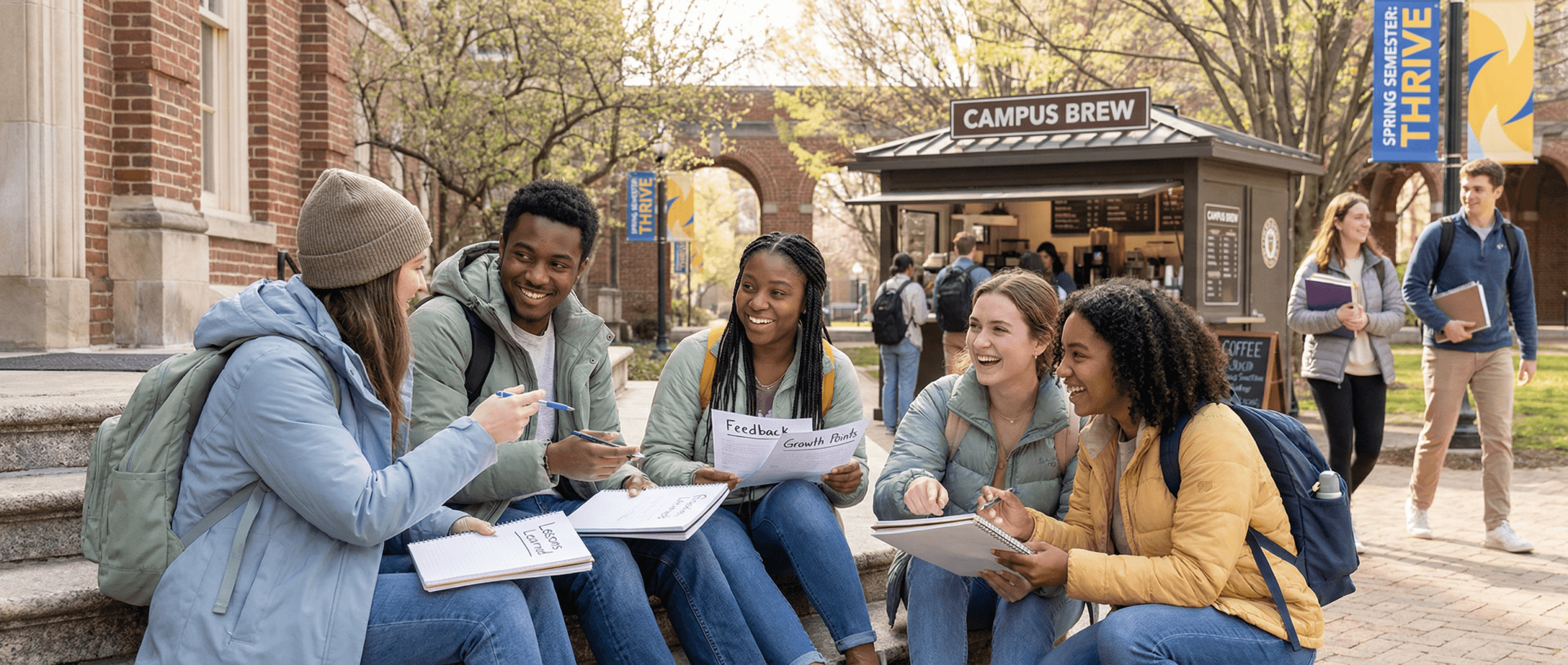
Keep a “Lessons Log”
For each test or paper returned:
- Record what strategy worked.
- Name one adjustment for next time.
- Add one line of gratitude: “I stayed with it through fatigue.”
Neuroscientists call this error-based learning encoding. You’re teaching the brain that reviewing mistakes equals growth a powerful antidote to avoidance.
Beyond Grades: Learning as a Lifelong Habit
College ends, but evaluative culture follows into performance reviews, parenting, leadership. The ability to switch from “What if I fail?” to “What can I learn?” stays invaluable.
The APA’s Stress in America (Students) survey shows that undergrads who cultivate mastery focus feel greater control, stronger motivation, and fewer sleep disturbances than peers fixated on ranking.
Learning mindset, then, isn’t just a semester hack it’s mental-health armor for adult life. Indeed, these skills support the broader framework discussed in College Mental Health Thriving Strategies designing routines that absorb stress efficiently rather than reacting to crises.
Takeaway
Growth Mindset: Treat ability as evolving, not fixed.
CBT Tools: Catch catastrophic thoughts; replace with truthful ones.
Challenge Reframes: Anxiety = energy ready for use.
Measure progress by skills learned, not scores earned.
Practice self-kindness early before you need comfort.
Academic pressure will never disappear, but its meaning can. When performance becomes a stage for learning rather than for proving worth, anxiety transforms from obstacle to ally.
This content is for educational purposes and does not substitute for professional psychological or therapeutic help.