

Morning Routines of High Performers: What Successful People Actually Do (And What’s Just Hype)
The morning routines of high performers have become the subject of endless fascination, promising that adopting the right habits will unlock success. You’ve seen the articles: wake up at 5 a.m., meditate for 20 minutes, cold plunge, green smoothie, journal, workout—all before most people hit snooze. The promise is seductive, suggesting that copying these practices will transform your productivity and achievement.
However, here’s what those articles rarely mention: the person profiled probably has household help, a flexible schedule, no caregiving responsibilities, and the financial security to design their ideal day. Additionally, they don’t mention the hundreds of successful people who wake up at 7 a.m., skip breakfast, or check email first thing without guilt.
The truth about morning routines of high performers is far more interesting and more useful than the mythology. When you examine what behavioral science actually says about habits, energy management, and performance, a different picture emerges. This reality is less about rigid rules and more about intentional design based on individual biology, circumstances, and goals.
This article separates evidence from hype, explores what actually matters in morning routines, and helps you build sustainable practices that support your energy and focus not someone else’s idealized Instagram version of productivity.
Separating Fact from Fiction: What We Actually Know About Morning Routines of High Performers
The Mythology of the “5AM Club” and Billionaire Routines
The internet loves a good morning routine story, especially when it involves a famous entrepreneur waking before dawn. Yet these narratives are highly selective. For every CEO who wakes at 5 a.m., another successful person sleeps until 8 a.m. or works late into the night because that’s when their brain functions best.

When researchers actually study successful people across industries not just the ones who write books about their routines they find tremendous variation in wake times, morning practices, and daily structures. What gets publicized tends to be the most extreme or unusual habits because they make better stories, not because they’re more effective.
Correlation vs. Causation: Morning Habits Don’t Create Success
This distinction is perhaps the most important thing to understand: a successful person’s morning routine didn’t make them successful. Their success came from talent, opportunity, timing, privilege, hard work, and countless other factors. The morning routine is something they do, but it’s not why they succeeded.
When someone wealthy and accomplished describes their morning meditation practice, they’re describing a correlation, not a cause. Many people meditate every morning and aren’t billionaires. Conversely, many billionaires don’t meditate at all. The habit may support their wellbeing and focus, but it didn’t create their success.
This understanding matters because it frees you from the pressure to replicate someone else’s exact routine in hopes of replicating their results. Instead, you can focus on what actually supports your energy, focus, and wellbeing regardless of whether it matches what famous entrepreneurs do.
What Behavioral Science Actually Says About Morning Routines
Behavioral psychologists who study habit formation have identified what makes routines stick, and it’s not willpower or elaborate multi-step sequences.
Research from scientists like BJ Fogg and Wendy Wood shows that habits form best when they’re:
- Small and achievable rather than ambitious and complex
- Anchored to existing routines (what Fogg calls “habit stacking”)
- Immediately rewarding in some way, even if the reward is just feeling good
- Consistent in context (same time, same place, same cue)
This evidence suggests that a simple, consistent routine you can actually maintain matters far more than an elaborate routine you do perfectly for two weeks before abandoning.
Why Cookie-Cutter Routines Ignore Individual Differences
People vary enormously in their chronotypes the natural biological preference for when you sleep and when you’re most alert. Some people genuinely are morning larks, energized at dawn. Others are night owls who think clearly late at night. Most people fall somewhere in between.
Sleep scientists have found that chronotype is largely genetic and difficult to change. When night owls force themselves into early-bird schedules, they often function below their potential and sacrifice sleep quality in the process. The same applies in reverse for morning people trying to stay up late.
Consequently, any advice that ignores chronotype and tells everyone to wake up at the same time is ignoring fundamental human biology.
The Privilege Often Invisible in “Ideal” Morning Routine Discussions
When someone describes their leisurely two-hour morning routine, they’re often not mentioning the circumstances that make it possible:
- A partner who handles morning childcare
- Household help that manages breakfast and getting kids ready for school
- Financial security that allows flexible work schedules
- No long commute eating into morning time
- Good health and energy levels
- Living situation that allows quiet, uninterrupted time
This doesn’t mean their routine isn’t genuinely helpful to them. Rather, it means the routine may not be replicable for someone with different circumstances. A single parent working two jobs doesn’t have the same morning possibilities as a CEO with a personal assistant, and that’s not a personal failing it’s reality.
Recognizing this helps you build routines based on your actual life, not someone else’s privileged ideal.
Evidence-Based Principles in Morning Routines of High Performers
While specific practices vary widely, certain underlying principles do appear consistently among people who perform well sustainably.
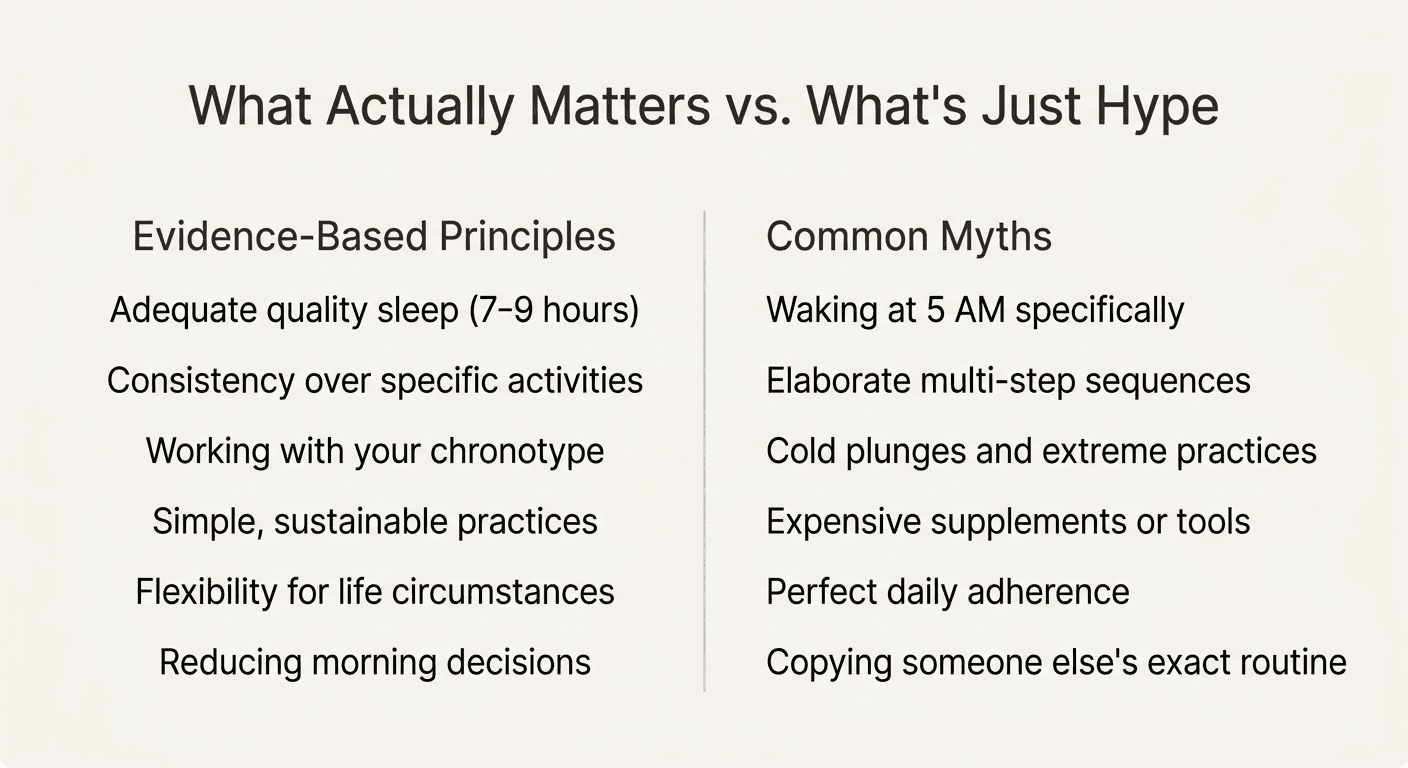
Consistency Over Perfection: Why Routine Itself Matters
The value of a morning routine isn’t necessarily in the specific activities it’s in the predictability and structure. When you follow a consistent sequence, you reduce decision fatigue and create a sense of control before your day becomes reactive to others’ demands.
Behavioral research shows that routines work partly because they reduce the cognitive load of constant decision-making. When your morning unfolds in a predictable pattern, your brain can conserve energy for more important decisions later.
Therefore, a simple routine you do every day drink water, shower, get dressed, eat breakfast proves more valuable than an elaborate routine you attempt inconsistently.
Protecting Sleep: High Performers Prioritize Rest, Not Just Early Rising
Despite the mythology around 5 a.m. wake-ups, research on high performers across fields shows that most prioritize sleep quality and adequate sleep duration. Matthew Walker’s extensive sleep research demonstrates that sleep is foundational to cognitive function, emotional regulation, creativity, and decision-making.
Many successful people do wake early, but they also go to bed early enough to get 7-8 hours of sleep. Those who don’t often pay a performance cost they might not recognize, or they compensate with naps, caffeine, or other strategies that aren’t part of the morning routine narrative.
The evidence is clear: sacrificing sleep to wake earlier rarely improves performance. Instead, it typically degrades it. Building morning routines for well-being without the 5 a.m. hype means respecting your sleep needs first.
Decision Reduction: Minimizing Morning Cognitive Load
High performers often streamline mornings to reduce decisions. This approach might look like:
- Wearing similar clothes every day (reducing “what to wear” decisions)
- Eating the same breakfast regularly
- Following a set sequence of activities
- Preparing what they can the night before
This isn’t about robotic efficiency it’s about preserving mental energy for decisions that actually matter. Decision fatigue is real, and each choice you make depletes a finite cognitive resource. When you automate routine decisions, you have more capacity for creative and strategic thinking.
Energy Management Before Task Management
Rather than cramming their mornings with tasks, many high performers think about energy management. They ask: What helps me feel energized and focused? What drains me?
For some people, that means movement first thing. For others, it means quiet time before engaging with information or other people. Still others prefer diving straight into focused work while their mind is fresh.
The specific answer matters less than the awareness of what affects your energy and the intentional design around it. Understanding anxiety vs. overwhelm can help you identify whether your morning struggles stem from genuine anxiety or simply feeling overloaded.
Intentional Time Blocks vs. Reactive Morning Scrolling
One pattern that does appear consistently among the morning routines of high performers is some form of intentional time before reactive engagement with email, news, or social media.
This doesn’t necessarily mean zero phone use or strict digital detox. Instead, it means choosing how to spend the first portion of your day rather than immediately responding to others’ agendas. For some people, that’s 10 minutes. For others, it’s two hours. The duration matters less than the intentionality.
Research on attention and focus supports this approach: when you start your day in reactive mode, you’re more likely to stay reactive all day. When you begin with intention even briefly you set a different tone. Practicing screen-time detox strategies can support this shift toward intentional mornings.
Morning Practices That Support Long-Term Sustainability (Not Burnout)
Perhaps most importantly, high performers who maintain their performance over years and decades tend to have routines that are sustainable, not exhausting.
This means:
- Routines that flex when life demands it (sick kids, travel, health issues)
- Practices that feel energizing, not like another obligation
- Habits that support rest and recovery, not just output
- Willingness to adjust when something stops working
The people who burn out are often those who treat morning routines as rigid performance tests rather than supportive structures. Understanding burnout recovery helps you recognize when your routine has become counterproductive.
The Science of Morning Timing and Chronotypes
Why “Early Bird” Isn’t Universally Better
Circadian rhythm research has thoroughly debunked the notion that morning people are more productive or successful. What studies actually show is that people perform best when they work during their biological peak hours and those hours vary considerably.
Night owls who work late and wake later can be just as productive and successful as early birds, as long as they’re working with their biology rather than against it. The problem is that many workplaces and cultural norms favor morning schedules, forcing night owls to function outside their optimal hours.
Understanding Your Chronotype (Natural Sleep-Wake Preference)

Chronotypes exist on a spectrum:
- Morning larks naturally wake early, feel alert quickly, and tire earlier in the evening
- Night owls naturally wake later, take longer to feel fully alert, and have energy later into the night
- Intermediate types fall somewhere in the middle with more flexibility
Your chronotype is largely genetic, though it does shift slightly with age. Teenagers tend toward night owl patterns, which shift earlier as people move into middle age and later life.
Understanding your chronotype helps you design realistic routines rather than fighting your biology.
How Sleep Quality Matters More Than Wake Time
Sleep scientists consistently emphasize that sleep quality and adequate duration matter far more than what time you wake up. Poor sleep whether from going to bed too late, waking frequently, or dealing with sleep disorders degrades cognitive function, emotional regulation, and physical health regardless of your wake time.
If you’re waking at 5 a.m. but only getting five hours of sleep because you stayed up late, you’re not optimizing your mornings you’re impairing your performance.
Circadian Rhythms and Performance: What the Evidence Shows
Research on circadian rhythms shows that cognitive function, physical performance, and creativity all fluctuate throughout the day based on your body’s internal clock. For most people, natural energy peaks and valleys occur predictably.
Interestingly, peak times for different types of tasks vary. Analytical work might peak in mid-morning for some people, while creative insight might come more easily in the afternoon or evening. Understanding your own patterns which requires paying attention over time allows you to structure your day around your biology.
When to Ignore the “Wake Up Earlier” Advice
You should be skeptical of advice to wake earlier if:
- You’re already sleep-deprived
- You’re a natural night owl being told to wake at 5 a.m.
- Earlier rising would require sacrificing sleep quality or duration
- Your evening responsibilities (caregiving, shift work) make early sleep impossible
- You have health conditions affecting sleep or energy
The goal isn’t to wake at a specific time it’s to get adequate, quality sleep and wake at a time that allows you to function well throughout your day.
Common Morning Practices in the Routines of High Performers (and the Evidence Behind Them)
Hydration First Thing (Simple but Physiologically Meaningful)
Drinking water upon waking is one of the most common and simplest practices among high performers. After hours without fluid intake, you’re naturally somewhat dehydrated, and even mild dehydration can affect energy and cognitive function.

This isn’t a magic productivity hack it’s basic physiology. Nevertheless, it’s genuinely helpful and costs nothing.
Movement and Exercise (Timing, Intensity, and Individual Variation)
Many high performers incorporate morning movement, but the specifics vary enormously:
- Some do intense workouts; others do gentle stretching or walking
- Some exercise first thing; others wait until mid-morning or afternoon
- Some prioritize it daily; others three to four times per week
Exercise science shows that the “best” time to exercise depends on your goals, chronotype, schedule, and what you’ll actually maintain. Morning exercise can be energizing for some people, but research doesn’t support universal claims that it’s superior to other times. The question of morning vs. evening workouts depends entirely on individual factors.
What does matter is regular movement in some form, at whatever time works for you.
Mindfulness, Meditation, or Quiet Reflection (What Studies Show)
Meditation and mindfulness practices appear frequently in the morning routines of high performers, and research does support cognitive and emotional benefits including improved focus, stress management, and emotional regulation.
However, the benefits come from regular practice, not necessarily from doing it in the morning specifically. Some people find morning meditation centers them for the day. Others prefer evening practice. Still others find walking or journaling more beneficial than formal meditation.
The evidence suggests that some form of intentional quiet or reflection is valuable, but the specific practice and timing can vary based on individual preference. Exploring micro-mindfulness for stress relief offers accessible starting points.
Strategic Caffeine Use (Timing Matters More Than You Think)
Many high performers are strategic about caffeine timing. Sleep scientists recommend waiting 90-120 minutes after waking to have coffee, allowing your natural cortisol awakening response to do its job first.
Drinking caffeine immediately upon waking can interfere with this natural process and potentially contribute to dependence. Waiting allows you to work with your biology rather than overriding it.
That said, if your current pattern is coffee first thing and it works for you, this isn’t something to stress about it’s simply an optimization some people find helpful.
Cold Exposure (Showers, Plunges): Examining the Claims
Cold showers and ice baths have become trendy in optimization circles. Some research does suggest potential benefits for alertness, stress resilience, and inflammation, but the evidence is more mixed than enthusiasts often claim.
Some people genuinely feel energized by cold exposure. Others find it miserable and derive no noticeable benefit. This is an area where individual response varies significantly, and the practice should be based on your experience, not influencer claims.
If you have cardiovascular issues or certain health conditions, sudden cold exposure can be risky. This is one practice worth discussing with a healthcare provider before adopting.
Journaling and Planning (Evidence for Intentional Thinking Time)
Writing in the morning whether journaling, planning, or brain-dumping thoughts is common among high performers and supported by research on cognitive offloading and goal clarity.
Writing helps externalize thoughts, reduce mental clutter, and create intention for the day. The specific format matters less than the practice of deliberately thinking about your day and priorities.
Some people prefer structured planning. Others do stream-of-consciousness journaling. Both can be valuable, depending on what serves your needs. Building emotional regulation skills through journaling can compound these benefits over time.
Nutrient-Dense Breakfast (Or Strategic Fasting): Individual Approaches
High performers vary widely in morning eating patterns. Some eat substantial breakfasts. Some do intermittent fasting and skip breakfast entirely. Some have coffee and eat later.
Nutrition science doesn’t support universal breakfast rules. Whether you should eat breakfast depends on your hunger cues, activity level, metabolic health, and what supports your energy throughout the day. Understanding smart snacking and energy balance can inform your approach.
Some people think clearly on an empty stomach. Others need food to function well. Pay attention to your own patterns rather than following someone else’s approach.
What the Morning Routines of High Performers DON’T Include (Debunking Common Myths)
Most Don’t Wake Up at 5AM (And Many Who Do Have Flexible Schedules)
Despite the prevalence of “5 a.m. club” rhetoric, research on high performers shows wake times across a wide spectrum. When researchers surveyed successful entrepreneurs and executives, they found morning routines ranging from 4:30 a.m. to 9 a.m.
Notably, many people with very early wake times either go to bed early enough to get adequate sleep, or they have schedule flexibility that allows for afternoon rest or recovery details that often get omitted from their morning routine narratives.
They Don’t Follow Rigid 90 – Minute Routines Every Single Day
The social media version of morning routines suggests unwavering daily commitment to elaborate sequences. In reality, most high performers adapt their routines to circumstances.
They might have an ideal routine for normal days and a compressed version for travel, busy periods, or when life intervenes. The consistency lies in the principles and key practices, not rigid adherence to identical timing every single day.
They Don’t Sacrifice Sleep for Morning Productivity
Despite narratives that sometimes glorify minimal sleep, sustained high performance requires adequate rest. High performers who succeed over decades generally prioritize sleep, even if that means waking later or occasionally skipping morning practices.
Those who do sacrifice sleep often pay a cost in health, decision-making quality, and creativity that may not be visible in their morning routine social media posts.
They Don’t Use Dozens of Productivity Tools and Apps
While some high performers use habit-tracking apps or productivity tools, many successful people use remarkably simple systems paper planners, basic to-do lists, or just mental routines.
The explosion of productivity apps and optimization tools often creates more complexity than value. The most effective routines are usually simple enough to maintain without technological scaffolding.
They Adapt Routines to Life Circumstances (Kids, Travel, Health)
Perhaps most importantly, sustainable high performers adjust their routines when circumstances change. New parent? The routine changes. Traveling across time zones? The routine adapts. Recovering from illness? The routine flexes.
Rigid adherence to routines regardless of context is more likely to create stress and guilt than sustainable high performance.
Building Your Own Evidence-Based Morning Routine
Start With Your Non-Negotiables (Sleep, Basic Needs)
Before designing an aspirational morning routine, ensure you’re covering basics:
- Adequate sleep (7-9 hours for most adults)
- Consistent sleep schedule aligned with your chronotype when possible
- Basic physical needs (hydration, nutrition, hygiene)
- Safety and stability (secure housing, financial basics)
If these aren’t in place, adding meditation or cold showers won’t meaningfully improve your life. Start with foundation, then build.
Identify Your Morning Energy Drains and Address Them
What makes your mornings feel chaotic or draining? Common culprits include:
- Deciding what to wear or eat
- Searching for lost items (keys, phone, work materials)
- Rushing because you didn’t leave enough time
- Immediately checking email or news and getting pulled into reactivity
- Conflicts with family members about morning responsibilities
Often, addressing one or two major drains creates more improvement than adding new practices.
Choose 1-3 Practices That Align With Your Goals and Values
Rather than adopting someone else’s entire routine, choose a few practices that genuinely support what matters to you:
- If you value creativity, maybe morning pages or a walk helps ideas flow
- If you value calm, maybe meditation or quiet coffee time before engaging with information
- If you value physical health, maybe movement or a healthy breakfast matters most
- If you value connection, maybe a brief check-in with your partner or kids sets the right tone
Start small. One practice done consistently proves more valuable than five practiced sporadically.
Experiment, Track, and Adjust Based on How You Feel
Treat routine-building as experimentation, not a commitment to someone else’s prescription.
Try something for two weeks and notice:
- How do you feel energy-wise throughout the day?
- Does this practice feel sustainable or like you’re forcing it?
- Are you actually doing it, or constantly skipping it?
- Is it creating value or just checking a “should” box?
Adjust based on honest feedback from your experience, not what you think you should be doing.
Build Gradually: Habit Stacking and Small Wins
BJ Fogg’s research on habit formation emphasizes starting tiny much smaller than you think necessary. Rather than “meditate 20 minutes every morning,” start with “take three deep breaths while coffee brews.”
Habit stacking linking new habits to existing ones creates powerful cues. For example:
- After I brush my teeth (existing habit), I’ll do 10 pushups (new habit)
- After I pour coffee (existing habit), I’ll write one sentence in my journal (new habit)
- While I wait for the shower to warm (existing habit), I’ll stretch for 30 seconds (new habit)
Small habits establish consistency. You can always expand once the pattern is established.
Plan for Disruption and Flexibility
Build routines with the assumption they’ll be disrupted. Have a “minimum viable routine” for chaotic days maybe just water and 5 minutes of quiet. Have a plan for travel. Have grace for yourself when illness or life circumstances throw everything off.
Flexibility makes routines sustainable long-term.
Morning Routines of High Performers in Different Life Situations
For Parents: Realistic Morning Practices With Kids
If you have young children, your morning routine exists around theirs. Realistic approaches include:
- Waking 15-30 minutes before kids (if that doesn’t sacrifice needed sleep)
- Having one personal practice before kid-focused morning begins

Morning routines of high performers rarely acknowledge the reality of parents managing children, schedules, and basic survival before work. - Building practices into family routines (morning walk together, breakfast conversation)
- Accepting that elaborate personal routines may not be feasible in this life stage
- Using evenings or other times for practices that matter to you


The fantasy of a serene two-hour morning routine while managing toddlers isn’t realistic for most parents, and that’s okay. Working parents juggling working mother fatigue need routines designed for their actual circumstances.
For Night Owls: Respecting Your Chronotype
If you’re a natural night owl:
- Don’t force early waking if your schedule allows later starts
- If you must wake early for work, prioritize sleep by going to bed earlier rather than adding morning activities
- Consider that your peak productive time might be late morning or afternoon, not dawn
- Use evenings for practices morning people do in the morning (reflection, planning, etc.)
- Advocate for flexible work arrangements if possible
Fighting your chronotype rarely works long-term. Design with your biology, not against it.
For People With Unpredictable Schedules
If your schedule varies shift work, on-call responsibilities, irregular hours consistency can come from practices, not timing:
- Build routines around “beginning of work day” rather than clock time
- Have practices tied to transitions (before work, after work) regardless of when those occur
- Keep your routine simple enough to do regardless of schedule
- Prioritize sleep consistency when possible, even if timing shifts
For Those Managing Depression or Chronic Fatigue
If you’re dealing with depression, chronic fatigue, or health conditions affecting energy:
- Keep routines extremely simple maybe just getting out of bed, basic hygiene, and one small practice
- Don’t compare yourself to “high performer” routines; your energy constraints are real
- Consider that professional support (therapy, medical care) may be more important than routine optimization
- Have compassionate flexibility for days when getting through basics is an achievement
- Work with healthcare providers on energy management strategies
Morning routine advice often implicitly assumes baseline health and energy. If that’s not your reality, different priorities apply. Knowing when to seek professional support for anxiety helps you recognize when routine changes aren’t enough.
For Remote Workers vs. Commuters
Remote workers face different challenges than commuters:
Remote workers may need routines that create clear boundaries between sleep and work, since there’s no commute providing transition time. Consider getting dressed, taking a brief walk, or having a workspace setup routine.
Commuters may need routines that prepare efficiently for leaving the house and use commute time strategically whether for podcasts, reading, meditation, or mental preparation.
The Evening Routine Connection
Why Night-Before Preparation Matters More Than Morning Willpower
Morning routines actually begin the night before. When you prepare in advance choosing clothes, packing lunches, gathering work materials, setting up coffee you remove morning decision points and friction.
This matters because willpower and decision-making capacity are lowest when you first wake. Relying on morning motivation to make good choices often fails. Preparation the night before works with your biology instead of against it.
Sleep Hygiene Basics That Support Better Mornings
The quality of your morning is largely determined by sleep quality, which is influenced by evening habits:
- Consistent bedtime (within 30 minutes most nights)
- Screen time limits before bed (blue light affects melatonin)
- Cool, dark sleeping environment
- Limited alcohol and caffeine in evening hours
- Stress management before sleep (not solving problems in bed)
These fundamentals affect how you feel upon waking more than most morning practices.
Evening Habits High Performers Use to Set Up Success
Common evening practices among high performers include:
- Brief planning for the next day
- Preparing what they can in advance
- Digital boundaries (email cutoff times, phone charging outside bedroom)
- Consistent wind-down routines
- Reflection on the day (what went well, what to adjust)
The specifics vary, but the pattern of intentional preparation is common.
The Sleep-Performance Connection You Can’t Optimize Away
No morning routine can compensate for chronic sleep deprivation. Sleep affects:
- Cognitive function and decision-making
- Emotional regulation
- Creativity and problem-solving
- Physical health and immune function
- Stress resilience
- Long-term health outcomes
If you’re sacrificing sleep to add morning practices, you’re undermining the foundation that makes everything else possible.
When Morning Routines Become Problematic
Recognizing Toxic Productivity and Optimization Obsession
Morning routines become problematic when they shift from supportive structure to performance anxiety:
- Feeling like you’ve failed if you don’t complete your routine perfectly
- Constantly adding new practices because what you’re doing never feels sufficient
- Comparing your routine to others and feeling inadequate
- Spending more time optimizing than actually doing meaningful work
- Using routines as procrastination or control when other areas feel uncertain
Routines should support your life, not become another source of stress and inadequacy.
When Routine Rigidity Creates More Stress Than Benefit
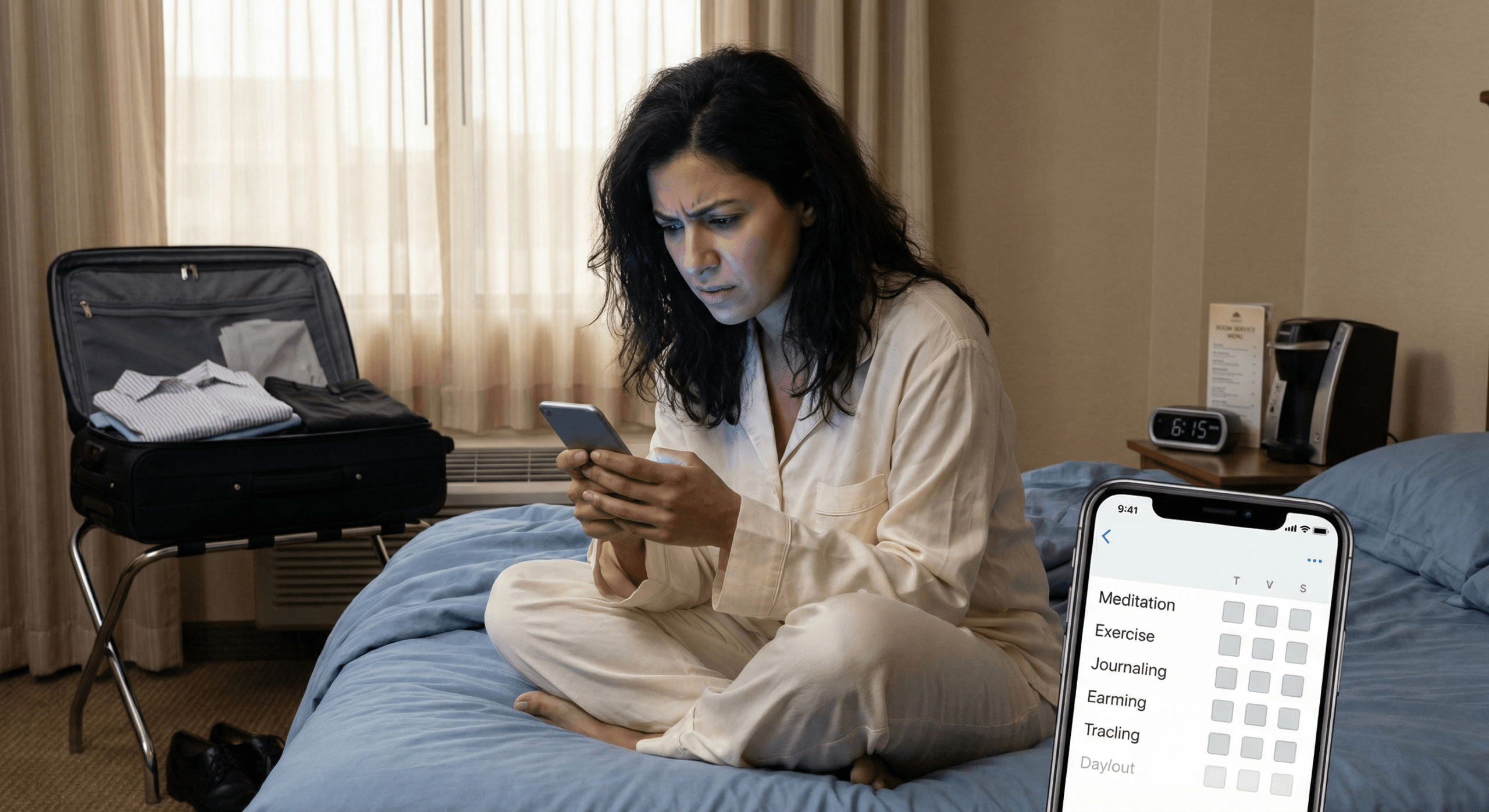
Some people become so attached to routines that any disruption creates anxiety. If you’re stressed about travel because it interrupts your routine, or if you can’t adapt when life circumstances change, the routine has become rigid rather than supportive.
Healthy routines flex. They’re tools, not rules.
Morning Anxiety and the Pressure of “Productive Mornings”
For some people, the cultural pressure around productive mornings creates anxiety about mornings themselves. If you wake up already stressed about whether you’ll accomplish your routine, something has gone wrong.
Morning practices should reduce anxiety and create groundedness, not add to your mental burden.
Balancing Aspiration With Self-Compassion
There’s a balance between aspiring to habits that support your wellbeing and beating yourself up for being human. You’ll miss days. You’ll go through periods where routines fall apart. You’ll discover practices that don’t work for you.
All of this is normal. Self-compassion matters more than perfect consistency. Practicing defining enough through self-compassion helps you maintain perspective.
The Habit Formation Science Behind Sustainable Routines
How Habits Form and Why Most Morning Routines Fail
Habits form through repetition in consistent contexts. They fail when they’re:
- Too ambitious (trying to change too much at once)
- Not anchored to clear cues
- Not immediately rewarding in some way
- Dependent on willpower rather than environmental design
Most morning routine failures aren’t personal failings they’re design problems.
The Role of Cues, Routines, and Rewards
Behavioral psychologist Charles Duhigg describes the habit loop: cue → routine → reward.
For morning habits:
- Cue: waking up, alarm, sunlight, coffee brewing
- Routine: the behavior you’re building (stretching, journaling, etc.)
- Reward: how you feel afterward (energized, calm, accomplished)
Making cues obvious and rewards immediate strengthens habit formation.
Why Willpower Isn’t the Answer (and What Is)
Research consistently shows that willpower is a limited resource that depletes throughout the day. Relying on willpower to maintain morning routines usually fails.
What works better:
- Environmental design (putting running shoes by your bed, setting up coffee the night before)
- Cue anchoring (linking new habits to established ones)
- Friction reduction (making good behaviors easy, removing obstacles)
- Starting small (building consistency before expanding)
Design your environment and routine to make desired behaviors easy and natural, not dependent on daily motivation.
How Long It Actually Takes to Build Morning Habits (Context-Dependent)
You’ve probably heard “21 days to form a habit” or “66 days on average.” The reality is more complex.
Research shows habit formation time varies enormously based on:
- Habit complexity (drinking water vs. 30-minute workout)
- Existing routines (adding to established patterns vs. creating new ones)
- Environment stability (predictable vs. unpredictable schedules)
- Individual differences
Simple habits in stable contexts might solidify in weeks. Complex habits or unstable environments might take months. What matters is persistence and adjustment, not hitting a specific timeline.
Resources for Building Sustainable Morning Habits
Evidence-Based Books on Habits and Routines
If you want to deepen your understanding of habit formation and sustainable routines, several evidence-based books are worth exploring:
Atomic Habits by James Clear synthesizes behavioral science research into practical frameworks for building habits and breaking bad ones. Clear emphasizes tiny changes, environmental design, and identity-based habits.
Tiny Habits by BJ Fogg draws on decades of behavioral research to present a method for behavior change that starts extremely small and builds gradually. His work challenges conventional wisdom about willpower and motivation.
The Power of Habit by Charles Duhigg explores the neuroscience of habit formation and provides frameworks for understanding and changing habits in personal and professional contexts.
Why We Sleep by Matthew Walker isn’t specifically about morning routines, but it’s essential reading for understanding why sleep quality matters more than wake time and how sleep affects every aspect of performance and health.
These resources can help you build routines based on evidence rather than influencer trends, though effective morning habits ultimately cost nothing these books simply deepen understanding.
Tracking and Reflection Tools (Optional Supports)
Some people find tracking helpful for building consistency. Options include:
- Simple paper calendars with checkmarks
- Basic habit tracking apps
- Morning pages or journaling
- Reflection questions at day’s end
Tracking is a tool, not a requirement. For some people, it provides helpful awareness and motivation. For others, it creates pressure and takes the joy out of practices. Experiment to see whether it serves you.
When to Work With a Coach or Therapist on Routine Building
Professional support may be valuable if:
- You’re struggling with depression, ADHD, or conditions affecting executive function
- You’ve repeatedly tried to build routines and feel stuck
- Morning anxiety or perfectionism is interfering with daily life
- You want personalized guidance on habit formation
- Underlying issues (trauma, chronic stress, health conditions) are affecting your mornings
Platforms like BetterHelp and Talkspace can provide individualized support that generic advice can’t, helping distinguish between routine design problems and deeper issues requiring different approaches.
Frequently Asked Questions About Morning Routines of High Performers
Do I really need to wake up early to be successful?
No. Wake time doesn’t determine success. What matters is getting adequate sleep, working during your peak energy hours (which vary by chronotype), and using your time intentionally regardless of when that time occurs.
Many successful people wake late. Many wake early. The correlation with success is coincidental, not causal. Design your schedule around your biology and responsibilities, not someone else’s wake time.
How long should a morning routine take?
There’s no universal answer. Your routine should be sustainable for your life circumstances. For some people, that’s 10 minutes. For others, it’s two hours.
Start with what you can actually maintain even if that’s just five minutes rather than forcing an elaborate routine you’ll abandon. You can always expand if and when circumstances allow.
What if I’m not a morning person?
Then don’t force yourself to become one. Respect your chronotype and design your most important activities around your natural energy patterns.
If you must wake early for work despite being a night owl, prioritize getting adequate sleep over adding morning practices. Consider that evening routines might serve you better than fighting your biology.
Should I do the same routine every single day?
Consistency helps habits form, but rigid adherence regardless of circumstances creates stress. Have a standard routine for normal days and simplified versions for travel, illness, or disruption.
The goal is supportive structure, not perfect performance.
What if I have kids and can’t control my mornings?
Then design routines around your reality, not an idealized child-free morning. This might mean one brief practice before kids wake, incorporating practices into family routines, or using other times of day for reflection and planning.
Parents’ mornings look different, and that’s not a failure it’s reality.
How do I stick with a morning routine when I travel?
Build flexibility into your routine so it can adapt. Have a minimal version that works anywhere maybe just hydration and five minutes of quiet. Prepare for routine disruption rather than expecting perfection.
Many high performers have travel-specific routines that differ from home routines.
Is it bad to check my phone first thing in the morning?
“Bad” is strong. Research does suggest that immediately going into reactive mode (email, news, social media) can set a reactive tone for your day. Many people find that intentional time before phone engagement helps them feel more grounded.
That said, individual circumstances vary. If checking your phone includes meaningful connection (texting a long-distance partner, checking on an aging parent), that’s different from doomscrolling news.
Experiment with both patterns and notice how they affect your energy and focus. Let your experience guide you rather than rigid rules.
Evidence-Based Takeaways and Important Context
What Actually Matters (and What Doesn’t) in Morning Routines of High Performers
Based on behavioral science and actual patterns among sustainable high performers, here’s what genuinely matters:
What matters:
- Adequate, quality sleep
- Some degree of morning consistency (reducing decision fatigue)
- Practices aligned with your values and goals
- Working with your chronotype and biology
- Sustainability over perfection
- Flexibility when circumstances change
What doesn’t matter:
- Specific wake time (unless dictated by your schedule)
- Following someone else’s exact routine
- Elaborate multi-step sequences
- Expensive tools, supplements, or programs
- Perfect daily consistency
- Matching “high performer” stereotypes
Morning routines are tools for supporting your energy and focus, not markers of virtue or determinants of success.
When to Seek Professional Guidance
Consider consulting healthcare providers or mental health professionals if:
- You have sleep disorders, chronic insomnia, or significant sleep problems
- You’re experiencing depression that makes mornings particularly difficult
- You have ADHD or executive function challenges affecting routine-building
- Chronic fatigue or health conditions are limiting your morning energy
- Morning anxiety is interfering with daily functioning
- You’re considering significant changes to sleep schedules or practices with health implications
Professional guidance can provide personalized support that takes your individual health and circumstances into account.
About the Resources We’ve Mentioned
LubDubSmile may earn a commission if you explore resources through our links, at no additional cost to you. Our guidance on morning routines is based on behavioral science and evidence about sustainable habits, not promotional relationships.
Effective morning routines require no purchases. The books we’ve mentioned provide deeper understanding of habit formation science, but the core practices consistency, adequate sleep, intentional time, working with your biology cost nothing.
We’ve prioritized free, evidence-based practices throughout this article because genuine optimization doesn’t come from products, programs, or expensive tools. It comes from understanding yourself and designing with intention.
Building Your Own Sustainable Approach
Your morning routine should support your life, not add pressure or become another source of inadequacy. Here’s how to build sustainably:
Start with sleep. No routine can compensate for chronic sleep deprivation. Protect your sleep first.
Know yourself. Your chronotype, energy patterns, responsibilities, and values should guide your choices, not someone else’s Instagram routine.
Start small. One practice done consistently beats five attempted sporadically. Build from there if you want.
Design for reality. Your routine should work with your actual life kids, commute, health, energy levels not an idealized version.
Be flexible. Routines that rigidly fail under disruption aren’t sustainable. Build in adaptation.
Measure what matters. Does your routine help you feel more energized and focused? Does it reduce morning stress? Those outcomes matter more than perfect adherence.
Morning routines aren’t the secret to success, and they’re not moral imperatives. They’re tools. Use them where they serve you. Modify or abandon them when they don’t.
Takeaway
The morning routines of high performers don’t create success they support energy, focus, and wellbeing when designed around individual biology, circumstances, and goals. Behavioral science shows that simple, consistent routines work better than elaborate sequences, sleep quality matters more than wake time, and sustainability requires flexibility. The most effective morning routine is one you can actually maintain, not one that sounds impressive on social media. Start with adequate sleep, design around your chronotype and real-life constraints, choose one or two practices that genuinely support you, and build gradually from there.
This content is for educational purposes and does not substitute for professional psychological or therapeutic help.