

When to Consider Professional Support for Anxiety: A Practical Guide for Adults
You’ve been managing your anxiety for months maybe years. You’ve tried breathing exercises, read self-help books, downloaded meditation apps. Some days are better than others, but lately, you’ve been wondering: Is this just how life feels for everyone, or is it time to talk to someone? This professional support for anxiety guide helps you answer that question with clarity and self-compassion.
That question alone is meaningful. When you’re asking yourself whether your anxiety warrants professional help, you’re already noticing that something isn’t quite working. And that awareness uncomfortable as it may be is actually valuable information. Recognizing when to seek professional support for anxiety is an important step toward better mental health.
This guide is designed to help you assess when professional support for anxiety might be beneficial. It’s not about diagnosing yourself or meeting some threshold of “bad enough.” It’s about recognizing patterns, understanding your options, and giving yourself permission to seek help if that feels right for you.
Understanding When Anxiety Becomes More Than “Normal Stress”
What “Normal” Anxiety Looks Like vs. When It’s Worth Exploring Further
Everyone experiences anxiety. It’s a natural response to uncertainty, challenge, or threat. Feeling nervous before a presentation, worried about a sick parent, or stressed during a busy work period these are all normal expressions of anxiety that typically resolve once the situation passes.
Anxiety becomes worth exploring further when it persists beyond the triggering situation, when it’s disproportionate to the actual circumstances, or when it begins to limit your life in noticeable ways. According to research from the National Institute of Mental Health, anxiety disorders affect nearly 20% of U.S. adults annually. Most people wait years before seeking treatment often because they’re not sure their experience “counts” as serious enough.
The distinction isn’t always clear-cut. Anxiety exists on a spectrum, and there’s no precise line between normal stress and something that could benefit from professional attention. But if your anxiety is consistently affecting your sleep, your relationships, your work, or your sense of wellbeing, that’s a meaningful indicator.
Why the Question “Is My Anxiety Bad Enough?” Is Already Important
If you’re questioning whether your anxiety warrants help, you’re already noticing that it’s taking up significant space in your life. That question itself Is this bad enough? suggests you’re experiencing enough distress to wonder about it.
Here’s something important to understand: you don’t need to reach a crisis point to benefit from professional support for anxiety. Therapy isn’t reserved for people who can’t function. Many people seek help because they’re functioning, but at a cost that’s become unsustainable. This connects to broader patterns discussed in building emotional regulation skills daily.
Common Reasons People Delay Seeking Help (and Why That’s Understandable)
There are many legitimate reasons people wait to pursue professional support for anxiety. You might believe you should be able to handle this on your own. You might worry about the cost, the time commitment, or what it would mean to identify as someone who “needs therapy.” You might come from a family or culture where mental health care carries stigma. Or you might simply be unsure whether a therapist would take your concerns seriously.
These barriers are real, and they make sense. Seeking help requires acknowledging vulnerability, allocating resources, and often confronting beliefs about self-reliance and strength. It’s understandable that people delay. But it’s also worth examining whether those barriers are protecting you or preventing you from feeling better.
The Myth of Needing to “Earn” Professional Support
There’s a pervasive belief that you need to reach some minimum threshold of suffering before you “deserve” professional help. This belief is both common and unhelpful.
Professional support for anxiety isn’t something you earn through suffering. It’s a resource available to anyone who feels their mental health could benefit from it. You don’t need a formal diagnosis, a crisis, or proof that you’ve tried everything else first. If anxiety is affecting your quality of life even if you’re still managing your responsibilities that’s reason enough to explore your options.
Clear Signs That Professional Support Could Help
When Anxiety Interferes with Daily Functioning
One of the clearest indicators that professional support for anxiety may be beneficial is when anxiety begins to interfere with your ability to do things that matter to you. This might look like:
- Avoiding work presentations or social events because the anticipatory anxiety feels unbearable

When daily tasks feel overwhelming and emotional exhaustion persists, professional support for anxiety can provide relief. - Struggling to concentrate on tasks because anxious thoughts keep interrupting
- Snapping at your partner or children because you’re constantly on edge
- Letting household responsibilities pile up because decision-making feels overwhelming

When you start organizing your life around avoiding anxiety rather than pursuing what you value, that’s a meaningful sign.
When Physical Symptoms Become Persistent or Concerning
Anxiety doesn’t just live in your mind it shows up in your body. Persistent physical symptoms can include:
- Waking up at 3 a.m. with racing thoughts most nights of the week
- Chronic muscle tension, headaches, or digestive issues with no clear medical cause
- Panic symptoms like chest tightness, rapid heartbeat, or difficulty breathing
- Health anxiety that leads to excessive doctor visits or constant symptom-checking online
If you’ve had medical tests that came back normal but you’re still experiencing these symptoms regularly, anxiety may be a significant factor. A mental health professional can help you understand the connection and develop strategies to address it. Understanding anxiety vs overwhelm differences can also provide clarity.
When Self-Help Strategies Stop Working (or Never Worked Well)
Self-help tools like breathing exercises, journaling, and mindfulness can be genuinely helpful for many people. But they’re not always sufficient on their own, particularly when anxiety has deeper roots or has been present for a long time.
If you’ve tried multiple self-help approaches without sustained relief, or if you have plenty of insight into why you’re anxious but can’t seem to change how you feel, that’s not a personal failing. It often means you could benefit from the more structured, personalized support that therapy provides. Resources like CBT worksheets for anxiety can complement professional treatment.
When Anxiety Is Affecting Your Relationships
Anxiety has a way of seeping into relationships. You might find yourself:
- Withdrawing from friends because social interaction feels exhausting
- Seeking constant reassurance from your partner, which strains the relationship
- Avoiding conflict to the point where resentment builds
Talking with trusted individuals can be a first step, but professional support for anxiety offers structured guidance. - Feeling irritable or short-tempered with people you care about
- Missing important events because anxiety kept you home


If people close to you have expressed concern about your stress level, or if you notice yourself pulling away from relationships that used to bring you joy, these are signs worth taking seriously. This connects to patterns explored in emotional safety in relationships.
When You’re Using Unhealthy Coping Mechanisms
When anxiety becomes chronic, many people develop coping strategies that provide temporary relief but create additional problems. These might include:
- Drinking alcohol most nights to quiet anxious thoughts
- Overworking to avoid being alone with your feelings
- Compulsive behaviors like excessive cleaning, checking, or organizing
- Avoidance patterns that are narrowing your life
These behaviors often start as reasonable attempts to manage distress. But when they become patterns that you feel you can’t control or that are creating their own consequences, professional support for anxiety can help you develop healthier alternatives.
When Anxiety Has Persisted for Months Without Improvement
Anxiety that lasts for weeks or months despite your best efforts to manage it may not resolve on its own. The American Psychological Association notes that persistent anxiety often responds well to evidence-based treatments like cognitive-behavioral therapy, particularly when it’s been present for an extended period.
If you’ve been “waiting it out” for several months and your anxiety hasn’t meaningfully improved or if it’s getting worse that’s a reasonable time to consider professional consultation.
Immediate Situations That Warrant Urgent Professional Help
Some situations require more immediate attention. If you’re experiencing any of the following, reaching out to a mental health professional, crisis line, or emergency services is important:
Panic Attacks That Feel Unmanageable or Are Increasing in Frequency
Occasional panic attacks can be managed with support. But if you’re having frequent panic attacks that are disrupting your ability to work, drive, or leave your home, professional intervention can help you regain stability.
Thoughts of Self-Harm or Suicide
If you’re having thoughts of harming yourself or feeling like life isn’t worth living, this is a crisis situation that requires immediate professional help. These thoughts are serious, and you deserve support right now.
If you’re in immediate danger, please call 911 or go to your nearest emergency room. You can also contact:
- 988 Suicide & Crisis Lifeline: Call or text 988 (available 24/7)
- Crisis Text Line: Text HOME to 741741
Severe Health Anxiety That’s Affecting Medical Care
If anxiety about your health is preventing you from seeking necessary medical care, or if you’re pursuing excessive testing despite reassurance from doctors, this pattern can be harmful and warrants professional mental health support.
Anxiety Severe Enough to Prevent Leaving Home or Working
When anxiety becomes so overwhelming that you’re unable to leave your house, go to work, or care for yourself, this represents a level of severity that requires professional intervention.
What Professional Support Actually Looks Like
Different Types of Mental Health Providers (Therapists, Psychologists, Psychiatrists)
Understanding your options can make the process less intimidating:
- Therapists/Counselors (LPC, LMFT, LCSW): Licensed professionals trained in talk therapy; most anxiety treatment happens with these providers
- Psychologists (PhD, PsyD): Doctoral-level providers who can provide therapy and psychological testing
- Psychiatrists (MD, DO): Medical doctors who can prescribe medication and provide therapy, though many focus primarily on medication management
What Happens in Therapy for Anxiety (Evidence-Based Approaches)

Therapy for anxiety typically involves evidence-based approaches such as:
- Cognitive-Behavioral Therapy (CBT): Helps you identify and change thought patterns and behaviors that maintain anxiety
- Exposure therapy: Gradually helps you face feared situations in a controlled, supportive way
- Acceptance and Commitment Therapy (ACT): Focuses on accepting anxiety while taking action aligned with your values
- Mindfulness-based approaches: Teaches skills to relate to anxious thoughts and feelings differently
Research consistently shows that these approaches can be highly effective for anxiety, though treatment looks different for each person based on their specific needs and circumstances.
Therapy, Medication, or Both: How Treatment Is Determined
Some people benefit from therapy alone, some from medication alone, and some from a combination. This decision is made collaboratively with your provider based on factors like:
- Severity and duration of your symptoms
- Your preferences and previous experiences
- Whether you’re experiencing depression or other conditions alongside anxiety
- Practical considerations like access to therapy
Only a qualified mental health provider can determine what approach makes sense for your situation. There’s no universal “right” answer.
Debunking Common Myths About Therapy for Anxiety
Myth: “Therapy is just talking about your feelings.”
Reality: Effective anxiety therapy is structured and skill-focused, not just venting.
Myth: “If I go to therapy, I’ll be on medication forever.”
Reality: Many people manage anxiety through therapy without medication, and when medication is used, it’s often not lifelong.
Myth: “Therapy only works if you had childhood trauma.”
Reality: Therapy helps people with all types of anxiety, regardless of their history.
Myth: “Once I start therapy, I’ll be dependent on it.”
Reality: Therapy is designed to give you tools you can use independently; many people complete treatment in months, not years.
Overcoming Common Barriers to Seeking Help
“I Should Be Able to Handle This Myself”
Self-reliance is valuable, but it has limits. You wouldn’t expect yourself to set a broken bone or perform your own dental work. Mental health care is healthcare, and seeking professional guidance when you need it is a sign of self-awareness, not weakness. This aligns with principles discussed in redefining strength beyond the unbreakable myth.
Concerns About Cost and Insurance
Cost is a real barrier for many people seeking professional support for anxiety. Options to explore:
- Check whether your insurance covers mental health services (many plans do under the Mental Health Parity Act)
- Ask about sliding scale fees (many therapists adjust rates based on income)
- Explore community mental health centers, which often offer low-cost or free services
- Check whether your employer offers an Employee Assistance Program (EAP), which typically includes free short-term counseling
For detailed cost information, see our therapy cost comparison guide.
Worry About Being Judged or Not Taken Seriously
Qualified mental health professionals are trained to take anxiety seriously at all levels of severity. They see people struggling with exactly what you’re experiencing every day. Your concerns won’t be dismissed or minimized and if you encounter a provider who makes you feel that way, you have every right to find someone else.
Cultural or Family Stigma Around Mental Health Care
Many cultures and families have complicated relationships with mental health care, often shaped by valid historical experiences, different frameworks for understanding distress, or values around privacy and self-sufficiency.
You can honor your cultural background while also making choices that support your wellbeing. Some people find it helpful to seek providers who share their cultural background or who have training in culturally responsive care.
“I Don’t Have Time” or “My Anxiety Isn’t Bad Enough”
Time is precious, and adding appointments to an already full schedule feels overwhelming. But consider this: if anxiety is taking up hours of your mental energy each week through worry, avoidance, or sleep disruption, therapy may actually give you time back.
As for whether your anxiety is “bad enough” there’s no minimum threshold. If it bothers you, it’s worth addressing.
Fear of Medication or Treatment Side Effects
Not everyone who seeks professional support for anxiety will be offered medication, and you always have the right to decline or discuss concerns. Treatment decisions should be collaborative, and a good provider will explain options, respect your preferences, and work with you to find an approach that feels right.
How to Take the First Step
Deciding Between In-Person and Online Therapy
Both formats can be effective. Consider:
In-person therapy may be preferable if you:
- Value face-to-face connection
- Have concerns about privacy at home
- Want options for more intensive treatment if needed
Online therapy may be preferable if you:
- Have limited time or transportation challenges
- Live in an area with few local providers
- Feel more comfortable starting therapy from home
- Want more flexible scheduling
Finding a Therapist Who Specializes in Anxiety
When looking for a provider:
- Search directories like Psychology Today or your insurance provider’s website
- Filter for providers who specialize in anxiety disorders
- Read profiles to get a sense of their approach
- Don’t hesitate to contact a few therapists to ask questions before committing
Using Your Insurance vs. Paying Out-of-Pocket
Check your insurance benefits first many plans cover mental health services with a copay. If you’re paying out-of-pocket, ask about:
- Session fees and payment plans
- Whether the provider can provide a “superbill” for potential insurance reimbursement
- Sliding scale options
Accessing Low-Cost or Free Mental Health Resources
If cost is prohibitive:
- Community mental health centers offer services on a sliding scale
- Employee Assistance Programs (EAPs) typically provide free short-term counseling
- University training clinics often offer reduced-fee services with supervised graduate students
- SAMHSA National Helpline (1-800-662-4357) can connect you with local resources
What to Expect in Your First Appointment
Your first session is typically an assessment where the therapist will ask about:
- What brought you to therapy
- Your current symptoms and how long they’ve been present
- Your history and current life circumstances
- Your goals for treatment
This is also your opportunity to ask questions, discuss treatment approaches, and assess whether you feel comfortable with this provider. It’s okay to “shop around” if the first therapist isn’t the right fit.
Questions to Ask Yourself When Deciding
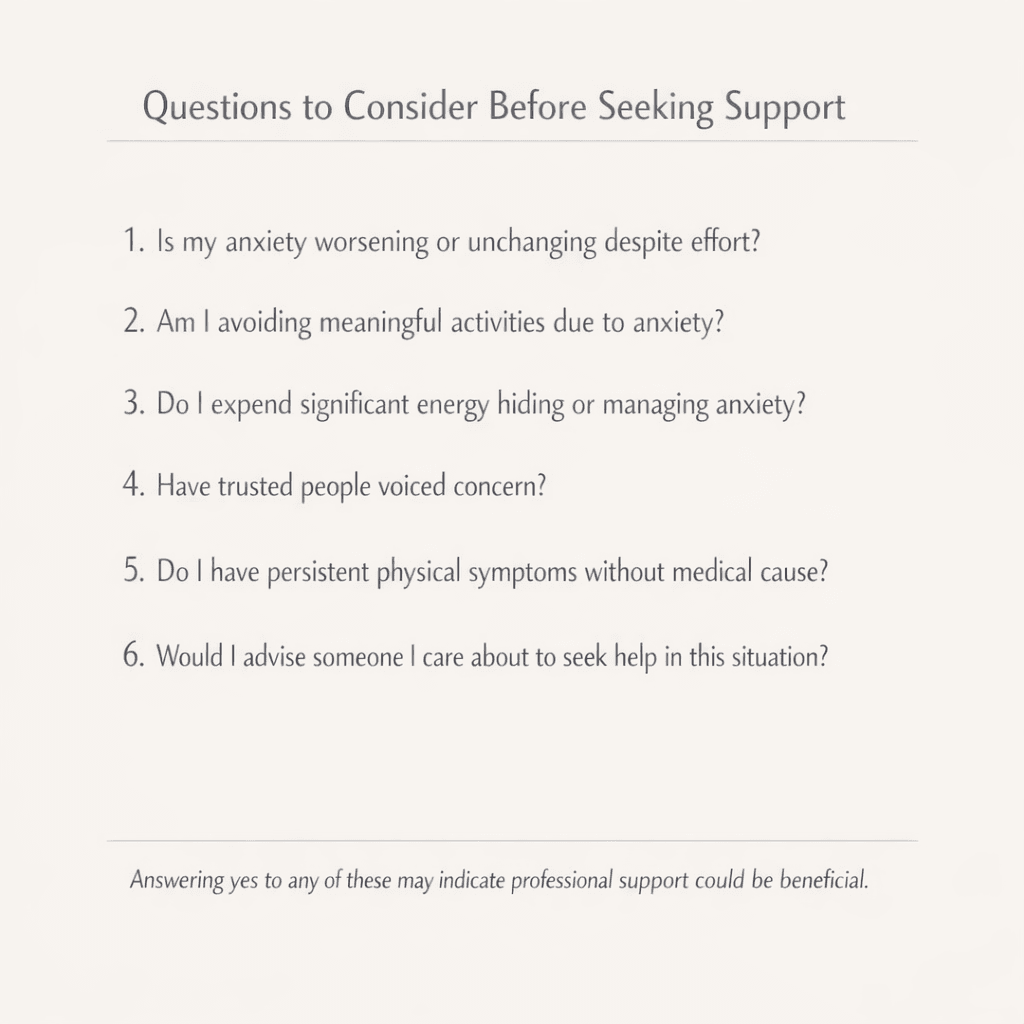
Sometimes it helps to step back and reflect on a few key questions:
Is my anxiety getting worse over time, or staying the same despite my efforts?
If you’ve been trying to manage anxiety on your own and it’s either not improving or getting worse, that pattern suggests professional support for anxiety could be beneficial.
Am I avoiding things that matter to me because of anxiety?
When anxiety starts making your world smaller when you stop seeing friends, decline opportunities, or avoid activities you used to enjoy that’s a sign it’s limiting your life in significant ways.
Do I spend significant mental energy managing or hiding my anxiety?
If you’re constantly monitoring your anxiety, working to keep it hidden from others, or exhausting yourself trying to appear “fine,” that invisible labor is meaningful and worth addressing.
Have people close to me expressed concern about my anxiety or stress?
Sometimes the people around us notice patterns we’ve normalized. If loved ones have mentioned concern more than once, it may be worth considering their perspective.
Am I experiencing physical symptoms I can’t explain medically?
If you’ve had medical evaluations that haven’t identified a cause for persistent physical symptoms, anxiety may be a contributing factor worth exploring with a mental health professional.
Would I recommend a friend in my situation seek help?
We’re often more compassionate toward others than ourselves. If you’d encourage a friend experiencing what you’re experiencing to talk to someone, that same encouragement applies to you.
Pathways to Professional Support
When you’re ready to explore your options, multiple pathways are available:
Online Therapy Platforms (Accessibility and Convenience)
Online therapy platforms like BetterHelp and Talkspace offer several advantages for people with time constraints, limited local options, or who prefer the convenience of remote sessions. These platforms typically:
- Match you with licensed therapists based on your needs
- Offer flexible scheduling, including messaging options
- Cost less than traditional in-person therapy in many cases
- Provide access to therapists across different states
These platforms can be a practical option for many people, though they’re one pathway among several. Consider your preferences, budget, and the level of support you need when deciding.
In-Person Therapists (Finding Providers in Your Area)
To find local therapists:
- Search Psychology Today’s therapist directory and filter by location, specialty, and insurance
- Contact your insurance company for a list of in-network providers
- Ask your primary care doctor for referrals
- Reach out to professional organizations like the Anxiety and Depression Association of America (ADAA)
Community Mental Health Centers and Sliding Scale Options
Community mental health centers are nonprofit organizations that provide mental health services regardless of ability to pay. Services are often offered on a sliding scale based on income, making them accessible to people without insurance or with limited resources.
Employee Assistance Programs (EAPs)
Many employers offer EAPs that include free, confidential short-term counseling (typically 3–8 sessions). Check with your HR department to see if this benefit is available to you.
Crisis Services and Immediate Support Resources
If you’re in crisis or need immediate support:
- 988 Suicide & Crisis Lifeline: Call or text 988 (24/7)
- Crisis Text Line: Text HOME to 741741
- SAMHSA National Helpline: 1-800-662-4357 (24/7, free, confidential)
Frequently Asked Questions About Seeking Help for Anxiety
How do I know if my anxiety is “bad enough” for therapy?
There’s no minimum threshold of suffering required to seek help. If anxiety is bothering you, affecting your daily life, or persisting despite your efforts to manage it, those are all valid reasons to consult a professional. When in doubt, an initial consultation can help you and a provider determine whether therapy would be beneficial.
Will my therapist think I’m wasting their time?
No. Mental health professionals understand that anxiety exists on a spectrum, and they see people at all levels of severity. Seeking help before reaching a crisis point is actually ideal it’s much easier to develop coping skills and address patterns early than after they’ve become deeply entrenched.
What if I try therapy and it doesn’t work?
Therapy isn’t one-size-fits-all, and not every therapist or approach will be the right fit for you. If you don’t see improvement after several sessions, it’s worth discussing this with your therapist or considering a different provider or approach. Many people benefit from therapy, but it requires finding the right match and approach for your needs.
Do I need to be diagnosed with an anxiety disorder to get help?
No. You don’t need a formal diagnosis to seek therapy or benefit from it. Many people work with therapists to manage stress, build coping skills, or navigate difficult periods without meeting criteria for a diagnosed disorder. Only a qualified mental health professional can provide a diagnosis, and treatment can be helpful regardless.
Can I stop therapy once I feel better?
Yes. Therapy doesn’t have to be lifelong. Many people work with a therapist for a specific period often several months to address particular concerns, learn skills, and then continue on their own. Some people return to therapy during stressful periods or life transitions. Your timeline is your own.
What’s the difference between a therapist and a psychiatrist?
Therapists (counselors, social workers, psychologists) provide talk therapy and help you develop coping strategies and address patterns in your thinking and behavior. Psychiatrists are medical doctors who can prescribe medication and often focus primarily on medication management, though some also provide therapy. Many people see a therapist for regular sessions and consult a psychiatrist if medication is being considered.
Important Information and Resources
Understanding the Purpose of This Guide
This article provides educational information to help you assess when professional support for anxiety may be beneficial. It is not a substitute for professional medical or psychological evaluation. Only qualified mental health professionals can diagnose anxiety disorders or determine the most appropriate treatment for your individual circumstances.
The signs and indicators discussed here are general guidelines drawn from clinical understanding of anxiety, not diagnostic criteria. Your personal experience, context, and professional assessment should guide your decisions about seeking help.
When to Seek Immediate Help (Crisis Resources)
If you are experiencing thoughts of self-harm, suicide, or are in immediate danger, please seek help right away:
- Call 911 or go to your nearest emergency room
- 988 Suicide & Crisis Lifeline: Call or text 988 (available 24/7, free, confidential)
- Crisis Text Line: Text HOME to 741741
- SAMHSA National Helpline: 1-800-662-4357 (free, confidential, 24/7 referral service)
These resources are available to you at any time, and reaching out is a sign of strength.
About Our Therapy Platform Recommendations
We recommend multiple pathways to care, and your choice should be based on your needs, preferences, and circumstances.
Online therapy platforms are one option among several. They may not be appropriate for everyone particularly those experiencing severe symptoms, crisis situations, or complex mental health needs. We’ve included a range of resources, both monetized and non-monetized, to help you find the pathway that makes the most sense for you.
Next Steps: Your Mental Health, Your Decision
Only you can decide when you’re ready to seek support. If you’ve recognized patterns in this article that resonate with your experience, consulting with a mental health professional can provide clarity about next steps whether that’s therapy, additional resources, or simply reassurance that what you’re experiencing is manageable.
Seeking help is not an admission of failure. It’s an investment in your wellbeing and a recognition that you deserve support. Your timeline is valid, and when you’re ready, many pathways are available to you.
Takeaway
Deciding whether to seek professional support for anxiety isn’t about reaching a specific threshold of severity it’s about recognizing when anxiety is affecting your quality of life and being open to exploring options that might help. Professional support for anxiety can take many forms, and no amount of suffering is required to deserve it. If you’re questioning whether you could benefit from help, consulting with a mental health professional can provide valuable clarity, whether or not you ultimately pursue treatment. Your wellbeing matters, and support is available when you’re ready.
This content is for educational purposes and does not substitute for professional psychological or therapeutic help.