


How to Stop Defensive Behavior During Conflict: A Framework for Adults
The moment your partner says “We need to talk about something,” you can feel it happening. Your chest tightens. Your jaw clenches. Before they’ve even finished their first sentence, some part of you is already building a case for why you’re not wrong, why they’re misunderstanding, why this criticism isn’t fair.
You know this pattern. You’ve seen the frustration on your partner’s face when, instead of hearing them, you launch into explanations or counterarguments, you’ve watched conversations that could have been simple become exhausting battles because you couldn’t stop defending yourself long enough to actually listen, and you’ve promised yourself you’d handle it differently next time, and then next time came and you reacted exactly the same way.
If you’re reading this, you’ve probably already done the hardest part: recognizing that your defensiveness is a problem. You’re not looking for someone to tell you that you’re just protecting yourself and everyone else is being too sensitive. You want to actually change. The challenge is that knowing you’re defensive and knowing how to stop defensive behavior during conflict are entirely different things.
Why You Become Defensive (And Why It’s So Hard to Stop)
Defensiveness, at its core, is protection. When you feel criticized, blamed, or attacked even when that’s not what’s happening your nervous system responds as though you’re in danger. This isn’t weakness or immaturity. It’s your brain doing exactly what it evolved to do: detect threats and mobilize responses.
Dr. Stephen Porges, who developed polyvagal theory, explains that our nervous system constantly scans for safety and threat cues, often below conscious awareness. When we perceive danger including social danger like criticism or rejection our bodies mobilize defensive responses before our thinking brain has a chance to evaluate the situation. This is why you can find yourself mid-defensive-reaction before you’ve consciously decided to respond that way.

The problem is that your brain isn’t great at distinguishing between physical threats and emotional ones. Criticism from your partner can activate the same fight-or-flight response as a physical attack. Your heart rate increases. Stress hormones flood your system. Your thinking brain the part that knows you should stay calm and listen gets partially hijacked by the part of your brain focused on survival.
Relationship researchers Dr. John Gottman and Dr. Julie Gottman, who have studied couples for over four decades at their research institute, identify defensiveness as one of the “Four Horsemen” communication patterns that predict relationship distress and, when chronic, divorce. In their research, they define defensiveness as “self-protection in the form of righteous indignation or innocent victimhood in an attempt to ward off a perceived attack.” The key word is “perceived” the attack often exists more in our interpretation than in what was actually said.
This is why knowing better doesn’t automatically translate to doing better. In the moment, you’re not operating from your rational mind. You’re operating from a threat response that’s faster than thought.
There’s an important distinction between defending yourself and being defensive. Defending yourself is calm, measured, and about sharing your perspective after you’ve genuinely heard the other person. Being defensive is reactive, immediate, and primarily about protecting yourself from the discomfort of criticism often before you’ve even fully understood what’s been said.
When you’re defending yourself, you can acknowledge what the other person is saying while also offering your viewpoint. When you’re being defensive, you’re not really listening at all. You’re building your case, looking for flaws in their argument, or shutting down entirely.
The origins of defensive patterns often trace back to childhood. Attachment researchers have documented how early experiences with caregivers shape our expectations about relationships and our responses to perceived threats within them. Dr. Sue Johnson, developer of Emotionally Focused Therapy and author of Hold Me Tight, explains that “the drama of distress in a relationship is really a primal panic about attachment about losing connection with a loved one.” When criticism triggers fear of losing that connection, defensive responses mobilize automatically.
If you grew up with critical parents, you may have learned that any admission of fault led to punishment or shame, if your family dealt with conflict through attack and counterattack, that became your template for how disagreements work, or if showing vulnerability was met with dismissal or ridicule, you learned to protect yourself by never letting anyone see you as wrong or inadequate.
Past relationships can reinforce these patterns too. If you were in relationships where partners used your admissions against you, where any acknowledgment of fault became ammunition for future fights, your defensiveness developed as reasonable protection. The pattern that’s causing problems now may have once been genuinely necessary for emotional survival.
Understanding where your defensiveness comes from isn’t about excusing it. It’s about recognizing that this pattern didn’t emerge from nowhere it served a protective function at some point. That understanding can help you approach change with self-compassion rather than self-criticism, which, ironically, makes change more possible.
Dr. Kristin Neff, whose research on self-compassion at the University of Texas at Austin has transformed how psychologists approach behavior change, has found that self-criticism actually undermines our ability to change, while self-compassion supports it. When we can acknowledge our patterns without harsh judgment, we’re more likely to have the emotional resources to do something different.
Recognizing Your Defensive Patterns

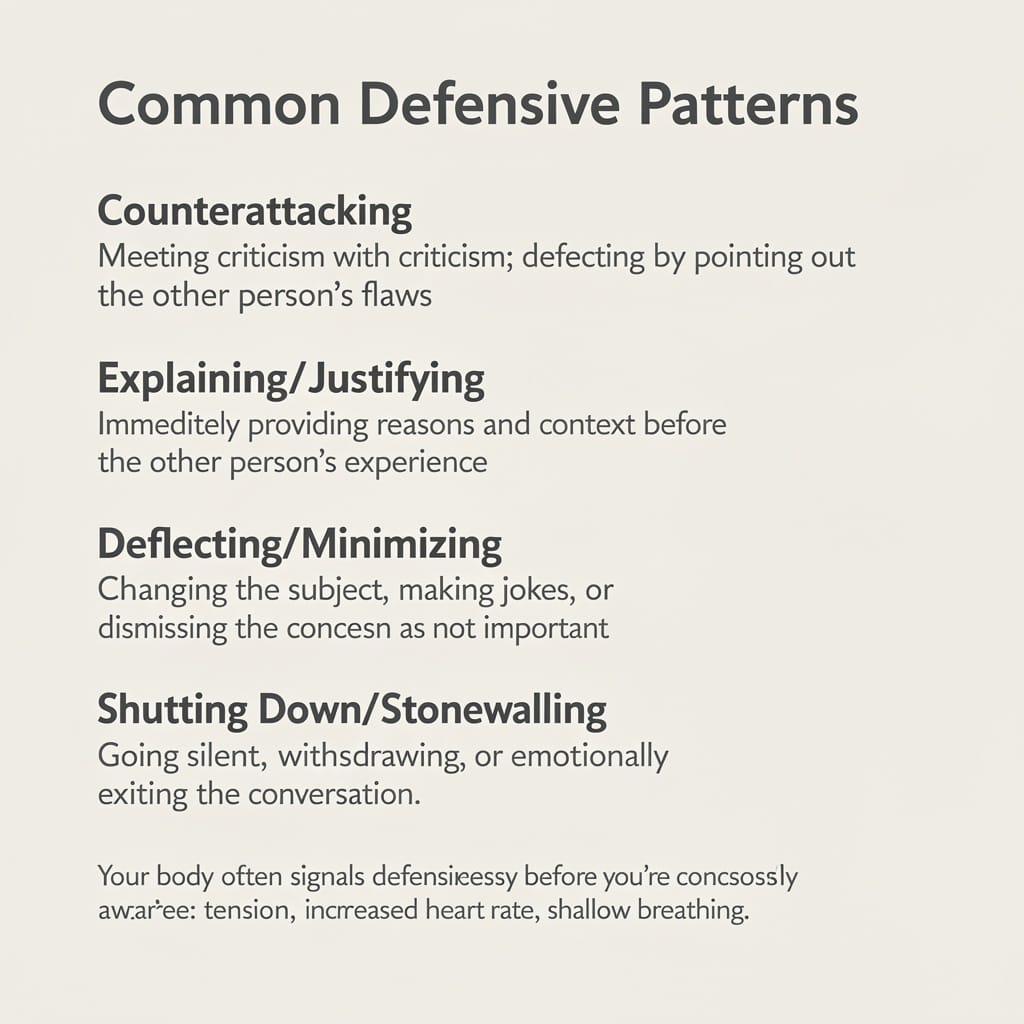
Stopping defensive behavior during conflict starts with recognizing when it’s happening. Defensiveness shows up in different forms, and most people have a primary style. The Gottmans’ research identifies several common manifestations, each of which serves the same protective function while looking different on the surface.
Some people counterattack meeting criticism with criticism, deflecting attention from themselves by pointing out the other person’s flaws. “I didn’t respond to your text? Well, you forgot to pick up groceries last week.” The conversation becomes about who’s more wrong rather than addressing the original issue. This pattern transforms what could be a simple conversation about one person’s hurt into an escalating battle where both people feel attacked.
Others deflect, changing the subject, making jokes, or minimizing the concern. “You’re upset about that? It’s not a big deal. Let’s talk about something else.” The goal is to escape the discomfort by refusing to engage with it seriously. While this might feel less aggressive than counterattacking, it communicates to your partner that their concerns don’t matter which can be just as damaging to trust over time.
The explaining style is particularly insidious because it feels like you’re being reasonable. You’re not attacking or deflecting you’re just explaining why you did what you did. “Yes, I was late, but there was traffic, and I had to finish that email, and I didn’t realize what time it was.” The problem is that launching into explanations before you’ve actually heard and acknowledged the other person’s experience communicates that their feelings don’t matter as much as your justifications.
Shutting down what the Gottmans call “stonewalling” is the final common pattern. You go silent, withdraw, or emotionally exit the conversation. You might still be physically present, but you’ve checked out. This can feel like you’re avoiding conflict, but it’s actually a form of defensiveness protecting yourself by becoming unreachable. Research from the Gottman Institute shows that stonewalling typically occurs when physiological flooding makes engagement feel impossible; heart rates exceed 100 beats per minute, and the capacity for productive conversation genuinely diminishes.
Your body often knows you’re becoming defensive before your mind does. Physical warning signs might include tension in your shoulders, jaw, or chest; increased heart rate; feeling hot; shallow breathing; or a sense of pressure building inside you. Learning to recognize these physical signals is crucial because they appear before the defensive behavior, giving you a window to intervene.
Pay attention to the internal narratives that precede your defensive reactions. These are the thoughts that flash through your mind in the moment: “That’s not fair.” “They’re always criticizing me.” “Here we go again.” “They don’t understand.” “I have to explain.” These thoughts aren’t always wrong, but they’re often the spark that ignites defensive behavior.
Notice your specific triggers. Certain topics might consistently trigger defensiveness your parenting, your work performance, your spending habits, certain delivery styles might feel particularly threatening raised voices, critical tones, absolute statements like “you always” or “you never” and certain people might trigger you more than others, often people whose opinions matter most to you. This makes sense from an attachment perspective: we’re most vulnerable to criticism from those we most need connection with.
Here’s something uncomfortable but important: what you intend when you’re being defensive and what others experience are often very different. You might feel like you’re simply sharing your perspective or providing context. What they experience is you dismissing their feelings, refusing to take responsibility, or making them feel unheard. The impact of your defensiveness matters, even when your intent isn’t hostile.
Learning to manage emotional hygiene can help you recognize these patterns before they escalate into conflict.
The Real Cost of Chronic Defensiveness
When someone knows that bringing up a concern with you will be met with counterattacks, explanations, or withdrawal, they eventually stop bringing things up. This might feel like peace, but it’s actually distance. Your partner learns that they can’t be honest with you about difficult things, so they share less and less of their inner world. The relationship becomes superficially smooth but emotionally hollow.
The Gottmans’ longitudinal research following couples over years and even decades has consistently found that defensiveness is one of the strongest predictors of relationship deterioration. In one study, they were able to predict divorce with over 90% accuracy based largely on the presence of the Four Horsemen during conflict conversations. Stopping defensive behavior during conflict isn’t just about smoother conversations it’s about preserving the foundation of trust relationships need.
Trust erodes over time. Each defensive interaction teaches your partner that you’ll prioritize protecting yourself over understanding them. They learn they can’t count on you to hear them, to take responsibility, or to work through problems as a team. Eventually, they may stop seeing you as someone they can truly rely on for emotional support.
Dr. Brené Brown, whose research on vulnerability and shame at the University of Houston has reached millions, describes this dynamic powerfully: “When we shut ourselves off from vulnerability, we shut ourselves off from connection.” Defensiveness is fundamentally a vulnerability-avoidance strategy. It protects us from the discomfort of acknowledging our flaws or mistakes, but the cost is the very connection we’re often trying to preserve.
The internal toll is significant too. Living in chronic defensiveness is exhausting. You’re always monitoring for threats, always ready to protect yourself. You might carry ongoing anxiety about when the next criticism will come. You might feel shame about your reactions, knowing you’re damaging relationships but feeling unable to stop. The very pattern that’s supposed to protect you ends up making you feel worse about yourself.
Understanding healthy conflict patterns in marriage can provide a framework for addressing these dynamics constructively.
The Pause: Your Most Powerful Tool
The single most important skill in stopping defensive behavior during conflict is creating space between the trigger and your reaction. In that space even if it’s just a few seconds you have the opportunity to choose a different response rather than defaulting to your automatic pattern.
This pause isn’t about suppressing your feelings or pretending you’re not upset. It’s about giving your nervous system a moment to downshift from threat response so your thinking brain can come back online. Without that pause, you’re reacting from a state where thoughtful responses aren’t available to you.
The neuroscience supports this approach. When your amygdala the brain’s threat detection center activates, it can temporarily impair the prefrontal cortex, which handles reasoning and emotional regulation. Taking even a few seconds to breathe and ground yourself allows the prefrontal cortex to come back online and resume its regulatory function.
Physical grounding techniques can help create that pause. Taking a slow breath, feeling your feet on the floor, or consciously relaxing your shoulders can signal to your nervous system that you’re not in immediate danger. These aren’t magic tricks they’re ways of giving your body information that counteracts the threat response. Porges’ polyvagal theory suggests that slow exhalation in particular activates the vagus nerve and promotes a calmer physiological state.
Sometimes you need to buy time verbally without dismissing the other person. Phrases that help include: “I want to understand what you’re saying. Let me take a moment to really hear this.” Or: “I notice I’m getting reactive. Can you give me a second?” Or simply: “Help me understand what you mean.” These phrases acknowledge that something important is happening while giving you space to regulate.
When you need more than a few seconds, it’s okay to request a break but how you do it matters. Saying “I’m done with this conversation” or walking away in frustration isn’t a pause; it’s avoidance. A productive break request sounds more like: “I’m getting too activated to respond well right now. I need twenty minutes to calm down, and then I want to come back to this.” The key is committing to return and actually doing so.
The Gottmans recommend taking at least twenty minutes for a break when physiologically flooded because research shows that’s approximately how long it takes for stress hormones to clear and heart rate to return to baseline. They also emphasize that what you do during the break matters ruminating about how wrong your partner is will maintain your activation, while genuinely self-soothing activities help you return to the conversation more regulated.
Practices from building emotional regulation skills can strengthen your capacity to create and use these pauses effectively.
Responding Instead of Reacting: Practical Strategies
Once you’ve created some space, you have options beyond your default defensive response. The goal is to listen genuinely before defending to actually understand what the other person is saying before you respond to it.
This is harder than it sounds because your brain wants to start building your defense immediately. While they’re talking, you’re formulating counterarguments, listening for inaccuracies you can challenge, preparing your explanation and not actually taking in what they’re saying.
Genuine listening means focusing on understanding their experience, not building your case. It means asking yourself: What are they actually trying to tell me? What do they want me to understand? What are they feeling?

Marshall Rosenberg, who developed Nonviolent Communication, offered a framework that many people find helpful. He suggested focusing on four elements: observations (what specifically happened), feelings (how the other person feels about it), needs (what underlying needs aren’t being met), and requests (what they’re asking for). When you listen for these elements rather than for things to defend against, you’re much more likely to actually understand what’s being communicated.
One practical technique is to separate the message from the way it might feel like an attack. Your partner saying “You never help with the kids’ bedtime” might feel like an accusation of being a terrible parent. But beneath that, the message might be: “I’m exhausted and I need more support.” Can you hear the need underneath the complaint?
Asking clarifying questions instead of defending can transform the interaction. “Can you tell me more about what you mean?” “What would it look like if I did this differently?” “I want to understand what’s the impact when I do that?” Questions like these communicate that you’re trying to understand rather than preparing your counterargument.
Before sharing your perspective, acknowledge theirs. This doesn’t mean agreeing with everything they’ve said. It means letting them know you’ve actually heard them. “I can see why that frustrated you.” “It makes sense that you felt dismissed when I did that.” “I hear that this has been bothering you.” Often, this acknowledgment is what the other person most needs and it makes them more able to hear your perspective in return.
Dr. Sue Johnson describes this acknowledgment as the crucial step that many couples skip: “Partners need to know that their feelings have landed, that they’ve been heard and their emotions make sense to their partner.” Without this step, attempts to share your own perspective feel like dismissal or deflection, even when that’s not your intent.
Taking responsibility for your part without accepting all blame is a nuanced skill. You can acknowledge what you contributed to the problem without agreeing that you’re entirely at fault. “You’re right that I didn’t respond to your text, and I can see how that felt like I was ignoring you. I wasn’t trying to ignore you, but I understand that was the impact.” This kind of response validates their experience while also maintaining your integrity.
What about when you’ve already reacted defensively before catching yourself? Repair matters. You can stop mid-reaction and say: “I’m sorry I’m being defensive right now. Can I try again?” You can return to the conversation later and acknowledge: “I got really defensive when you brought that up. I want to hear what you were trying to tell me.”
The Gottmans’ research emphasizes that repair attempts are one of the most important predictors of relationship success. What distinguishes happy couples from unhappy ones isn’t the absence of conflict or even the absence of defensive reactions it’s the presence of successful repair. Repair isn’t failure; it’s actually evidence of growth.
Understanding couple communication patterns that heal can provide additional frameworks for these repair conversations.
Reframing How You Hear Feedback
The story you tell yourself about criticism often determines how defensive you become. If you interpret “I wish you’d help more with chores” as “You think I’m lazy and useless,” you’ll react to that story not to what was actually said. The gap between what’s said and what you hear is where much defensiveness lives.
One of the most important reframes is separating criticism of your actions from rejection of your worth. When your partner says you did something hurtful, they’re usually talking about a specific behavior in a specific moment not issuing a verdict on your entire character. But if your worth feels contingent on being right or blameless, any criticism feels like an attack on your fundamental value as a person.
This is particularly common for people who grew up with conditional approval where love felt dependent on performance or perfection. Criticism can feel like withdrawal of love, which makes it existentially threatening rather than just uncomfortable. Dr. Brené Brown’s research on shame illuminates this dynamic: “Shame is the intensely painful feeling that we are unworthy of love and belonging.” When criticism triggers shame rather than healthy guilt (which focuses on behavior, not identity), defensiveness surges as protection against that unbearable feeling.
Learning to hear feedback as information rather than attack takes practice. The question to ask yourself is: Is there any useful information here, even if I don’t like how it’s being delivered? Sometimes the answer is yes there’s something valuable to learn, even if the criticism feels unfair or harsh. Sometimes the answer is genuinely no the criticism reflects the other person’s issues more than yours. Being able to assess this calmly is very different from reflexively defending against everything.
Because here’s an important truth: sometimes criticism actually is unfair. Sometimes the other person is projecting their issues onto you. Sometimes their delivery is so harsh or their characterization so inaccurate that defending yourself is appropriate. The goal isn’t to become someone who accepts all criticism without question. It’s to be able to distinguish between criticism worth considering and criticism worth challenging and to do either from a grounded place rather than a reactive one.
When criticism is genuinely unfair, you can address that without spiraling into defensiveness. “I don’t think that’s accurate, and here’s why” delivered calmly after listening is very different from “That’s not fair!” delivered immediately as a defensive reaction.
Building Long-Term Resilience
Stopping defensive behavior during conflict isn’t just about in-the-moment techniques. It’s about building a foundation of self-worth that can tolerate being wrong, being imperfect, and being criticized without feeling fundamentally threatened.
If your sense of yourself depends on being right, blameless, or beyond criticism, every piece of negative feedback will feel dangerous. Building a more resilient self-concept means developing the capacity to think: “Yes, I messed up in this instance. That’s a normal part of being human, and it doesn’t define my worth.”
This kind of self-worth isn’t built through affirmations or positive thinking. It’s built through practicing tolerance for imperfection acknowledging mistakes without spiraling into shame, receiving criticism without collapsing or counterattacking, and discovering that you can be wrong about something and still be okay.
Dr. Kristin Neff’s research suggests three components of self-compassion that support this resilience: self-kindness (treating yourself with warmth rather than harsh judgment), common humanity (recognizing that struggle and imperfection are part of the shared human experience), and mindfulness (being aware of difficult feelings without over-identifying with them). Each of these directly counteracts the shame spiral that often underlies defensiveness.
Self-compassion is crucial when you slip into defensive patterns despite your best efforts. If you respond to your own defensiveness with harsh self-criticism (“I’m terrible at this, I’ll never change”), you’re just reinforcing the same shame dynamic that often underlies defensiveness in the first place. A more helpful response: “That was my defensive pattern showing up again. It makes sense that it’s hard to change. I’ll keep practicing.”
Strengthening your capacity to sit with discomfort supports everything else. Defensiveness is often an attempt to escape the uncomfortable feelings that criticism evokes shame, inadequacy, fear of rejection. If you can learn to tolerate those feelings without immediately acting to make them stop, you have more choices about how to respond.
This capacity is sometimes called “distress tolerance” in psychological literature. It’s a learnable skill one that grows with practice. Each time you notice discomfort arising and choose not to immediately escape it through defensive behavior, you build your capacity to do that again. Over time, what once felt unbearable becomes merely uncomfortable.
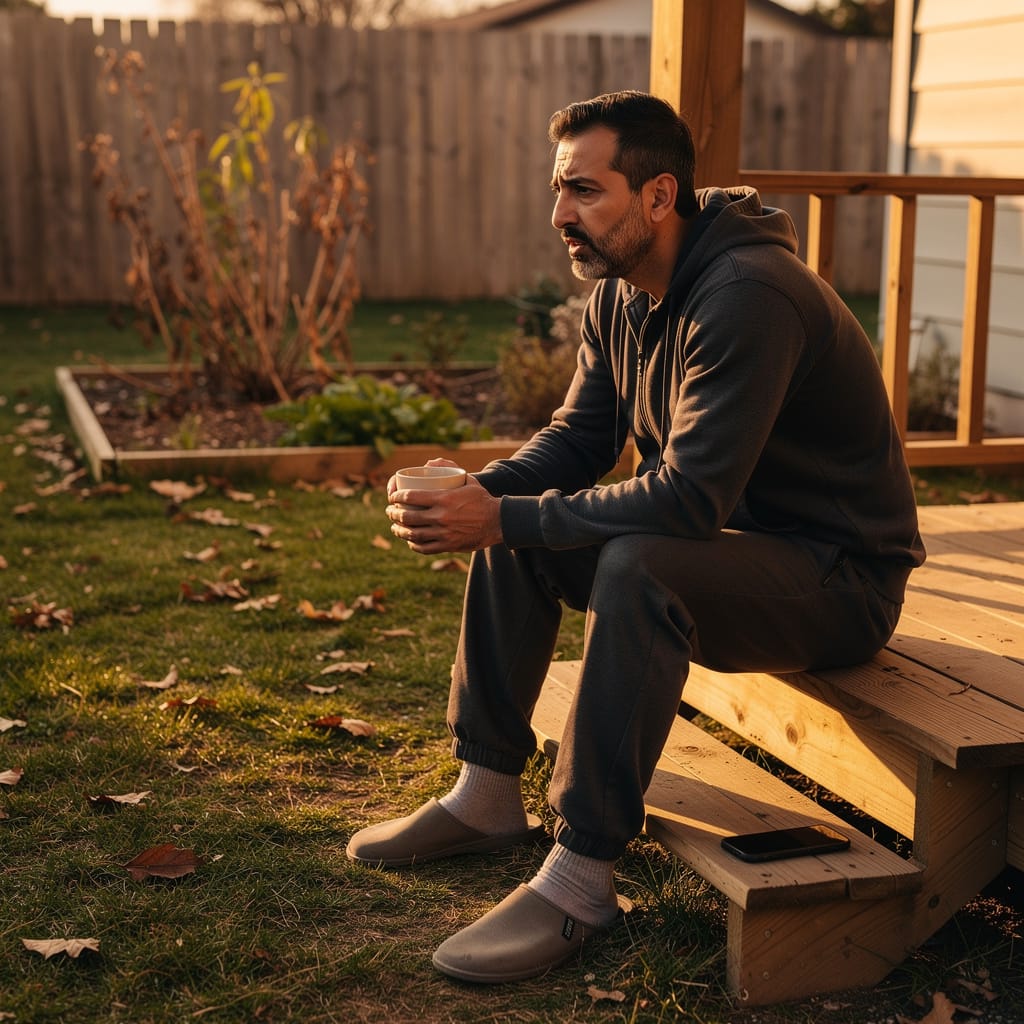
Progress with defensiveness usually doesn’t look like never being defensive again. It looks like shorter episodes you become defensive, but you catch yourself faster, it looks like faster recovery you can return to the conversation and repair more quickly and it looks like earlier awareness you notice you’re becoming reactive before you’ve said something regrettable. These shifts represent real change, even if you’re still sometimes defensive.
Exploring resources on defining enough through self-compassion can support this internal foundation work.
When Defensiveness Runs Deeper
For some people, defensiveness is a surface behavior that shifts relatively easily with awareness and practice. For others, it’s deeply connected to trauma, attachment wounds, or chronic shame that require more than self-help strategies to address.
If your defensiveness traces back to childhood abuse, neglect, or living with highly critical or unpredictable parents, the patterns may be encoded more deeply than conscious strategies can easily reach. Trauma affects the nervous system in ways that make threat responses more easily triggered and harder to regulate.
Dr. Bessel van der Kolk, author of The Body Keeps the Score and one of the leading researchers on trauma’s effects, explains that trauma “changes the brain’s alarm system, the way we filter information, and our capacity to think about what we’re doing while we’re doing it.” For people with trauma histories, defensive reactions may be more automatic, more intense, and more difficult to interrupt through willpower alone.
If your defensive patterns are causing significant damage to relationships you care about if partners have left because of them, if you’re constantly in conflict, if people you love have told you they feel unsafe being honest with you that’s worth taking seriously as potentially needing professional support.
Attachment-based therapies, including Emotionally Focused Therapy (developed by Dr. Sue Johnson), specifically address the underlying attachment fears that often drive defensive patterns. By working with a therapist to understand and heal these deeper wounds, many people find that their surface-level defensive behaviors shift more easily.
Therapy can address what self-help can’t. A therapist can help you process underlying trauma, understand attachment patterns, develop emotional regulation skills with professional guidance, and have a space to practice vulnerability safely. For deeply rooted patterns, working with someone who specializes in attachment, trauma, or couples therapy can accelerate change in ways that reading articles and trying harder on your own can’t.
This isn’t failure. It’s recognizing that some patterns require more intensive support to shift. Many people find that therapy provides the foundation that makes surface-level strategies actually effective.
Understanding when to seek professional support for anxiety can help you determine if deeper therapeutic work would benefit you.
Frequently Asked Questions
Is defensiveness always bad?
No. Defensiveness exists on a spectrum, and some amount of self-protection is healthy. The problem isn’t having any defensive reactions it’s when defensiveness becomes your default response to all feedback, when it prevents you from hearing legitimate concerns, or when it damages your relationships. The goal isn’t to eliminate self-protection entirely but to respond more intentionally rather than automatically.
What’s the difference between explaining myself and being defensive?
The key differences are timing and tone. If you’re launching into explanations before the other person has finished speaking, before you’ve acknowledged their perspective, or with an energy of justification and self-protection, that’s defensiveness. If you’ve genuinely listened, acknowledged their experience, and then calmly share context or your perspective, that’s explaining yourself. The question to ask: Am I explaining because they’ve asked to understand my perspective, or am I explaining to make their criticism go away?
What if my partner says I’m defensive but I disagree?
This is tricky because sometimes people do perceive defensiveness where there isn’t any and sometimes being told you’re defensive triggers defensiveness about being called defensive. Consider: What is their experience when you respond to criticism? Even if your intent isn’t defensive, is the impact that they feel unheard or dismissed? Sometimes the most useful question isn’t “Am I being defensive?” but “Is my partner feeling heard right now?” If the answer is consistently no, that’s worth addressing regardless of the label.
How long does it take to change these patterns?
Honestly? Years-long patterns usually don’t shift in weeks. You might see some improvement quickly catching yourself faster, recovering more easily but fundamental change in how you respond to criticism takes ongoing practice. Most people describe progress as gradual, nonlinear, with setbacks along the way. The measure of progress isn’t perfection; it’s whether you’re trending in the right direction over months and years.
What if I become defensive about being called defensive?
It is extremely common and actually makes sense being called defensive feels like criticism, which triggers the very response being criticized. If you find yourself reacting to “You’re being defensive” with “I’m not being defensive!” that’s your pattern proving its own existence. Try instead: “You might be right. Let me take a breath and try to hear what you’re actually saying.” Even if you’re not sure you were being defensive, creating space to consider it is more productive than reflexively denying it.
Moving Forward: Progress, Not Perfection
If you’ve read this far hoping for a technique that will make you never defensive again, I should be honest: that’s not how this works. Defensiveness won’t disappear completely. It’s a deeply human response, and even people who have done significant work on this still get triggered sometimes.

What changes is your relationship to the pattern. You recognize it faster, have tools to create space, you can repair when you slip, you understand yourself well enough to know what triggers you and can sometimes anticipate and prepare. The defensive reaction becomes something you experience and manage rather than something that controls you.
Measuring real progress means looking at: Are defensive episodes getting shorter? Am I catching myself earlier? Can I repair more effectively afterward? Am I able to hear criticism sometimes without immediately reacting? Are the people in my life experiencing me as more open and less defended? These are the markers of genuine change.
If you want to deepen this work, several resources might support you. The Gottman Institute’s research on the “Four Horsemen” of relationship communication provides an excellent framework for understanding how defensiveness fits into larger conflict patterns. Their book The Seven Principles for Making Marriage Work offers concrete tools for healthier communication. Marshall Rosenberg’s Nonviolent Communication provides a framework for expressing yourself and hearing others in ways that reduce defensiveness on both sides. For understanding the shame dynamics that often underlie defensiveness, Brené Brown’s Daring Greatly offers accessible and research-based insights.
For patterns rooted in trauma, attachment wounds, or chronic shame, working with a therapist particularly one who specializes in attachment, trauma, or couples therapy can provide support that self-help resources can’t. This isn’t an admission of failure; it’s recognition that some patterns benefit from professional guidance.
Summary
Recognize that defensiveness comes from your nervous system as a protective response not a character flaw and create a pause between the trigger and your reaction, as this is the most powerful tool for change. Genuinely listen before defending, acknowledge your partner’s perspective before sharing yours, and repair when you slip. Progress looks like faster recognition, shorter episodes, and better repair over time, and for patterns rooted in trauma or chronic shame, professional therapy can provide support that self-help alone can’t.