

Green Flags in a New Relationship: What Emotional Maturity Actually Looks Like
Green flags in a new relationship deserve as much attention as red flags and yet recognizing them turns out to be harder than most people expect. Here’s something that doesn’t get discussed enough: sometimes, when someone treats you well, it feels wrong. Not wrong because something’s off with them. Wrong because it feels unfamiliar too calm, too steady, too easy.
If you’ve spent significant time in relationships where love came packaged with anxiety, you may have learned that intensity means connection and consistency feels flat. That pattern doesn’t make you broken. It makes you human. Understanding it forms part of learning to recognize what emotional maturity actually looks like not in theory, but in the specific, ordinary moments of early dating.
This article isn’t a checklist. It’s a framework for paying attention to green flags in a new relationship with enough clarity that you can actually trust what you see.
Why Green Flags in a New Relationship Matter as Much as Red Flags
The Problem With Only Knowing What to Avoid
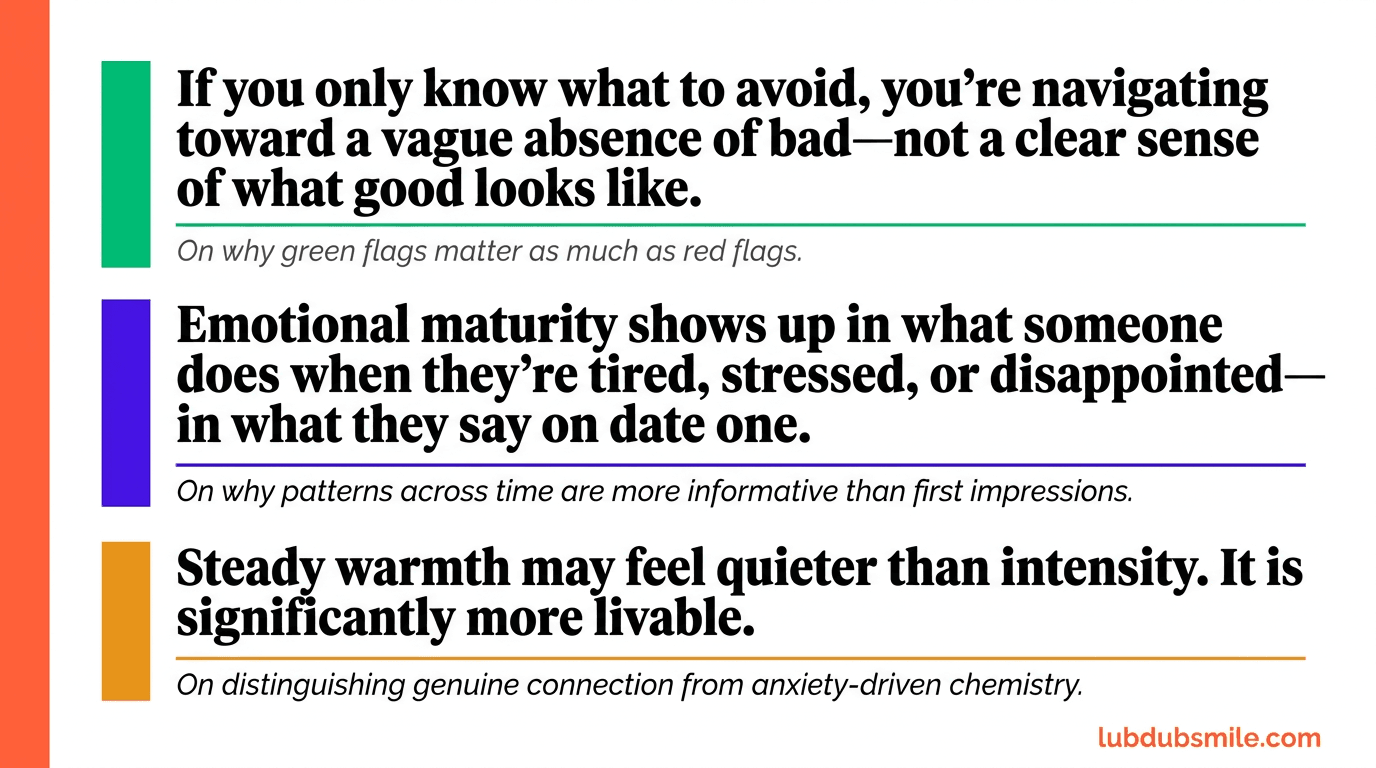
Most relationship content focuses on what to watch out for. That’s useful pattern recognition protects people. But it’s incomplete. If you only know what to avoid, you’re navigating toward a vague absence of bad rather than a clear sense of what good actually looks like. Green flags in a new relationship fill that gap. They give you something to move toward, not just something to run from. Without that positive framework, genuinely healthy behavior can pass unnoticed or even feel suspicious.
When Healthy Behavior Feels Unfamiliar or Even Suspicious
Therapists who work with attachment patterns regularly encounter a particular challenge: people with difficult relational histories sometimes find healthy behavior genuinely uncomfortable. A partner who accepts a “no” without pushing might feel too easy to read. Consistency, without anxious highs and lows, can register as flat or boring rather than safe and solid. This isn’t a personal failing it’s nervous system adaptation. The body learned what connection feels like through early experience, and when reality looks different, it can trigger doubt rather than relief. Recognizing this in yourself matters as much as recognizing green flags in a new relationship partner.
Why Emotional Maturity Shows Up in Patterns Over Time
Anyone can have a good date. Emotional maturity reveals itself over time, across different circumstances, especially under mild stress or disappointment. The person who handles a small conflict gracefully on date three is more informative than the person who says all the right things on date one. Early dating behavior often reflects active effort and self-monitoring. What someone does when the relationship grows more comfortable, when something doesn’t go their way, or when they’re tired and stressed that’s the more accurate picture. Green flags in a new relationship are patterns to notice across multiple contexts, not auditions to evaluate in a single moment.
The Difference Between Genuine Green Flags and Performative Growth
Awareness of therapeutic language has grown widespread. Many people can accurately name attachment styles, articulate what healthy communication looks like, and describe their emotional patterns with considerable sophistication. That self-awareness can carry genuine meaning. It can also represent vocabulary without supporting behavior insight that hasn’t yet translated into consistent action. The distinction becomes clearer over time, particularly under mild pressure. What someone does when they’re disappointed, frustrated, or uncertain reveals more than what they say in comfortable moments. Watch for congruence between language and lived behavior as the clearest signal that green flags in a new relationship are real.
Using This Framework Without Turning It Into a Scorecard
The sections that follow offer concrete examples of what emotional maturity tends to look like in early relationships not to create a rigid evaluation system, but to help you recognize patterns you might otherwise dismiss or misread. Emotional maturity looks different across personalities, communication styles, and cultural backgrounds. A quieter person’s version of emotional attunement looks different from an expressive person’s. Context matters enormously. Consistency across that context matters more than any single moment, however striking.
How They Handle Conflict and Difficult Conversations
Disagreeing Without Attacking Character or Worth
Emotionally mature people disagree clearly but direct engagement toward your idea, not your character. No eye-rolling, no “you always think that way,” no sighing that implies the conversation isn’t worth having. After a difficult exchange, you leave feeling taken seriously even when the conclusion was “we see this differently.” That combination honest disagreement delivered without contempt is one of the clearest green flags in a new relationship and one of the strongest predictors of long-term relationship health. The Gottman Institute has documented contempt as the most corrosive force in relationships; its absence in early conflict is genuinely significant.
Taking Accountability Without Deflecting or Collapsing Into Shame
When something goes wrong on their end, an emotionally mature person acknowledges it without deflecting responsibility or collapsing into disproportionate self-blame both of which can function as ways of avoiding genuine accountability. Deflection keeps the focus off the behavior. Excessive shame shifts the focus to managing the other person’s distress rather than addressing what happened. A real green flag sounds like: “I should have handled that differently. I’m sorry.” Followed by actual behavior that reflects it. The apology without the behavior change is not a green flag it’s a pattern worth noting.
Staying Curious About Your Perspective Even Under Disagreement
During difficult conversations, emotionally mature people ask questions not as a debate tactic designed to find weaknesses in your argument, but to genuinely understand how you arrived at your position. They sit with your perspective long enough to consider it before formulating their response. That quality curiosity in the face of disagreement rather than defensiveness is one of the most valuable green flags in a new relationship. It signals that the person can prioritize understanding over winning, which makes navigating future conflict meaningfully easier.
Allowing Space Without Weaponizing the Pause
Some people need time to process before engaging productively, and that’s a legitimate form of emotional self-awareness. The green flag lies in how that need gets expressed. Requesting space with clear intention “Can we come back to this tonight? I need some time to think” is different from three days of silence that leaves you wondering what happened and what it means. Emotionally mature people communicate the pause rather than using it as indirect punishment. That distinction between requested space and punishing withdrawal matters enormously when reading green flags in a new relationship.
Returning to Difficult Conversations Rather Than Letting Them Dissolve
Perhaps the clearest conflict-related green flag in a new relationship is this: they bring things back. A few days after a hard conversation, they share a realization, offer a follow-up thought, or check in to see how you’re feeling about what was discussed not to relitigate the original disagreement, but to close the loop and confirm that the relationship is intact. Repair, not conflict-free living, is what relationship health actually requires. The willingness to return rather than avoid signals that this person treats the connection as more important than their own comfort.
How They Relate to Their Own Emotions
Naming Feelings Without Being Overwhelmed or Destabilized by Them
Emotional self-awareness requires more than access to feelings it requires the capacity to hold them without being flooded. An emotionally mature person can identify and articulate what they’re feeling without that feeling taking over the interaction or requiring management from you. “I was disappointed when that fell through” is different from disappointment becoming a weather system that derails the evening. Naming emotions without being overwhelmed by them signals the kind of internal stability that makes relationship a collaboration rather than a caregiving arrangement a genuine green flag in a new relationship.
Regulating Without Requiring You to Manage Their Emotional State
Emotional self-regulation means handling internal states without conscripting others into managing them. Emotionally mature people may share how they feel and that sharing is healthy but they don’t require you to fix, soothe, or rescue them from those feelings on their behalf. Research consistently links this capacity to secure attachment: seeking connection and support without demanding emotional rescue. When someone consistently requires you to manage their internal state, the relationship dynamic shifts in ways that accumulate over time. The absence of that dynamic is a meaningful green flag in a new relationship.
Not Punishing You for Triggering Normal Emotional Responses
Normal emotional responses arise in normal relationships. You said something that landed wrong. They felt hurt. The emotionally mature response sounds like: “When you said that, I felt dismissed can I tell you why?” What it doesn’t look like: withdrawal, extended coldness, indirect signals that something is wrong while leaving you to figure out what happened and how to fix it. The capacity to name a triggered feeling rather than express it through behavior is a significant green flag in a new relationship it means difficult moments stay in the open rather than becoming a slow accumulation of silent grievances.
Comfortable Sitting With Silence, Uncertainty, and Emotional Ambiguity
Early relationships involve inherent uncertainty, and emotionally mature people can tolerate that ambiguity without requiring premature resolution. They can sit with not knowing exactly where things are headed and they can manage a silence without filling it anxiously. They can stay present with an unresolved feeling long enough to understand what it’s actually about. That tolerance for uncertainty rather than a compulsive need to have everything defined immediately reflects internal security rather than anxiety management. It’s a quiet but important green flag in a new relationship.
Processing Difficult Feelings Without Drama or Suppression
Emotional health in early relationships tends to look neither flooded nor closed off. Emotionally mature people move through emotional range without producing a weather system for everyone around them but also without burying things until they resurface at unpredictable moments. Neither extreme serves real intimacy. The capacity to feel something, process it with some degree of groundedness, and come through it without lasting damage to the interaction or relationship is one of the more understated green flags in a new relationship.
How They Treat Your Emotions
Genuine Curiosity About Your Inner Life and Experience
An emotionally mature partner asks how you’re feeling and actually listens to the answer. They follow up on things you mentioned previously, they remember what you said and they notice when something seems off and ask about it without pressure. The Gottman Institute’s research consistently identifies this quality turning toward a partner with genuine interest in their inner world as foundational to long-term relationship satisfaction. Curiosity about your emotional experience, expressed consistently and without agenda, is one of the warmest green flags in a new relationship.
Validating Your Feelings Even When They Don’t Share Them
Validation doesn’t require agreement or shared experience. An emotionally mature person can say “that sounds really hard” without needing to have felt the same way, without immediately reframing the experience toward a positive interpretation, and without explaining why you probably shouldn’t feel what you feel. The capacity to validate an emotional experience they don’t fully understand because they recognize that what you feel is real regardless of whether it matches their interpretation is rarer than it sounds and represents a meaningful green flag in a new relationship.
Not Making You Feel Too Much or Too Sensitive
You share a worry or a fear, and you don’t leave the conversation embarrassed for having raised it. Nobody signals that you’ve said too much, asked for too much, or responded too intensely to something ordinary. Being allowed to have your emotional experience without editing it for someone else’s comfort is a more significant green flag in a new relationship than it might initially appear because many people spend years calibrating their emotional expression to someone else’s tolerance, often without realizing that’s what they’re doing.
Holding Your Vulnerability With Genuine Care and Discretion
You share something that feels genuinely risky a past wound, a current fear, something you haven’t told many people. An emotionally mature partner receives it without flinching, without turning it into something small, and without referencing it carelessly in a later moment. Vulnerability met with care creates safety. Safety allows more honesty. More honesty builds real intimacy over time. When someone holds what you’ve shared with visible care and discretion, that creates a particular kind of trust one of the most meaningful green flags in a new relationship.
Exploring emotional safety as the foundation of true intimacy provides useful context for understanding why this quality matters so deeply in early relationships.
How They Respect Your Limits
Accepting “No” Without Punishing, Pouting, or Pressuring
You cancelled plans because you were exhausted. They said “totally understand, let’s reschedule” and meant it. No guilt trip delivered through tone, no sulking presented as neutrality, no “fine” that clearly doesn’t mean fine. People who respect limits when the stakes are low tend to respect them when the stakes are higher. Early limit-setting moments reveal how someone relates to having their preferences go unmet and that reveals quite a lot. Accepting “no” gracefully and without residue is one of the most reliable green flags in a new relationship.

Not Requiring Justification for Every Limit You Set
Emotionally mature people understand that “no” is a complete sentence rather than an opening position in a negotiation. You don’t need to provide a detailed account of why you want space or why you’re not ready to discuss something. The absence of that pressure the sense that your limits don’t require defending is itself significant. When someone consistently accepts your stated limits without requiring explanation, they signal respect for your autonomy that carries real implications for the relationship going forward.
Honoring Your Limits Consistently Rather Than Only Initially
Initial compliance with limits is relatively easy it reflects effort and intention. The more informative signal comes three, four, five months in, when the relationship has grown more comfortable and the conscious effort has relaxed. Do they still respect the same limits? Have any been gradually tested or eroded? Consistency over time distinguishes genuine respect from early performance. Sustained, consistent limit-honoring across changing relational circumstances is one of the more durable green flags in a new relationship.
Having and Expressing Their Own Limits Clearly and Without Apology
Someone who never says no, never expresses a preference that differs from yours, and accommodates everything without apparent friction isn’t necessarily easygoing they may be managing significant discomfort around asserting their own needs. Emotionally mature people have their own limits and express them directly without excessive apology or circuitous hinting. That directness is itself a green flag in a new relationship. A partner who can say clearly what they need and don’t need makes genuine mutual understanding possible in a way that indefinite accommodation cannot.
Exploring how people build the skill of expressing limits without guilt can deepen your understanding of what healthy limit-setting looks like in practice.
How They Show Up With Consistency
Words and Actions Align Across Time and Circumstances
Emotional maturity, at its most basic level, produces congruence between what someone says and what they do. They said they’d call, and they called. Their self-description as someone who values honesty aligns with what you’ve actually observed. Their claimed values appear in their choices. This congruence isn’t perfect in anyone everyone has moments where intention and behavior diverge. But a general, reliable alignment between expressed values and lived behavior, sustained across different circumstances, is one of the most informative green flags in a new relationship. It means the person you’re meeting in conversation is the person you’ll meet over time.

Following Through on Small Things as a Form of Attention
Small follow-throughs accumulate into something significant. Remembering that your presentation was this week and asking how it went. Noticing that you seemed off during a previous conversation and checking in a few days later. Following through on something they mentioned they’d send or share. These small attentions signal that someone’s interest in you extends beyond the moments when you’re directly in front of them and that their words carry weight because they back them with consistent action. Attentive follow-through on small things is an understated green flag in a new relationship.
Steady Warmth Rather Than Hot-Cold Cycles
The push-pull pattern intense closeness followed by unexplained withdrawal, warmth replaced by distance without clear reason can feel like chemistry when it’s actually producing anxiety. The nervous system activates around unpredictability, and that activation can register as excitement or attraction. Emotional maturity, by contrast, tends to look less dramatic: steady warmth, reliable availability, engagement that doesn’t require you to constantly recalibrate where you stand. That steadiness may feel quieter than intensity, but it’s significantly more livable. Recognizing steady warmth as a green flag in a new relationship requires distinguishing it from flatness which it isn’t.
Presence That Doesn’t Require Emotional Labor to Maintain
Being with an emotionally mature person feels relatively easy not because there’s no substance or depth, but because there’s no ongoing emotional labor required to keep the interaction on track. Conversations don’t require careful navigation to avoid triggering a response. Interactions don’t require monitoring their mood before deciding how to present something. You’re not performing a carefully managed version of yourself designed to prevent a particular reaction. That ease the simple experience of being with someone without the labor of managing around them is one of the more significant and underappreciated green flags in a new relationship.
How They Talk About Their Past
Owning Their Role in Past Relationship Difficulties
The way someone talks about past relationships reveals quite a lot about how they’ve processed those experiences. Emotionally mature people discuss past relationships with honest reflection that includes their own contribution to what went wrong. Not “my ex was wild” delivered with zero self-examination. Not performative self-blame designed to signal growth. Measured, honest acknowledgment that they were a participant in what happened with some clarity about what they understand about that participation. That quality of self-aware reflection is a clear green flag in a new relationship.
Not Villainizing All Former Partners or Making You Their Therapist
Two patterns deserve attention in how someone discusses their past. The first is speaking about every past partner with contempt or dismissal which raises questions about how they might discuss you someday. The second is using early dates as processing sessions, with you serving as unpaid therapist for unresolved feelings about previous relationships. Emotional maturity includes having done enough of that processing elsewhere in actual therapy, in close friendships before entering something new. A new partner can hold your history with care without carrying the therapeutic weight of it.
Demonstrating Growth Through Behavior, Not Just Vocabulary
Anyone can say “I’ve grown a lot since then.” The green flag is evidence of that growth ways of relating that reflect actual behavioral change rather than updated awareness. Does their reported learning appear in how they actually handle conflict, receive feedback, or manage disappointment? Or does the growth exist primarily in how they describe themselves? Green flags in a new relationship are always behavioral, not declarative. What someone does consistently matters more than what they report about themselves.
Calibrating Disclosure Appropriately for the Relationship Stage
Emotionally mature people understand that early relationships carry limited capacity for emotional weight. They share enough honestly to build genuine connection without requiring new partners to carry material that belongs in therapy or established close friendships. That calibration enough vulnerability to feel real, not so much that it overwhelms reflects self-awareness about what’s appropriate for the relational stage. When someone gets that calibration right in early dating, it signals broader awareness of how relationships develop and what they require.
Curiosity About Your Past Without Making It an Interrogation

Genuine interest in what shaped you is different from systematic inquiry into your history. Emotionally mature people are interested in your past without making that interest feel like a case file is being assembled. They ask questions and receive answers at the pace you choose to offer them. They’re curious without pushing past the edges of what you’re ready to share. That quality of interested patience real curiosity held within genuine respect for your pace is a warm green flag in a new relationship.
How They Respond to Your Success and Independence
Genuinely Celebrating Your Wins Without Competing or Deflecting
Your good news lands as just good news. No subtle one-upmanship, no brief congratulation that quickly pivots to their own accomplishments, no qualification that subtly diminishes the win. Secure people can feel genuinely pleased for a partner because their own sense of worth doesn’t depend on relative standing. The capacity to celebrate someone else’s success wholeheartedly without needing to compete, qualify, or redirect is a meaningful green flag in a new relationship and reflects a kind of security that becomes increasingly important over time.
Supporting Your Independent Life Without Creating Friction
Emotional security in early relationships shows up partly in how someone responds to your life outside the relationship. Encouraging plans you have without them, expressing genuine interest in your friendships and outside pursuits, not creating friction or subtle guilt around your independent commitments these behaviors signal that someone understands a healthy relationship contains two full people rather than two people merging into one. Supporting your independence without resentment requires genuine security. That security is a significant green flag in a new relationship.
Comfortable When You Don’t Need Them
A particularly revealing moment: you had a good day, you’re in a good place, and you don’t need much from them tonight. An emotionally mature partner can receive that without interpreting it as withdrawal or rejection. Their sense of security in the connection doesn’t depend on being needed. That independence the capacity to be fine when you’re fine on your own reflects secure attachment rather than anxious attachment, and produces a relational experience that feels spacious rather than pressured. Comfort with your autonomy is a quiet but important green flag in a new relationship.
What Emotional Maturity Doesn’t Look Like
Emotional Maturity Is Not the Absence of Bad Days or Difficult Moments
Emotionally mature people get irritable, handle things worse than they would on a better day, and occasionally respond to stress in ways they later regret. What distinguishes maturity from immaturity isn’t perfect behavior it’s what happens after imperfect behavior. The capacity to notice, acknowledge, take responsibility, and approach the next similar situation differently is the actual marker. Someone who handles everything perfectly is either performing or hasn’t yet encountered enough stress. Someone who handles things imperfectly and repairs genuinely is demonstrating real emotional maturity which is itself a green flag in a new relationship.
Expressing Needs Clearly Is a Strength, Not a Warning Sign
A common misread: someone who expresses emotional needs directly can seem demanding or needy compared to someone who appears to need nothing. In practice, clear need-expression paired with personal responsibility for those needs is a green flag in a new relationship. Immaturity looks like expecting needs to be met without expressing them, or expressing them through behavior withdrawal, irritability, indirectness rather than words. Someone who can say “I’d really appreciate X” and take responsibility for that request demonstrates the kind of relational skill that makes long-term partnership workable.
Conflict Avoidance Is Not the Same as Emotional Maturity
Someone who never disagrees, never raises a concern, and appears to have no friction with anything you say or do isn’t necessarily mature they may carry conflict-avoidant patterns that surface later as resentment, shutdown, or sudden intensity after months of apparent ease. Real peace in relationships builds through navigated conflict rather than its absence. Someone who engages when something matters to them, raises concerns with care rather than contempt, and works through difficulty rather than around it demonstrates more genuine emotional maturity than someone who avoids friction at the cost of honesty.
Therapeutic Vocabulary Without Supporting Behavior Is Not a Green Flag
Knowing the right language attachment styles, emotional regulation, nervous system responses has become widespread enough that it can create an impression of emotional maturity that precedes the actual development of it. The vocabulary is not the flag. The behavior is. Watch for congruence between the language someone uses to describe their emotional intelligence and how they actually behave under mild pressure, disappointment, or conflict. That congruence, or its absence, is the more informative signal about whether you’re seeing genuine green flags in a new relationship.
Context and Cultural Background Shape How Maturity Appears
Emotional maturity doesn’t look identical across people, personalities, or cultural backgrounds. A quieter person’s attunement looks different from an expressive person’s. Cultural contexts shape how emotions are expressed, how conflict is approached, and what closeness feels like. Applying a single behavioral template as the universal definition of green flags in a new relationship produces errors. What you’re looking for is someone whose way of being whatever form it takes is consistent, honest, and reflects genuine regard for your experience. Context always matters.
Your Own Response as Important Information
When Healthy Behavior Feels Boring, Wrong, or Suspicious
If steadiness registers as flat, reliability feels unexciting, and easy consistency produces doubt rather than reassurance, that’s worth examining not as a character flaw, but as useful information. Your nervous system carries expectations shaped by earlier experience. When reality diverges from those expectations, it can produce discomfort even when reality is genuinely healthier than what came before. That discomfort is data about your relational history, not evidence that something is wrong with the person in front of you. Recognizing this distinction is part of learning to read green flags in a new relationship accurately.
Why Familiar Chaos Can Register as Chemistry
Intensity and anxiety activate the nervous system in ways that feel similar to attraction. The highs and lows of unpredictable connection produce a physiological response that resembles excitement because in some ways it is excitement, just not the kind that sustains a healthy relationship over time. Understanding that the feeling of chemistry and the presence of actual relational health are not the same thing makes it possible to make more deliberate choices rather than following sensation toward familiar territory. Distinguishing intensity from genuine connection is one of the harder parts of learning to recognize green flags in a new relationship.
Exploring emotional agility and how it shapes relationship patterns can deepen understanding of why certain emotional dynamics feel compelling even when they’re costly.
What Your Discomfort With Green Flags Might Reveal
If you notice yourself finding reasons a genuinely kind, consistent, available person isn’t right for you too easy to read, too available, not quite exciting enough it may be worth sitting with that discomfort before acting on it. The distinction between a genuine instinct that something is off and a familiar pattern pulling toward drama is worth understanding. Both can produce similar-feeling doubt. One is informative; the other is a pattern worth interrupting. Understanding which is operating requires honest self-examination that doesn’t always happen in the moment.
Building the Capacity to Receive Healthy Behavior
Recognizing green flags in a new relationship is one skill. Allowing yourself to actually receive them without sabotaging the connection or retreating when it deepens is a different and sometimes harder skill. Both develop over time, with self-awareness, and sometimes with professional support. Building the capacity to stay present with healthy behavior, rather than finding reasons to exit it, is some of the most meaningful relational work available.
Therapy as a Tool for Deepening Your Own Discernment
If healthy behavior consistently feels foreign, if self-reflection isn’t shifting what you’re drawn to, or if you find yourself in similar patterns despite genuinely wanting something different, working with a therapist offers what self-directed reading and reflection alone cannot. Understanding when professional support helps can guide that decision. A therapist can work with your specific relational history in ways that general frameworks cannot address.
Frequently Asked Questions
Can someone show emotional maturity in some areas but struggle in others?
Yes this is the norm rather than the exception. Emotional maturity shows up unevenly across different domains. Someone may handle conflict with considerable skill while struggling significantly with vulnerability. The relevant question is whether areas of difficulty involve genuine awareness and ongoing growth, or whether they appear entrenched and defended against examination. Green flags in a new relationship rarely present as complete or uniform what matters is the direction of movement.
How much time passes before green flags are reliably informative?
Patterns become meaningfully clearer over three to six months, across varied circumstances that include minor stressors and disappointments. Early dating behavior reflects active effort and self-monitoring. Behavior when the relationship grows more comfortable, or when something doesn’t go as expected, tells a more accurate story. Observing across different contexts not just comfortable, successful moments produces the most reliable picture.
What if I’ve never experienced emotional maturity in a partner?
Recognizing it may feel genuinely difficult not because you’re incapable of recognizing it, but because you don’t carry an experiential template for it. Attachment research documents this well: people build relational expectations from what they’ve experienced, and when reality looks different, it can feel unfamiliar rather than better. Therapy focused on attachment patterns can help develop that template. Adult Children of Emotionally Immature Parents by Lindsay C. Gibson also offers frameworks for understanding what was missing and what green flags in a new relationship can actually look like.
Is setting high standards for emotional maturity appropriate?
Yes. Wanting a partner who handles conflict respectfully, manages their own emotional state, and shows up consistently is not asking too much. That said, standards applied without accounting for context, personality, or the inherent unevenness of human development can become a way of keeping connection at a safe distance. The goal is discernment the capacity to read accurately rather than a standard of perfection that no real person meets.
What if I recognize these green flags in a relationship but struggle to demonstrate them myself?</p>
This is honest and important self-knowledge rather than a disqualifier. Emotional maturity is developmental it grows with self-awar
eness, experience, deliberate practice, and often support. Recognizing the gap between what you want to offer and your current patterns is itself a form of emotional maturity. The gap is information, not a verdict.
Building Discernment and Moving Forward
Green Flags Are Patterns to Continue Observing, Not Conclusions to Draw Early
No set of behaviors in early dating guarantees a healthy long-term relationship. People are complex; stress reveals what comfort conceals; and early investment in appearing a certain way can shape behavior in ways that shift as the relationship grows comfortable. Green flags in a new relationship are genuinely promising patterns that deserve sustained observation over time not conclusions to draw in the first weeks, and not guarantees to rely on before the pattern has proven itself across varied circumstances.
When Therapy Can Deepen Your Relational Wisdom
If recurring patterns leave you questioning your own judgment, if healthy behavior consistently feels unfamiliar or suspicious, or if self-reflection isn’t shifting what you find yourself drawn to therapy offers personalized support that no article can provide. Comparing therapy platforms can help you find accessible professional support. Psychology Today’s therapist finder (psychologytoday.com/us/therapists) is a useful starting point for local options. Working with a therapist who understands attachment and relationship patterns can accelerate the development of exactly the kind of discernment this article is about.
Resources Worth Reading Alongside Professional Support
Attached by Amir Levine and Rachel Heller offers an accessible introduction to adult attachment theory and how it shapes partner selection and relational experience. Loving Bravely by Alexandra Solomon explores building intentional relationships with self-awareness at the center. Both are worth reading as companions to not substitutes for professional support when patterns feel stuck or self-reflection isn’t producing the shifts you’re looking for.
Trusting Your Growing Capacity for Discernment
Discernment develops. It grows with experience, self-reflection, honest examination of your own patterns, and the gradual work of understanding what you bring to relationships alongside what you’re looking for in them. Recognizing green flags in a new relationship accurately is a learnable skill one that improves with attention and time. You’re already doing part of that work by asking not just “what should I watch out for?” but “what does good actually look like, and would I recognize it?”</p>
Keep asking it. The question itself is part of the answer.
Green flags in a new relationship appear in behavioral patterns over time how someone handles conflict without contempt, regulates their emotions without requiring rescue, honors your limits consistently, and shows up with steady warmth rather than dramatic cycles and recognizing them requires examining your own response, because when steadiness feels suspicious and intensity feels like chemistry, that gap is worth understanding before acting on it.
If you are working through relationship patterns, attachment wounds, or significant relational history, support from a licensed therapist can provide personalized guidance tailored to your specific experience.
This content is for educational purposes and does not substitute for professional psychological or therapeutic help.