

How Emotional Intelligence Affects Your Earning Potential Over Time
Emotional intelligence and earning potential are more connected than most professionals recognize and that connection grows stronger as careers advance. Two candidates compete for a VP role. One has superior technical output documented over five years. The other has comparable technical output and measurably stronger stakeholder relationships, higher team retention rates, and a track record of influencing cross-functional decisions. The second candidate gets the role.
If you’ve watched a version of this play out and filed it under organizational politics or favoritism, you may be missing a more useful interpretation. At senior levels, advancement decisions increasingly weight relational and leadership capability alongside technical performance not because technical skills don’t matter, but because they’ve become the entry requirement rather than the differentiator.
The question worth examining isn’t whether this is fair. It’s whether understanding the mechanism changes how you invest in your development. This article examines what the research actually supports, what it doesn’t, and where emotional intelligence specifically affects earnings at each career stage.
This article makes an evidence-based case for emotional intelligence as a career asset not the overclaiming version that EI consultants frequently sell, but a more rigorous and ultimately more useful one.
The Evidence Case: What Research Actually Shows
What Peer-Reviewed Research Actually Finds
Daniel Goleman’s widely cited claim that emotional intelligence (sometimes called emotional quotient, or EQ) accounts for approximately 67% of leadership effectiveness circulates without the methodological scrutiny it warrants. Peer-reviewed researchers studying emotional intelligence, including psychologists Dana Joseph and Daniel Newman in a meta-analysis published in the Journal of Applied Psychology, found meaningful but considerably more modest relationships between emotional intelligence and job performance than popular EI literature suggests.
This doesn’t mean emotional intelligence’s career relevance is marketing fiction. It means the honest case is different from the inflated one and the honest case is still worth making.
A more defensible reading of the evidence: emotional intelligence and earning potential connect most reliably in roles involving significant interpersonal demands, leadership responsibility, or client relationships. Ability-based emotional intelligence measures which test actual emotional reasoning capacity rather than self-reported emotional skills show more consistent and replicable relationships with job performance than self-report instruments. Most commercially available EI assessments are self-report tools with significant validity limitations. The precise percentage attributions common in EI marketing should be treated as advocacy rather than established finding.
The research is strongest for specific mechanisms: leadership effectiveness, team performance, client relationship quality, and organizational influence. These are real and financially relevant. Understanding emotional intelligence in relationships both professional and personal provides a useful foundation for applying these findings practically.
Where EI Becomes More Financially Relevant as Careers Advance
One of the more robust patterns in career research: emotional intelligence’s differentiating role tends to increase as careers advance. Early in a career, technical competence and foundational performance are the primary variables emotional intelligence matters but is less decisive when outputs are more directly attributable and roles are more individually structured.
As careers advance into management, senior individual contributor, and leadership roles, the nature of value creation shifts. Impact increasingly flows through other people’s work rather than one’s own direct output. Influence becomes more important than execution. Decisions become more ambiguous and politically complex. Client and stakeholder relationships carry greater financial stakes.
In that environment, technical excellence becomes the table stakes rather than the differentiator. Emotional intelligence particularly social awareness, relationship management, and self-regulation under pressure becomes increasingly what separates comparable technical performers from one another. The distinction between soft skills vs hard skills becomes less useful at this level because the “soft” skills carry hard financial consequences.
IQ vs. EI: The False Hierarchy
The emotional intelligence literature sometimes implies that emotional intelligence matters more than cognitive ability at senior levels. Does EI matter more than IQ? This overclaims. Cognitive ability remains highly relevant across career stages, and the research supports this. What changes is the relative differentiating power of each in contexts where everyone at the table already meets a cognitive threshold.
Early in a career, cognitive ability predicts performance strongly because the work is largely individual and technical. As careers advance and roles involve higher relational complexity, emotional capability increasingly explains variance in outcomes that cognitive ability alone cannot. Both matter. Neither categorically dominates the other.
Understanding Emotional Intelligence as Professional Capability
What EI Actually Is (Beyond the Buzzword)
The most academically rigorous emotional intelligence framework developed by psychologists Peter Salovey, John Mayer, and David Caruso defines emotional intelligence as the capacity to perceive, use, understand, and manage emotions accurately in oneself and others.
Emotional intelligence differs from personality traits like warmth or extraversion, and from general interpersonal skills. At its core, emotional intelligence is a measurable capacity for processing emotional information accurately and using it effectively.
For career purposes, four domains carry the most practical relevance:
- Self-awareness accurate perception of your emotional states and their effects on others
- Self-regulation managing emotional responses rather than being governed by them
- Social awareness reading others’ emotional states and organizational dynamics
- Relationship management influencing, developing, and managing relationships effectively
Together, these four domains shape how emotional intelligence and earning potential interact across every career stage. Self-awareness career development the ability to see yourself clearly in professional contexts is the foundation on which the other three build.
Self-Regulation and Professional Credibility
Of the four domains, self-regulation often carries the most direct and visible career consequences because failures of self-regulation happen in real time and tend to create lasting reputational effects. Patterns of poor self-regulation frequently contribute to the kind of burnout recovery challenges that derail otherwise strong careers.

You’re the expert in every meeting, and you know it, and it shows and what it shows has started affecting whether people want you in meetings at all. The emotional reaction to challenge, the defensiveness when questioned, the visible frustration when things don’t go your way these communicate volumes about what working with you under pressure looks like. For people making decisions about who to bring into high-stakes situations, these signals matter significantly.
Your performance reviews consistently rate you “exceeds expectations” technically and “meets expectations” on leadership behaviors. The leadership feedback gets dismissed because technical output is excellent. Three promotion cycles later, the pattern is worth examining with more curiosity than defensiveness.
Relationship Management as Revenue Driver
At senior levels, relationship management isn’t interpersonal nicety it’s a revenue variable. Client relationships that produce referrals, renewals, and expanded scope carry measurable financial value. Stakeholder relationships that smooth organizational decision-making carry time and resource value. Team relationships that produce retention carry recruiting and productivity value.
Strong couple communication patterns and professional relationship management draw from the same underlying emotional intelligence capabilities the ability to listen accurately, regulate your own reactions, and respond in ways the other person can receive.
The Center for Creative Leadership’s research on leadership derailment documents extensively why leaders fail despite strong technical credentials. The consistent finding: it’s rarely technical failure. It’s relational failure to build and maintain relationships, inability to manage conflict constructively, inability to adapt communication to different audiences, and difficulty managing emotional reactions under pressure. These aren’t soft failures. They’re career-ending ones with financial consequences for the organizations involved.
The Mechanisms: How Emotional Intelligence and Earning Potential Connect
Promotion Decisions at Senior Levels
Promotion decisions at senior levels involve judgment about someone’s capacity to operate effectively in roles they haven’t yet held. Decision-makers extrapolate from observed behavior: How does this person handle ambiguity? How do they treat people when under pressure? What is their track record of developing others? Do people want to work for them?
These are emotional intelligence-relevant questions. Their answers come not from performance reviews but from the informal network of observations that decision-makers access when evaluating someone seriously. The quality of that informal evidence is substantially shaped by the relational reputation the candidate has built over time.
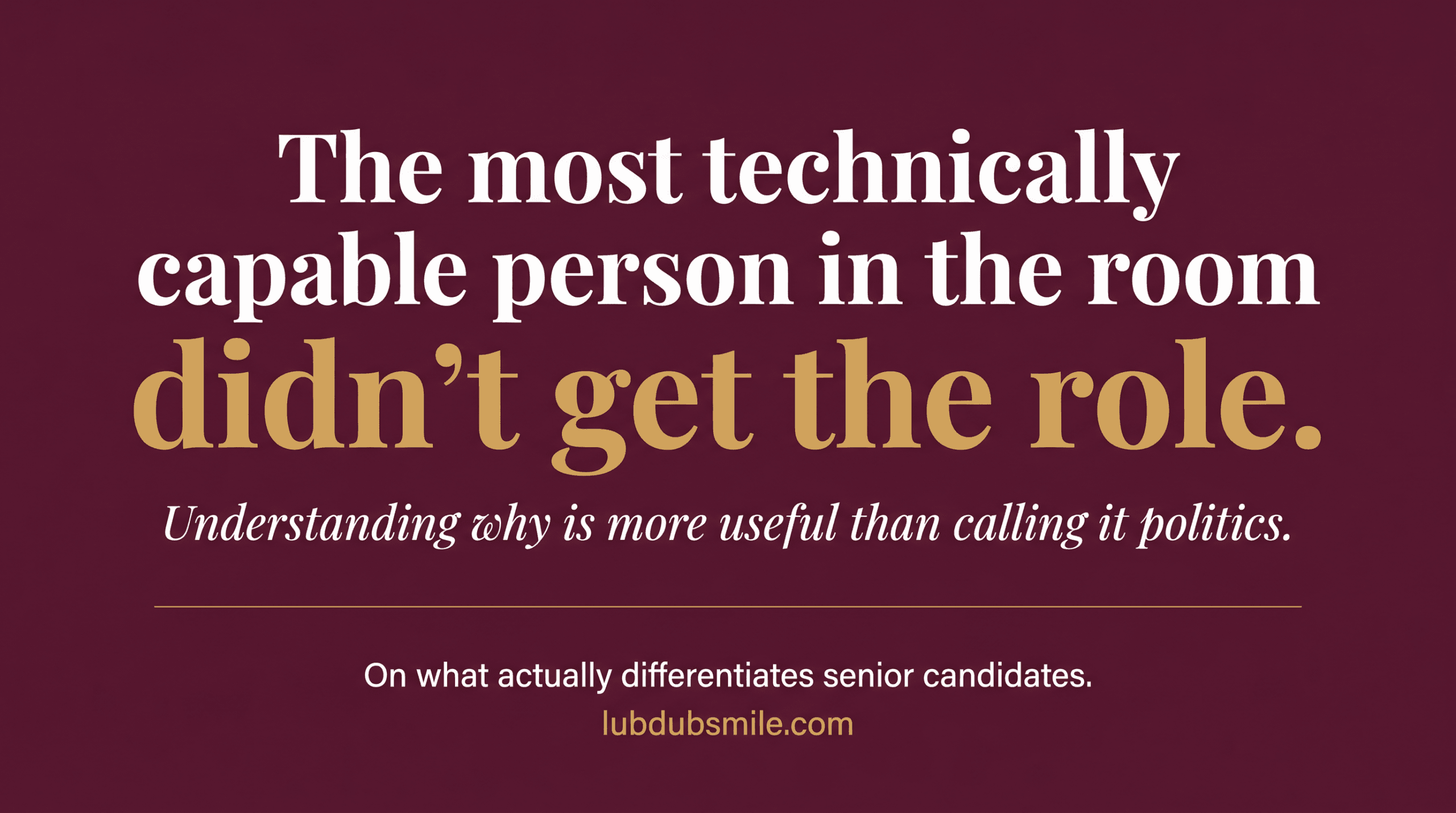
When the most technically capable person doesn’t get the role when you’ve been passed over for a promotion despite strong performance examining what informal evidence those decision-makers were working from is more analytically useful than concluding the process was political. Learning to stop defensive behavior in conflict is one of the most visible and practically addressable emotional intelligence gaps at this level.
Negotiation Effectiveness
Negotiation research consistently finds that performance in negotiation depends on the negotiator’s ability to read the other party’s interests, emotional state, and constraints and to manage their own emotional state in ways that maintain productive engagement.
You’ve negotiated every salary increase using market data and documented output. The colleague who earned 15% more used the same data and also understood the decision-maker’s specific pressures in that moment. Social awareness the ability to read what someone actually needs in a conversation rather than only presenting your own case is a negotiation asset with direct financial value. The connection between emotional intelligence and salary outcomes operates through exactly this mechanism. This applies to salary discussions, client contract negotiations, and any high-stakes commercial conversation.
Team Performance and Leader Financial Accountability
Team performance is a financial variable that reports to the leader’s account. Leadership influences turnover rates, productivity, quality of output, innovation, and engagement all of which carry financial consequences increasingly attributable to the responsible leader.
Your team’s turnover rate is higher than peers’. Recruiting and onboarding costs are real financial variables your organization tracks. The connection to your leadership approach may not have been named directly, but it appears in the data.
Conversely, leaders who create environments where high-performing people want to stay, where honest information flows upward, and where people produce their best work generate financial value that compounds over time. Emotional intelligence and earning potential operate together here not theoretically, but measurably. TalentSmart’s research, which should be read with awareness of its commercial interests, found that emotional intelligence accounts for a meaningful portion of performance differences between high and low earners though precise figures vary by study methodology and industry context.
Network Quality and Opportunity Access
Research on career outcomes consistently finds that social capital the quality and diversity of professional relationships influences opportunity access. The relevant question isn’t simply who you know. It’s the quality of those relationships: whether people think of you when relevant opportunities arise, whether they’re willing to advocate for you, and whether they share useful information with you.
Network quality is substantially influenced by emotional intelligence. Specifically: whether people experience you as understanding their perspective, whether they trust you with honest information, and whether interactions with you tend to be productive and energizing rather than draining. Social fitness and relationship quality research consistently supports the link between relationship investment and long-term career outcomes. High-quality networks produce higher-quality opportunities over time.
EI and Earning Potential at Different Career Stages
Early Career: Reputation Building and First Impressions
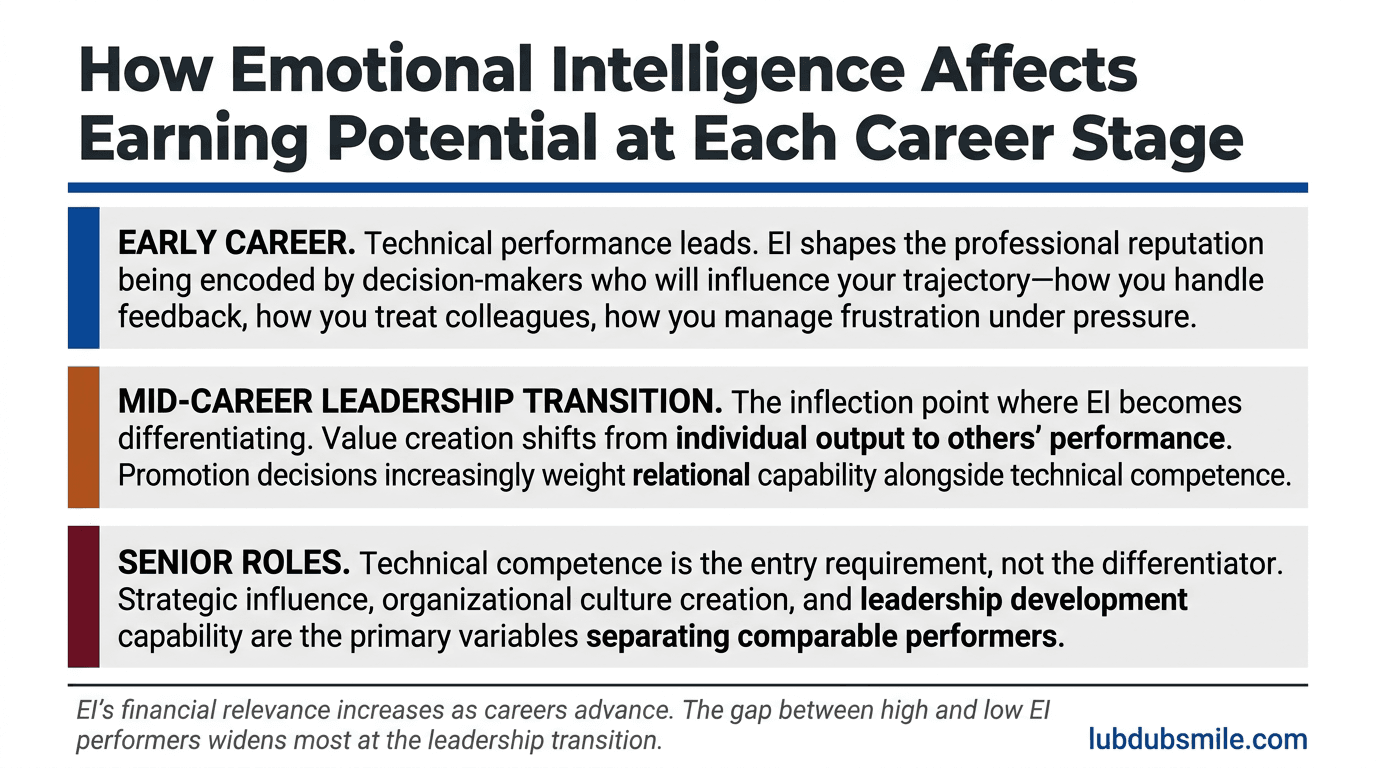
Early in a career, the emotional intelligence variable that matters most is how you build your initial professional reputation. Technical performance leads. Relational patterns, however, are being observed and encoded by people who will influence your trajectory. How you handle feedback, how you treat support staff, how you manage frustration when things go poorly, how you relate to people with more organizational power these patterns create the reputation that follows you.
Early career is when it’s easiest to develop emotional intelligence and earning potential habits together and when reactive patterns can be changed before they become deeply associated with your professional identity. Resources on building emotional regulation skills and emotional agility provide structured starting points for this work. Learning how to improve emotional intelligence for career advancement is more effective at this stage because the stakes are lower and behavioral patterns are more flexible.
Mid-Career: The Leadership Transition Where EI Becomes Differentiating
The transition from individual contributor to people leader is where emotional intelligence becomes most explicitly differentiating. Technical expertise that produced excellent individual results doesn’t automatically translate into the ability to develop and direct others’ excellence. The skills required shift: less doing, more developing; less demonstrating, more creating conditions for others to succeed.

This transition is where technically strong careers often plateau when emotional intelligence development hasn’t kept pace. Individual performance gets rewarded with management responsibility, but management requires a different capability set. Those who develop that set advance. Those who don’t tend to remain in senior individual contributor tracks which may be appropriate but represents a different earning ceiling.
High achievers navigating this transition frequently encounter a specific and underexamined challenge: emotional vulnerability as a professional asset a capacity they were rarely taught to recognize or use.
Senior Roles: When Technical Skills Are Table Stakes
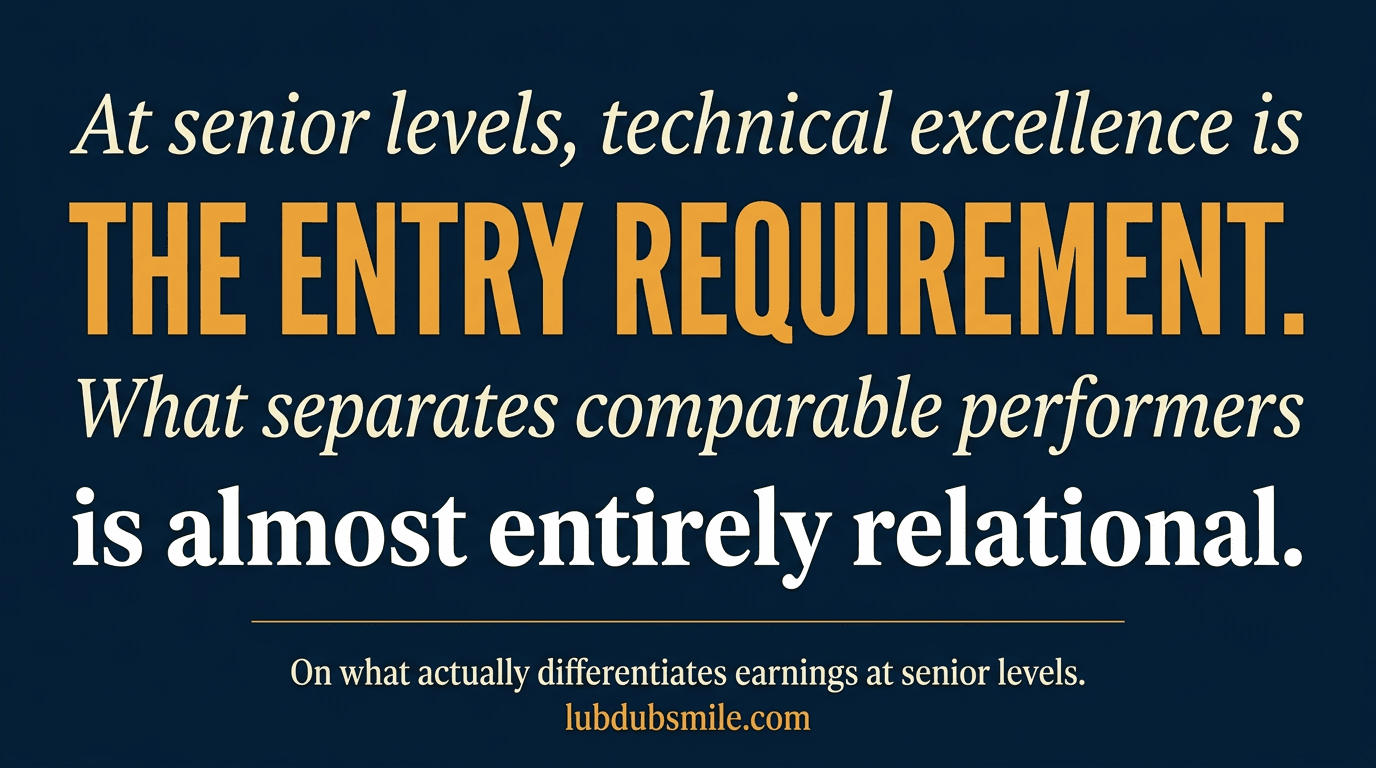
At senior levels, everyone under consideration has demonstrated technical competence. That is the entry requirement. What differentiates senior candidates is almost entirely relational and leadership capability: strategic influence across stakeholder groups, the ability to create organizational cultures that perform, the capacity to develop other leaders, and the judgment to navigate complex interpersonal and political dynamics effectively. Emotional intelligence leadership effectiveness the ability to produce results through relational capability rather than individual output is the differentiating variable at this level.
The financial premium for measurably strong emotional intelligence at this level defined in terms of leadership outcomes is substantial and well-supported in research. The C-suite premium for leaders who create genuinely high-performing organizational cultures is real and documented.
The same relational capability gaps that limit emotional intelligence and earning potential at this level often create friction at home. High-achieving couples frequently discover that communication breakdowns at work and at home share a common origin.
Entrepreneurship: Team Capacity as Revenue Constraint
For entrepreneurs, the financial relevance of emotional intelligence and earning potential appears in a specific and measurable way: team-building and retention capacity determines how far a business can grow beyond the founder’s personal output. Founders whose leadership creates high-turnover teams, who can’t attract or retain senior talent, or who create cultures where honest information doesn’t reach them face a revenue constraint that is directly relational in origin.
The ceiling on an entrepreneur’s business is often their ceiling as a leader of people. Emotional intelligence development in this context is a direct business growth investment. Sustained healthy aging and performance maintenance also play a role for founders navigating the physical and cognitive demands of long-term leadership.
The Career Plateau: When Technical Competence Stops Advancing You

The Pattern: High Output, Stalled Advancement
The pattern is recognizable enough to name: sustained excellent technical performance, consistent delivery, genuine competence and advancement that plateaus or moves more slowly than that output seems to warrant. Multiple cycles of this pattern, without clear technical explanation, is information worth taking seriously. Career plateau reasons are varied structural factors, timing, and opportunity gaps all play a role. But when the pattern persists, it’s worth examining all variables honestly.
The instinct to explain the plateau through organizational politics, favoritism, or timing may occasionally be accurate but it’s also the explanation that requires the least self-examination. Structural factors including bias, limited opportunity, and network disadvantage are real and shouldn’t be dismissed. When the pattern persists across multiple cycles, roles, and organizations, however, the common variable is the person, not the context.
The Feedback You’re Receiving (And May Be Dismissing)
Performance feedback about leadership presence, stakeholder management, communication style, or interpersonal effectiveness is emotional intelligence-relevant feedback. When it appears consistently and consistently gets dismissed as secondary to technical output, the dismissal itself deserves examination whether it reflects accurate analysis or defensive protection.
The feedback that’s hardest to hear accurately is typically the feedback most worth hearing. People with lower self-awareness one of the four core emotional intelligence domains characteristically overestimate their interpersonal effectiveness, which makes the feedback feel inaccurate even when it isn’t.
360-degree feedback from direct reports, peers, and stakeholders typically provides a more accurate picture of emotional intelligence-relevant behaviors than self-assessment or supervisor-only feedback. Operating without that data means making development decisions with incomplete information about your actual professional reputation.
Specific EI Gaps That Most Affect Earnings
The three emotional intelligence gaps below carry the greatest financial consequences across career stages:
- Low self-awareness the gap you can’t see
- Emotional reactivity the gap that damages credibility in real time
- Difficulty reading rooms the gap that quietly limits influence
Low Self-Awareness: The Gap You Can’t See
Self-awareness is simultaneously the most foundational emotional intelligence competency and the one most resistant to self-detection. If you accurately understood how you come across in professional situations, the gap would already be addressed. The characteristic of low self-awareness is that your internal experience of your behavior doesn’t match others’ experience of it.
Common manifestations: consistently underestimating the impact of your communication on others, being surprised when you learn how others experience you, assuming that because you didn’t intend something its impact doesn’t matter. In career terms, this gap produces a systematic blind spot about the relational costs of certain behaviors costs that accumulate in reputation and relationship quality over time.
Emotional Reactivity and Professional Credibility
Visible emotional reactivity frustration that shows, defensiveness that’s apparent, irritability that others have to manage around creates a specific kind of professional reputational damage that’s difficult to overcome because it’s viscerally remembered.
A person who reacts visibly to challenge communicates something specific about what high-pressure collaboration with them looks like. Decision-makers extrapolate from observed behavior to predicted behavior in more demanding future roles. One memorable reactive episode can shape perception for months or years.
Difficulty Reading Rooms and Organizational Dynamics
Social awareness the ability to accurately read what’s happening in a room, in a conversation, in an organization is a navigational asset in complex organizational environments. People who consistently misread dynamics, miss political currents, or fail to notice how their contributions are landing are less effective organizational operators regardless of their technical contribution.
At senior levels, organizational navigation is part of the job description, even when it’s not explicitly listed. Failure here doesn’t show up as a specific incident it shows up as a pattern of initiatives that don’t gain traction, relationships that don’t develop, and influence that plateaus.
Assessing Your Own EI (Honestly)
Why Self-Assessment Has Significant Limitations
Self-report emotional intelligence instruments even well-branded commercial ones have fundamental validity limitations because they depend on accurate self-perception. Research on self-assessment accuracy consistently finds that adults with lower emotional intelligence are more likely to overestimate it. This creates a systematic problem: the people who most need accurate emotional intelligence assessment are those least likely to obtain it through self-report tools.
Self-assessment isn’t useless patterns in self-perception are themselves meaningful. It should be treated as one data source, not a reliable independent measure.
Using 360-Degree Feedback as Reliable Data
360-degree feedback, when implemented with genuine confidentiality and respondent candor, provides behaviorally grounded information that self-assessment cannot. Specifically: patterns in how others experience your communication, leadership, and interpersonal behaviors that you cannot observe from inside your own perspective.
If you have access to this kind of data and haven’t examined it analytically for emotional intelligence-relevant patterns, you’re making development investment decisions without complete information.
What Your Career History Reveals
Your career history specifically, patterns across roles, relationships, and organizations is behavioral evidence about your emotional intelligence and earning potential trajectory. Recurring patterns in feedback, recurring interpersonal difficulties, recurring relationship outcomes, recurring results in high-pressure situations: these patterns are more reliable emotional intelligence evidence than self-assessment because they’re outcomes in the world rather than introspective reports.
Examining your career history analytically what patterns recur, what you’re consistently commended for, what feedback has appeared in multiple contexts provides emotional intelligence data that doesn’t require a validated instrument.
Developing EI as Career Strategy
What EI Development Actually Requires
Significant emotional intelligence development requires behavioral practice in real situations, feedback on actual behavior, and the discomfort of operating differently than habitual patterns suggest. Reading about emotional intelligence has limited behavioral impact without accompanying practice and feedback development is not primarily an intellectual exercise.
The Center for Creative Leadership’s research on leadership development emphasizes that developmental experiences particularly challenging roles, feedback from others, and hardships that require adaptation produce more emotional intelligence growth than training programs alone. The practical implication: seek roles and situations that stretch relational capability, deliberately pursue feedback on interpersonal effectiveness, and work in contexts that require emotional intelligence application. A growth mindset toward career development treating relational capability as learnable rather than fixed supports this process.
Therapy and Coaching for EI Development: Different Roles
Both therapy and professional coaching can support emotional intelligence development, but they serve different functions.
Therapy is appropriate when emotional intelligence limitations connect to patterns with deep personal or emotional origins reactive patterns linked to attachment history, emotional regulation challenges connected to anxiety or other clinical factors, or difficulty with self-awareness that has roots in formative experience. The emotional depth of therapeutic work can address the underlying patterns that produce surface behavioral limitations. Executive therapy programs often address exactly these patterns in high-performing professionals who haven’t previously engaged with therapeutic support.
Professional coaching particularly from coaches with training in behavioral feedback and leadership development addresses the career application of emotional intelligence: how specific behaviors land professionally, how to develop specific relational competencies, and how to navigate high-stakes situations more effectively.
For serious emotional intelligence development as career investment, both pathways carry legitimate value often serving different components of the work. Professionals can also explore telehealth therapy options that provide access across state lines with greater scheduling flexibility.
Books and Frameworks Worth the Investment
Daniel Goleman’s Emotional Intelligence and Primal Leadership co-authored with Boyatzis and McKee provide foundational frameworks with practical career application. Emotional Intelligence 2.0 by Bradberry and Greaves, while more popular than academic, offers practical development strategies. For more rigorous academic grounding, exploring Mayer, Salovey, and Caruso’s ability-based emotional intelligence framework provides a more scientifically defensible foundation for understanding what emotional intelligence measurement actually means.
Read emotional intelligence literature with analytical scrutiny. Not all claims survive methodological examination. Useful frameworks don’t require accepting every claim their proponents make. The attachment theory book comparison on LubDubSmile offers a related reading framework for understanding the relational patterns that often underlie emotional intelligence gaps.
Frequently Asked Questions
Can EI actually be developed, or is it fixed?
Yes, adults can develop emotional intelligence. The degree and pace of development varies significantly by component and individual. Self-awareness and social awareness show more reliable development with feedback and coaching than more automatic components like emotional reactivity, which involves nervous system patterns requiring more sustained practice. Carol Dweck’s growth mindset research at Stanford supports the broader principle that capacities treated as developable tend to develop more than those treated as fixed though her work is not emotional intelligence-specific. Claiming emotional intelligence develops fully or quickly would be overclaiming. Claiming it’s fixed would also be inaccurate.
How long does EI development take to affect career outcomes?
Meaningful behavioral shifts typically require months of sustained practice. Reputation effects of those behavioral changes lag the changes themselves reputations update more slowly than behaviors do. Most emotional intelligence programs imply faster timelines than research supports. For significant career impact, emotional intelligence development is a multi-year investment with compounding return rather than a quarter’s initiative.
Is a high IQ more valuable than high EI at senior levels?
Neither is categorically more valuable. What changes is the marginal return on each. At senior levels where everyone meets a cognitive threshold, additional IQ points carry diminishing marginal career return while emotional intelligence capability carries increasing marginal return because value creation at that level increasingly depends on relational and leadership capability. IQ doesn’t become irrelevant at senior levels. Both matter. The differentiating variable increasingly is emotional intelligence.
How do I know if my EI is limiting my career?
Look for these signals:
- Recurring feedback about interpersonal or leadership effectiveness across multiple sources
- Advancement that has plateaued without obvious technical explanation
- Patterns of relationships that don’t develop or deteriorate under pressure
- Consistent difficulty influencing without authority
- Team retention or engagement challenges that repeat across roles
One or two of these may reflect contextual factors. Patterns across time and context carry more weight than isolated incidents.
Does EI matter differently across gender in the workplace?
Yes, and this warrants clear acknowledgment. Research on emotional intelligence expression in organizational contexts shows that organizations often reward emotional competencies differently depending on who demonstrates them. Assertiveness and emotional expression receive different evaluations based on the gender of the person demonstrating them. An emotional intelligence development strategy that ignores organizational gender dynamics would be incomplete. People who identify as women in particular face situations where developing certain emotional intelligence competencies may be necessary but not sufficient for equitable advancement, given structural and bias-related barriers. Emotional intelligence is one variable in career advancement it doesn’t operate outside of structural context.
The Long-Term Professional Investment Case
What the Evidence Supports (And Doesn’t)
The evidence supports the following: emotional intelligence and earning potential connect meaningfully, particularly in leadership roles and roles with significant interpersonal demands. The contribution is strongest through specific mechanisms leadership effectiveness, team performance, client relationship quality, and organizational influence. Emotional intelligence becomes increasingly differentiating as careers advance. Development is possible, though it requires sustained effort and often external support.
The evidence does not support that emotional intelligence accounts for specific percentages of success or earnings with any precision; that emotional intelligence development guarantees advancement; that emotional intelligence matters equally across all roles and industries; or that emotional intelligence alone determines outcomes when structural factors including bias and opportunity also operate.
Making development investment decisions on the accurate version of the evidence is more useful than making them on the inflated version because accurate expectations produce more targeted strategy and more realistic timelines.
Treating EI Development as Portfolio Investment
The investment framing that analytically-minded professionals often find most useful: emotional intelligence development is a capability investment with compounding career return, highest marginal value in the leadership transition zone, and realistic timelines of years rather than months.
Like any portfolio investment, the return depends on consistent contribution over time, the quality of the investment vehicle meaning the development approach and how well the investment matches your specific career stage and goals. Treating emotional intelligence development as a one-time program purchase or a quarter’s initiative produces different outcomes than treating it as sustained professional capability building.
For professionals at or approaching the leadership transition where technical skills are becoming table stakes and emotional intelligence and earning potential are becoming inseparable the ROI case for sustained emotional intelligence investment is among the strongest available in professional development.
Emotional intelligence and earning potential grow together and the gap widens most at the leadership transition.
Self-assessed emotional intelligence has significant limitations. For meaningful measurement, validated instruments administered by qualified professionals provide more reliable data than self-report tools.
This content is for educational purposes and does not substitute for professional psychological or therapeutic help.