How Top Content Creators Prevent Burnout: Sustainable Strategies for Digital Professionals
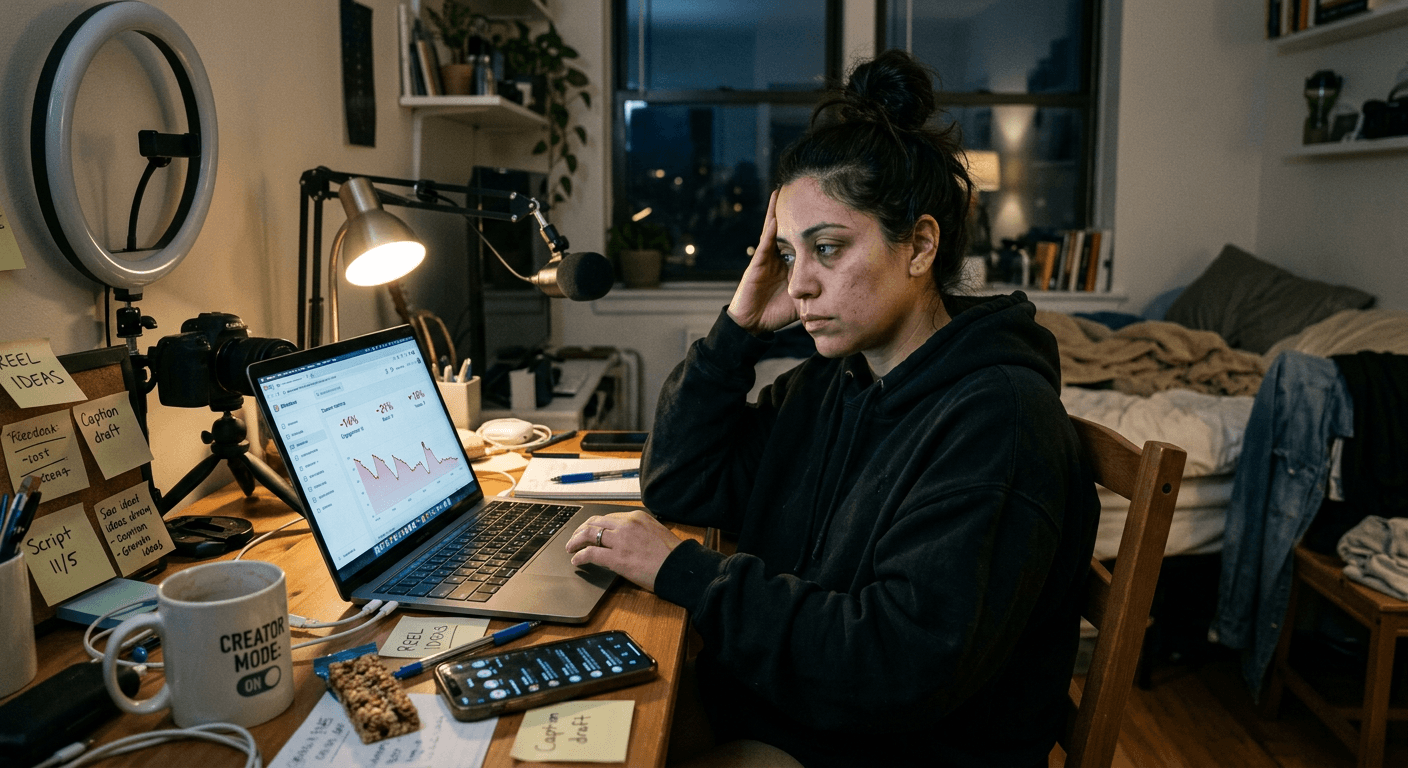
Creator burnout prevention starts with recognizing what’s happening. You haven’t posted in three days, and the anxiety is building. Your views are dropping. DMs have questions you haven’t answered. You open your drafts folder, stare at half-finished content, and feel nothing not excitement, not creativity, just a hollow obligation to produce something, anything, before the algorithm forgets you exist.
If this sounds familiar, you’re not weak. You’re not failing. You’re experiencing something that affects creators across every platform, at every level of success, across every niche. This reality is structurally built into the very economy you’re trying to thrive in.
This article doesn’t offer miracle cures or hustle-harder frameworks. It offers honest, evidence-informed strategies for sustainable content creation ones that acknowledge the genuine pressures of the creator economy while giving you practical tools to protect your energy, creativity, and wellbeing.
The Reality of Creator Burnout (It’s Not Just You)
Why Content Creation Is Uniquely Exhausting
Traditional jobs have clear boundaries. You clock in, you work, you clock out. Your personal life remains separate from your professional output.
Content creation erases those boundaries almost entirely. Your experiences, relationships, thoughts, and daily life become raw material. Your face, voice, and personality are the product. When you’re depleted personally, you’re depleted professionally and there’s no separating the two.
Additionally, content creation combines multiple demanding roles simultaneously: creator, editor, marketer, community manager, brand strategist, business owner, and sometimes customer service representative. The cognitive load is enormous, and most of it is invisible to audiences who see only the polished final product. Understanding cognitive performance optimization can help frame why this mental load matters.
Algorithm Pressure, Audience Expectations, and Always-On Culture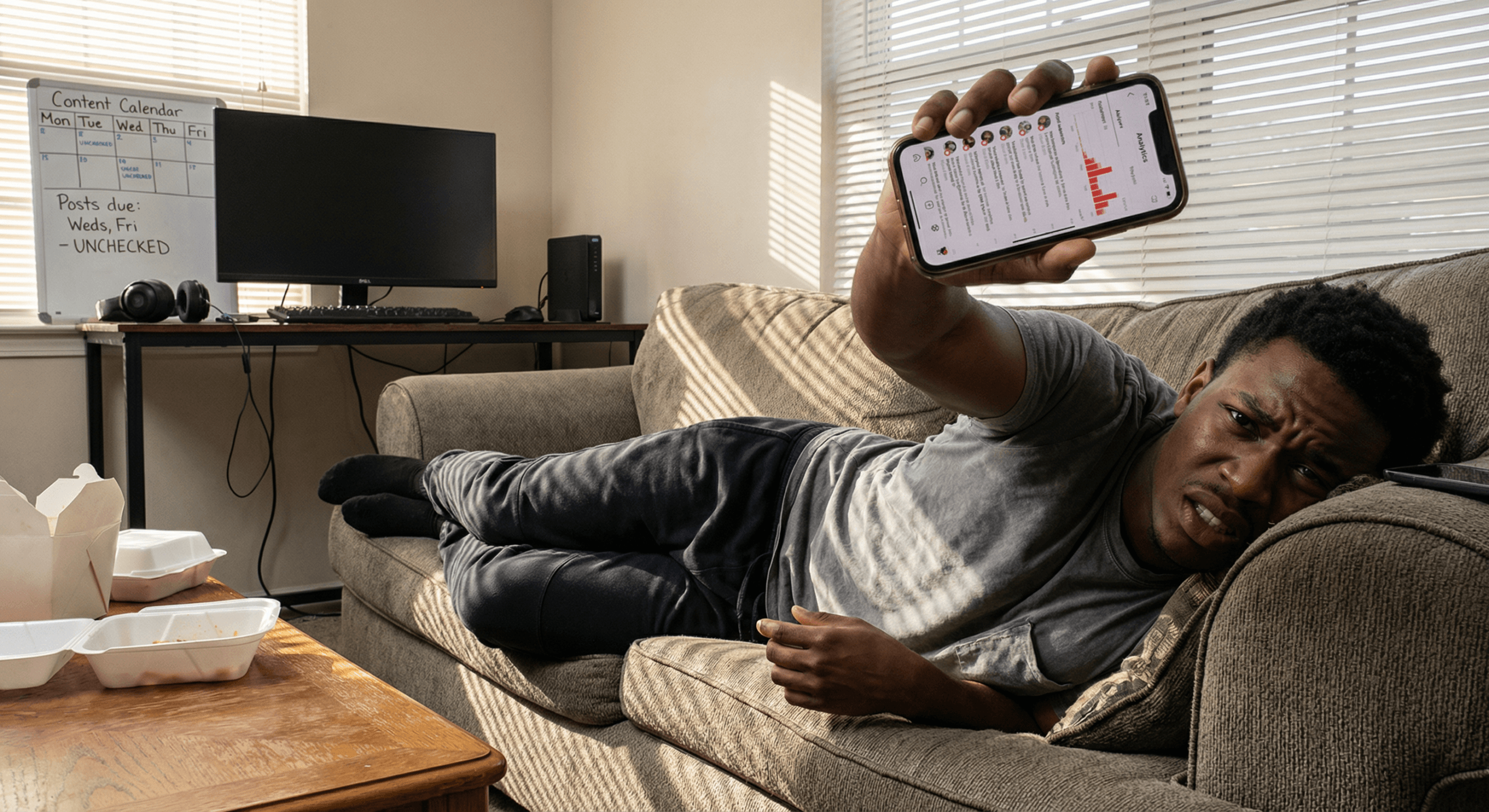
Platforms are designed to reward relentlessness. YouTube favors consistent uploaders. TikTok’s algorithm pushes recent content to new audiences. Instagram penalizes posting gaps. Podcasts that skip weeks lose rankings.
This creates structural pressure that isn’t imaginary your income and visibility genuinely can be affected by taking breaks. Knowing this, many creators push through exhaustion, ignoring their body’s signals because the algorithm doesn’t care whether you’re tired, sick, grieving, or burned out.
Simultaneously, audiences can develop expectations of constant access. Regular posting trains followers to expect regularity. Comments asking “Where have you been?” can feel like pressure even when they’re well-intentioned. Some creators describe feeling owned by their audiences obligated to produce regardless of their personal wellbeing.
The Myth That Passion Prevents Burnout
“Love what you do and you’ll never work a day in your life.” This cultural myth is particularly harmful for creators, because it implies that burnout signals you’ve lost passion for your craft.
Research on burnout, including the foundational work of psychologist Christina Maslach, consistently shows that passion doesn’t protect against burnout. In fact, people most passionate about their work are often most vulnerable to burnout, precisely because they’re willing to push through warning signs out of love for what they do.
You can love creating videos and still dread opening your editing software. Genuine enjoyment of connecting with your audience can coexist with exhaustion from their expectations. These aren’t contradictions they’re how creator burnout prevention becomes necessary.
Survivorship Bias: What We Don’t Hear
When we look for inspiration from successful creators, we’re looking at survivors people who built sustainable careers and are still standing to talk about it. We rarely hear from creators who burned out and quit, walked away from audiences they’d built over years because the cost to their mental health was too high, or loved creating but couldn’t sustain it under platform pressures.
This survivorship bias shapes available advice. What worked for creators with teams, stable income, and years of built-in momentum may not apply to someone just starting out or working full-time while building their audience.
Recognizing Burnout vs. Normal Creative Fatigue
Creative fatigue is normal and temporary a natural ebb in motivation that resolves with rest. Burnout is more persistent and pervasive. Creator burnout prevention requires knowing the difference.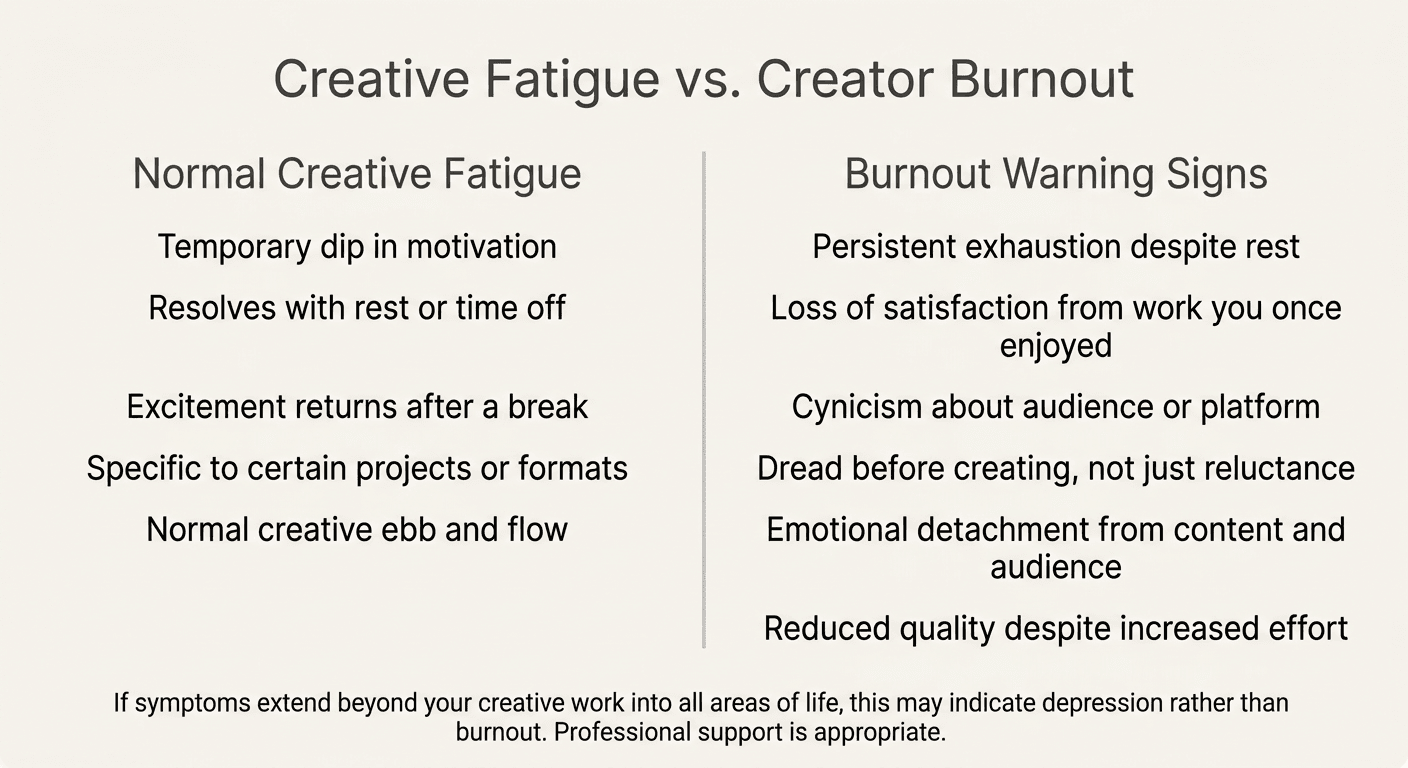
Signs that what you’re experiencing may be burnout rather than normal creative fatigue:
- Persistent exhaustion that doesn’t improve with rest or time off
- Loss of satisfaction from content you previously enjoyed making
- Cynicism about your audience, platform, or work
- Dread before creating rather than occasional reluctance
- Reduced quality or effectiveness despite maintaining or increasing effort
- Emotional detachment from content performance and audience connection
If you’re also experiencing persistent low mood, loss of interest in things beyond content creation, difficulty functioning in daily life, or thoughts of self-harm, these may indicate depression rather than burnout and professional mental health support is appropriate.
What Actually Causes Creator Burnout
The Consistency Trap
Algorithms reward creators who post consistently, creating a treadmill effect you post because you need to post, not because you have something meaningful to share. Volume pressure replaces quality standards. The joy of creating something you’re proud of gets replaced by anxiety about meeting posting schedules.
This trap is real and systemic, not a personal weakness. Creator burnout prevention means recognizing when consistency has become compulsion.
Creative Depletion: Output Exceeding Input
Creativity requires input. Reading, experiencing, observing, resting, being bored these feed the creative process. When output consistently exceeds input, creative depletion follows.
Many creators spend so much time creating content about their lives that they stop actually living their lives. They’re always in production mode noticing content opportunities, filming, planning rather than fully experiencing moments. This depletion of raw material eventually depletes creativity itself.
Blurred Boundaries Between Work and Life
When you’re on vacation but spending it creating content about being on vacation, the boundary between your life and your work has dissolved. This specific form of burnout risk affects creators more acutely than most professionals.
Your relationships, struggles, family moments, and personal experiences may feel like they need to be shared, documented, or monetized. Over time, this can feel extractive like you’re mining your own life for content rather than living it for yourself. Practicing emotional hygiene can help maintain separation between your inner world and your professional output.
Audience Relationship Complexity
The parasocial relationship audiences develop with creators creates unique pressure. Audiences feel they know you. They may feel entitled to your time, transparency, response to their messages, or explanation when you’re absent. Managing thousands of relationships even one-directional ones is emotionally taxing.
Criticism, meanwhile, can feel personal in ways that workplace criticism rarely does. Someone criticizing your content often criticizes your appearance, personality, or choices. Over time, this can erode confidence and make creating feel psychologically risky.
Mindset Shifts That Support Creator Burnout Prevention
Redefining Success Beyond Metrics
Metrics views, followers, engagement rate, revenue are useful data points, not the totality of your worth or success. Creators who sustain long careers often describe gradually loosening their attachment to numbers and reanchoring their sense of success in:
- Work they’re proud of regardless of performance
- Genuine connections with some portion of their audience
- Skills developed and creative growth
- Consistency with values about what and how they create
- The sustainability of their practice over time
This doesn’t mean ignoring metrics they matter for business decisions. It means not letting them determine how you feel about yourself or your work.
Detaching Self-Worth from Content Performance
Content performance is influenced by timing, algorithm changes, platform priorities, cultural moments, and countless variables beyond your control. A video flopping doesn’t mean you failed. A post going viral doesn’t mean you’ve achieved meaningful success. When your self-worth fluctuates with content performance, you’ve outsourced your emotional wellbeing to systems that don’t care about you.
Building emotional regulation skills supports the capacity to separate content metrics from personal value.
Permission to Create at a Sustainable Pace
Many creators feel they’re constantly behind not posting enough, not growing fast enough, not capitalizing enough on trends. This creates chronic urgency that’s cognitively and emotionally exhausting.
Creators who sustain long careers often describe a turning point where they gave themselves permission to create at a pace they could maintain indefinitely, rather than a pace requiring continuous sacrifice. Creator burnout prevention depends on this shift from sprint mentality to marathon thinking.
Embracing Long-Term Career Thinking
The creators still making content 10 years from now likely aren’t the ones burning brightest today at the cost of their health. Long-term career sustainability often requires accepting slower growth than what’s theoretically possible with maximum effort.
The question isn’t “How much can I output this month?” It’s “What pace can I sustain for the next decade?”
Boundaries That Actually Protect Creators
Scheduled Off-Hours
“I’ll rest when I feel like it” rarely works in an algorithmically driven environment because there’s always another video to make, another comment to respond to, another trend to address. Scheduled off-hours protected from work regardless of what’s happening with your content provide actual recovery.
This might look like no content work after a specific time each day, two days per week entirely free from creating, planning, and analytics, or clear rules about when you check platform notifications.
Platform Consumption Boundaries
There’s an important distinction between creating content and consuming it. If you’re scrolling your niche for hours daily, you’re likely experiencing more comparison and anxiety than inspiration. Many creators find intentional limits on platform consumption significantly reduce anxiety and support creator burnout prevention.
Comment and DM Boundaries
You are not required to respond to every comment or message. Many creators set specific windows for engagement and don’t respond outside those times protecting their off-hours from the endless pull of audience management.
Some creators turn off comments on certain posts, moderate actively, or use keyword filters to reduce exposure to harmful content. These aren’t failures to engage they’re necessary boundary-setting.
Protecting Private Life
Not everything needs to be content. Keeping certain relationships, experiences, and parts of your life entirely private protects you from fully mining your own life for material. It also preserves space that’s genuinely yours.
Many creators describe deliberately keeping major relationships, struggles, or personal developments off-camera, not because they’re being inauthentic, but because they need something that remains theirs alone. This boundary is essential for creator burnout prevention.
Communicating Boundaries to Your Audience
When you’re honest with your audience about boundaries “I take weekends off and won’t be responding to messages then,” “I don’t share details about my family,” “I’m taking two weeks off and will return on this date” most audiences respond positively. Transparency normalizes the fact that you’re a person, not a content-producing machine.
Learning how to set boundaries without guilt can inform your approach to audience boundary communication, even though the contexts differ.
Systems That Reduce Creative Exhaustion
Content Batching
Rather than creating content in real-time response to daily pressure, batching involves producing multiple pieces of content in dedicated creation sessions. This approach offers several advantages for creator burnout prevention:
- Getting into creative flow and sustaining it across multiple pieces
- Building buffer so you’re not always posting freshly created content
- Reducing cognitive switching between creation mode and regular life
- Giving yourself scheduled recovery periods between creation sessions
Knowing Your Minimum Viable Output
What’s the least you can publish while maintaining your audience relationship and platform presence? Knowing your minimum viable output allows you to have a realistic floor for difficult periods, stop treating maximum output as your baseline expectation, and recover from burnout without abandoning your audience entirely.
Some creators discover that posting half as often affects their growth far less than they feared and that their mental health improvement more than compensates for the modest performance difference.
Repurposing Strategically
One piece of substantive content can become many. A long-form YouTube video becomes a podcast episode, a newsletter, clips for TikTok and Instagram, and quotes for Twitter. Rather than creating different content from scratch for every platform, strategic repurposing multiplies impact while limiting total creation effort.
Building Buffer Into Your Calendar

Creating a content buffer several pieces ahead of schedule means that when life happens (illness, family demands, creative blocks, bad mental health days), you have something to publish without creating under pressure.
Creators who always post same-day have zero recovery room. Those with two to four weeks of buffer have substantially more flexibility to rest, recover, or pivot without audience interruption.
When to Outsource or Build Support
If your content income allows it, outsourcing time-intensive but non-creative tasks video editing, thumbnail design, scheduling, transcription can significantly reduce workload without compromising your creative voice. Even one task removed from your plate can meaningfully reduce burnout risk.
Many creators resist this because it feels like admitting they can’t do everything. Recognizing the value of delegating without guilt reframes outsourcing as smart resource management.
Protecting Creative Energy (Input vs. Output)
Why Consuming Feeds Creativity
Rest isn’t wasted time it’s input. Reading books outside your niche, watching films, visiting new places, having conversations unrelated to your content, being bored enough that your mind wanders these fill the reservoir that output drains.
Creators who produce constantly without consuming broadly often notice creative flattening content that technically gets made but lacks the originality, depth, or enthusiasm that built their audience in the first place.
Hobbies and Interests You Don’t Monetize
One of the most protective things a creator can maintain is at least one hobby or interest they deliberately don’t turn into content. Something pursued purely for enjoyment, without audience, analytics, or monetization.
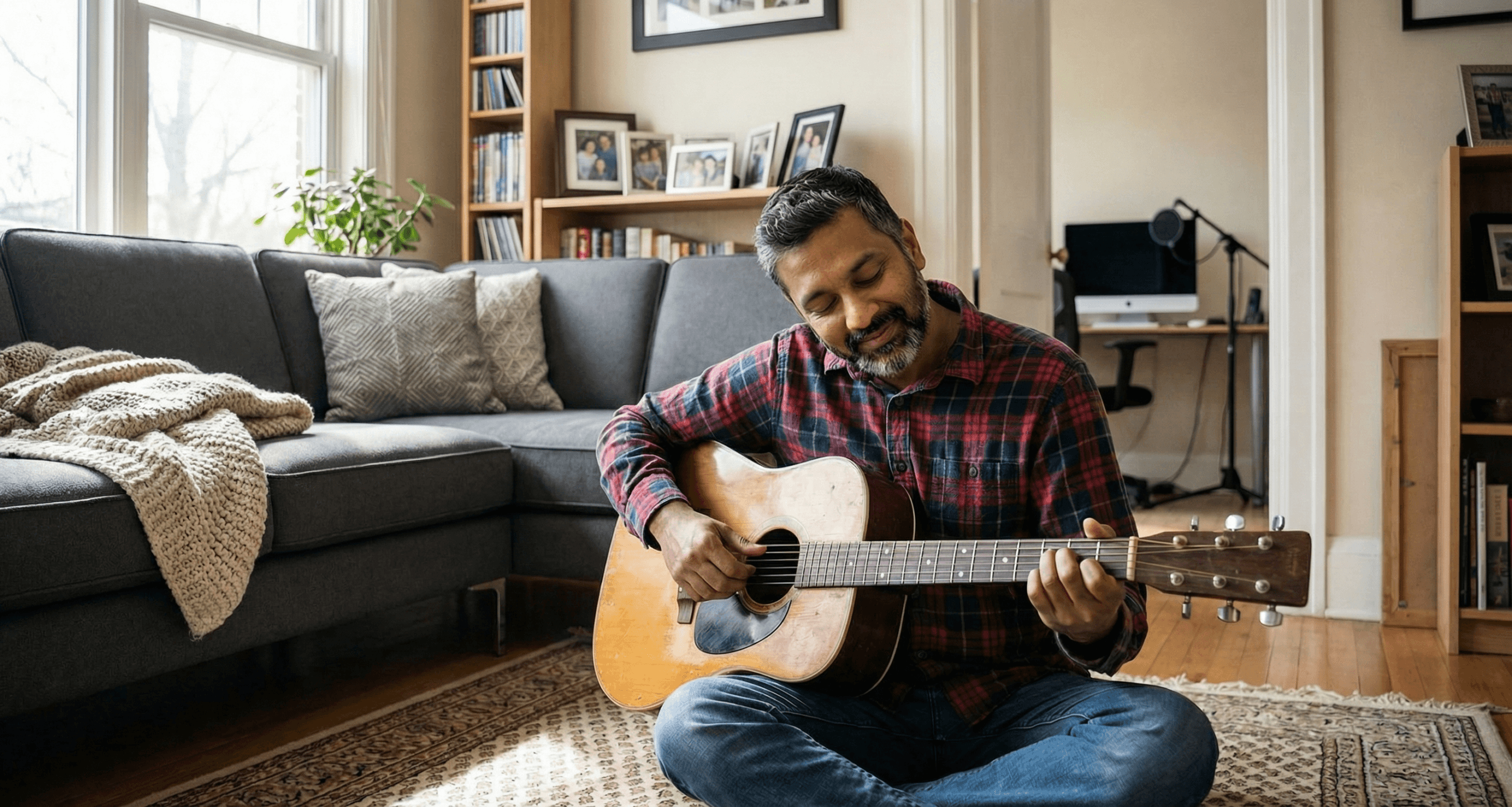
When every interest becomes content potential, you lose the ability to have private enjoyment. Protecting one space of pure personal interest preserves something essential the experience of doing things for yourself rather than for your audience.
Creating for Fun (Projects Nobody Sees)
Some creators maintain private creative projects writing no one reads, photography no one sees, videos made purely for themselves. This preserves intrinsic motivation that likely drew you to creating in the first place, separate from extrinsic pressures of audience and algorithm.
Social Connection Outside Your Audience
Your audience is not your community, even if it feels that way. Parasocial relationships flow primarily in one direction. Real social connection with people who know you personally and aren’t consuming you as content is cognitively and emotionally distinct.
Protecting time for genuine relationships outside your creator identity is essential for long-term wellbeing and creator burnout prevention.
Handling Algorithm Anxiety and Platform Pressure
Algorithm Changes Aren’t Personal
Platforms adjust algorithms for business reasons that have nothing to do with your content quality or your worth as a creator. Reach drops happen to everyone, including creators with millions of followers. Understanding this doesn’t eliminate the pain of losing momentum, but it helps prevent the catastrophizing and shame that often accompanies it.
Diversifying Platforms and Income
Platform dependence is one of the most significant burnout risks when your entire income depends on one platform’s algorithm, every algorithm change feels existential. Diversifying across platforms, and diversifying income sources (brand partnerships, digital products, memberships, consulting, licensed content), reduces the stakes of any single platform’s changes.
Building Owned Audiences
Email lists and direct communities aren’t subject to algorithm changes. A creator with 50,000 email subscribers has something more stable than a creator with 2 million Instagram followers and no other audience connection. Building owned audience relationships provides a buffer against platform dependence and supports creator burnout prevention.
Defining Your Own Metrics
Instead of letting platforms define success through their metrics, some creators define their own: revenue per post rather than views, quality of audience engagement rather than quantity, growth in email subscribers rather than platform followers, and work satisfaction rather than virality.
This doesn’t mean ignoring platform metrics it means they’re one data point rather than the scoreboard of your worth.
Taking Breaks Without Destroying Your Career
What Actually Happens When Creators Take Breaks
Many creators who take planned breaks discover consequences are less severe than feared. Loyal audience members return and sometimes engage more warmly after the absence. Platform reach dips and then recovers, often faster than expected. Mental health improvements from rest translate to better content quality and renewed motivation. The break provides perspective that improves strategic thinking.
This doesn’t mean breaks have zero consequences sometimes they do affect growth trajectories. But chronic burnout has worse long-term consequences than a planned, communicated break.
Communicating Breaks to Your Audience
Telling your audience you’re taking a break explaining that you need rest or time to recharge tends to humanize you and build goodwill. Most audiences don’t want to consume content made by someone running on empty. Many creators report their communication about breaks becoming some of their most engaged content, because it’s authentic and relatable.
Regular Rest Cycles vs. Crash-and-Recover Patterns
The creator who works relentlessly until they crash, takes an emergency break, recovers slightly, and repeats the cycle is caught in a pattern that compounds over time. Each crash takes longer to recover from. Each return requires more energy to rebuild.

Sustainable creators tend to build regular, planned rest into their schedule weekly recovery time, seasonal slower periods, annual extended breaks rather than waiting until they break down. Understanding burnout recovery approaches reinforces why proactive rest outperforms reactive collapse.
When Self-Help Strategies Aren’t Enough
Signs You Need Professional Support
Individual strategies have limits. Creator burnout prevention through self-help reaches its ceiling when symptoms persist despite meaningful rest and boundary changes, when anxiety about your content career affects your sleep, relationships, or physical health, when you’re using unhealthy coping mechanisms to manage creator stress, or when you’ve lost interest in things you care about beyond content creation.
When Burnout Becomes Depression or Anxiety
Burnout and clinical depression share symptoms exhaustion, lack of motivation, reduced performance but they’re distinct conditions requiring different approaches. Burnout primarily relates to work stress. Depression affects all areas of life and involves neurobiological factors that self-help strategies alone may not address.
If you’re uncertain which you’re experiencing, a mental health professional can help clarify and provide appropriate support. Research from the American Psychological Association offers frameworks for understanding the distinction. Therapy isn’t reserved for crisis it’s valuable support for high-pressure careers like content creation.
Considering Career Pivots Without Shame
Sometimes the sustainable answer is change a different platform, a different content format, a different niche, or transitioning away from creator income entirely. This isn’t failure. It’s recognizing that what you wanted from content creation has changed, or that structural demands have become incompatible with your wellbeing.
Many creators who’ve transitioned or pivoted report relief they didn’t expect and often find ways to create that are healthier than the model they left.
Frequently Asked Questions
Can I sustain content creation long-term, or is burnout inevitable?
Burnout isn’t inevitable, but it’s common particularly among creators who don’t intentionally build sustainability practices early. Sustainable long-term creation usually requires deliberate systems, boundaries, and periodic reassessment of how and why you’re creating. Creator burnout prevention is an ongoing practice, not a one-time fix.
How do I take breaks without losing my audience?
Communicate breaks in advance, explain them honestly, and if possible, schedule a return date. Build content buffer before your break so you have something to post even while resting. Transparent communication about needing rest resonates with audiences and generates goodwill rather than resentment.
What if my income depends on constant posting?
Income dependence is one of the most challenging aspects of creator burnout. If you’re in this situation, focus on building buffer, diversifying income streams, and gradually establishing minimum viable output that’s sustainable, rather than trying to immediately solve the income-posting tension.
Is creator burnout different from regular job burnout?
Yes, in several meaningful ways. Creator burnout involves blurred personal-professional boundaries, audience relationship management, income instability tied to output, algorithm pressure, and the unique experience of monetizing your own personality and life. It also occurs without traditional workplace support structures no HR department, no sick leave, no team to distribute load during difficult periods.
How do I know if I should quit or just need a break?
Temporary burnout and genuine unsustainability can look similar in the acute moment. If possible, take an actual break not a reduced posting week, but real rest before making major career decisions. Decisions made while burned out often don’t reflect your considered preferences. If after meaningful rest you still feel certain that content creation is incompatible with your wellbeing, that’s more reliable information.
Moving Forward: Sustainable Creation Is Possible
Sustainability Is Individual
There’s no universal formula for sustainable content creation. What works depends on your platform, content type, income situation, personality, audience, personal circumstances, and what you actually want from your creator career. Treat other creators’ strategies as data points rather than prescriptions.
Systemic Issues Aren’t Your Fault
Creator burnout prevention requires acknowledging that burnout is both a systemic problem created by platform structures rewarding relentlessness and punishing rest and an individual challenge requiring personal response. Both things are true: the system creates unreasonable pressure, and your individual choices about boundaries, systems, and pace significantly influence your sustainability.
Resources That May Help
For readers wanting to explore sustainable creative practice further, several evidence-based resources address burnout and sustainable work from different angles. Emily and Amelia Nagoski’s Burnout examines the stress cycle and how to complete it. Seth Godin’s The Practice offers a framework for showing up creatively without tying your identity to outcomes. Paul Jarvis’s Company of One challenges the assumption that growth is always the goal.
If you’re experiencing symptoms of burnout, depression, or anxiety related to your creator career, therapy platforms can connect you with therapists familiar with entrepreneurial and creative professional stress.
Takeaway
Sustainable creation depends on detaching self-worth from metrics, protecting private life from content extraction, maintaining creative input through hobbies and experiences you don’t monetize, and diversifying platforms and income to reduce algorithm dependence.
If you’re experiencing persistent exhaustion, depression, or anxiety affecting your daily life, please consult a qualified mental health professional. Creator burnout is real, structurally driven, and not a sign of weakness or insufficient passion.
This content is for educational purposes and does not substitute for professional psychological or therapeutic help.





This has helped me recognize the early signs of exhaustion I was ignoring and gave me the permission I needed to prioritize my own recovery.
Thank you lubdubsmile.com
We are so glad this guide reached you at the right time.
Thank you for sharing your experience with us!
Warmly,
The LubDubSmile Team