
The Supplement Stacking Problem: Why More Pills Doesn’t Mean Better Health
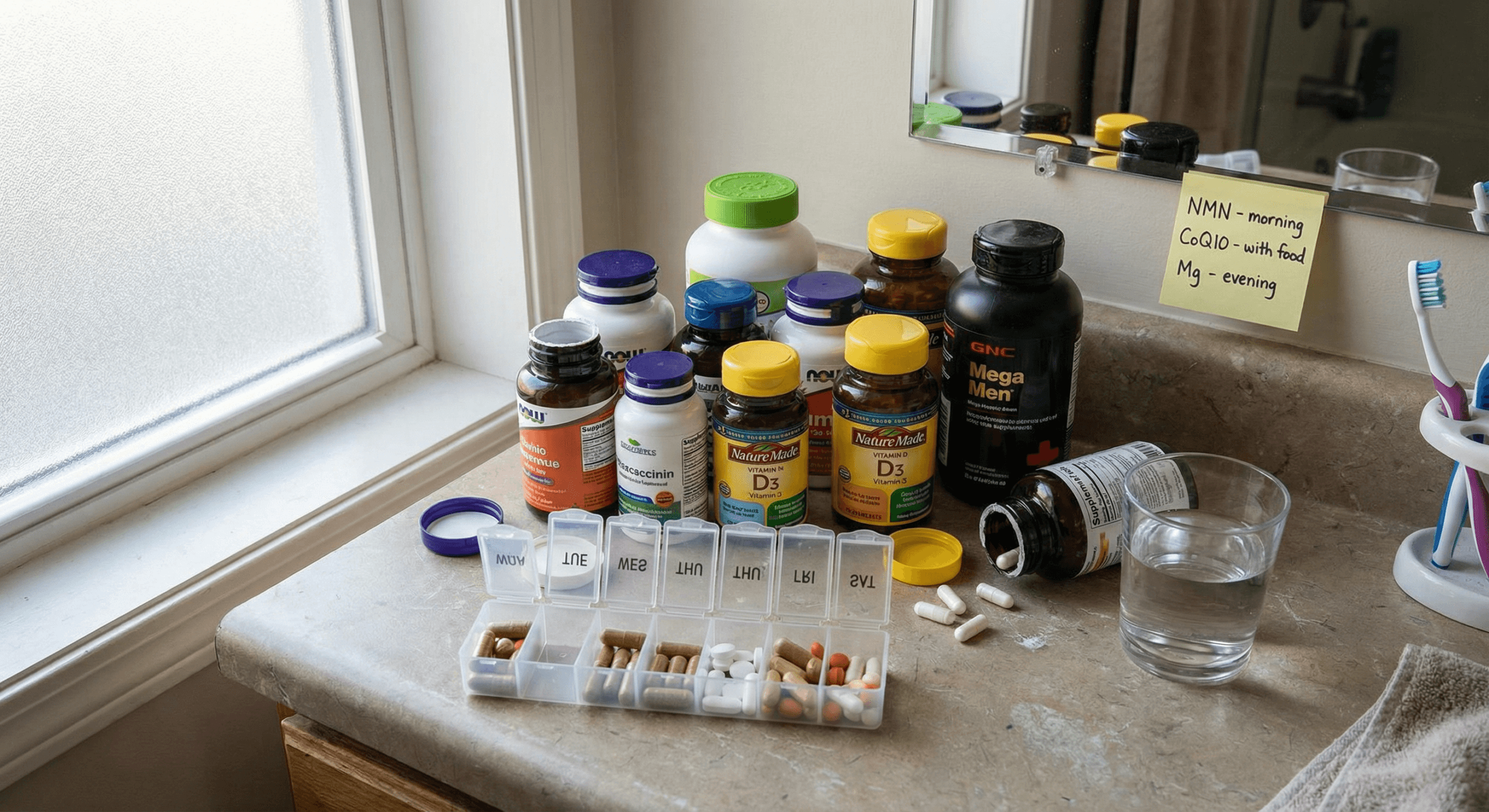
Supplement stacking has become the default approach for health-conscious adults over 40. Open the medicine cabinet of a wellness-oriented person in this demographic and you’ll likely find a small pharmacy. Survey data suggests the average person in this group now takes between five and eight daily supplements a number that’s climbed steadily over the past decade.
This isn’t recklessness. It’s the opposite. Most people arrive at a multi-supplement routine through genuine health motivation: a doctor suggests vitamin D, research on cardiovascular health leads to CoQ10, an article on cellular aging mechanisms introduces NAD+ precursors, and suddenly a single daily multivitamin has become a complex regimen spanning multiple bottles, brands, and dosing schedules.
The question worth examining isn’t whether individual supplements have research support many do. The more practical question is whether supplement stacking actually produces better outcomes, or whether complexity itself introduces problems that undermine the original intent.
What This Article Examines
This article investigates four dimensions of the supplement stacking problem: the cumulative cost that often goes unexamined, the compliance challenges that compound with complexity, the quality variance introduced by sourcing from multiple manufacturers, and the emerging trend toward consolidation reshaping the supplement landscape.
This is not a recommendation for or against specific supplements or brands. It’s a consumer health investigation into a structural problem affecting millions of adults managing complex supplement regimens and a practical framework for thinking more critically about how supplementation decisions are made.
The Cost Reality of Supplement Stacking
What Individual Longevity Supplements Actually Cost
When supplements are evaluated individually, their costs often seem reasonable. When they’re stacked, the cumulative expense tells a different story. The following table reflects mid-range pricing for specific compounds found in advanced consolidated longevity formulations not the cheapest available, not the most premium, but representative of what a quality-conscious consumer typically pays when sourcing each ingredient separately at research-relevant doses.
| Supplement | Form / Notes | Daily Dose | Approx. Monthly Cost | Approx. Annual Cost |
|---|---|---|---|---|
| Glycine | Pure amino acid | 2,000 mg | $12–$18 | $144–$216 |
| SIRT6Activator® | Fucoidan extract (proprietary) | 1,600 mg | $55–$75 | $660–$900 |
| NMN | β-Nicotinamide Mononucleotide | 1,000 mg | $65–$90 | $780–$1,080 |
| Trimethylglycine | Betaine Anhydrous | 1,000 mg | $12–$18 | $144–$216 |
| Ca-AKG | Calcium Alpha-Ketoglutarate | 800 mg | $40–$55 | $480–$660 |
| Trans-Resveratrol | Purified trans form | 500 mg | $25–$40 | $300–$480 |
| Nitralis® | Fermented Beetroot, Magnesium Ascorbate, Epimedium Extract (proprietary) | 400 mg | $35–$50 | $420–$600 |
| Quercetin | Standard extract | 400 mg | $20–$30 | $240–$360 |
| Magnesium Bisglycinate | Chelated form | 250 mg | $12–$18 | $144–$216 |
| SulforaBoost® | Glucoraphanin + myrosinase (proprietary) | 230 mg | $30–$45 | $360–$540 |
| High Molecular Weight Hyaluronic Acid | HMW form specifically | 200 mg | $25–$35 | $300–$420 |
| Coenzyme Q10 | Ubiquinol form | 200 mg | $28–$40 | $336–$480 |
| Vitamin K2 | MK-7 form | 120 mcg | $10–$15 | $120–$180 |
| Vitamin D3 | Cholecalciferol | 50 mcg (2,000 IU) | $8–$12 | $96–$144 |
| Spermidine | Wheat germ extract | 8 mg | $45–$60 | $540–$720 |
| Combined Total | $422–$601 | $5,064–$7,212 |
Sourcing all fifteen compounds individually at mid-range quality puts monthly outlay at approximately $422 to $601 or between $5,064 and $7,212 per year. One manufacturer behind a consolidated formulation containing all these compounds has independently estimated the equivalent individual sourcing cost at $603 per month or above when accounting for premium quality products at the specific doses and forms listed a figure aligning closely with the upper range of the calculation above.
Why Several Ingredients Cost More Than Expected

This stack is not a standard vitamin-and-mineral combination. Several ingredients here are specialty compounds carrying meaningfully higher sourcing costs than commodity supplements.
SIRT6Activator® is a proprietary fucoidan extract derived from brown seaweed that has attracted research interest for its potential role in activating SIRT6, a protein involved in DNA repair and cellular maintenance. As a branded, patented ingredient, it is not available as a generic alternative at equivalent specification.
Nitralis® is a proprietary blend combining fermented beetroot, magnesium ascorbate, and epimedium extract. Sourcing this combination independently would require purchasing three separate products, with no guarantee of equivalent processing or bioavailability.
SulforaBoost® is a specific glucoraphanin preparation from broccoli sprouts paired with active myrosinase enzyme. Standard broccoli extract products are not equivalent the myrosinase enzyme is what enables conversion of glucoraphanin into the active compound sulforaphane, and many off-the-shelf products lack it entirely.
Spermidine at 8 mg daily represents a relatively high dose compared to many commercial products, placing it in a premium pricing tier. NMN at 1,000 mg similarly sits at the upper end of commonly available dosages.
These are not interchangeable commodities. Sourcing them individually doesn’t just cost more it requires navigating a fragmented specialty market where quality standards vary considerably and authentic licensed versions of proprietary ingredients are not always easy to verify.
The Premium Quality Factor
The figures above assume mid-range products. Premium versions those with third-party certification, pharmaceutical-grade raw materials, and transparent manufacturing documentation often cost 30 to 50 percent more per product. Budget options exist at lower price points, but they introduce quality uncertainty we’ll examine shortly.
The cost of quality isn’t optional if efficacy matters. A supplement containing less of an ingredient than its label claims, or using a poorly absorbed form, represents money spent without corresponding benefit regardless of how affordable the purchase price appears.
Hidden Costs Beyond the Price Tag
Financial outlay is only part of the equation. Managing a fifteen-compound regimen involves costs that rarely appear in any budget calculation.
Research time is substantial. Evaluating each supplement individually reading studies, comparing brands, checking third-party test results, verifying sourcing claims takes hours. Multiplied across fifteen products, this represents a significant and ongoing investment of cognitive effort that most people realistically cannot sustain.
Decision fatigue compounds with each additional product. Which brand of NMN? Ubiquinol or standard CoQ10? Which source of spermidine? Each decision requires evaluation, and the cumulative weight of these choices contributes meaningfully to the mental burden of maintaining a complex regimen.
Logistical overhead accumulates quietly: tracking inventory across fifteen bottles from potentially fifteen different suppliers, reordering on different schedules, managing storage requirements that vary by product, and ensuring each compound is taken consistently at appropriate times.
Sourcing difficulty adds another layer for this specific category of compounds. Proprietary branded ingredients like SIRT6Activator®, Nitralis®, and SulforaBoost® are not widely available through mainstream retail channels. Locating legitimate sources, verifying authenticity, and confirming what you’re purchasing matches research specifications requires effort most consumers aren’t equipped to invest.
Understanding how to approach preventive health decisions with the same analytical rigor can help frame supplement stacking within a broader health optimization context.
The Compliance Problem
What Research Shows About Supplement Adherence
Health research has documented a consistent pattern: adherence to any daily regimen declines as its complexity increases. A foundational review of adherence behavior published in the WHO’s Adherence to Long-Term Therapies report established that regimen complexity is one of the most consistently identified barriers to sustained health behavior a finding replicated across pharmaceutical, dietary, and supplementation contexts.
Research examining polypharmacy the use of multiple medications simultaneously has found that people taking five or more daily medications make significantly more errors, experience greater confusion about dosing schedules, and demonstrate lower long-term adherence than those managing simpler regimens. While supplements differ from prescription medications in regulatory status, the behavioral dynamics of managing multiple daily compounds are functionally equivalent.
Studies examining dietary supplement use patterns in adults suggest that initiation rates are high many people begin taking supplements with genuine commitment but sustained adherence over six to twelve months drops considerably, particularly when regimens involve more than three to four daily products. More steps involved in a health behavior means lower sustained compliance rates tend to follow.
Why Complexity Undermines Consistency
The challenge extends beyond simply remembering to take pills. Different supplements carry different timing requirements. Fat-soluble compounds including CoQ10 ubiquinol and vitamins D3 and K2 are best absorbed alongside dietary fat. Some compounds are recommended away from food. Others have timing considerations related to their proposed mechanisms NMN is sometimes suggested for morning use aligned with circadian biology; magnesium bisglycinate is often taken in the evening for its calming properties.
Managing these variables across the reality of a busy adult life travel, irregular schedules, social commitments, family demands creates daily friction that accumulates over time. A regimen of fifteen compounds is not fifteen times harder to maintain than one. In practice, the relationship between complexity and compliance appears nonlinear: beyond a certain threshold, each additional element disproportionately increases the probability of the entire regimen breaking down.
Exploring sustainable daily practices can provide useful frameworks for building any health behavior including supplementation that actually sticks.
What Inconsistent Supplementation Actually Means
Most longevity-oriented supplements are theorized to work through consistent, cumulative exposure rather than acute effects. Research into compounds like NMN suggests that sustained daily intake is required to meaningfully influence NAD+ levels in tissues, since the body does not store NAD+ precursors in significant quantities between doses. Similarly, the proposed cellular mechanisms of compounds like spermidine and Ca-AKG involve ongoing pathway activation rather than one-time effects.
Sporadic dosing the predictable consequence of an overly complex supplement stacking regimen may reduce or eliminate whatever potential benefit these compounds offer. A person taking five supplements daily with near-perfect consistency may achieve more reliable biological exposure than someone taking fifteen supplements with 60 percent adherence across the stack.
The Psychological Burden of a Complex Regimen

Supplement fatigue is a real and widely recognized phenomenon. The pattern typically follows a predictable arc: initial enthusiasm during research and purchase, disciplined adherence for the first weeks, gradual erosion as novelty fades and logistics accumulate, and eventual abandonment of some or all products.
This is not a character flaw. It is a predictable behavioral response to regimen complexity. Research into habit formation consistently demonstrates that simpler routines are more likely to become automatic and self-sustaining, while complex routines require ongoing conscious effort that depletes over time. Recognizing this pattern is the first step toward designing a more sustainable approach.
Resources on burnout recovery offer relevant insights into why sustainable simplicity consistently outperforms ambitious complexity in long-term health behavior.
The Quality Variance Problem
Why Sourcing Supplements Individually Creates Quality Risk
The supplement industry operates under regulatory frameworks that differ substantially from pharmaceutical manufacturing. In the United States, the Dietary Supplement Health and Education Act of 1994 (DSHEA) established that manufacturers are responsible for ensuring their products are safe and accurately labeled but unlike pharmaceuticals, supplements do not require pre-market approval from the FDA for safety or efficacy. The practical consequence is that quality standards vary enormously between manufacturers, and enforcement is largely reactive rather than preventive.
When sourcing fifteen supplements from different manufacturers each operating under their own quality standards, testing protocols, and ingredient sourcing practices the cumulative quality risk from supplement stacking compounds considerably. Problems in any single product can undermine the integrity of the entire regimen.
What Quality Variance Actually Looks Like
The problem manifests in several dimensions.
Label accuracy is perhaps the most straightforward concern. Independent testing organizations including ConsumerLab have published analyses documenting that a meaningful percentage of tested supplements contain substantially more or less of the active ingredient than their labels claim. For longevity compounds where dosage matters where 500 mg and 1,000 mg of NMN represent meaningfully different levels of potential NAD+ precursor delivery label inaccuracy directly undermines the purpose of supplementation.
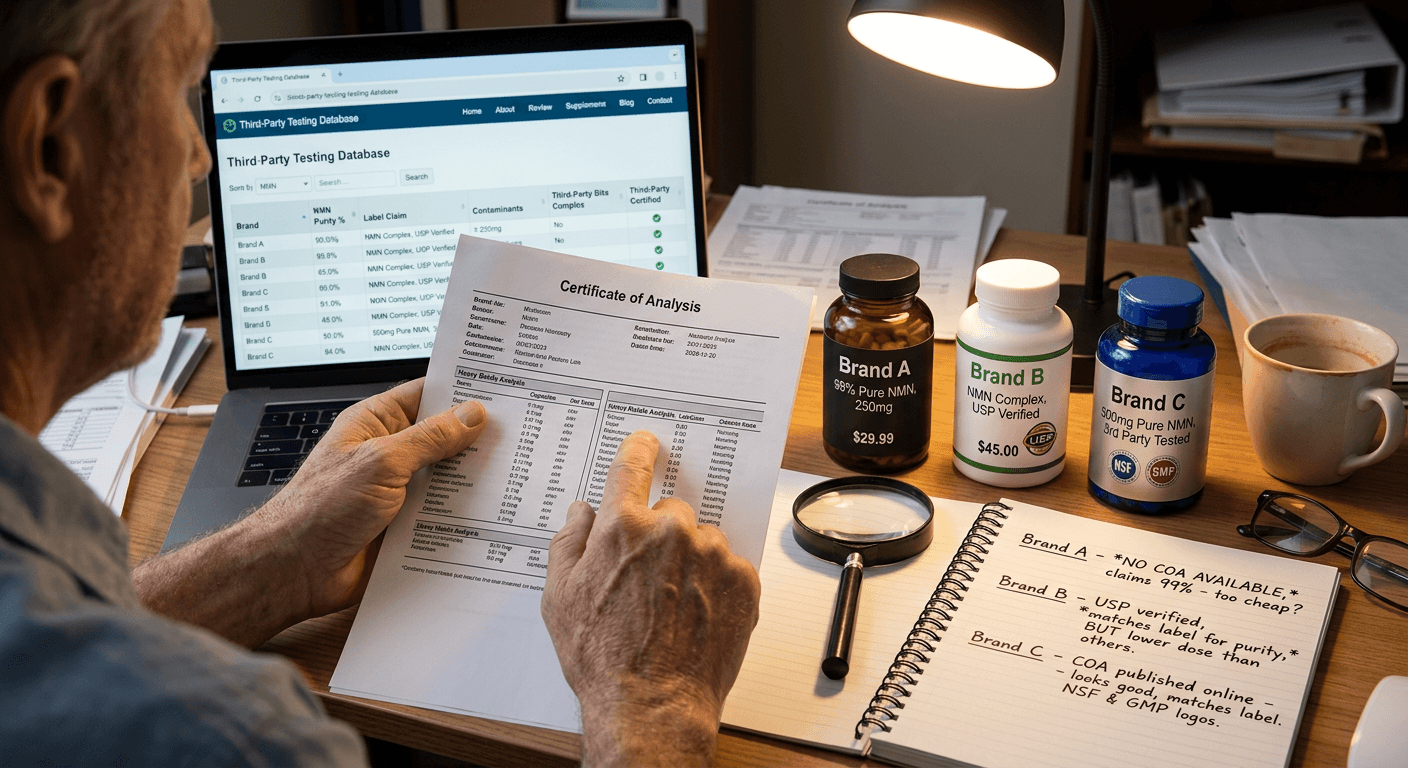
Contamination risk represents another dimension. Independent testing has identified heavy metals, microbial contaminants, undeclared pharmaceuticals, and undeclared allergens in commercially available supplements. Multiplied across fifteen products from multiple manufacturers, the probability that at least one product carries a quality issue increases with each addition to the stack.
Bioavailability differences add further complexity. The same ingredient from different manufacturers may be absorbed quite differently depending on its chemical form, particle size, excipients, and formulation approach. CoQ10 provides a useful illustration: ubiquinol is generally considered more bioavailable than ubiquinone, but labeling practices vary and not all products specify which form they contain. A consumer may be taking the correct dose on paper while absorbing a fraction of the intended amount.
Ingredient authenticity is a particular concern for proprietary compounds. SIRT6Activator®, Nitralis®, and SulforaBoost® are branded ingredients with specific manufacturing specifications. Generic alternatives claiming equivalence may use different raw materials, processing methods, or concentrations that produce different biological profiles. Verifying authenticity requires documentation that many suppliers do not readily provide.
The Third-Party Testing Standard
Third-party testing programs including NSF International, USP Verified, and Informed Sport provide independent verification of label accuracy, contaminant screening, and manufacturing standards. These certifications represent meaningful quality assurance in an industry with limited mandatory oversight.
However, third-party certification is not universal, and different programs offer different levels of scrutiny. When assembling a multi-supplement stack, ensuring every product meets equivalent quality thresholds requires verifying each manufacturer’s testing documentation individually a process that must be repeated whenever a product changes formulation, manufacturer, or raw material supplier.
The Research Burden on the Consumer
Evaluating quality across fifteen different supplements from potentially fifteen different manufacturers is a substantial and ongoing task. Checking testing certifications, requesting certificates of analysis, comparing manufacturing standards, evaluating sourcing claims, and staying current with changes to each product’s formulation or supply chain requires significant effort.
Most consumers, even highly motivated ones, do not have the time, technical background, or laboratory access to do this thoroughly. This creates a persistent gap between the intended quality of a supplement stacking regimen and the actual quality being consumed daily. That gap isn’t a consumer failure it is a structural consequence of a fragmented market that places the quality verification burden almost entirely on the buyer.
Understanding the quality frameworks discussed in our quality omega-3 supplements guide illustrates how these verification challenges apply across the broader supplement category.
The Emerging Trend Toward Consolidation
How the Supplement Industry Is Responding
The supplement industry has recognized the stacking problem. One visible response is the emergence of consolidated longevity formulations products designed to combine multiple researched compounds into a single daily supplement.
The premise is straightforward: rather than purchasing NMN, resveratrol, CoQ10, spermidine, Ca-AKG, quercetin, and a range of specialty ingredients from multiple separate manufacturers, a consolidated formulation delivers clinically relevant doses of each compound in one product, from one manufacturer, under one quality standard.
This category is relatively new and still maturing. Not all consolidated products are equivalent in quality, dosing, or ingredient selection. But the trend reflects a market acknowledgment that the supplement stacking model creates real problems cost, compliance, and quality variance among them that affect real consumers trying to engage seriously with longevity research.
The Appeal of the All-In-One Approach
The practical advantages are clear: a simplified daily routine with fewer decision points and fewer bottles. A single quality standard to evaluate instead of fifteen manufacturers to vet. Potentially lower total cost than purchasing each ingredient separately particularly when individual sourcing costs approach or exceed $600 per month. Reduced cognitive load. And perhaps most importantly easier adherence, which research suggests may be the single most important factor in whether any supplementation approach produces meaningful benefit.
What to Look for if Considering a Consolidated Formulation
For readers evaluating any consolidated longevity supplement, five criteria merit particular attention.
Ingredient transparency. The product should fully disclose every ingredient and its individual dosage, including the specific form of each compound. Proprietary blends listing ingredients without specifying amounts make it impossible to determine whether doses are clinically relevant.
Dosage relevance. Each ingredient’s dose should be comparable to amounts used in published research. Combination products often include token amounts of popular ingredients enough to list on the label, not enough to correspond to studied doses. This practice, sometimes called “fairy dusting,” is common and undermines the product’s entire value proposition.
Research backing. Each included ingredient should have independent research support for the biological pathway it targets, as explored in our overview of cellular health after 40. Ideally the specific combination has some evidence base, though this standard is harder to meet for newer formulations.
Third-party testing. Independent verification of label accuracy and purity from a recognized certification body provides meaningful quality assurance. Products without third-party testing require a higher degree of trust in the manufacturer trust that should be earned through documented transparency rather than assumed.
Manufacturer transparency. Company history, manufacturing facility standards, willingness to share certificates of analysis, and responsiveness to consumer inquiries all signal organizational seriousness about quality. For formulations containing proprietary branded ingredients, verifying that authentic licensed versions are used rather than generic substitutes is particularly important.
What These Criteria Do Not Guarantee
Meeting all five criteria reduces risk it does not eliminate uncertainty. Even the most transparently produced, rigorously tested, appropriately dosed supplement is not guaranteed to produce specific health outcomes. Individual response variation remains significant. The research supporting many longevity compounds is still evolving, and no supplement replaces the foundations of health: appropriate nutrition, regular physical activity, adequate sleep, and stress management.
Professional consultation remains important before starting any new supplement regimen, particularly for those managing existing health conditions or taking prescription medications. Resources on when to seek professional support can help guide this decision.
Important Limitations of This Overview
This article does not evaluate specific supplement brands or products. The cost figures presented reflect approximate mid-range market pricing at the time of writing and are subject to change based on market conditions, supplier pricing, and product availability. Individual supplement needs vary substantially based on health status, genetic factors, dietary patterns, and lifestyle.
The behavioral research on adherence referenced here reflects patterns observed across health behavior studies generally. Individual experiences with supplement compliance may differ. Supplement science is an evolving field, and current understanding may change as new research emerges.
Individual variation is significant. What represents an appropriate supplement regimen for one person may be unnecessary or inadvisable for another. Age, sex, existing health conditions, current medications, and individual metabolic factors all influence whether specific supplements are appropriate and at what doses. Population-level patterns discussed here do not predict individual outcomes.
When to Involve a Healthcare Professional
Anyone currently taking prescription medications should consult their healthcare provider before modifying their supplement regimen. Supplement-drug interactions are real and clinically significant compounds including quercetin and resveratrol may interact with certain medications, and high-dose vitamin K2 is relevant for anyone taking anticoagulant therapy.

Those with existing health conditions, adults over 65 with different absorption and metabolism considerations, and anyone contemplating significant changes to their current approach should seek professional input before proceeding.
A productive conversation includes bringing a complete list of every supplement you currently take, including doses, forms, and brands. Discussing what you hope supplementation will address and what outcomes you’re looking for helps your provider give specific guidance. Asking specifically about potential interactions with any medications you take, and requesting guidance on appropriate monitoring relevant blood work, functional markers, or follow-up timelines helps evaluate whether your supplement stacking approach is producing the intended effect.
Informed consumers who involve qualified professionals in their supplement decisions consistently make better choices and avoid expensive mistakes.
Smarter, Not More
The core insight is deceptively simple: the goal of supplementation is not volume. It is appropriate, consistent, quality-verified intake of compounds with credible research support, taken at relevant doses, as part of a broader approach to health that includes the fundamentals no supplement can replace.
More supplements does not automatically mean better outcomes. Complexity introduces its own risks monthly costs approaching or exceeding $600 when sourcing advanced longevity compounds individually, declining compliance as supplement stacking regimen complexity increases, and compounding quality variance when products are sourced from multiple manufacturers operating under different standards.
A simpler, well-researched, consistently maintained approach may serve long-term health goals more effectively than an elaborate stack assembled piecemeal from multiple suppliers. LubDubSmile will continue examining longevity research and supplementation evidence as the science evolves. For related context on the cellular mechanisms these compounds target, our overview of cellular aging after 40 provides the biological foundation, and our ongoing coverage of cardiovascular and metabolic health connects these topics to the broader picture of sustainable wellness.
Takeaway
Supplement stacking combining five, ten, or fifteen daily longevity compounds from multiple manufacturers creates three compounding problems: cumulative costs that can exceed $600 monthly when sourcing research-relevant doses individually, declining adherence as regimen complexity increases beyond what sustainable daily behavior can support, and quality variance that compounds across each manufacturer’s different standards, testing protocols, and ingredient sourcing practices.
Medical Disclaimer: This article is for educational purposes only and does not constitute medical advice.
This content is for educational purposes and does not substitute for professional medical or therapeutic help.