

Why High Achievers Struggle With Emotional Vulnerability
High achievers emotional vulnerability sits at the heart of one of the most paradoxical patterns in modern psychology: the people who seem most capable in every measurable domain are often among the least accessible in the domain that resists measurement entirely. You can present a flawless quarterly review in front of 200 people without flinching. You’ve navigated organizational crises, made high-stakes decisions under pressure, and constructed a career that most people would recognize as genuinely exceptional. But when your partner says “I need more from you emotionally,” you feel something close to panic and then, almost immediately, something that looks remarkably like a wall.
This isn’t a contradiction. It’s a pattern. And for many high achievers, it represents one of the most confusing and costly aspects of their psychology.
Why do high achievers struggle with emotional vulnerability? The short answer: the same mechanisms that produce exceptional professional performance simultaneously construct exceptionally effective emotional armor. Achievement-oriented psychology built on competence, control, and performance directly conflicts with what genuine emotional presence requires. Understanding this pattern is meaningful. Changing it requires something more than understanding.
The Paradox of High Achievement and Emotional Inaccessibility
Why Professional Courage and Emotional Courage Are Different Skills
Professional risk-taking and high achievers emotional vulnerability look similar from the outside both involve exposure, uncertainty, and the possibility of failure. But they operate through entirely different mechanisms that determine why competence in one tells you almost nothing about capacity in the other.
Professional risk has metrics. You can analyze it, prepare for it, manage it, and recover from it within systems you understand. Even failure in professional contexts is recoverable you learn, adjust, and try again within a legible framework. You know the rules, even when you don’t know the outcomes.
Emotional vulnerability has no metrics. You can’t analyze your way to authentic presence. You can’t prepare adequately for the experience of another person genuinely seeing you, because that experience is inherently uncontrolled. Nobody knows the rules, because there are no rules only the exposed nerve of genuine connection and the unmanageable reality that it could go any number of directions.
For people whose competence is central to their identity, this distinction is profound. Professional risk threatens outcomes. High achievers emotional vulnerability threatens identity itself.
The Gap Between External Success and Internal Depth
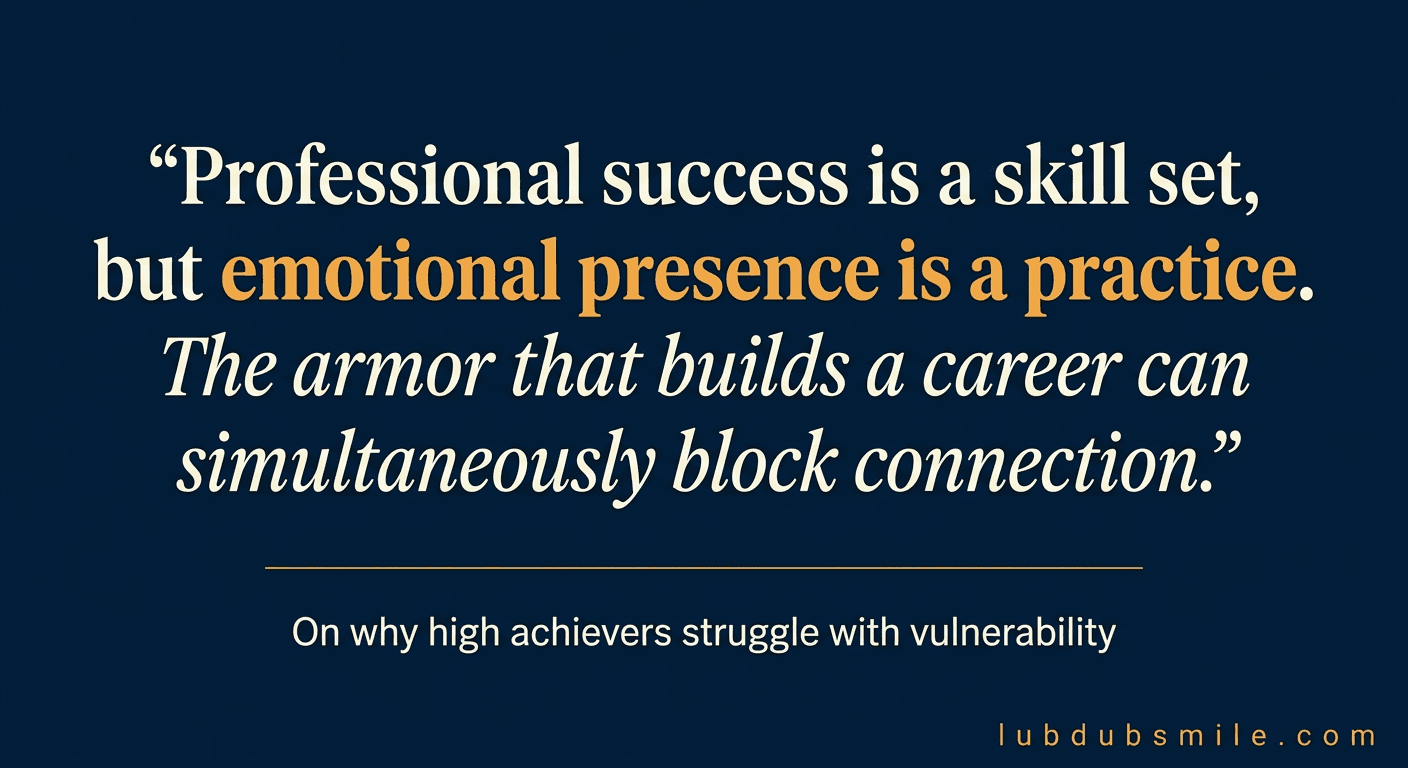
You’ve constructed an extraordinary life by external metrics. In quiet moments which you’ve become skilled at avoiding through productivity there’s an emptiness you’re not sure how to address. The achievements accumulate. The satisfaction doesn’t quite arrive in the way the achievements were supposed to deliver it. The relationships feel somehow surface-level despite years together. Something is missing, and you’re not entirely sure how to name it.
The gap between external success and internal depth is one of the most common experiences among high achievers, and one of the least discussed. Partly because acknowledging it feels like ingratitude. Partly because high achievers manage discomfort through activity with considerable skill. And partly because the admission requires a kind of vulnerability that is precisely what this article addresses.
Psychologists who study achievement motivation note that extrinsic success, when it becomes the primary organizer of identity, tends to produce diminishing emotional returns. Self-determination theory, which researchers Edward Deci and Richard Ryan developed, finds that psychological wellbeing depends substantially on intrinsic motivations and genuine connection not outcomes. Achievement satisfies something. Depth is what never quite built alongside it. Understanding high achievers emotional vulnerability starts with recognizing this gap honestly.
The Psychological Roots: Where This Pattern Often Begins

Achievement as Childhood Survival Strategy
For many high achievers, the drive to excel wasn’t simply innate talent meeting opportunity. It was adaptive a strategy that developed in childhood for earning approval, safety, or love within environments that didn’t provide these unconditionally.
When a child learns that performance earns warmth that the A gets the praise, the accomplishment produces the attention, the competence generates the approval that love was supposed to provide freely achievement becomes more than ambition. It becomes a survival mechanism. Survival mechanisms are extraordinarily durable, because they formed under conditions that made them genuinely necessary.
The child who learned to perform their way to safety often becomes the adult who cannot imagine safety without performance. Vulnerability the state of another person seeing you without the protection of competence never became a practice because it was never safe. The armor wasn’t irrational. It worked.
When Performance Was the Only Safe Form of Love or Approval
Jonice Webb, in her research on childhood emotional neglect, identifies a pattern she describes as children learning to develop everything except emotional depth because emotional depth, in some family systems, didn’t receive welcome, didn’t receive modeling, or actively received punishment through criticism or dismissal.
High-achieving children in these environments often develop a particular kind of emotional suppression: feelings are real, but inconvenient, unsafe, or simply not readable within the family system. So they manage them. They redirect feelings into productivity. They resolve feelings through solving rather than experiencing. The emotional musculature doesn’t develop because there was nowhere to exercise it safely.
The adult version of this child is often extraordinarily capable and genuinely limited not by choice, but by a developmental gap that was never anyone’s explicit intention. Understanding this is meaningful. It is also not sufficient for change.
Perfectionism and the Terror of Being Seen as Inadequate
Perfectionism research, including work by clinical psychologists Paul Hewitt and Gordon Flett, distinguishes between self-oriented perfectionism (high standards for oneself) and socially prescribed perfectionism (the belief that others hold impossibly high standards that must be met). The latter correlates particularly strongly with shame sensitivity the fear that others will see you as inadequate, flawed, or failing.
Brené Brown’s research at the University of Houston identifies shame as the primary driver of emotional armor. High achievers, she finds, often carry particularly acute shame sensitivity around inadequacy because their entire self-concept has built on demonstrating competence. Vulnerability, which requires showing up without the armor of competence, activates the shame threat directly.
This is why “just be open” advice is not merely unhelpful but genuinely misses the mechanism. Opening up doesn’t feel like a communication choice for high achievers navigating emotional vulnerability. It feels like an existential threat.
The Attachment Dimension: How Early Relational Patterns Shape Emotional Armor
Attachment theory adds another lens to high achievers emotional vulnerability. Adults who developed avoidant attachment patterns in early life often in response to caregivers who were emotionally unavailable, dismissive of feelings, or who rewarded independence over connection frequently develop adult emotional armor that mirrors those early relational environments.
High achievers who developed avoidant attachment often unconsciously replicate the emotional unavailability they learned was “safe.” They excel professionally because the professional world rewards self-sufficiency. They struggle relationally because genuine connection requires the exact dependence and emotional openness that their early experience taught them was dangerous. Recognizing this attachment dimension helps explain why high achievers emotional vulnerability often persists despite intellectual understanding of the pattern.
How Emotional Armor Looks in High Achievers
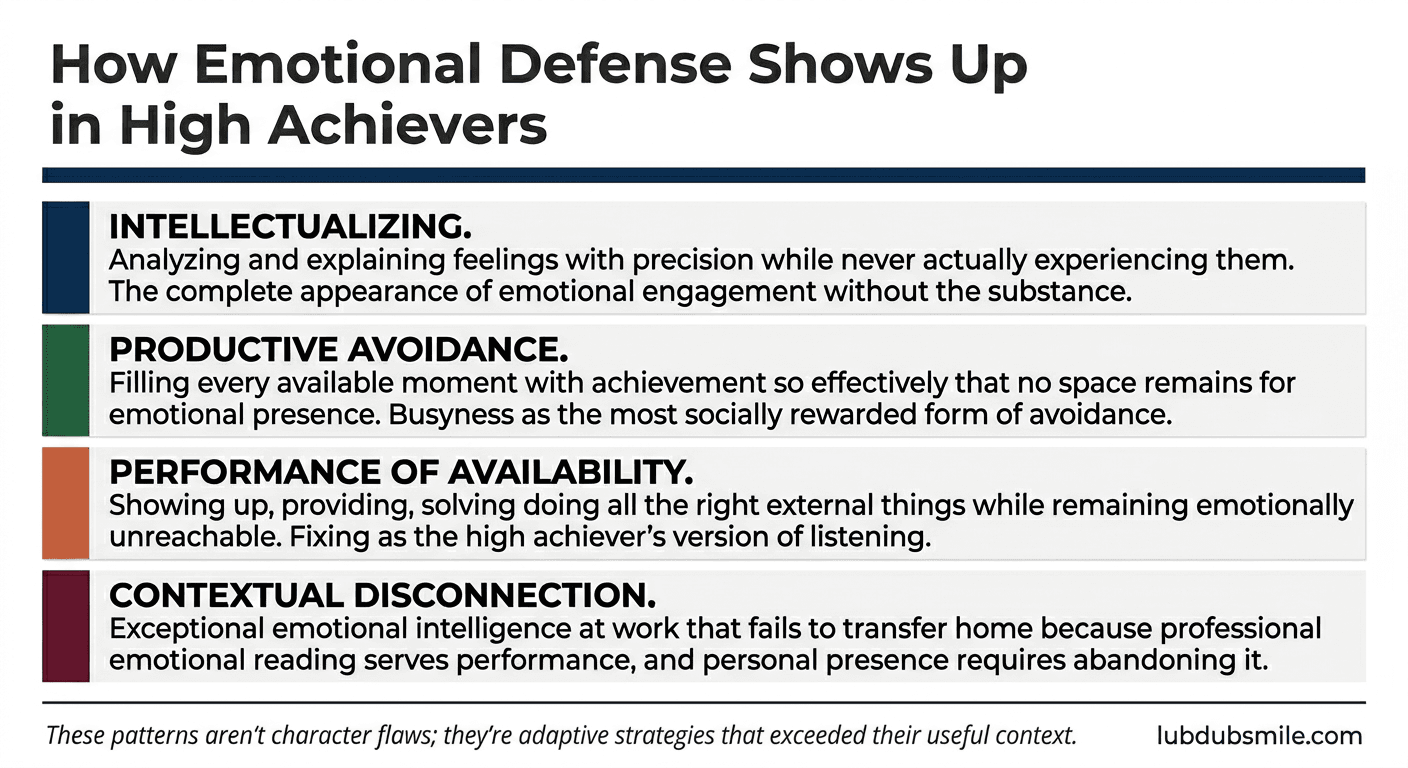
Intellectualizing Feelings Instead of Experiencing Them
The intellectualization defense mechanism is particularly strong in high achievers because intelligence is simultaneously the armor and the tool that maintains it. When feelings arise, the high achiever’s capable mind immediately begins analyzing, categorizing, and explaining them a process that creates the appearance of engaging with emotion while actually creating distance from it.
You’ve been in therapy for six months. You’re a model client you’ve read everything, you understand all the patterns and your therapist says you’re still not actually in the room emotionally. This is intellectualization at its most sophisticated: the complete appearance of emotional engagement without the substance.
Explaining an emotion and feeling it are neurologically distinct experiences. Understanding why you feel something is not the same as allowing yourself to feel it. For high achievers facing emotional vulnerability, the former is so much more comfortable and so much more natural that the distinction often goes unnoticed for years.
Using Busyness and Achievement as Emotional Avoidance
Productivity is a form of emotional avoidance that society rewards. When a high achiever fills their schedule to capacity, takes on one more project, stays late one more night, and arrives home with no energy left for the kind of present connection that intimate relationships require this often reads as dedication. It can also be, simultaneously, avoidance.
The feelings that arise in genuine relational presence the uncertainty, the need, the exposure of another person knowing you don’t arise when you’re solving problems, executing strategy, or producing results. Busyness is clean. Emotional presence is not. For people who organize their self-concept around competence and control, the relative comfort of busyness over presence is not a small thing. Recognizing this represents a first step in addressing high achievers emotional vulnerability honestly.
The Performance of Emotional Availability Without the Substance
Some high achievers are genuinely unaware of their emotional unavailability because they’re doing all the right external things showing up, providing, solving, being physically present. Your performance review at work is exceptional. At home, your teenager says “you’re not really listening” when you’re sitting right there, giving perfect advice.
The advice is the tell. Fixing is the high achiever’s version of listening it demonstrates engagement and competence simultaneously while avoiding what the person actually asked for: presence. Being with someone in their experience rather than working on their problem requires exactly the non-doing that high achievers find most uncomfortable.
Emotional Unavailability in High Achievers: Professional vs. Personal Contexts
High achievers emotional vulnerability often shows the sharpest contrast between professional and personal contexts. At work, the high achiever excels at reading the room, navigating interpersonal dynamics, and delivering what stakeholders need. At home, those same skills often fail to transfer because professional emotional reading serves performance goals, while personal emotional presence requires something different entirely: showing up without an agenda, without a solution, and without control of the outcome.
This contrast confuses both the high achiever and the people around them. “You’re so emotionally intelligent at work why can’t you bring that home?” The answer is that professional emotional intelligence and genuine personal vulnerability aren’t the same skill. One serves performance. The other requires abandoning it.
Why Vulnerability Feels More Threatening Than Professional Risk
The Identity Stakes: Vulnerability Threatens the Entire Self-Concept
For a high achiever whose identity has substantially built on competence, effectiveness, and having things together, vulnerability doesn’t just risk embarrassment or disappointment. It threatens the entire organizing framework of the self.
Professional failure is painful and recoverable within a self-concept that remains intact. Emotional exposure feels different it reveals the person behind the performance, which is precisely the person the armor protects. The professional self has survived failures. The emotional self that others haven’t yet seen has almost never faced a test, which makes it feel impossibly fragile.
This is the core reason why emotional vulnerability is more threatening than professional risk for high achievers. Professional risk challenges outcomes. High achievers emotional vulnerability challenges identity itself.
Loss of Control as Existential Threat
High achievement is substantially about control of outcomes, environments, impressions, and results. The professional world rewards this orientation. Relationships do not operate by the same rules.
Genuine emotional connection is inherently uncontrolled. You cannot manage how someone receives your vulnerability. You cannot predict or prevent the possibility of rejection, inadequacy, or another person seeing you as less than you’ve presented yourself to be. For people whose nervous systems orient around maintaining control, this uncontrollability is not merely uncomfortable. It registers as threat.
Polyvagal theory, which Dr. Stephen Porges developed, helps explain the neurological dimension: genuine emotional openness requires the nervous system to be in a state of safety ventral vagal activation rather than the sympathetic activation that high achievement often requires. For people whose nervous systems oriented toward performance and vigilance in childhood, safety-based openness may literally require deliberate neurological cultivation. High achievers emotional vulnerability isn’t simply a pattern it has a physiological dimension that matters significantly.
The Cost of Sustained Emotional Armor
The Loneliness Inside Crowded Success
The loneliness of high achievement is a real phenomenon that rarely gets its name. People fill the high achiever’s world colleagues, family, social circles while the high achiever experiences a persistent sense of being fundamentally unknown. Because if no one has access to the interior, no one can actually know you. The connection remains at the level of the performance, which is impressive but not intimate.
This loneliness is particularly acute because it coexists with circumstances that are supposed to preclude it. You have everything. People surround you. The loneliness feels like ingratitude, which makes it harder to acknowledge, which makes it more persistent. For many high achievers, addressing emotional vulnerability represents the only pathway out of this particular isolation.
Burnout That Isn’t About Overwork
A specific form of burnout that high achievers experience distinct from simple overwork involves the depletion that comes from ongoing disconnection from genuine meaning and genuine connection. When achievement feels hollow because the depth that would make it feel meaningful hasn’t built alongside it, more achievement doesn’t solve the problem. It often deepens it.
This disconnection-driven burnout responds poorly to rest and vacation because the problem isn’t effort it’s the absence of the relational and emotional nourishment that makes effort feel worthwhile. Understanding this distinction matters because it changes what the burnout is pointing toward. Exploring burnout recovery approaches can help clarify whether what you’re experiencing points toward rest or toward something deeper including the emotional unavailability that often underlies this form of depletion.
The Internal Cost: Narrowed Emotional Range Over Time
Emotional armor is not static. When a person uses it consistently over decades, it tends to narrow the emotional range available not just to others, but to oneself. The feelings that initially received management for strategic reasons gradually become genuinely harder to access. The emotional musculature, without exercise, weakens.
This narrowing is often the thing that finally motivates high achievers to address the pattern when they notice they can’t fully feel the things that are supposed to matter, that even joy or love arrives muted and at a distance. This isn’t pathology. It’s what consistent suppression, over enough time, produces. Recognizing it as a consequence of emotional armor rather than a character trait is an important reframe in understanding high achievers emotional vulnerability.
The Intelligence Trap: When Thinking Replaces Feeling
Why Smart People Are Often the Best Avoiders
Intelligence, in the context of emotional avoidance, is not an advantage. It’s the sophistication of the defense system. The smarter you are, the more convincing the rationalizations, the more elaborate the frameworks that intellectualize experience, the more complete the illusion of emotional engagement without the reality of it.
You’re excellent at solving problems, so when someone shares feelings, your first instinct is to fix rather than feel and you watch them slowly stop sharing. The fixing is not malicious. It’s the genuine application of the only emotional tool that has developed: competent problem resolution. But it solves the problem of emotional discomfort while failing the person who was hoping for something else entirely.
The Difference Between Understanding Your Pattern and Changing It
This distinction is particularly important for high achievers, and particularly easy to miss. Understanding why you have emotional armor the childhood origins, the adaptive function, the dimensions that neuroscience reveals is genuinely meaningful. It’s also, for high achievers specifically, a risk.
Understanding becomes another achievement. The framework gets mastered. The pattern receives mapping. And none of this, by itself, changes the thing it’s analyzing. Insight and transformation are not the same process, and confusing them is the most sophisticated form of the same avoidance.

Research on behavioral change consistently finds that insight creates the possibility of change but doesn’t produce it. Change requires doing something different which means tolerating the discomfort that doing something different produces. For high achievers navigating emotional vulnerability, this is often the step that gets skipped in favor of further analysis.
Building emotional regulation skills requires this kind of practice rather than insight alone. The distinction matters enormously for high achievers who mistake understanding for transformation.
What High Achievers Emotional Vulnerability Actually Requires
Vulnerability Isn’t Weakness or Oversharing
The first clarification worth making: vulnerability is not the opposite of strength. Brené Brown’s research is unambiguous on this point vulnerability is the willingness to show up and allow someone to genuinely see you when you can’t control the outcome. It’s not emotional flooding, it’s not strategic disclosure that performs openness while maintaining control and not also weakness.
For high achievers specifically: high achievers emotional vulnerability doesn’t require abandoning competence or dismantling the identity you’ve constructed. It requires adding a dimension to it the capacity for genuine presence that exists alongside and enriches the capability, rather than threatening it.
Emotional Availability in Increments
Emotional armor that took decades to construct doesn’t dissolve through a single act of disclosure. The expectation that vulnerability should be sudden, complete, or comfortable is itself another form of the achievement orientation that someone has applied to emotional growth as though there’s a performance standard for openness that, once met, produces the desired result.
Incremental emotional availability slightly more honest about a feeling than usual, slightly less quick to fix rather than be present, slightly longer in the discomfort before deflecting is how the capacity actually develops. Not through revelation, but through practice in conditions of gradually increasing exposure. Emotional agility develops through exactly this kind of incremental, consistent practice rather than through dramatic transformation.
Practical Daily Approaches for High Achievers Navigating Emotional Vulnerability
Theory about high achievers emotional vulnerability is meaningful but insufficient without practice. Three approaches that research supports and high achievers often find accessible:
Notice before you fix. When someone shares a feeling, practice pausing for 10 seconds before responding. During that pause, ask yourself what the person might need acknowledgment or solution. Most of the time, it’s acknowledgment. Fixing is the reflex; presence is the practice.
Name the physical sensation first. Rather than asking “what am I feeling?” which invites intellectualization ask “where do I feel this in my body?” The chest tightness, the jaw tension, the change in breathing are emotional data that bypass the defense system. Attending to physical sensation develops emotional access that doesn’t depend on analysis.
Practice incomplete disclosure. Sharing something emotionally real doesn’t require full emotional exposure. Starting small “I’m more anxious about this than I’ve let on,” “I’m not sure I handled that well,” “I actually don’t know what I want here” builds the tolerance for genuine expression that larger vulnerability requires.
Staying in Discomfort Long Enough to Have an Experience
The central skill that emotional vulnerability requires and the one high achievers most consistently lack is the capacity to tolerate emotional discomfort without immediately resolving it. Not suppressing feelings but not acting to immediately escape them either. Staying in the experience long enough for it to actually be an experience rather than a problem to solve.
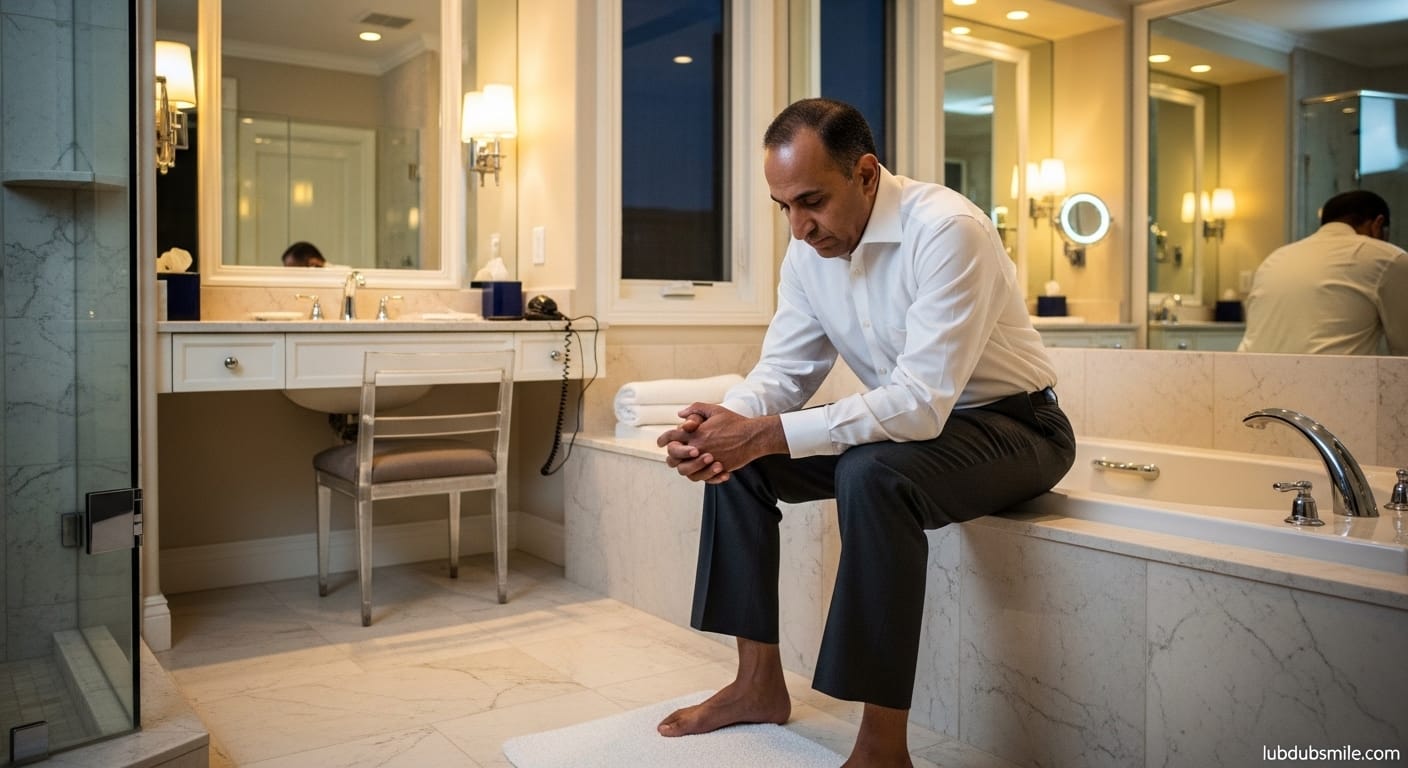
This is not comfortable, particularly for people whose entire professional identity has built on moving from problem to resolution efficiently. Sitting with uncertainty, with need, with the exposure of genuine feeling, without managing it this is the practice. It’s unglamorous and slow and produces no measurable outcomes, which is precisely why it presents genuine difficulty for high achievers facing emotional vulnerability.
Pathways Toward Greater Emotional Depth
Slowing Down Enough to Notice What You’re Actually Feeling
The first practical move is deceptively simple and genuinely difficult: creating conditions in which you’re not moving fast enough to successfully avoid your interior. For high achievers who have organized their lives around productive motion, moments of genuine stillness are rare by design. The stillness is where the feelings are.
This might look like time without a screen, without an agenda, without a problem to solve. It might look like sitting with the discomfort of not filling the space. It might look like asking “what am I feeling right now?” and staying with the question long enough to notice something more specific than “fine.”
Emotional hygiene practices offer practical daily structures for creating this kind of internal access not as dramatic intervention but as consistent, sustainable habit. High achievers often find it easier to build practices with structure than to rely on undirected openness.
Somatic Awareness: The Body Knows Before the Mind Does
For high achievers who intellectualize their emotional experience, somatic awareness offers a route around the defense system. The body responds to emotional experience before the mind has had the opportunity to analyze and categorize it. Physical sensations tightness in the chest, a change in breathing, tension in the jaw or shoulders are emotional data that bypass the intellectualization that typically intercepts feelings before they’re fully experienced.
Learning to notice physical sensations as emotional information not to analyze them but simply to attend to them develops a form of emotional access that doesn’t depend on the intellectual faculties that have maintained the avoidance. For high achievers navigating emotional vulnerability, the body often offers the most honest data available.
Therapy as Structured Practice in Emotional Presence
Therapy, for high achievers, often needs framing that differs from how it usually presents itself. It’s not primarily about insight high achievers generate insight efficiently and often use it to remain unchanged. It’s about practicing, in a relationship with structure and boundaries, the emotional presence that doesn’t get practiced elsewhere.
A therapist with expertise in achievement-oriented clients will often notice and name the intellectualization as it happens not as criticism, but as redirection toward what’s actually being avoided in the room. This is uncomfortable. It’s also the mechanism through which the therapy becomes useful rather than another intellectual exercise.
If you’ve been in therapy and remain curiously unchanged, this may be worth examining. Exploring therapy options can help identify practitioners who have specific experience with high achievers and the particular patterns emotional vulnerability creates in this population.
When to Seek Professional Support
Signs the Pattern Needs More Than Self-Awareness
Consider professional support if your relationships are significantly suffering despite genuine desire to connect; if a partner has named emotional unavailability as a serious concern; if you recognize the pattern clearly but find yourself unable to change it despite sustained effort; if there’s childhood history that you haven’t yet processed; or if the loneliness inside success has become genuinely difficult to sustain.
These aren’t indications of pathology. They’re indications that the territory is genuinely complex and benefits from skilled navigation. High achievers emotional vulnerability often runs deep enough to require more than self-directed insight can reach.
Therapy for High Achievers: What to Look For
High achievers often benefit from therapists who are not easily impressed by insight and who are willing to redirect from intellectualization to present experience. Approaches that work well with this population often include psychodynamic work (examining patterns and their origins), somatic approaches (working through the body rather than around it), and attachment-focused therapy (addressing the relational patterns that emotional armor creates).
Understanding when professional support for emotional patterns is warranted can help you assess whether what you’re experiencing calls for individual guidance. The framing high achievers often find most meaningful: emotional depth isn’t the opposite of what you’ve constructed. It’s the dimension that makes what you’ve constructed feel like what you were actually working toward.
Frequently Asked Questions
Can high achievers be emotionally vulnerable without losing their professional edge?
Yes greater emotional availability supports rather than undermines professional effectiveness through better relationships, more accurate self-assessment, and greater capacity for sustained meaning in work. Research on emotionally intelligent leaders consistently demonstrates this. The belief that emotional depth threatens professional capability is often part of the armor itself, not an accurate assessment of the tradeoff.
Is emotional unavailability the same as introversion?
No. Introversion describes how people process stimulation and renew energy it’s a temperament dimension that has no direct relationship to emotional availability. Introverts can be deeply emotionally present; extroverts can carry high emotional unavailability. The patterns sometimes coexist but remain independent. Introversion shouldn’t explain or excuse emotional armor.
What if I genuinely don’t feel much is that a problem?
It depends on whether the limited emotional experience is temperamental or something that has developed through consistent suppression. Some people have naturally lower emotional intensity, and this isn’t pathological. But when emotional range has narrowed through suppression that persists over time when feelings that were once accessible have become difficult to reach that’s different and worth exploring. The question “is this who I am or what I’ve done to myself?” is worth sitting with honestly.
How do I explain this to my partner without it sounding like an excuse?
By not using it as one. Understanding the psychological roots of emotional unavailability is meaningful; using that understanding to explain why change isn’t your responsibility is not. What your partner needs to hear is not the explanation but what you intend to do about it and that intention needs to follow through with actual change, however gradual. Insight offered in place of effort isn’t transparency. It’s a more sophisticated form of the same avoidance.
Why do high achievers struggle with emotional vulnerability more than other people?
High achievers often struggle more acutely because achievement-oriented psychology which emphasizes control, competence, and measurable performance directly conflicts with what emotional vulnerability requires: relinquishing control, tolerating incompetence, and accepting that outcomes can’t be managed. The professional world rewards the exact orientation that makes emotional openness feel dangerous. Other people who haven’t organized their identity around performance often have less at stake emotionally when they show vulnerability.
How long does it take to develop emotional availability?
Longer than any article will tell you, and more nonlinearly than any framework suggests. Patterns that constructed over decades don’t resolve in months. What changes is often incremental: slightly faster recognition of emotional experience, slightly less reflexive intellectualization, slightly greater capacity to stay in discomfort before resolving it. These increments, when you practice them consistently over time and ideally with professional support, accumulate into something genuinely different. The timeline is the wrong question. The right question is whether you’re engaged with the practice.
Depth as the Next Achievement

The emotional range you’ve narrowed to protect yourself is also the range that would make your success feel like more than success. The relationships you want the ones that don’t carry the quality of surfaces touching require exactly what you’ve most carefully protected yourself from. The accomplishment that has eluded you isn’t on any list you’ve made.
Integration is possible. Achievement and depth aren’t permanent opposites. The courage that constructed your career and the courage that high achievers emotional vulnerability requires are genuinely different skills but you can learn both, you can develop both, and the latter is available to you at whatever point you decide the cost of the armor exceeds what it protects.
That decision can’t be optimized. It can only be made.
High achievers struggle with emotional vulnerability because the mechanisms that build exceptional careers also build exceptional emotional armor and dismantling that armor requires practice, not just the insight that high achievers already do well.
This article provides frameworks for understanding high achievers emotional vulnerability, but it is not a substitute for professional therapeutic support. If this pattern is significantly affecting your relationships or wellbeing, working with a therapist can provide personalized and meaningful guidance.
This content is for educational purposes and does not substitute for professional psychological or therapeutic help.