

Eating as Self-Care: Why Feeding Yourself Consistently Is an Act of Self-Respect
Eating as self-care is not a concept most people apply to themselves even when they apply it thoughtfully to everyone around them. You make sure everyone in your household has eaten before you think about whether you have. At 3pm, you realize your only sustenance was coffee and the half a piece of toast your toddler left at breakfast. You’re not hungry exactly or you’ve stopped noticing hunger exactly but something is off in a way you’ve learned to ignore.
Is eating self-care? Yes and more specifically, eating as self-care means treating your own hunger with the same regard you extend to everyone else’s. It’s the daily, repeated decision to include yourself in the category of people whose basic needs deserve attention. The guilt most people feel when they do stop to eat the sense that they should be doing something else, helping someone else, being more productive is not a moral signal. It’s a pattern. And like most patterns, it runs automatically until someone examines it.
Most people know, intellectually, that they should eat regularly. They plan meals with genuine care for their families. They track nutrition with sophisticated attention when focused on it. And then, somehow, they spend six hours forgetting to eat while making sure everyone else is taken care of.
What makes this pattern worth examining is not that it is unusual but that it is so ordinary it rarely gets named. Adults who would never let a child go without lunch spend entire working days doing exactly that to themselves, without registering it as a choice. LubDubSmile covers this territory because the relationship between self-regard and physical self-maintenance is real, documented, and consistently underaddressed in both wellness and caregiving conversations.
The question worth asking isn’t why you don’t know better. It’s why knowing better hasn’t been enough and what eating as self-care might look like when it builds from something more durable
than discipline.
The Eating as Self-Care Pattern Nobody Names
Why You’re the Last Person You Think to Feed
You plan meals for the week with genuine care and follow through for your family. For yourself, you eat whatever requires the least thought at whatever moment you can’t avoid any longer. This disparity thorough provision for others, afterthought provision for yourself is so common among adults in caregiving and professional roles that nobody names it as what it is.
It’s not selflessness. It’s a pattern. And like most patterns, it developed for understandable reasons and now runs automatically, well beneath the level of conscious decision. Eating as self-care requires first recognizing this pattern for what it is not a character trait but a habit that conditioning built, and that careful examination can change.
The connection between caregiving and self-neglect is one of the most consistent findings in wellbeing research: people in caregiving roles tend to systematically deprioritize their own basic needs, including nourishment, in ways that ultimately reduce rather than increase their capacity to care for others.
How Professional and Caregiving Identity Deprioritize Personal Nourishment

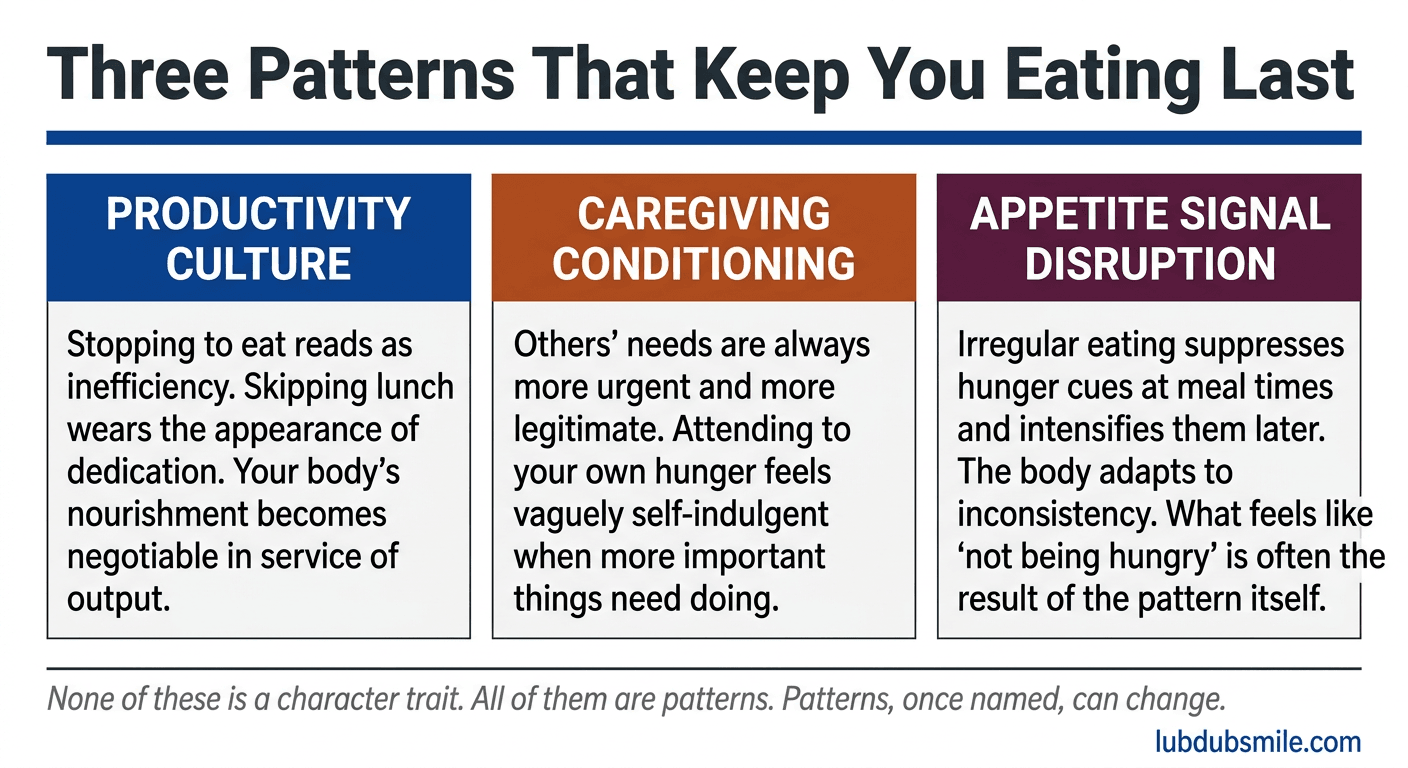
Productivity culture carries a particular implicit message: stopping to eat is inefficiency. The meal you eat at a desk, the lunch that disappears to finish something, the breakfast that coffee replaces because there wasn’t time these often wear the appearance of dedication rather than what they actually are: a daily act of placing your body last.
Caregiving identity carries a different but related message: others’ needs are more urgent and more legitimate than your own. When someone has absorbed this long enough, attending to their own hunger doesn’t just feel lower priority. It can feel vaguely self-indulgent like stopping to address a need that could wait while more important things need doing.
Both messages are wrong. Neither reveals itself as worth questioning until something prompts a closer look. Practical self-care for caregivers offers a starting point for that examination because eating as self-care begins with recognizing that your needs are as legitimate as the needs of the people you care for.
Why This Isn’t a Nutrition Problem It’s a Relationship Problem
You’ve optimized your diet in every way the supplements, the food quality, the nutritional knowledge and the one variable you haven’t touched is whether you actually eat on any consistent schedule.
The knowledge isn’t the missing piece. The relationship with your own needs is. Specifically: the working assumption that your hunger, your fatigue, your basic physical requirements are negotiable in ways that other people’s aren’t.
Recognizing this isn’t meant to produce guilt about the pattern. It’s meant to locate the actual lever because addressing the surface behavior works differently when eating as self-care builds from changed relationship rather than added discipline.
What Eating as Self-Care Actually Communicates to Yourself
Nourishment as Daily Declaration of Worth
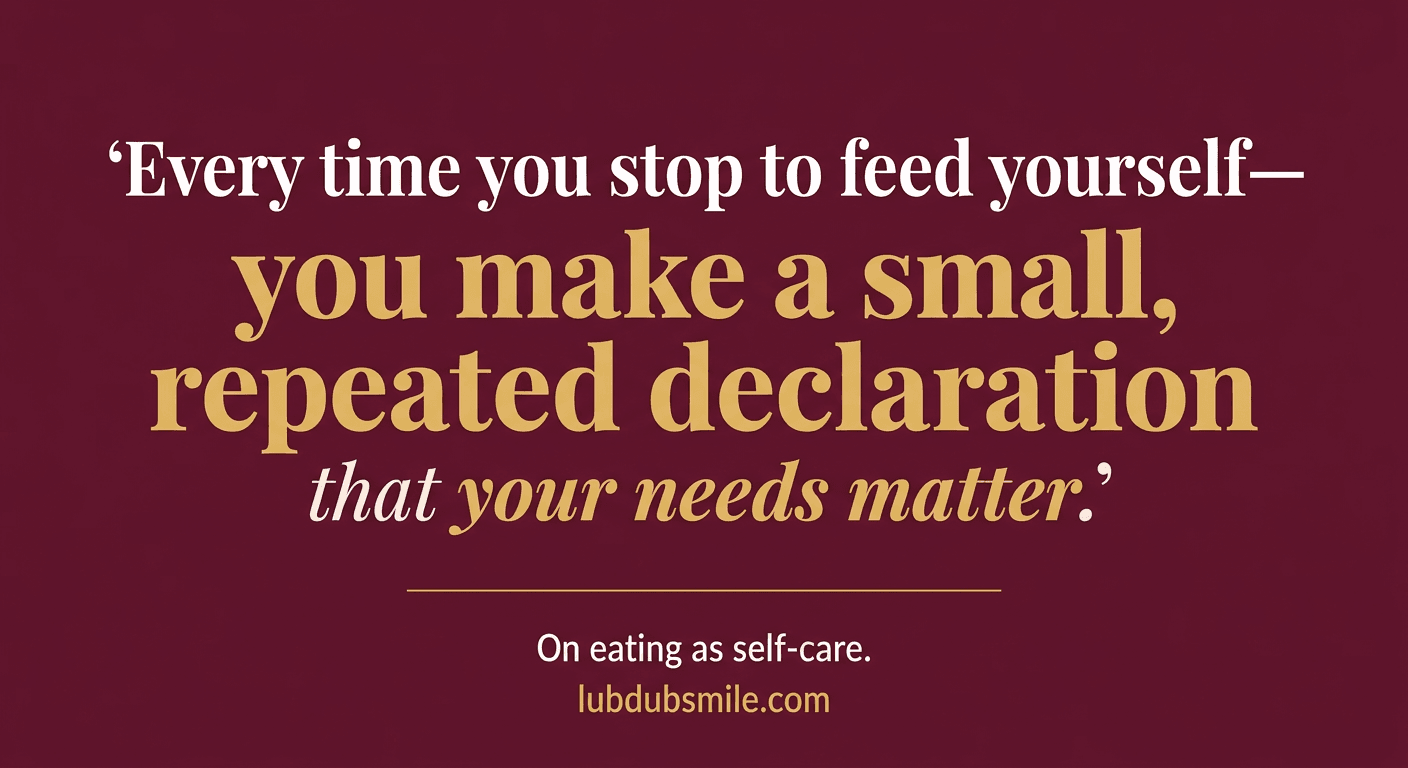
Every time you stop to feed yourself actually stop, actually eat, actually treat your hunger as something worth responding to you make a small, repeated declaration that your needs matter. Not loudly. Not dramatically. Just through the daily accumulation of treating yourself as someone worth nourishing.
The reverse is also true. When you consistently defer your own eating when lunch becomes a maybe, when breakfast is coffee, when dinner happens at 9pm because you finally ran out of other things to prioritize you also make a daily declaration. A quieter one, about whose needs have weight and whose can wait.
Defining enough through self-compassion and self-worth makes clear that worth isn’t an abstract concept it expresses itself through the small, daily ways we include or exclude ourselves from consideration, eating as self-care is one of the most immediate and repeated expressions of this.
Eating That Centers on Discipline vs. Eating That Centers on Dignity
When eating centers on discipline treats consistent nourishment as something to achieve through effort, willpower, and structure. It frames eating well as a performance of self-control. It generates compliance when willpower is present and falls apart when it isn’t.
Eating that centers on dignity treats consistent nourishment as an expression of basic self-regard. It doesn’t require willpower because it’s not about discipline it’s about including yourself in the category of people whose needs deserve attention. It’s less glamorous than optimization and more stable than motivation.
The shift is subtle in language and significant in practice. “I’m eating breakfast because I should” produces different behavior under stress than “I’m eating breakfast because I’m someone whose mornings include actual nourishment.” Eating as self-care operates through the second framing not a performance but a practice of inclusion.
Where Chaotic Eating Patterns Come From
Productivity Culture That Treats Eating as Inefficiency
You tell yourself you’ll eat after this meeting, and then there’s another meeting, and by the time you remember, it’s been eight hours and you’re making the worst possible decisions for the worst possible reasons. You feel vaguely guilty eating in front of your computer because it’s time that isn’t technically working and you don’t question why that calculus makes sense to you.
Productivity culture has successfully framed eating as interruption. The meal you eat is time away from output. The lunch break is a relic of a less productive era. The person who eats lunch sitting down, away from their work, has somehow opted out of the seriousness with which they’re supposed to be taking their responsibilities.
This is a framework, not a fact. And it’s worth naming as such, because once named, it becomes optional. Eating as self-care directly challenges this framework it reclaims nourishment as something that serves rather than competes with everything else you’re trying to accomplish.
Caregiving Conditioning: Treating Others’ Needs as Always More Urgent
For people in caregiving roles parents, healthcare workers, teachers, those caring for aging family members consistently placing others’ needs before their own isn’t just habit. People who heard explicit reinforcement that this is what virtue looks like often carry it deeply. Good parents, good caregivers, professionals who commit fully: the archetype consistently involves putting others first.
The problem isn’t caring for others. The problem is when “others first” becomes “self never” and when that pattern extends, invisibly, to the most basic acts of physical self-maintenance.
Emotional hygiene as a daily practice identifies the accumulated cost of consistently subordinating personal maintenance to external demands including the cost that shows up as irritability, reduced capacity for genuine warmth, and the chronic depletion that undermines the very caregiving it was meant to support.
Growing Up in Households Where Your Needs Came Last
For some people, inconsistent self-nourishment traces back further than professional culture or caregiving identity. When a child grows up in a household where the family consistently places their needs last where asking for things produces friction, where attending to oneself gets framed as burden or selfishness the adult they become often struggles to treat their own needs as legitimate. Not because they intellectually believe they don’t matter, but because the default setting still calibrates to the earlier environment.
This isn’t pathology. It’s a learned pattern operating below conscious awareness. Recognizing it is the beginning of being able to consciously choose something different including choosing eating as self-care as a genuine daily practice rather than a nice concept.
When Chaos Becomes the Default and Structure Feels Foreign
For many adults, the absence of consistent meal structure isn’t a decision it’s just what emerged when life became busy enough and self-prioritization dropped low enough that eating became reactive rather than intentional. The chaos is so longstanding that structure feels effortful and unfamiliar, even when it’s genuinely available.
Research on appetite regulation shows that irregular eating disrupts the hunger hormone signals ghrelin and leptin that would naturally prompt nourishment. When you consistently skip meals, the body learns to suppress hunger cues in those windows, then produces more intense hunger signals later. You’re not hungry in the morning and you’ve convinced yourself you’re just not a breakfast person and you don’t connect this to the fact that by noon you’ll eat anything that isn’t bolted to the floor. That pattern isn’t temperament. It’s the body adapting to irregular intake. Eating as self-care begins with understanding this mechanism rather than treating the pattern as a character trait.
The physiology here is worth sitting with, because it reframes something many adults have been interpreting as a personal failing. The person who feels ravenous and out of control at 7pm is not demonstrating poor willpower. They are experiencing the predictable endpoint of a day in which the body was consistently asked to wait. The intensity of evening hunger is proportional to the degree of daytime self-neglect, not to some character weakness in how the person relates to food. That distinction matters practically because the intervention changes entirely depending on which explanation you accept.
The Body’s Experience of Inconsistent Nourishment
What Your Body Learns from Irregular Feeding
The body is pattern-responsive. When eating is irregular and unpredictable, the body adjusts its hunger signaling, its metabolic patterns, and its anticipatory responses to the pattern it’s experiencing. This adaptation isn’t failure it’s the body’s intelligence working correctly.
The consequence is that restoring more consistent nourishment can feel uncomfortable at first. The body that has adapted to inconsistency doesn’t immediately produce reliable hunger signals on a more regular schedule. The first few days of eating more consistently may involve eating without strong hunger, which can feel wrong for people who’ve been using hunger as the only justification for eating.
The goal isn’t to override the body’s signals it’s to create conditions in which the body’s signals can recalibrate toward something more reliable. Eating as self-care supports that recalibration through consistency rather than forcing it through willpower.
Building consistent meal structure is the practical complement to the self-respect reframe this article offers because the physiological recalibration that eating as self-care requires happens through structural consistency, not through intention alone.
Energy, Mood, and Cognitive Function Without Consistent Fuel
The brain uses glucose as its primary fuel source, and whether consistent fuel is available demonstrably affects its function. This isn’t a diet claim it’s basic physiology. Research on nutrition and cognitive function consistently finds that adequate, consistent nourishment forms the physiological foundation for the emotional regulation, cognitive clarity, and energy you’re trying to bring to everything else you care about.
The decisions you make at 4pm after an intake that started and stalled at 7am differ in quality from decisions you make with consistent nourishment across the day. The patience you have at the end of a day where eating was an afterthought differs from the patience you have when basic physical needs received attention throughout.
Understanding how to fuel yourself with carbohydrates, protein, and fat in a balanced way supports the cognitive and emotional function that makes everything else in your day more manageable which is why eating as self-care is ultimately an investment in your capacity for everything you care about, not a distraction from it.
The Late-Day Eating Pattern as Physiological Response, Not Moral Failure
The person who barely eats during the day and then finds themselves eating heavily in the evening isn’t lacking willpower. They’re experiencing the physiological consequence of substantial daytime underfeeding. The body seeks to restore what it didn’t receive when it needed it often in a way that feels chaotic or out of control because the body first suppressed hunger signals and then reasserts them intensely.
This pattern is common, well-understood physiologically, and often something people interpret as a character failing rather than a predictable response to irregular nourishment. Understanding it as the latter is more useful and more kind. Eating as self-care reframes this pattern from evidence of poor self-control to a logical physiological response that changes when the cause daytime self-neglect changes.
Reframing Meals as Eating as Self-Care Practices
Breakfast as First Act of Self-Regard Each Day
Not because breakfast is the most important meal in the metabolic sense individual needs genuinely vary but because choosing to nourish yourself before the day’s demands fully begin is a meaningful act of inclusion. It says, before the meetings and the children and the responsibilities: I’m also here, and my needs are also in this day.
This doesn’t require elaborate preparation. It requires the decision that you’re someone whose morning includes actual nourishment. That decision made consistently is eating as self-care in its most daily form.
Lunch as Commitment to Your Own Continuity
Lunch is the meal that disappears most often to busyness. It’s also the meal that most directly sustains the capacity to do whatever the afternoon requires. Treating it as a commitment to yourself, with the same fidelity you’d bring to a meeting that matters reframes it from optional to non-negotiable.

What gets treated as non-negotiable tends to happen. What gets treated as “I’ll get to it when I can” tends not to. Eating as self-care applied to lunch means giving your midday nourishment the same status you give the other things you actually follow through on.
The Ritual Dimension: Eating as Presence, Not Productivity
Sitting down to eat even for 15 minutes rather than eating standing over a sink or in front of a screen is a micro-practice of treating yourself as someone worth a few minutes of actual presence. Not because sitting is nutritionally superior to standing, but because it embodies a different relationship with the act.
Dr. Kristin Neff’s self-compassion research consistently finds that treating yourself with the care you’d extend to someone you love isn’t indulgent it’s a prerequisite for sustainable wellbeing. Applied to eating as self-care: nourishing yourself with some attention and intention is the practice of that care in one of its most daily and available forms.
The APA’s framework for self-care and psychological wellbeing identifies consistent meeting of basic physical needs as foundational to emotional health not the least important form of self-care, but one of the most immediate. Eating as self-care meets this standard every time you treat your own nourishment as worth stopping for.
What Gets in the Way (Honestly)
“I’m Not Hungry” (And What That Might Mean)
Sometimes not hungry means not hungry, sometimes it means the body has suppressed hunger signals through irregular eating patterns, sometimes it means stress hormones are overriding appetite cues and sometimes it means eating has become sufficiently disconnected from self-regard that the body’s signals toward nourishment have stopped receiving attention.
Not hungry is information worth approaching with curiosity rather than immediately accepting as instruction to skip the meal. The question isn’t whether you feel hungry right now. It’s whether eating as self-care consistent nourishment as an expression of self-regard is something you’re treating as worth attending to.
“I Don’t Have Time” (And What Time Is Actually Being Spent On)
Ten minutes to eat something is genuinely available in most days that also have time for phone scrolling, email refreshing, and the various small expenditures that accumulate without notice. The time claim is often real in its felt experience but it’s worth examining what the time is actually going toward, and whether those expenditures are genuinely higher priority than the basic maintenance of the self doing all of it.
Eating as self-care doesn’t require significant time. It requires the decision that your nourishment is worth ten minutes.
“Others Need Me More Right Now” (The Martyrdom Pattern)
The calculus in which your needs are always lower priority than others’ needs rarely produces the noble outcome it promises. More often, it produces a person running on empty who has less to give because their own tank sits below sustainable. Taking 15 minutes to eat lunch doesn’t take those 15 minutes from the people who need you. It typically produces someone with more capacity for the next several hours.
Asking for help and delegating without guilt addresses the same underlying resistance the belief that conditioning built, that taking anything for yourself takes something from others. Eating as self-care challenges this belief in its most basic and daily form.
Building Eating as Self-Care From Self-Respect, Not Discipline

Starting With One Anchored Meal
Not a complete overhaul of your eating. One meal you commit to consistently same general time, actual food, eating it with some attention. One anchor point in the day that represents the decision that your nourishment is non-negotiable in that window.
Behavioral consistency research suggests that anchoring new patterns to existing routines reduces the friction of change. If coffee happens reliably every morning, pairing breakfast with it creates a natural scaffold. If there’s a consistent afternoon break in your schedule, anchoring lunch to it works similarly. Eating as self-care doesn’t require a complete system it requires a starting point.
Making Eating Non-Negotiable the Same Way Work Meetings Are
The meetings on your calendar happen because they’ve received the status of non-negotiable. Eating as self-care can receive the same status. This isn’t about rigidity it’s about giving your own nourishment the organizational status you give other things you consider important.
Some people find it useful to schedule meals the way they schedule meetings blocked time, treated with the same fidelity. Not because eating requires a calendar invitation, but because until the habit establishes itself, structural support helps.
Preparing Food as Act of Care for Future-You

When you prep food in advance, you’re doing something specific: providing for your future self with the same foresight you’d bring to providing for someone you care about. Making tomorrow’s lunch today isn’t meal prep optimization it’s treating the person you’ll be tomorrow as worth taking care of.
This reframe doesn’t make meal prep more enjoyable. It does make it feel like something other than a chore more like a small, repeated investment in someone whose needs deserve attention. Eating as self-care applied to food preparation means bringing the same care to your own nourishment that you already bring to other people’s.
Nourishing yourself thoughtfully between meals with the same intention that drives meal prep reinforces the pattern of treating your hunger as worth responding to throughout the day not just at the meals you’ve anchored.
What Consistent Enough Looks Like (Not Perfect)
Not every meal you eat sitting down, not pristine nutritional balance at every eating occasion and not zero chaotic eating days when life is genuinely demanding. Consistent enough means: a recognizable pattern of actually feeding yourself, most days, with some intention. Enough that your body begins to anticipate nourishment rather than adapt to scarcity. Enough that you stop feeling like someone eating as an afterthought.
Progress here isn’t measured in perfection. It’s measured in the gradual shift from treating your own nourishment as optional to treating it as included. Eating as self-care is a practice and like all practices, it matters that it continues rather than that it’s always perfect.
Sustainable wellness practices without obsession make the same point about health habits generally: the goal is a pattern you can maintain, not a performance you achieve once and then abandon. Eating as self-care belongs in the category of practices you maintain accessible, repeatable, and building from something more durable than motivation.
When Eating as Self-Care Isn’t Enough
When the Relationship With Food Involves Clinical Complexity
For some people, the relationship with food involves complexity that extends well beyond self-neglect patterns. Significant restriction, marathon eating, purging, intense food-related anxiety, or emotional patterns that make eating feel unsafe or out of control are not something an eating as self-care reframe addresses. These require professional support from dietitians who hold training in non-diet approaches and therapists who specialize in eating concerns.
This distinction matters and is worth naming directly. The self-respect reframe this article offers is for adults whose eating is chaotic due to neglect, busyness, or patterns that a lifetime of conditioning built not for those whose eating involves clinical complexity that deserves specialized care.
The National Eating Disorders Association provides resources, professional referrals, and a helpline (1-800-931-2237) for anyone whose relationship with food involves significant distress. Reaching out for appropriate support is itself an act of self-care one that eating as self-care in the sense this article describes doesn’t replace.
Depletion That Has Crossed Into Burnout
When the pattern of self-neglect including but not limited to irregular eating has continued long enough, the depletion it produces can cross into clinical burnout that individual behavioral changes don’t adequately address. At that point, the pattern deserves professional attention rather than a self-help reframe.
Burnout recovery approaches that address the full picture of chronic depletion including its physical, emotional, and relational dimensions can provide the kind of support that makes the eating as self-care reframe something that actually lands rather than another good idea in an exhausted mind.
Frequently Asked Questions
Why do I always feed everyone else before myself?
Because you’re operating inside a pattern not a character flaw. Eating as self-care consistently gets deprioritized in people who’ve absorbed the message that others’ needs are more legitimate than their own, whether through caregiving identity, productivity culture, or early environments where their needs came last. The pattern runs automatically until someone examines it. Naming it as a pattern rather than a personality trait is the beginning of being able to choose something different.
Is eating self-care?
Yes. Eating as self-care means treating your own hunger with the same regard you extend to everyone else’s stopping to nourish yourself because you’re someone whose needs deserve attention, not because you’ve finally run out of other things to do first. It’s not about perfect nutrition or elaborate meals. It’s about the daily, repeated decision to include yourself in the category of people worth feeding.
What if I genuinely don’t feel hungry at meal times?
Hunger signals the body has suppressed are a common consequence of irregular eating patterns. The body adapts to the timing it experiences, and irregular timing can produce unreliable signals often underactive at conventional meal times and more intense later. Eating at consistent times even when not acutely hungry can help recalibrate these signals over time. Eating as self-care doesn’t require acute hunger as its justification it builds from self-regard rather than physiological urgency. If absent hunger is persistent or involves other symptoms, consulting a healthcare provider is appropriate.
Is this approach compatible with intentional fasting?
Intentional fasting involves a deliberate relationship with eating structure which differs from chaotic or avoidant eating. The eating as self-care principle applies regardless of eating window: within whatever pattern you’ve chosen, are you treating your own nourishment with intentionality and regard? If someone uses fasting to avoid eating, restrict, or punish rather than as a deliberately chosen approach, that’s worth examining honestly.
What if I’ve always eaten this way and it seems fine?
“Seems fine” and “is fine” can differ, particularly in self-neglect patterns where disconnection from one’s own needs means reduced awareness of their absence. It’s worth asking: does your relationship with your own hunger feel responsive and attentive? Do you eat with some presence and regard for yourself? If “seems fine” is accompanied by fatigue, chaotic late-day eating, or a sense of treating yourself as an afterthought the fine may be worth questioning. Eating as self-care asks a different question than nutrition optimization: not whether your diet is adequate, but whether you treat your own nourishment as worth attending to.
How do I start when my schedule is genuinely unpredictable?
Start with the most predictable part of your day and anchor one meal there. If mornings are consistent but afternoons aren’t, breakfast is your anchor. If evenings are more reliable, dinner is. One consistent, intentional meal is a beginning and beginnings change patterns in ways that waiting for ideal conditions doesn’t. Eating as self-care doesn’t require a perfect schedule. It requires one starting point that you actually follow through on.
Can my children see this change in me and will it affect them?
Yes to both, in meaningful ways. Children who watch a parent eat consistently and with some regard for their own nourishment learn that adult needs are legitimate and worth attending to. They also absorb a model for their own relationship with eating that builds from self-care rather than self-neglect. Eating as self-care, practiced visibly, teaches something that explicit instruction about healthy eating rarely achieves: that the person caring for them is also someone whose needs deserve care.
The Eating as Self-Care Invitation: You Are Worth Feeding
Eating as self-care is not about perfect eating. It isn’t about another nutritional protocol to follow until willpower runs out. It’s about something more fundamental: the daily, repeated decision about whether your own basic needs make the list.
For many adults reading this, the pattern of treating their nourishment as optional is so established that it rarely gets examined. It’s just how things are the eating that happens when everything else is handled, the meals that disappear when something more important comes up, the lunch that turned into coffee and whatever was left on someone else’s plate.
What becomes possible when that pattern gets examined when the question “why do I keep coming last in my own life?” is asked honestly is not a perfectly structured eating plan. It’s a different relationship with the act of nourishing yourself. One in which eating as self-care isn’t a performance of discipline but a daily practice of including yourself. Of treating your hunger as worth responding to. Of being, in the most ordinary and repeated way, someone whose needs count.
That shift, small as it sounds, has a way of rippling.
Start with one meal. Sit down for it. Eat it because you’re someone worth feeding not because you finally ran out of other things to do first.
Takeaway
Eating as self-care reframes consistent nourishment from a discipline problem to a relationship problem and the relationship in question is the one you have with your own needs, expressed daily through whether your hunger receives the same regard you extend to everyone else’s.
This article offers an eating as self-care reframe for adults with chaotic eating patterns that neglect, busyness, or conditioning built. If your relationship with food involves significant restriction, spree eating, purging, or food-related distress, please reach out to qualified professionals. The National Eating Disorders Association (NEDA) helpline is available at 1-800-931-2237, or text “NEDA” to 741741.
This is not medical nutrition advice. Individual eating needs vary based on health status, medical conditions, and personal circumstances. Consult a registered dietitian for personalized nutritional guidance.
This content is for educational purposes and does not substitute for professional psychological or therapeutic help.