
Career identity misalignment often arrives quietly not as a dramatic crisis, but as a persistent low-grade unease you can’t quite name. You’re introduced at a dinner party by your job title, and instead of the familiar pride, you feel a quiet dislocation like someone is pointing at a costume and calling it you. This article examines what career identity misalignment actually is, what triggers it, what it is and isn’t telling you, and how to navigate it without destroying what you’ve built. You smile. You respond the way you always have. And somewhere underneath the response, something doesn’t quite fit.
Or perhaps it arrived differently. You got the promotion you’d been working toward for three years. For three days you felt what you expected to feel. Then nothing and you’ve been quietly carrying that nothing ever since, not quite knowing what to do with it or whether you’re allowed to name it.
The work is fine. The pay is fine. The people are fine. And “fine” has started feeling like a verdict instead of a description.
This experience is more common than its silence suggests. Gallup’s ongoing workplace engagement research consistently finds that roughly two-thirds of U.S. workers report feeling disengaged though the reasons vary significantly and career identity misalignment represents only one subset of that disengagement. Career identity misalignment sits in a particular category of discomfort real enough to create persistent unease, ambiguous enough that it’s hard to name, and loaded enough with implication that examining it too closely can feel dangerous. Because what if looking directly at this feeling leads somewhere inconvenient? What if it means you’ve built the wrong life?
The invitation here is to look at it more closely not to answer that question immediately, but to understand what’s actually happening when a career title stops feeling like yours.
Career identity misalignment sits in a category of experience that most professional development conversations quietly avoid. It is not dramatic enough to be treated as crisis, not simple enough to be resolved by a career quiz, and not socially acceptable enough to raise in most workplaces. What it actually is, is a legitimate developmental signal that deserves the same quality of honest examination adults bring to other significant life questions. That is the standard this article applies.
Naming Career Identity Misalignment: What You’re Actually Feeling
Career identity misalignment is the experience of a professional identity that no longer accurately reflects who you are a gap between the title you hold and the self that holds it.
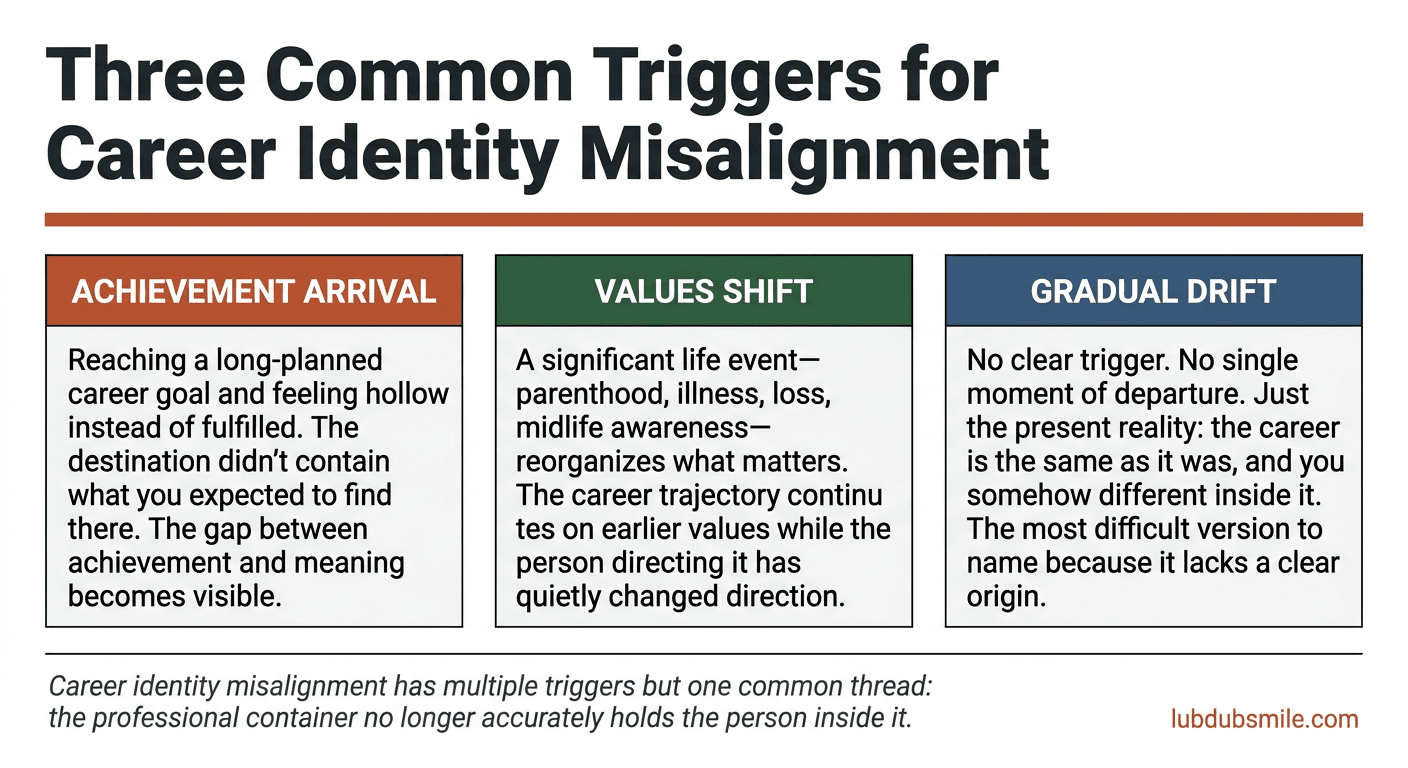
The three most common triggers include reaching a long-planned career goal and feeling nothing, experiencing a significant life event that shifts your values, and a gradual drift away from professional identity without any clear turning point.
Career Identity Misalignment: The Dissonance That’s Hard to Explain
Career identity misalignment resists articulation without sounding ungrateful. You have the job. You may have the salary, the title, the respect of colleagues, the external markers of success. Complaining about this feels indulgent. Admitting it publicly feels professionally risky. Even thinking it clearly feels like a betrayal of the effort that got you here.
So most people don’t name it. They work harder instead, or they wait for the feeling to pass, or they attribute it to tiredness or stress or needing a vacation. Sometimes those explanations are accurate. Often they cover a more significant question.
Someone asks what you do and you answer correctly your title, your company, your function and somewhere in the answer you notice you’re describing someone else’s life. That noticing is the thing worth paying attention to. Career dissatisfaction and feeling stuck in your career often begin exactly here in the gap between the professional narrative you present and the internal experience of who you actually are. Understanding emotional regulation in daily life can help you sit with that noticing rather than immediately suppressing it.
Why Career Identity Misalignment Often Arrives After Achievement, Not Before

Researchers have documented the hollowness that can follow achievement in psychological literature for decades. Researchers sometimes call it “arrival fallacy” the mistaken belief that reaching a goal will produce lasting satisfaction, and the disorientation when it doesn’t.
Psychologist Tal Ben-Shahar has written about the way goal-oriented people often postpone their sense of meaning to the moment of achievement, only to find that the achievement doesn’t deliver what was promised. The emptiness isn’t evidence of ingratitude or dysfunction. It’s the predictable result of discovering that the destination didn’t contain what you’d hoped to find there.
Career identity misalignment at the moment of achievement is worth naming clearly because it changes the interpretation. The hollowness isn’t a sign that you chose wrongly, or that the work is worthless, or that you’re broken. It’s a sign that the meaning you expected wasn’t contained in the title and that you might need to look for it somewhere else, or understand it differently. Career fulfillment and professional achievement are not the same destination. Knowing how to find purpose in your career requires separating the two clearly.
The Gap Between Your LinkedIn Profile and Your Internal Experience
You update your LinkedIn and feel nothing. You remember when updating it felt like progress. Now it feels like maintaining a profile for someone you used to be.
That gap between the professional identity you present and the internal experience of who you are is the territory this article addresses. Career identity misalignment isn’t always dramatic. It’s often quiet: a sense of performing rather than being, of narrating your professional self rather than inhabiting it, of the distance between your resume and your actual inner life widening in ways that are hard to quantify.
Take career identity misalignment seriously not because it necessarily requires dramatic action, but because living in significant internal-external misalignment carries psychological costs that tend to compound over time.
How Career Titles Become Identity (And Why That’s Complicated)
When Professional Identity Fills the Space Where Self-Concept Lives
Professional identity is one of the most powerful organizers of adult self-concept in achievement-oriented culture. What you do for work answers the question “who are you?” in most social contexts. It provides structure, purpose, belonging, and social location. For people who built their adult identity through career achievement, the title isn’t merely a job description it’s the answer to existential questions that haven’t been asked or answered elsewhere.
When professional identity carries that weight, any challenge to it a title that stops fitting, a role that evolves away from values, a promotion into misalignment affects not just career satisfaction but the entire architecture of self-concept. Career identity misalignment in this context isn’t career dissatisfaction. It’s a structural identity challenge. The process of building authentic identity and belonging often requires examining what happens when professional containers no longer hold the person inside them.
The Architecture of Title-Based Identity: How It Gets Built
Identity organized primarily around professional title usually gets built incrementally and invisibly. Early career success produces positive reinforcement for professional performance. The career becomes the primary arena for competence, growth, and recognition. You organize social life around professional peers. You link self-worth to professional standing. Years of this accumulation produce an identity structure in which the professional self isn’t one component of self-concept but its central organizing principle.
This trajectory carries nothing inherently pathological. Many people build rich professional identities that serve them well. The complication arises when the professional container becomes the entirety of the self because any change in the container then becomes career identity misalignment rather than a career development event. The container and the person inside it have grown apart.
The Title That Fit Then and the Person You Are Now
You’re excellent at something that increasingly doesn’t feel like yours. The performance reviews confirm it. The competence is real. And somehow that’s part of the problem.
Psychologist Erik Erikson understood that adult development isn’t linear that the identity that served you well at one life stage may genuinely need renegotiation at another. The title that accurately expressed who you were at thirty-two may not adequately contain the person at forty-five. Values shift through lived experience. Priorities evolve through parenting, loss, illness, and the accumulated wisdom of years. The career trajectory you set on earlier values continues on its own momentum while the person directing it has quietly changed direction inside.
Career identity misalignment at midlife carries nothing of failure. It’s development. The complication is that development is internal and invisible, while career trajectories are external and carry their own institutional momentum. Adults navigating this shift often find that redefining personal strength after 40 helps reframe what feels like loss as growth.
Common Triggers That Surface Career Identity Misalignment
The three most common triggers for career identity misalignment are reaching a long-planned role and feeling nothing, experiencing a significant life event that shifts your values, and noticing a gradual drift you can’t trace to a single moment.
Reaching the Role You Planned For (And Feeling Nothing)
The promotion, the title, the role that was the stated goal arrived at, and accompanied by something unexpected: not the satisfaction anticipated but a flat, strange absence of it. This is one of the most disorienting versions of career identity misalignment because there’s no external problem to point to.
The job is good. The achievement is real. The feeling is hollow. When the feeling doesn’t match what the achievement is supposed to produce, the interpretation that something is wrong with you that you’re ungrateful, broken, or simply wired incorrectly for satisfaction can rush in to fill the explanatory gap.
A more useful interpretation: career identity misalignment is information. It points at the gap between what you believed the achievement would deliver (meaning, fulfillment, a sense of having arrived) and what achievements actually deliver (accomplishment, recognition, external markers of success). These aren’t the same thing, and confusing them which achievement-oriented culture actively encourages sets up the disappointment. Career fulfillment lives somewhere other than the title itself.
Life Events That Shift Values (Loss, Parenthood, Illness, Midlife)
Significant life events often produce value shifts that career trajectories don’t automatically reflect. A serious illness changes what feels important. Becoming a parent reorganizes priorities in ways that the career established before parenthood doesn’t account for. The death of someone close raises questions about how you spend time that weren’t pressing before. Midlife brings, for many people, a shift in what the remaining decades are for.
Identity researchers and developmental psychologists describe midlife as a time when generativity the concern for what you’re creating and leaving, for whom becomes more pressing than achievement for its own sake. A midlife career change impulse often isn’t a crisis at all. It’s a developmental signal that the career built for achievement in early adulthood no longer adequately expresses the generative concerns of mid-life. Parents navigating career identity misalignment at this stage often discover that practical self-care strategies become foundational to the identity work itself.
The Gradual Drift: When You Can’t Point to When It Changed
Not all career identity misalignment has a clear trigger. Many people experience a gradual drift a slow migration of authentic self away from professional identity that happened without a specific moment of departure. They can’t point to when the title stopped fitting. They simply notice, one day, that it doesn’t.
Gradual career identity misalignment is particularly difficult to address because it lacks the clarity of a triggering event. There’s no obvious “this is what changed” to examine. There’s only the present reality: the career is the same as it was, and you are somehow different inside it. The drift is real even when it’s invisible.
Career identity misalignment through gradual drift calls for the same honest examination as any other version perhaps more so, because the absence of a clear trigger makes it easier to dismiss.
What This Feeling Is Telling You (And What It Isn’t)
Career identity misalignment is information but it’s easy to misread. Understanding the distinction between what it signals and what it doesn’t is essential before taking action.
It Doesn’t Always Mean You Need to Change Careers
Career identity misalignment doesn’t necessarily mean the career needs to change. Many people who experience profound work identity crisis and professional identity questioning find their path forward involves changing their relationship with their current work not the work itself. How meaning gets found within it. Consider which aspects you choose to emphasize. Look at what unfolds beyond the role itself. Clarify the purpose you assign to your work.
Career identity misalignment is information. It’s not a prescription. The question it raises is “what is worth examining?” not “what should I immediately do?” Should you quit your job if you’re unhappy? Not before examining what the unhappiness is actually about.
It Might Mean Your Values Have Evolved Ahead of Your Trajectory
Self-determination theory research, developed by psychologists Edward Deci and Richard Ryan, consistently finds that psychological wellbeing depends not on achievement but on whether activities express genuine values and provide autonomy. When careers are built on earlier values and those values have evolved, the career can continue delivering achievement while failing to deliver the wellbeing that values-aligned work provides.
Career identity misalignment driven by values evolution requires a different relationship between work and values which sometimes leads to career change but often leads to something more internal: a recalibration of what the work means and what it’s for. Meaningful work and purpose at work don’t always require a new job title. Sometimes they require a new relationship with the existing one.
It Sometimes Means Something Else Entirely
People often confuse career identity misalignment with burnout, depression, or anxiety and these conditions can produce what feels like career meaninglessness even when the underlying issue isn’t career-related. Burnout produces emotional exhaustion and cynicism that can look like career identity misalignment. Depression can drain meaning from everything, including work, in ways that feel like professional misalignment but lift with appropriate treatment. Anxiety can create a sense that something is deeply wrong that attaches to career as its object.
Professional burnout vs career crisis is a distinction worth making carefully. If the feeling comes with persistent sadness, hopelessness, inability to experience pleasure in other areas of life, difficulty functioning, or significant anxiety, consulting a mental health professional is more appropriate than career exploration alone.
The distinction between career identity misalignment and burnout is worth more precision than it typically receives, because the two can coexist and because conflating them produces different errors. Burnout treated as identity misalignment leads people toward career changes that don’t address the exhaustion driving the dissatisfaction. Identity misalignment treated as burnout leads people toward rest that doesn’t address the values gap producing the emptiness. The more useful diagnostic question is not which one it is but what the feeling does when restoration is applied. If adequate rest, recovery, and relief from pressure restore a sense of meaning in the work, burnout is the more likely explanation. If the emptiness persists through rest and surfaces most clearly in moments of professional clarity rather than depletion, identity misalignment is worth examining more directly.
Sitting With Uncertainty Before Interpreting
The impulse when confronting career identity misalignment is to interpret and act quickly. What does this mean? What should I do? The most useful initial response is neither of these. Sit with the experience long enough to understand it more fully before drawing conclusions about what it requires.
Uncertainty is uncomfortable. It’s also where genuine examination happens. Acting quickly whether by switching jobs impulsively or by suppressing the feeling and working harder typically forecloses the understanding that career identity misalignment is offering. Building emotional agility can support the capacity to hold this kind of productive uncertainty without rushing to resolve it prematurely.
These four interpretations of career identity misalignment share one common thread: they all require honest examination before action. What follows is a framework for that examination.
The Question of Authentic Identity
Is There a “Real Self” Waiting to Be Discovered?
Popular discourse around career identity misalignment often implies a fixed authentic self that exists beneath the professional identity, waiting to be uncovered and expressed. “Find your true calling.” “Discover who you really are.” “The real you is in there somewhere.”
This framing, while emotionally appealing, isn’t well-supported by what identity researchers actually understand about how selves work. Identity isn’t a static thing waiting to be discovered people construct it actively. Psychologist James Marcia built on Erikson’s identity development work to establish that people don’t find identity but form it through exploration, experience, and commitment to emerging answers that remain subject to revision.
Career identity misalignment, understood through this lens, isn’t a sign that you’ve lost your real self. It’s a sign that the identity construction process needs updating that what you built no longer accurately represents the person doing the building.
Values as More Stable Compass Than Passion or Title
The “find your passion” framework has become pervasive career advice, despite compelling evidence against it as a reliable guide. Research by psychologist Carol Dweck and colleagues suggests that treating passion as something to be found (a “fixed” orientation) rather than developed (a “growth” orientation) actually reduces the likelihood of sustained engagement with work.

Values what genuinely matters to you, what you want your time to be in service of, what kinds of impact feel meaningful provide a more stable guide through career identity misalignment than passion because they don’t depend on continuous emotional enthusiasm to remain directional. You can express values through many different careers, roles, and activities. Passion tends to be more specific and therefore more fragile.
The question “what am I passionate about?” is less useful than “what do I value, and how aligned is my current work with expressing those values?” Career fulfillment follows values alignment more reliably than passion pursuit. The process of defining enough through self-compassion often clarifies which values the professional identity has been neglecting.
Exploring Who You Are Beyond Your Title
What You Were Before This Career
The person you were before career identity misalignment was even a possibility is worth remembering. Not to return to that earlier self (they were younger, in different circumstances, with different experience), but to access threads of self that predate the professional construction.
Before career ambition took center stage, what genuinely captured your interest?
Which pursuits or curiosities pulled you in but never found space within your career path?
Where did you consciously set parts of yourself aside because they didn’t align with your professional direction? These aren’t necessarily the elements to build a new career around but they’re information about what the current professional identity may be leaving unexpressed.
How You Want to Spend Your Attention (Not Just Your Time)
Time is one way to examine what matters. Attention is another, and possibly more revealing. What genuinely commands your interest when you’re not performing your professional identity? What do you find yourself thinking about, reading about, drawn toward without instrumental purpose?
Career identity misalignment often becomes visible in exactly these moments when the performance of professional self falls away and something else, quieter and more persistent, takes its place. What, if anything, currently engages something more than the competent performance of professional responsibility?
These questions don’t necessarily produce career directions. They produce information about what the current professional container may be leaving unaddressed.
Journaling Prompts for Career Identity Exploration
These are starting points for honest self-examination, not diagnostic instruments:
- When did your job title last feel genuinely like yours? What was different then?
- If you removed your job title, how would you describe who you are to someone who genuinely wanted to know?
- What values does your current work express? What values does it not express?
- What would you work on if no one would ever know about it?
- What are you afraid this feeling means? What would you do differently if that fear turned out to be unfounded?
Navigating This Without Destroying What You’ve Built
Career identity misalignment creates pressure for resolution. Understanding how to navigate that pressure without making impulsive decisions is as important as the exploration itself.
The Difference Between Exploration and Impulsive Exit
Career identity misalignment creates pressure for resolution. The discomfort wants an answer, and quitting provides one immediately, decisively, visibly. For some people, at some points, career change is the right response. But impulsive exit driven primarily by the desire to escape discomfort rather than by clear-eyed understanding of what’s needed tends to replicate rather than resolve identity problems.
Career development researcher Herminia Ibarra, in her work on career identity change, found that people who navigate career transitions most successfully tend to act their way into new identities through small experiments rather than committing to major change based on reflection alone. Testing, experimenting, exploring before committing. Career transition planning works best when exploration precedes commitment. Career change vs staying isn’t a binary decision that needs resolution before the examination completes.
Finding Meaning Within Your Current Role While Exploring
The premise that exploration requires leaving is often false. Significant identity exploration can happen alongside continued presence in a current role not as permanent compromise, but as the space in which clarity develops before action.

Which parts of your current work feel truly meaningful? Where do your relationships at work feel most genuine and real? Even in a role that doesn’t fully align, what contributions reflect who you truly are? These questions aren’t about suppressing career identity misalignment they’re about finding the threads of authentic engagement that exist within it while the larger questions develop.
Job Crafting: Reshaping Your Role Toward Greater Authenticity
Research by psychologists Amy Wrzesniewski and Jane Dutton introduced the concept of “job crafting” the ways individuals reshape their roles toward greater personal meaning by changing the tasks they emphasize, the relationships they invest in, and the meaning they make of their work.
Not every role or organization offers job crafting latitude. But for many people experiencing career identity misalignment, more room exists to shape how their work gets done than they’ve actively exercised. The title stays the same. The relationship with the role evolves. Career fulfillment becomes possible without career change. Meaningful work often emerges from reshaping what already exists rather than starting over.
Financial and Practical Reality as Legitimate Factor, Not Just Obstacle
Acknowledge the financial and practical dimensions of career identity misalignment honestly not as the fear keeping you stuck, but as legitimate constraints that belong in the picture.
If you can’t afford to explore this if the income is genuinely necessary, if dependents rely on it, if there’s no financial runway for transition that’s a real constraint, not merely avoidance. You can examine career identity misalignment within financial constraints, even if career change cannot happen right now. Understanding how to delegate without guilt may free the time and mental bandwidth this exploration requires, even when the role itself stays.
Career Identity and Relationships
When Your Identity Shift Affects How Others See You
Career identity misalignment isn’t only personal. Professional identity is embedded in relationships, social contexts, and others’ expectations. Partners who met you as a particular professional. Parents who defined your success through your title. Social networks organized around professional identity. These relational dimensions make career identity misalignment feel higher-stakes because changing how you understand yourself professionally may change how others relate to you.
This is real. It’s also not necessarily a reason to avoid examination. Acknowledge it as a genuine complicating factor rather than dismissing it as others’ problem to manage. Open communication in close relationships can support partners in navigating career identity misalignment together rather than in isolation.
Whose Life Are You Living?
This is the question underneath many experiences of career identity misalignment: How much of this was chosen from an authentic sense of self, and how much was built from others’ expectations, social scripts about success, or early decisions made before there was enough life experience to know what mattered?
The answer is almost never entirely one or the other. Most people’s career trajectories involve both authentic choice and external shaping. The question isn’t whether external influence existed it always does but whether the current trajectory still expresses enough of genuine self to feel worth continuing, and whether aspects of career identity misalignment have moved too far from authentic values to sustain.
Professional Support for Identity Work

When Therapy Helps With Career Identity Misalignment
Therapy is particularly useful when career identity misalignment has emotional roots that reflection alone doesn’t reach: when you built the professional identity in response to family dynamics, early experiences of conditional approval, or fear rather than genuine aspiration. A therapist can help examine the origins of the identity structure, distinguish career disillusionment from depression, and support the identity renegotiation that significant change requires.
If the feeling accompanying career identity misalignment includes persistent emptiness, hopelessness, or inability to experience wellbeing in other areas, professional mental health support is appropriate before or alongside career exploration. Executive therapy programs specifically serve high-performing professionals navigating exactly these questions. Professionals seeking flexible access can also explore telehealth therapy options across state lines.
The Difference Between Career Coaching and Identity Work
Career coaching addresses career decisions, strategy, and transition what next, how to get there, what the options look like. Identity work addresses the deeper question of who you are and what gives your life meaning. Both carry value. They address different levels of career identity misalignment.
For some people, career coaching is the appropriate first step when the identity question has enough clarity that what’s needed is strategic navigation. For others, identity work needs to precede career strategy because making career decisions without clarity about what’s being optimized for tends to produce decisions that replicate the original career identity misalignment.
Frequently Asked Questions
Does this feeling mean I should quit my job?
Not necessarily. Career identity misalignment has multiple possible responses, of which quitting is only one. Many people resolve it by changing their relationship with their current work rather than the work itself. The feeling invites examination it does not deliver a verdict on what action to take. Acting before the examination completes tends to produce decisions that miss the actual question.
What if I can’t afford to explore this I need the income?
Financial necessity is a legitimate constraint, not just fear. You can examine career identity misalignment within financial constraints even when career change cannot happen. Therapy, journaling, small experiments, values examination none of these require income sacrifice. Career transition may need different circumstances. Identity exploration doesn’t have to wait for them.
How do I know if this is career identity misalignment or just burnout?
The distinction matters. Burnout tends to produce exhaustion and cynicism specifically in professional domains and improves with restoration. Career identity misalignment runs deeper questioning meaning and fit rather than just energy. If rest and recovery don’t produce meaningful change, or if the feeling extends into broad inability to experience purpose at work or elsewhere, professional consultation is appropriate. Depression can resemble both and requires its own assessment.
What if I figure out who I am and it’s impractical?
Clarity rarely points only toward impractical options. Understanding your values through career identity misalignment usually reveals how to express them within existing structures not only through dramatic reinvention. When authentic direction genuinely isn’t currently viable, knowing that still provides more useful information than comfortable ambiguity. Clarity, even inconvenient clarity, is better information than not knowing.
Is it normal to feel career identity misalignment after years of career success?
Yes. Research on mid-career adults consistently finds identity questioning at this stage. Erikson’s developmental theory identifies midlife as a period when questions shift from “how do I advance?” to “what am I building, and does it matter?” Career identity misalignment often represents exactly this developmental shift not dysfunction, but the developmental work of mid-adulthood. A mid-career crisis is frequently a mid-career recalibration worth taking seriously rather than suppressing.
The Invitation to a Different Relationship With Your Work
The title that no longer feels like you may be pointing at something that deserves more than the suppression of a feeling. Career identity misalignment may be pointing at the gap between who you’ve become and the professional container that was built for who you were.
That gap isn’t necessarily a crisis. Career identity misalignment is often information about values that have evolved, about meaning that needs different sources, about a self that has grown beyond its current professional expression. What it means, specifically, for you depends on examination that this article can only begin.
The invitation isn’t to abandon what you’ve built. Examine your relationship with it with honesty about what it expresses and what it doesn’t, with curiosity about what the next chapter of professional identity might look like, and with patience for the exploration that meaningful integration requires. Rebuilding your sense of self is never a single event. It’s an ongoing process that deserves time.
You are not your title. You never were. The title was always pointing at you sometimes accurately, sometimes approximately, sometimes from a growing distance. The work of mid-career is, in part, understanding the gap that career identity misalignment reveals and deciding what to do with it.
That examination is worth beginning, even if slowly. Especially if slowly.
Career identity misalignment signals that your values have grown beyond your professional container and honest examination, not impulsive action, is the path forward.
This article provides frameworks for exploring career identity misalignment, but it is not a substitute for professional mental health support or career advice. If you are experiencing persistent depression, anxiety, or inability to function, please consult a mental health professional. Major career decisions have significant financial and practical implications that require careful consideration beyond identity exploration.
This content is for educational purposes and does not substitute for professional psychological or therapeutic help.