

Meal Structure Benefits: Why Predictable Eating Patterns Support More Than Nutrition
Meal structure benefits extend well beyond nutrition yet most nutrition conversations ignore them entirely. You’ve tracked macros, tried intermittent fasting, cut carbohydrates, added protein, experimented with meal timing windows, and read enough nutrition content to have an informed opinion on most dietary debates. And yet something isn’t working the way you expected.
Why is meal timing important? Meal structure benefits including appetite regulation, blood sugar stability, reduced decision fatigue, and more automatic food choices emerge from the predictability and consistency of when eating occurs, not just from what gets eaten. The variable most nutrition conversations ignore isn’t what you eat. It’s how reliably you eat.
Your energy fluctuates dramatically through the day. You eat well in the morning, inconsistently through the afternoon, and find yourself consuming most of your calories between 8 and 10 p.m. not because you lack nutritional knowledge or willpower, but because a pattern established itself and you’ve been living inside it without examining it.
This isn’t another diet. It’s a different lens entirely one that focuses on the behavioral and physiological infrastructure that makes any approach to food more or less sustainable.
Nutrition content tends to cluster around food composition because food is concrete, measurable, and commercially tractable. Eating patterns are harder to package and considerably harder to sell. That asymmetry helps explain why the behavioral infrastructure of eating, when you eat, how reliably, and how your body learns to anticipate it, receives a fraction of the attention that macronutrients and dietary frameworks do, despite consistent research evidence suggesting it matters just as much.
What Meal Structure Actually Means (And What It Doesn’t)
Structure vs. Rigidity: An Important Distinction
Meal structure, properly understood, is not eating at precisely the same minute every day. It’s not a rigid schedule that ignores hunger, social context, or life’s inevitable disruptions. It’s not a new set of food rules in behavioral language.
Meal structure means having a reasonably predictable eating pattern anchor points in your day when you reliably eat, spaced in ways that support appetite regulation, with enough consistency that your body’s hormonal and behavioral systems can orient around it. The meal structure benefits this consistency produces are behavioral and physiological simultaneously.
The distinction between structure and rigidity matters enormously. Structure creates conditions in which flexible, sustainable eating becomes easier. Rigidity creates anxiety, all-or-nothing thinking, and the kind of perfectionism that causes people to abandon any approach entirely after a single disruption. For a broader look at how this principle applies to health habits generally, healthy aging without obsession explores the difference between sustainable consistency and counterproductive perfectionism.
The goal is flexible structure a framework that bends without breaking.
The Missing Conversation in Most Nutrition Advice
Most nutritional conversations operate on a single axis: food quality. What are you eating? How much protein? Which carbohydrates? What cooking methods? These questions have value, but they ignore a dimension that behavioral nutrition research suggests is equally consequential: eating pattern consistency.
Research examining what distinguishes people who successfully maintain dietary quality over time has repeatedly found that pattern consistency eating at similar times, in similar contexts, with similar regularity predicts dietary quality better than nutrition knowledge, motivation to eat well, or even food access. The meal structure benefits of consistency create conditions in which better choices become easier and more automatic.
There is something worth naming directly in the research on meal skipping and dietary quality: the findings consistently point at timing as a cause rather than a symptom. Most behavioral nutrition interventions try to improve what people eat. The structural research suggests that improving when people eat changes what they choose almost automatically, because the choice is made from a different physiological and cognitive starting point. This reordering of cause and effect is not trivial. It means that for a meaningful proportion of adults who have struggled with food quality despite genuine nutritional knowledge, the intervention they have not tried is not another approach to food selection but a more deliberate approach to the conditions in which selection happens.
You can have excellent nutritional intentions and thoroughly undermine them with chaotic eating patterns. You can have moderate nutritional knowledge and sustain genuinely good eating through structural consistency. The variable is underappreciated precisely because it isn’t a food it’s a behavior around food.
The Behavioral Meal Structure Benefits: Why Patterns Matter

How Irregular Eating Patterns Undermine Nutritional Intentions
Consider a common pattern among health-conscious professionals: a reasonable breakfast, a skipped lunch because a meeting ran over, an increasingly urgent hunger by 3 p.m. that overrides any planned food choices, a grabbing of whatever’s convenient, and then a large calorie intake in the evening hours when the day’s accumulated deficit finally catches up.
This isn’t a failure of nutritional knowledge or willpower. It’s a predictable behavioral consequence of structural breakdown. The pattern created its own momentum, and the individual was responding to biological signals that the pattern itself generated.
When eating is irregular, decision-making about food occurs when cognitive resources are most depleted late in the day, after hours of executive function demands, when hunger has become urgent rather than gentle. Research on decision fatigue consistently shows that choices made later in the day, under pressure, and in a state of physiological need are less aligned with considered preferences than choices made earlier, when you’re less depleted and less hungry.
The meal structure benefits of eating at predictable intervals include reduced decision fatigue, better food choice quality, and significantly less compensatory eating later in the day. Burnout recovery research consistently identifies energy depletion not character failure as the driver behind the poor choices that accumulate when structure breaks down.
The Habit Loop in Eating: Cues, Routine, Reward
Behavioral science describes habits as loops: a cue triggers a routine, which produces a reward that reinforces the loop. Eating is one of the most habit-driven behaviors humans engage in, and meal structure works precisely through this mechanism.
When eating occurs at consistent times in consistent contexts the morning meal at home before work, lunch at a similar midday window, dinner as a household anchor point the cues become reliable triggers. Hunger arrives predictably. The routine requires less decision-making. The reward of satiety reinforces the pattern.
When eating is irregular, cues become unreliable and the habit loop doesn’t form. Every eating occasion requires active decision-making what to eat, when to eat, how much rather than the automatic ease of an established pattern. The mental load of eating increases substantially, and that load gets paid from cognitive reserves that are already being taxed by everything else in a full adult day. One of the core meal structure benefits is precisely this reduction in cognitive load eating becomes something the pattern handles rather than something you consciously navigate each time.
Why Children’s Meal Schedules Work (And What Adults Can Learn)
Parents who feed children on schedules intuitively understand something about appetite regulation that they often fail to apply to themselves. The reason children’s nutrition often improves dramatically with regular meal and snack times isn’t primarily about the food it’s about the predictability.
Regular feeding in children prevents both the extreme hunger that leads to poor choices and the snacking disruption that undermines appetite at actual mealtimes. It creates a rhythm that the body learns to anticipate. Hunger arrives at the right times. Meals are satisfying because appetite has built appropriately.
These same meal structure benefits apply to adult bodies. The biology doesn’t change the eating schedule does. Many parents who feed their children breakfast, morning snack, lunch, afternoon snack, and dinner with reliable consistency report eating only coffee until 2 p.m. themselves. The micro-recovery strategies that working parents need include eating structure as one of the most underappreciated tools available not just for nutrition but for sustained energy through demanding days.
The Physiological Meal Structure Benefits: What Happens in Your Body
Hunger Hormones and Predictability
Ghrelin often called the hunger hormone releases in anticipation of eating. Research on ghrelin and habitual meal timing shows that ghrelin patterns are substantially influenced by habitual eating schedules. When you eat at consistent times, ghrelin release becomes predictable, arriving before your usual mealtimes and declining after eating. Appetite arrives when you want it and subsides appropriately.
When eating is irregular, ghrelin patterns become erratic. Hunger arrives unpredictably or not at all. The body’s appetite signaling loses synchronization with your intended eating occasions, which means you may not feel hungry when a meal would serve you well, and may feel intensely hungry at inconvenient times or in the evening when the day’s accumulated deficit finally signals urgency.
Leptin, the satiety hormone, shows similarly pattern-dependent behavior. Chronic irregular eating associates with reduced leptin sensitivity in research, meaning the signal that you’ve eaten enough becomes less reliable. Among the most significant meal structure benefits is the restoration of reliable appetite signaling hunger and satiety that actually guide appropriate eating rather than working against it.
Managing the gap between meals is where snacking can play a strategic role. Smart snacking strategies that support meal spacing rather than undermining it complement the structural consistency that appetite hormone regulation requires.
Blood Sugar Stability and Energy Consistency
Blood sugar variability is influenced not only by what you eat but by the pattern in which you eat it. Extended periods without eating followed by large meals create greater glucose fluctuations than more distributed, predictable eating occasions and those fluctuations have downstream effects on energy, concentration, and mood that most people experience as character defects rather than physiological consequences.

The afternoon energy crash that many professionals experience isn’t inevitable. It’s often a downstream consequence of morning eating patterns too little at breakfast or nothing at all, insufficient fuel during the morning, and blood sugar dynamics that create a valley in the mid-to-late afternoon regardless of what was consumed.
For professionals whose work demands sustained cognitive output, the meal structure benefits of stable blood glucose include more consistent concentration, better decision quality through the afternoon, and less reliance on caffeine as the primary energy management strategy. Cognitive performance optimization consistently identifies nutrition timing not just nutrition quality as a meaningful variable in sustained mental output.
It’s important to note that for individuals managing diabetes or blood sugar conditions, these concepts intersect with clinical nutrition management that requires personalized guidance from registered dietitians and healthcare providers.
The Circadian Dimension: Your Body’s Eating Clock
Emerging research in circadian biology suggests that the body has a temporal dimension to metabolism that interacts with eating patterns. Research from Satchin Panda’s laboratory at the Salk Institute suggests that metabolic processes including digestion, insulin sensitivity, and cellular repair follow circadian rhythms that eating timing partly sets.
It’s worth noting that much of this research is preliminary, conducted in controlled settings or animal models, and the specific practical implications for generally healthy adults are still developing. What the research does consistently suggest is that eating in reasonable alignment with waking hours rather than shifting substantial calorie intake to late nighttime hours appears to support more favorable metabolic patterns for many people.
This isn’t a prescription for rigid eating windows. It’s a physiological context for understanding why the late-night eating pattern that many adults fall into may work against their biology. For adults in their 40s and beyond, these circadian meal structure benefits intersect with age-related metabolic changes that make timing increasingly relevant. Healthy aging in your 40s addresses how metabolic patterns shift with age and why behavioral consistency becomes increasingly valuable.
Sleep and Eating: The Bidirectional Relationship
The relationship between eating patterns and sleep quality flows in both directions. Poor sleep disrupts appetite hormones specifically increasing ghrelin and decreasing leptin the following day, creating stronger hunger signals and reduced satiety. This creates a pattern where poor sleep drives less regulated eating, which may disrupt the following night’s sleep further.
Conversely, eating large meals close to sleep onset affects sleep quality for many people, both through digestive activity and through the metabolic signaling that late calorie intake triggers. The practical implication isn’t restriction it’s distribution. Getting more of the day’s eating accomplished earlier in the waking hours leaves the evening period with less heavy digestive demand at sleep time.
Sleep hygiene for adults who struggle with energy and appetite regulation makes clear that the sleep-eating relationship operates as a system disrupting either side destabilizes the other. Among the less-discussed meal structure benefits is the downstream improvement in sleep quality that comes from eating more of the day’s calories earlier rather than concentrating them in the evening.
Applying Meal Structure Benefits: Carbohydrates and the Behavioral Lens
Why Carbohydrates Belong in This Conversation (Without the Demonization)
Carbohydrates are the body’s primary and preferred energy substrate. The brain runs almost exclusively on glucose. Physical activity depends on glycogen stores that carbohydrates provide. The hormonal response to carbohydrate intake is central to appetite regulation, energy availability, and satiety.
Carbohydrates belong in this conversation not because they’re problematic but because their distribution across the eating day significantly affects energy consistency, satiety, and appetite regulation which is where the meal structure benefits of carbohydrate distribution become most practical. Understanding how balancing carbohydrates, protein, and fat across meals affects energy and satiety throughout the day is central to understanding the full scope of these benefits.
Carbohydrate-heavy eating tends to concentrate at the end of the day in many adults’ patterns, which is one of the most structurally significant eating pattern issues worth examining.
The Late-Day Carbohydrate Pattern: Behavioral Explanation, Not Moral Failure
The pattern of eating most carbohydrates in the evening hours is extraordinarily common among adults who would describe themselves as health-conscious. It follows a predictable logic: breakfast is light or skipped; lunch is rushed or modest; by the evening, the day’s accumulated deficit arrives with intensity, and the most accessible, satisfying foods which tend to be carbohydrate-rich appear in volume.
This isn’t a discipline failure. It’s a behavioral consequence of structural breakdown earlier in the day. The evening eating is the symptom; the skipped or insufficient earlier meals are the cause. Addressing the structural cause ensuring adequate, satisfying earlier meals that include carbohydrates is more effective and more sustainable than trying to restrict evening eating through willpower applied to the symptom.
One of the most practical meal structure benefits is that adequately fueling the earlier part of the day removes the physiological conditions that make late-day carbohydrate loading inevitable.
How Carbohydrate Distribution Affects Energy and Satiety
Distributing carbohydrates across meals rather than concentrating them in one large eating occasion supports steadier energy availability for most people. This doesn’t require precision timing or obsessive tracking. It means ensuring that meals earlier in the day include carbohydrates alongside protein and fat, rather than reserving carbohydrate-rich foods for the evening.
Breakfast that includes whole food carbohydrates oats, fruit, whole grain bread, legumes provides morning fuel that supports sustained energy and delays intense hunger. A lunch that includes carbohydrates maintains afternoon energy more consistently than a carbohydrate-absent meal. The evening meal, as a result, becomes a normal part of the eating pattern rather than a compensatory one.
Satisfying whole food choices that provide real carbohydrate satisfaction make this kind of distribution easier to sustain because the meals feel genuinely satisfying rather than like compromise.
Why Eliminating Carbohydrates Often Undermines Long-Term Structure
Low-carbohydrate dietary approaches have genuine evidence for specific applications, but one frequently underappreciated cost is structural: carbohydrate restriction tends to undermine eating pattern sustainability over time for many people. The rigidity required to maintain very low carbohydrate intake conflicts with normal social eating, convenience, and the variety that makes eating patterns sustainable long-term.

When meal structure benefits are the goal, any dietary approach that significantly increases the complexity of eating decisions or restricts the social contexts in which you can eat tends to work against structural consistency. Flexibility within structure is not just a philosophical preference it’s a practical requirement for patterns that last.
What Irregular Eating Actually Does
Meal Skipping and Its Downstream Effects
Meal skipping particularly breakfast and lunch, the most commonly missed meals among working adults has behavioral consequences that extend well beyond the meal itself. Research on meal skipping and dietary quality consistently finds that missed meals earlier in the day associate with greater total calorie intake, lower dietary quality in subsequent eating occasions, and more erratic appetite signaling throughout the following twenty-four hours.
The mechanism is straightforward: skipping a meal doesn’t eliminate hunger it defers and intensifies it. The hunger that arrives later is more urgent, occurs at a time when cognitive resources are more depleted, and drives choices that are less aligned with nutritional intentions than choices made earlier and more calmly.
This isn’t inevitable or universal. Some people genuinely do well with fewer eating occasions and have strong hunger cues that regulate appropriately without formal meal timing. Individual variation in appetite regulation is real and worth respecting. But for the many adults who find themselves in patterns of evening eating they don’t consciously choose, meal skipping earlier in the day is frequently the structural cause worth examining. The meal structure benefits of simply not skipping anchor meals are often more significant than any specific food quality improvement.
The Late-Night Eating Pattern: Why It Happens
Late-night eating is one of the most common eating pattern complaints among health-conscious adults, and one of the most misattributed. It’s consistently framed as a willpower failure, an emotional eating problem, or evidence of poor self-control.
More often, it’s the predictable behavioral endpoint of a day that guarantees it. Insufficient eating during the day creates caloric and psychological deficits that arrive with full force in the evening hours when the structure of the day has relaxed and the kitchen is accessible. The late-night eating isn’t the problem it’s the solution the body found to a structural problem that began earlier.
Addressing late-night eating through evening restriction treats the symptom. Building structural adequacy during the day with anchor meals that include satisfying combinations of carbohydrates, protein, and fat at reliable intervals removes the conditions that make late-night eating a physiological necessity.
When Appetite Cues Get Distorted
One of the less-discussed consequences of chronic irregular eating is appetite cue distortion. When eating is highly irregular over extended periods, hunger signals become unreliable. People in sedentary work environments report routinely not feeling hungry until late in the day not because they don’t need food, but because the physiological hunger signals have suppressed through inactivity, stress hormones, and the pattern of consistently ignoring them.
Rebuilding appetite cue reliability is one of the genuine meal structure benefits of establishing structural regularity in eating. When the body learns it will receive food at predictable intervals, hunger signals become more precise, earlier, and more useful as guides to appropriate eating occasions.
Building on Meal Structure Benefits in Real Life
Starting With Anchor Meals (Not Perfection)
The most effective starting point for building meal structure isn’t a complete daily eating schedule it’s identifying one or two anchor meals that can be consistent most days. Anchor meals are reliable eating occasions that occur at similar times in similar contexts with enough regularity that they become automatic.
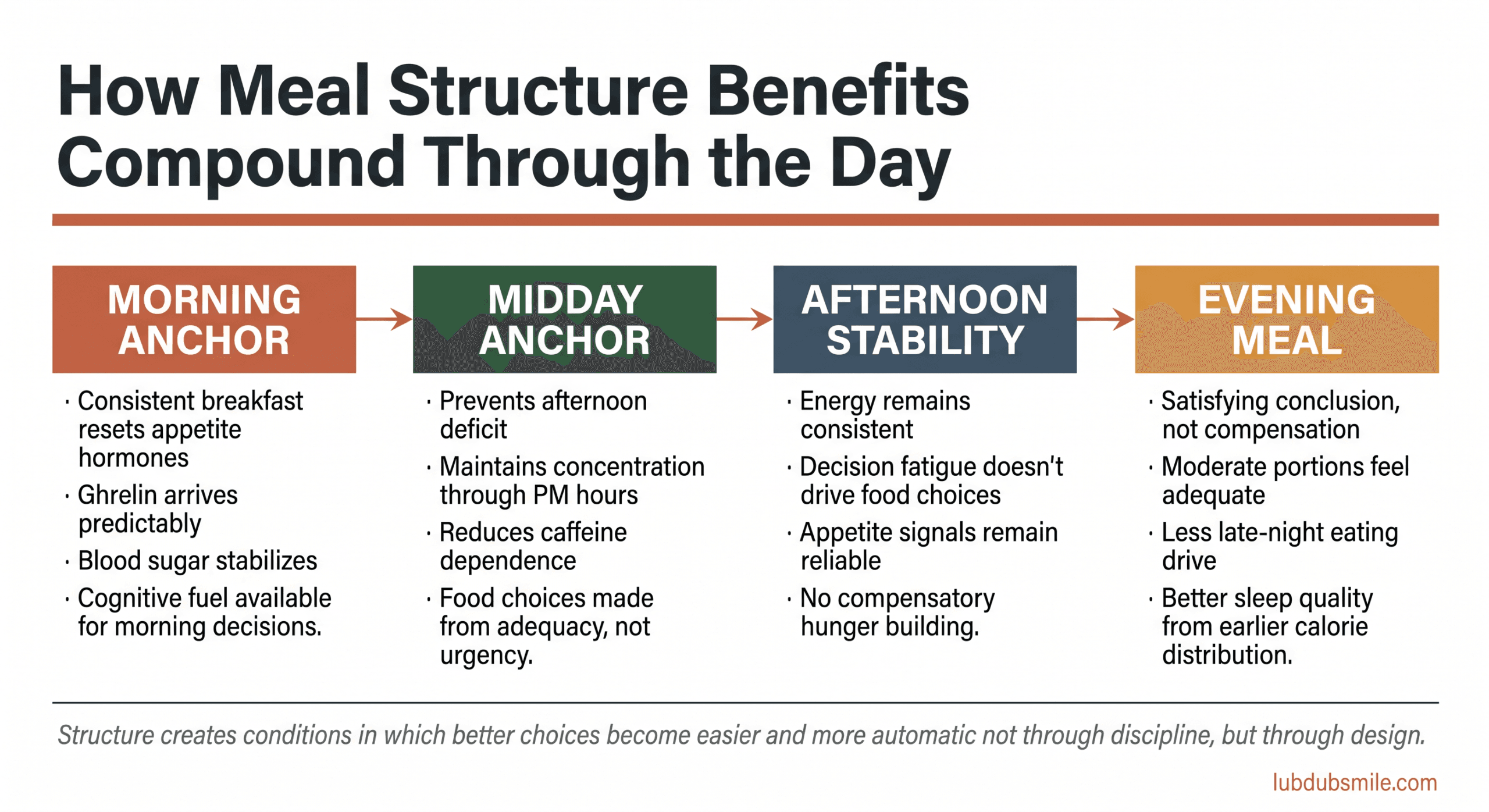
For most adults, breakfast is the highest-leverage anchor: it sets the day’s appetite pattern, prevents the mid-morning hunger that disrupts morning productivity, and begins the carbohydrate distribution that prevents late-day deficits. Lunch as a second anchor creates a mid-day reset that sustains afternoon function.
Starting with anchors rather than a complete system makes the structure achievable without overwhelming anyone who’s starting from chaos. The meal structure benefits compound as each anchor meal becomes automatic reducing the daily decision-making load progressively rather than all at once.
Breakfast: The Most Skipped Structural Opportunity
Breakfast is the most commonly skipped meal and, from a structural standpoint, one of the most consequential. This isn’t because breakfast is metabolically magical it’s because whether or not you eat in the morning establishes the eating schedule for the entire remaining day.
People who consistently eat breakfast report more stable appetites, better dietary quality throughout the day, and less evening eating in nutritional research. The mechanism isn’t that breakfast revs metabolism it’s that breakfast starts the appetite regulation cycle, establishes structure, and prevents the accumulated deficit that drives compensatory late-day eating.
For people who genuinely aren’t hungry in the morning, the issue is often that the circadian appetite signal hasn’t trained to arrive in the morning because eating has deferred for so long. A lighter, earlier eating occasion even something modest can begin shifting the appetite pattern over several weeks. Forcing a large meal when appetite is absent isn’t the goal; gradually shifting when appetite appears through behavioral consistency is.
Morning routines that support wellbeing address the practical reality of establishing morning habits without demanding perfection the same principle applies directly to building a morning eating anchor that delivers genuine meal structure benefits throughout the rest of the day.
Planning for Disruption
Meal structure doesn’t require perfect daily consistency it requires enough consistency that the pattern provides reliable orientation most of the time. Life will disrupt eating schedules regularly. Travel, unpredictable work demands, social occasions, family responsibilities these are constants, not exceptions.
The question isn’t how to maintain perfect structural consistency but how to build patterns robust enough to survive normal disruption without complete collapse. Having a minimum viable structure knowing what you’ll do for meals when everything else is uncertain is more valuable than an elaborate ideal plan that abandons entirely when imperfect.
A pattern of consistent weekday anchor meals, with more flexibility on weekends but some structural orientation, delivers most of the meal structure benefits of complete seven-day consistency with considerably more real-world sustainability.
What Consistent Enough Looks Like
For most generally healthy adults, consistent enough means:
- A reliable morning eating occasion most days (five to six of seven)
- A midday eating occasion that prevents severe afternoon hunger
- An evening meal that serves as a satisfying conclusion rather than a compensatory large intake
- Enough carbohydrate distribution throughout the day that energy is reasonably stable and late-night eating isn’t physiologically driven
This is achievable within busy professional schedules, parenting demands, irregular work hours, and the other realities of adult life. The meal structure benefits here don’t require tracking, weighing, or precisely timing anything. They require intention applied to pattern rather than to individual food choices.
Applying Meal Structure Benefits Across Different Lifestyles
Shift Workers and Non-Traditional Schedules
Shift workers face genuine challenges to conventional meal structure advice, because their waking and working hours don’t align with standard meal timing recommendations. The circadian dimension of eating is particularly relevant here research on shift workers consistently documents metabolic challenges that eating during nighttime hours associates with.
For shift workers, the structural principle that applies most is consistency within whatever schedule they maintain: eating at similar times relative to their waking hours, maintaining anchor meals that orient their appetite regulation within their actual circadian reality, and avoiding extreme eating irregularity on days off that destabilizes whatever pattern has developed during work hours. The meal structure benefits available to shift workers are real they simply require calibration to actual waking hours rather than conventional meal times.
Parents Managing Children’s Meals Alongside Their Own
Parents who carefully schedule children’s meals while neglecting their own eating are living the irony this article’s hook describes. The most practical structural advice for parents is simple: eat with your children. Using children’s meal and snack schedule as your own structural anchor solves the planning problem and the execution problem simultaneously.

Family meals as structural anchors serve multiple functions they maintain parental eating regularity, model eating structure for children, provide social eating context that supports both quality and enjoyment, and require no separate planning infrastructure beyond what’s already happening for the children. These meal structure benefits extend across the entire household when the family eating schedule becomes a genuine anchor for everyone.
Remote Workers Without Built-In Meal Breaks
Office environments created accidental meal structure through social norms people went to lunch because colleagues did, took coffee breaks at similar times, and stopped working at predictable intervals. Remote work removed this external scaffolding without replacing it.

Remote workers frequently report that meal regularity deteriorated significantly when they began working from home not because they valued it less, but because the environmental cues that triggered eating occasions disappeared. Rebuilding those cues intentionally scheduling meal breaks as actual calendar appointments, establishing a workspace ritual that transitions to a meal occasion, or coordinating with household members around shared eating times reconstructs the structural support that the office environment previously provided.
Frequent Travelers and Disrupted Schedules
Travel creates structural challenges through time zone shifts, irregular schedules, and limited food environment control. The most practical structural approach for frequent travelers is prioritizing one anchor meal per day typically breakfast, which is most reliably available across travel environments and letting the structure of the day’s other eating occasions flex around travel demands without abandoning structure entirely.
When Meal Structure Needs Professional Support
Medical Conditions Affecting Eating Patterns
For individuals managing diabetes, gastrointestinal conditions, eating disorder history, or complex metabolic health needs, meal structure concepts intersect with clinical nutrition territory that requires professional guidance.
The principles in this article are for generally healthy adults without significant medical nutritional needs. Applying meal structure benefits concepts to diabetes management, for example, involves specific considerations around medication timing, blood glucose monitoring, and carbohydrate distribution that require individualized registered dietitian guidance not general behavioral nutrition principles. Preventive health screenings by age can help you identify when professional assessment of metabolic health is appropriate before implementing any significant eating pattern changes.
Eating Disorder History: When Structure Requires Specialist Guidance
Meal structure can be genuinely supportive or genuinely destabilizing depending on individual history. For people recovering from restrictive eating disorders, anorexia, or orthorexia, structured eating is often a clinical tool used under professional guidance as part of recovery not something to implement independently based on general wellness content.
For people with histories of spree eating or compulsive eating, structured eating can reduce the deprivation cycles that contribute to satiate behavior but this, too, is best explored with eating disorder-informed professionals who can individualize the approach and monitor its effects.
If meal structure benefits concepts are producing anxiety, food restriction, obsessive thinking about eating timing, or other concerning responses, these are signals to seek professional support rather than push through. The goal of meal structure benefits is less mental load around eating, not more.
Frequently Asked Questions
What are the benefits of eating at regular times?
Eating at regular times what researchers call meal structure benefits produces predictable appetite hormone patterns, more stable blood sugar, reduced decision fatigue around food choices, and more consistent energy throughout the day. The body’s ghrelin (hunger) and leptin (satiety) systems orient to habitual timing, meaning appetite arrives appropriately and satiety signals become more reliable when eating follows a predictable schedule.
Why is meal timing important?
Meal timing is important because irregular eating patterns create the behavioral and hormonal conditions that undermine food quality choices regardless of how much nutritional knowledge you have. Meal structure benefits emerge from consistency: when eating occurs predictably, appetite regulation improves, late-day compensatory eating reduces, and food decisions happen at times of day when cognitive resources are more available rather than most depleted.
Does meal structure mean eating at exactly the same time every day?
No. Structural consistency means similar enough that your body’s appetite regulation systems develop reliable orientation not identical down to the minute. A breakfast window of 7–9 a.m. provides meal structure benefits without requiring precision. The behavioral and hormonal systems that structure supports respond to pattern over many days, not to minute-by-minute exactness.
What if I’m not hungry at traditional meal times?
Absent morning hunger is often a consequence of late-night eating or highly irregular prior patterns rather than a fixed physiological characteristic. Gradually shifting eating earlier while reducing late-evening eating typically brings hunger cues forward over several weeks. Eating a modest amount at a consistent time even without strong hunger can begin this recalibration without forcing large meals on an unwilling appetite.
Is intermittent fasting compatible with meal structure?
They can coexist, but they have different orientations. Intermittent fasting typically involves extending the overnight fast, which may or may not align with individual structural needs. For some people, time-restricted eating creates structural consistency that supports the meal structure benefits described here. For others, it creates conditions for the exact late-day compensatory eating that meal structure is meant to prevent. The compatibility depends on your specific response and eating patterns within whatever window you maintain.
Do carbohydrates at certain times cause weight gain?
No. Weight is influenced by total calorie balance over time, not by when carbohydrates appear. The concern about evening carbohydrates often reflects the larger, more frequent eating occasion they’re part of rather than any metabolic property of evening carbohydrate consumption specifically. Distributing carbohydrates throughout the day is a behavioral energy management strategy one of the practical meal structure benefits not a weight management technique based on carbohydrate timing metabolism.
Does meal timing affect weight loss?
Meal timing influences weight management indirectly through its effects on appetite regulation, food choice quality, and total intake patterns rather than through direct metabolic effects of when calories arrive. The meal structure benefits most relevant to weight management include reduced late-day compensatory eating, more consistent appetite signaling, and better food decision quality throughout the day. These behavioral effects are meaningful they’re just not the direct metabolic mechanisms that timing-based diet marketing typically claims.
The Bottom Line: Meal Structure Benefits as Foundation, Not Formula
Most nutrition conversations focus entirely on what goes into meals the quality, composition, and quantity of food. This one has focused on something prior to that: the behavioral and physiological infrastructure that makes any approach to food more or less sustainable.
Meal structure benefits don’t replace food quality. Consistently eating highly processed food on a perfect schedule doesn’t produce the same outcomes as eating whole foods with structural consistency. But structure is the foundation on which nutritional intentions can actually land. Without it, even excellent knowledge of nutrition produces erratic results because the behavioral and hormonal conditions in which food choices get made keep working against the choices you intend to make.
The practical starting point is modest: identify your anchor meals, build enough morning eating regularity to prevent afternoon and evening compensation, include carbohydrates throughout the day rather than concentrating them in the evening, and develop a minimum viable structure robust enough to survive normal disruption.
Structure is not rigidity. The meal structure benefits you’re after come from flexibility within a framework that supports your biology and your behavior simultaneously making better eating easier not through discipline but through design.
Takeaway
Meal structure benefits including metabolic consistency, appetite regulation, energy stability, and reduced decision fatigue around food emerge from the predictability and consistency of when eating occurs, not just from what gets eaten, making structural regularity an underappreciated nutritional variable that explains why people with good intentions often struggle with sustained consistency.
This article discusses meal structure as a behavioral and physiological framework for generally healthy adults. It is not medical nutrition advice. Individuals managing diabetes, metabolic conditions, or eating disorders should work with registered dietitians or healthcare providers. For anyone with a history of disordered eating, structured eating approaches should only be explored with guidance from an eating disorder-informed professional.
This content is for educational purposes and does not substitute for professional psychological or therapeutic help.