

Rebuilding Your Sense of Self After a Long-Term Relationship Ends
Rebuilding your sense of self after a long-term relationship ends is one of the least-discussed yet most disorienting challenges people face after a significant partnership concludes. You’re standing in the grocery store trying to remember what food you like, and you realize you’ve been choosing based on what they preferred for so many years that you genuinely don’t know. You stand there longer than makes sense, staring at shelves, feeling something larger than confusion something closer to vertigo.
This is identity loss. People will tell you that you’ll grieve the person, the relationship, the future you imagined. What they rarely mention is that you’ll also grieve yourself the version of you that existed within that partnership, the “we” that organized your daily life, your opinions, your social world, your sense of direction. When the relationship ends, all of that comes apart simultaneously.
Psychologists who study relationship dissolution describe identity disruption as nearly universal after long-term partnerships end. Research from the APA confirms that in close relationships, both people’s senses of self genuinely intertwine over time. Losing the relationship means losing part of how you understood yourself. There is a name for what you’re experiencing. Research documents it clearly. And it is not a personal failing.
At LubDubSmile, we approach identity loss after relationship dissolution as a subject that deserves the same clinical seriousness we bring to physical health topics. The cultural conversation around breakups tends toward either minimization (“you’ll be fine”) or dramatization (“you’ll never recover”), and neither serves adults who are genuinely in the middle of this experience. What the research actually shows is that identity disruption after long-term partnership is real, well-documented, and navigable, but it operates on its own timeline and requires its own specific kind of work. This article is built around that honest account, not around reassurance, and not around a tidy arc of recovery that arrives on schedule.
Why You Feel So Lost

How Long-Term Relationships Shape Identity
Long-term relationships don’t just change your schedule or your living situation they reshape how you understand yourself at a fundamental level. Tastes, preferences, and daily routines become calibrated to another person over years. The social world reorganizes around the relationship. The future frames itself in the first-person plural. Opinions form partly in dialogue with theirs. Security, belonging, and daily rhythm all structure themselves around someone else’s consistent presence.
None of this represents weakness or lack of self. It’s what intimate partnership does naturally and inevitably. The longer and deeper the relationship, the more thoroughly it weaves itself into the fabric of identity not as an intrusion, but as a natural feature of genuine closeness. Rebuilding your sense of self after a long-term relationship ends requires first acknowledging how fully that closeness reorganized your inner world because that acknowledgment removes the shame from what follows.
After years of being half of “we,” the word “I” can feel like a foreign pronoun. Opinions that once felt solid now feel uncertain without their response to shape them. The map you navigated by has simply disappeared, and you didn’t realize how much of your direction came from sharing it with someone else until it was gone.
Multiple Losses Happening Simultaneously
When a long-term relationship ends, the loss isn’t singular it’s plural and simultaneous. The relationship itself disappears: daily companionship, shared humor, the particular intimacy of being genuinely known by someone over years. Beyond that, the imagined future dissolves. The social world that organized itself around the couple fractures or realigns. And the self that existed within that specific relational context the role occupied, the version of personhood that existed in that particular dynamic also ends.
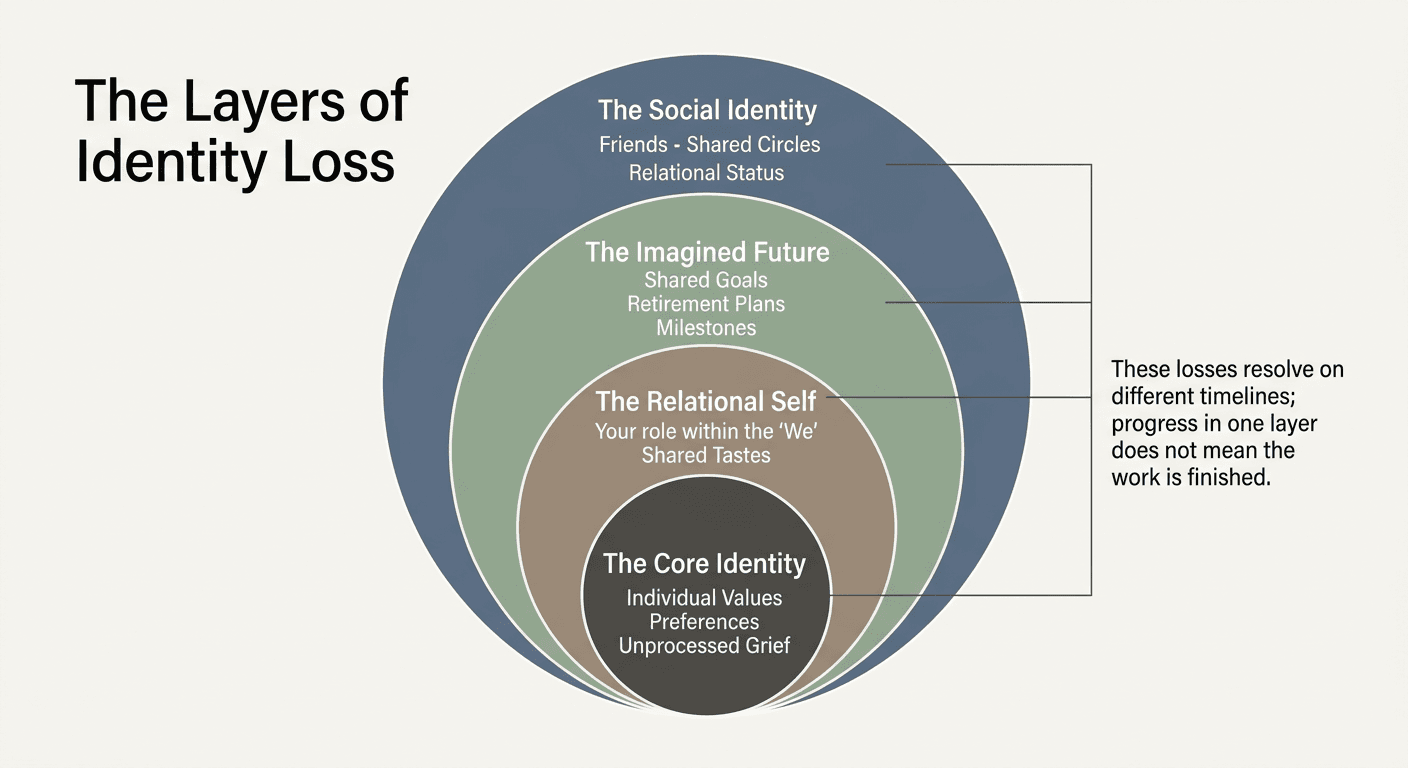
Grief researchers recognize these as distinct losses requiring separate processing at different paces. Someone can move through grief for the person while still feeling deep in grief for the shared future. Someone can feel clear about the relationship ending while remaining profoundly disoriented about who they are now. Progress in one area doesn’t automatically produce progress in another. Understanding this prevents the frustration of feeling like you should be further along than you are because the losses are multiple, not one, and they resolve on different timelines.
When No Pre-Relationship Self Exists to Return To
For some people particularly those who partnered young, or whose adult identity formed largely within the relationship no clear pre-relationship self exists to return to. Well-meaning people keep saying “you’ll find yourself again,” and the honest response is: which self? The person who existed before the relationship was younger, less experienced, and living in circumstances that no longer exist. That person isn’t who you are now, and returning to them isn’t possible or even desirable.
This reality feels disorienting at first. But what feels like the absence of a self to return to is actually an invitation unwelcome, perhaps, but an invitation nonetheless to construct something genuinely new rather than restore something old. Rebuilding your sense of self after a long-term relationship ends, in this context, isn’t restoration. It’s creation. That distinction changes what the work actually requires.
Disorientation Is Not Destruction
Identity disruption after a long-term relationship ends can feel, from the inside, indistinguishable from falling apart entirely. That feeling is real and deserves acknowledgment. But the feeling is not the same as the fact. A sense of self doesn’t disappear when destabilized it requires reconstruction after a central structural element has been removed. A building with a load-bearing wall removed doesn’t cease to exist; it requires rebuilding. That’s different from demolition.
What you’re experiencing is reorganization painful, exhausting, disorienting reorganization that can feel permanent while it’s happening. Research on identity disruption after relationship dissolution consistently shows that most people do rebuild a coherent sense of self over time not identical to what existed before, but coherent, stable, and often more genuinely their own than what preceded it. Rebuilding your sense of self after a long-term relationship ends is possible precisely because disorientation and dissolution are not the same thing.
Grief Comes First And Runs Alongside Everything Else
Why Bypassing Grief Undermines the Entire Process
The impulse to accelerate past grief into rebuilding makes complete human sense. The disorientation is uncomfortable enough that doing something with it feels better than simply enduring it. But grief that bypasses surfaces sideways as persistent numbness, unexpected emotional floods at inconvenient moments, difficulty feeling genuinely present in new experiences, or a vague inability to connect with the rebuilt life you’re working hard to construct.
Grief and rebuilding your sense of self after a long-term relationship ends aren’t sequential activities with a clear handoff between them. They happen simultaneously, in overlapping layers, over more time than most people anticipate. You catch yourself about to share something with your ex before remembering, and the loss hits again not just of them, but of who you were when together, of the particular version of yourself that existed in that dynamic. These moments aren’t setbacks or evidence that you’re not making progress. They’re grief doing its necessary work, and that work supports rather than obstructs the rebuilding.
Allowing Grief Without Surrendering to It Entirely
A meaningful difference exists between allowing grief and surrendering entirely to it. Allowing grief means making room for sadness, loss, and disorientation without immediately suppressing or escaping them. It means letting yourself feel what’s real without demanding that the feeling resolve on a schedule someone else has decided is appropriate.
Surrendering entirely to grief looks different: an extended inability to function in daily life, complete withdrawal from all connection with others, a sense that grief has crowded out every other available emotional experience, and no movement or light present alongside the darkness. Neither extreme serves rebuilding your sense of self after a long-term relationship ends. The middle path grief allowed, grief felt, grief moving through rather than either forced out or given permanent residence is where the actual work happens. If you’re finding yourself unable to work, care for basic needs, or access any moments of relief, discussing that with a mental health professional represents self-knowledge, not failure.
Knowing the Difference Between Grief and Clinical Depression
Grief and clinical depression can look similar from the outside while functioning very differently on the inside. Grief tends to move in waves moments of profound sadness exist alongside moments of relative relief, some functional capacity coexists alongside genuine difficulty, and the capacity to experience occasional positive feeling persists even amid significant loss. The pain, while real and sometimes overwhelming, remains recognizably contextual connected to what was lost.
Clinical depression tends toward something more pervasive and uniform: persistent low mood that doesn’t lift with positive events, loss of capacity for pleasure across all areas of life rather than specifically around the loss, significant functional impairment extending beyond the grief context, and hopelessness that feels complete rather than situational. Identity disruption and grief after a long-term relationship represent normal responses to significant loss. They can also contribute to clinical depression, particularly for people with prior mental health history or limited support.
If what you’re experiencing feels less like waves and more like a uniform inability to function, access any positive experience, or imagine that circumstances might change please seek professional support. This distinction matters clinically, and professional guidance makes navigating it meaningfully safer.
What Actually Happened to Your Identity
How Enmeshment Develops as a Feature of Genuine Closeness
Identity enmeshment the gradual interweaving of two people’s sense of self happens naturally in long relationships and without malice or weakness on anyone’s part. Shared preferences develop organically. The social world consolidates around the couple over years. Decisions form with another person’s needs in view so consistently that considering only one’s own needs starts to feel unfamiliar, even selfish. The future frames itself in terms of shared goals. The sense of belonging organizes around being part of this particular unit rather than around individual identity.
None of this is pathology. All of it is closeness the natural consequence of two people genuinely mattering to each other over an extended time. Rebuilding your sense of self after a long-term relationship ends requires treating this enmeshment as a feature of genuine intimacy rather than a personal failure of boundary-maintenance. That reframe matters because it relocates the disorientation that follows dissolution: it isn’t evidence that something was wrong with you. It’s evidence that something was real between you.
The Social Identity Loss That Rarely Gets Named
One of the practical dimensions of identity loss that frequently goes unacknowledged is the social one and it’s more significant than it initially appears. Long-term couples typically share social circles built over years, and when the relationship ends, those circles often fracture, realign, or become inaccessible in ways that are genuinely painful and disorienting. People you considered friends may choose sides, drift away, or simply become awkward to see without the relational context that made connection easy.
Beyond losing specific relationships, the relational identity itself changes. No longer part of a recognized social unit, the sense of belonging shifts or disappears entirely. Rebuilding your sense of self after a long-term relationship ends requires acknowledging this social dimension as a genuine loss rather than a peripheral inconvenience because minimizing it prevents processing it, and unprocessed social grief tends to surface as isolation, loneliness, or a persistent sense of not fitting anywhere.
Understanding how social fitness strengthens overall health can help reframe social rebuilding as a legitimate health priority rather than a secondary concern.
What You Might Actually Feel Relieved to Release
Alongside the grief and disorientation, many people moving through this process notice something they didn’t expect: relief. Not always, not immediately, and not without complexity but real. Sometimes the self that existed within the relationship wasn’t entirely authentic. Preferences that were suppressed to maintain peace accumulated over years without conscious awareness. Opinions softened so consistently to avoid conflict that the original opinion became unclear. Parts of the self that felt unwelcome or consistently misunderstood quietly contracted. Ambitions that didn’t fit the shared life were set aside gradually enough that the loss barely registered at the time.
The ending of the relationship, as genuinely painful as it is, can also mark the beginning of reclaiming those contracted parts. Relief and grief coexist honestly in this process. Rebuilding your sense of self after a long-term relationship ends can simultaneously involve grief for what was lost and relief for what might now become possible and both deserve acknowledgment without one canceling the other out.
Something worth naming directly here: the relief that can accompany relationship endings often goes unacknowledged in both cultural conversation and therapeutic literature, partly because it feels incompatible with grief and partly because admitting it can attract judgment from others who expect uncomplicated mourning. But relief and grief are not mutually exclusive emotional states. They coexist, sometimes in the same hour, and treating relief as a sign that the relationship didn’t matter or that grief isn’t real serves nobody navigating this process honestly. The contracted parts of self, the suppressed preferences, the opinions softened over years for the sake of peace, the ambitions set aside because they didn’t fit, these are real losses too, and their recovery is as legitimate a part of this process as mourning what is gone. Giving yourself permission to feel both simultaneously is not emotional confusion. It is emotional accuracy.
The Archaeology of Self

What Interested You Before the Relationship Organized Your World
Not to return to who you were before that earlier self is gone, as all earlier versions of ourselves eventually are and should be but as information about your own nature. What drew your attention and energy before another person’s tastes and preferences became the organizing framework for daily life? or what made you feel genuinely alive and engaged? What did you lose track of without quite noticing, so gradually that the loss didn’t register until now?
These questions don’t function as invitations to nostalgia. They function as archaeology digging carefully to find threads of self that were always present but may have receded under years of accommodation, compromise, and shared life. Those threads aren’t the whole self you’re rebuilding. But they’re genuine starting points, and starting points matter when you’re trying to find your direction in territory that feels entirely unfamiliar. Rebuilding your sense of self after a long-term relationship ends often begins with exactly this kind of careful excavation.
Values and Beliefs Worth Returning to With Fresh Attention
In long relationships particularly those with significant power imbalances, or simply with one partner’s personality exerting more gravitational pull than the other’s one person’s values and beliefs can gradually become the dominant framework through ordinary drift rather than force. Over years, one partner’s way of seeing things becomes the lens through which both people interpret experience. The other partner’s original views become uncertain, even to themselves.
Part of rebuilding your sense of self after a long-term relationship ends involves returning to your own values with genuine curiosity rather than reactive opposition. Not: what do I believe now that I’m free to disagree with them? But: what do I actually think when I’m not filtering my views through someone else’s anticipated response? What do I care about when the caring isn’t shaped by what fits the shared life? Working through these questions with a therapist or through consistent journaling practice can accelerate the clarity that often comes slowly on its own.
Resources like intentional dating after divorce offer relevant frameworks for how this kind of self-knowledge shapes what you eventually bring into new relationships when and if that becomes relevant.
Ambitions and Paths Worth Revisiting Now
Many people in long relationships set aside ambitions that didn’t fit the shared life career directions that required relocation, creative pursuits that consumed time the partnership needed elsewhere, ways of living that the other person didn’t share or actively discouraged. These were often choices made freely and appropriately at the time, not impositions. They reflect the genuine compromises that committed partnership requires.
But they’re worth revisiting now, because the conditions that required those compromises no longer exist. Rebuilding your sense of self after a long-term relationship ends includes asking: What did I want that didn’t fit? What did I set aside? What still feels alive somewhere, waiting for circumstances that now actually exist?
Building Forward: The New Self
The Self You’re Building Isn’t the Pre-Relationship You
This point deserves emphasis clear enough to cut through the common cultural narrative: the self you’re working toward is not the person you were before the relationship. That person was younger, less experienced, navigating different circumstances, and living in a world that no longer exists in the same form. Trying to return to them isn’t just impossible it isn’t actually what you want, even when it feels like it might be.
The relationship however it ended, whatever its difficulties also gave you things. Understanding of yourself that only comes from sustained intimacy with another person. Knowledge about what you need, what you won’t accommodate, what you can and can’t offer. Capacities you developed because the relationship required them. Rebuilding your sense of self after a long-term relationship ends means carrying all of that forward while no longer being organized around the relationship that produced it.
Small Choices as the Actual Mechanism of Identity Rebuilding
In the absence of a stable sense of self, small choices become genuinely significant in a way they never were when identity felt secure. What do you want for breakfast when no one else’s preferences are part of the calculation? Or what do you want to do with a Sunday afternoon that belongs entirely to you? What kind of people do you want around you when there’s no relational context shaping the answer?
These small choices made repeatedly, honored consistently, accumulated over months are how rebuilding your sense of self after a long-term relationship ends actually happens at the ground level. Not through grand revelations or dramatic transformations, but through the patient accumulation of small preferences asserted and trusted. Each choice is a brick. Each honored preference adds to the foundation. You’re not building a cathedral yet you’re gathering materials and learning which ones belong to you.
The Surprising Direction of Growth
Many people who navigate this process discover, somewhere in the middle of it, that the self emerging on the other side carries qualities they didn’t have before: greater clarity about what they actually need, stronger capacity to recognize their own preferences without external validation, more honest understanding of what they will and won’t accommodate in close relationships, and a sense of identity that rests on something internal rather than on a relational role.
That clearer understanding of what you need from close connection, including what emotional safety in relationships actually looks like and why it matters, tends to become more legible on the other side of this kind of identity work than it was before it.
This doesn’t make the loss worth it in any simple sense loss doesn’t require redemption to be real. But it does suggest that rebuilding your sense of self after a long-term relationship ends can produce something more fully developed than what existed before. The difficulty and the growth aren’t opposites. Often they’re the same thing.
Practical Pathways for Identity Reconstruction
Journaling as Sustained Honest Inquiry
Writing that functions as genuine inquiry rather than a polished account for imagined readers is among the most consistently useful tools for rebuilding your sense of self after a long-term relationship ends. Not journaling as performance, but journaling as honest conversation with yourself: What do I actually feel today, under the story I’ve been telling about how I feel? What do I want, when I clear away what I’m supposed to want? What surprised me about my own reactions this week?
After years of understanding yourself partly through another person’s responses, this kind of self-directed inquiry can feel strange and unreliable at first. But asking these questions consistently, without judgment about the quality of answers, gradually builds familiarity with your own perspective. It rebuilds the habit of treating your own inner experience as primary data rather than as something requiring someone else’s filter.
Solitude as Practice Rather Than Punishment
Solitude after a long relationship ends can feel like punishment the silence where conversation used to be, the absence of someone to process the day with, the unfilled evening hours. The instinct to fill this space immediately is understandable and not entirely wrong: constant solitude isn’t healthy either, and maintaining social connection matters enormously during this period.
But solitude also offers something that busyness cannot provide: the opportunity to discover what you actually think, feel, and want when you’re not orienting yourself toward another person. Rebuilding your sense of self after a long-term relationship ends requires learning to be with yourself genuinely present with your own experience, without distraction in a way that long partnership can quietly erode over years.
Rebuilding Social Identity Deliberately
The social world that existed around the couple needs something new to replace it something that belongs to you rather than to the relational unit you used to be part of. This work rarely happens automatically.
Deliberately reconnecting with friendships that faded during the relationship is one starting point. Pursuing interests that bring you into contact with new people is another. Being honest with existing friends about what you actually need not performance of recovery, but genuine company and support matters more than it might seem. Rebuilding your sense of self after a long-term relationship ends happens partly in solitude and partly in connection, and the social dimension is often the one people neglect because it requires more visible vulnerability than journaling alone in private.
Reclaiming identity after kids addresses parallel territory the experience of losing individual identity within a consuming relational role and offers frameworks applicable to any significant identity reconstruction process.
New Experiences as Generators of Self-Knowledge
Trying genuinely new experiences not as distraction but as deliberate self-discovery produces information about yourself that reflection alone cannot generate. You don’t know whether you like something until you’ve encountered it. After a long relationship during which your experience of the world filtered through shared preferences and shared life, new experiences create fresh data: what draws your attention, what makes you feel engaged and alive, what leaves you genuinely cold.

The point isn’t the experience itself. The point is what you discover about yourself through it. Rebuilding your sense of self after a long-term relationship ends involves actively generating this kind of self-knowledge.
Therapy as Structured Navigation
Therapy for post-relationship identity work isn’t crisis intervention it’s structured, supported navigation of territory that is genuinely difficult to map alone. A therapist provides a consistent container for both grief and identity work simultaneously. They help distinguish healthy grief from clinical depression in real time. They notice patterns that remain genuinely invisible from inside one’s own experience. And they provide a sustained relationship within which trust in your own judgment and perception can slowly, carefully rebuild.
Narrative therapy, existential therapy, and attachment-based approaches are particularly well-suited to the meaning-making and self-reconstruction that rebuilding your sense of self after a long-term relationship ends requires.
Comparing therapy platforms can help you find accessible professional support when local options are limited or prohibitively expensive.
The Challenges Nobody Warns You About
Making Decisions Without a Partner to Consult
After years of consulting, considering, and choosing together, making even minor decisions alone can feel unexpectedly overwhelming. This isn’t indecisiveness as a character trait. It’s a decision-making capacity that atrophied during the relationship because it wasn’t needed in the same way.
Rebuilding your sense of self after a long-term relationship ends includes rebuilding confidence in your own judgment specifically. The practice is simply making choices small ones first, repeatedly and tolerating the discomfort of having no external validation that the choice was correct. Over time, trust in your own judgment returns through the accumulation of evidence that you can make choices and live with them.
Resisting the Urge to Fill the Emptiness Immediately
The discomfort of identity loss is real enough that many people move quickly to fill it with a new relationship, compulsive social activity, constant streaming media, or any other pattern that prevents the quiet in which the disorientation would otherwise surface. The impulse is understandable. But filling space and rebuilding identity are not the same activity.
A new relationship entered before the identity work has begun may provide temporary relief while replacing one external identity structure with another meaning the underlying work remains undone. The emptiness, uncomfortable as it genuinely is, contains information. Rebuilding your sense of self after a long-term relationship ends requires tolerating enough of that discomfort to allow it to become informative.
When Others Expect You to Be Fine Already
People around you will apply their own timelines to your process timelines based on their own experiences, their comfort with your distress, their limited visibility into what you’re actually navigating. Some will be impatient. Some will worry if you’re still struggling past a point they’ve decided you should have moved through.
Their timelines are not yours, and performing recovery for others’ comfort at the expense of your actual process is counterproductive in ways that compound over time. Rebuilding your sense of self after a long-term relationship ends doesn’t operate on anyone else’s schedule.
Time, Patience, and Self-Compassion
There Is No Reliable Timeline
Some people begin to feel like themselves again within months. Others take years not because they’re doing something wrong, but because the factors influencing the process vary enormously. Relationship length, depth of identity enmeshment, the quality and availability of support, individual psychological history, concurrent life stressors, and the particular shape of the loss all influence how the process unfolds.
Comparison to others’ recovery timelines serves no useful function and introduces shame into a process that already carries enough difficulty without it. What matters is whether you’re engaged with the process rather than actively avoiding it. Time alone doesn’t heal identity disruption; engaged time does.
Why Self-Compassion Functions as Infrastructure
Brené Brown’s research on vulnerability and shame makes a case for self-compassion not as self-indulgence but as foundational infrastructure for genuine growth and change. When people treat themselves harshly for struggling for “taking too long,” for still feeling grief at a point when they believe they should have moved past it they add shame to an already difficult process. Shame complicates and prolongs grief rather than motivating faster resolution.
The person navigating identity loss after a long-term relationship deserves the same quality of compassion they would naturally extend to a close friend navigating the same experience. That standard not perfection, not speed, just genuine warmth toward yourself in difficulty is what rebuilding your sense of self after a long-term relationship ends genuinely requires.
For adults navigating this process in midlife, our guide to redefining strength after 40 speaks directly to why the cultural scripts around resilience and recovery can actually complicate this kind of self-rebuilding work rather than support it.
How You’ll Know You’re Returning to Yourself
Not a clean moment. Not a single realization that marks the transition from lost to found. More often, a gradual accumulation of smaller signals that appear and then disappear before appearing more frequently. You choose something based purely on your own preference and notice, afterward, that no anxiety accompanied the choice. An evening alone feels like genuine rest rather than punishment for not having plans. Laughter arrives without needing to check whether it fits the mood. You notice something you want not what you’re supposed to want, not what would have fit the old life and you recognize it clearly as real and as yours.
These moments arrive inconsistently at first. They become more frequent over time. Rebuilding your sense of self after a long-term relationship ends looks exactly like this: moments becoming more reliable, more fully your own.
When to Seek Professional Support
Consider professional support if you experience any of the following:
- Inability to function in daily life work, basic self-care, maintaining relationships beyond brief episodes of acute grief
- Significant functional impairment persisting for more than a few weeks without any movement or relief
- Persistent hopelessness that feels pervasive and uniform rather than contextual and wave-like
- Reliance on alcohol, substances, or compulsive behaviors to manage the disorientation
- Identity disruption so complete that knowing what you think, feel, or want about anything has become genuinely inaccessible
- Thoughts of self-harm or suicide seek immediate support
These experiences aren’t failures. They’re signs that what you’re navigating requires skilled professional support alongside personal effort.
A therapist asks questions you haven’t thought to ask yourself. They notice patterns that remain invisible from inside your own experience. Narrative therapy, existential therapy, and attachment-based approaches are particularly well-suited to the meaning-making and self-reconstruction that rebuilding your sense of self after a long-term relationship ends requires.
Emotional agility and resilience resources can also support the broader self-awareness work this process involves.
Moving Forward: The Self on the Other Side
The self that emerges from this process is not a restored version of who you were before. Someone new comes forward carrying the experience of the relationship, carrying the experience of its ending, carrying every choice made in the space between those two realities. Someone who knows more about what they need, what they will and won’t accommodate, what actually matters to them separate from what they learned to value through someone else.

Rebuilding your sense of self after a long-term relationship ends is not a comfortable process to inhabit. But it is a meaningful one and the consistent evidence of people who have navigated it suggests that what feels like dissolution is actually reconstruction. Just slower, messier, and more profound than anyone prepared you for.
You carry more than you realize from having loved someone and having been changed by it. The self on the other side of this work may surprise you not by being someone completely different, but by being more completely and more honestly yourself than you’ve been in a long time.
Rebuilding your sense of self after a long-term relationship ends is real. Moving forward requires you to allow grief rather than bypass it, make small choices based on your own preference, practice solitude rather than avoid it, rebuild social connection outside the couple’s context, and seek professional support when the territory becomes too difficult to navigate alone.
This article offers frameworks for understanding and navigating identity loss after a long-term relationship, but it is not a substitute for professional mental health support. If you are experiencing persistent depression, inability to function, or significant distress, please consult a mental health professional.
This content is for educational purposes and does not substitute for professional psychological or therapeutic help.