

How High-Achieving Couples Can Communicate Without Competing Against Each Other
High achieving couples communication breaks down in a specific, recognizable pattern and most partners can identify it the moment someone names it accurately. You’re thirty minutes into a conversation about whose week was harder. Somewhere along the way, both of you stopped describing your experience and started building a case. Neither of you noticed when that happened. Neither of you is winning. And somehow, neither of you can stop.
Why does high achieving couples communication so often turn competitive? Because professional success rewards the exact skills that damage intimate conversation: building arguments, persuading under pressure, and maintaining positions when challenged. These skills produce results in careers. In intimate partnership, they produce distance. The operating system that works at work creates friction at home and recognizing this gap is the first step toward changing it.
This dynamic affects many high-achieving couples not in dramatic arguments, but in the quieter realization that most of their conversations feel more like depositions than discussions. The skills that constructed successful careers have migrated into the relationship, and they’re doing damage that neither partner quite intended.
Why High Achieving Couples Communication Turns Competitive
The Professional Skills That Don’t Transfer to Partnership
High achievers develop a specific communication skill set because those skills produce results: persuasion, the ability to build arguments, anticipating counterpoints, maintaining positions under pressure. In professional settings, these capabilities create outcomes. In intimate partnership, they create distance.
The problem isn’t the skills themselves it’s the cont

ext. Professional communication centers on goals, operates between people who don’t need to feel emotionally safe with each other to function, and rewards winning. Partnership requires something different: the ability to make another person feel genuinely heard, even when you disagree with what they’re saying. High achieving couples communication fails most often at exactly this transition.
When Winning Arguments Becomes the Goal Instead of Understanding
In most professional environments, winning an argument produces better outcomes or at least cleaner ones. In partnership, winning typically produces distance. Your partner doesn’t experience being out-argued as being helped. They experience it as being dismissed.
Research from the Gottman Institute identifies defensiveness and contempt as two of the strongest predictors of relationship distress. Both appear with particular frequency in dynamics where partners compete rather than collaborate not because high achievers are contemptuous people, but because framing the partner as an obstacle rather than a collaborator activates exactly these responses. Understanding this mechanism is essential to improving high achieving couples communication.
How Achievement Psychology Shapes Communication
Achievement orientation produces genuine relationship strengths: reliability, follow-through, willingness to work hard on things that matter. These qualities serve partnerships. The liability emerges when performance orientation migrates into emotional conversations when a partner sharing a feeling becomes a problem to solve efficiently, or a complaint becomes an argument to refute.
Developing emotional intelligence in relationships is the specific skill set that high achievers most need to complement their professional capabilities not to replace them, but to add the dimension that intimate partnership requires.
The Identity Stakes: Why Being Wrong Feels Larger Than It Should
For many high achievers, professional identity and personal identity connect closely. Being wrong in a low-stakes argument with a partner can activate something that feels significant because being wrong anywhere carries identity implications when your self-concept builds on being capable and correct.
This isn’t vanity. It’s a coherent response to years of environments where being right had genuine consequences. The problem is that intimate partnership isn’t one of those environments and responding to it as if it is creates relationships where both partners feel they’re constantly under evaluation. This identity-threat dynamic is one of the most underappreciated drivers of high achieving couples communication problems.
When Two High Achievers Bring the Same Pattern Into the Same Room
When both partners are high achievers whose communication style drives competition, the dynamic compounds. Neither has learned to yield because yielding never served them professionally. Both have skill in building arguments. Both carry identity investment in their positions. The result, as one couples therapist described it, is “two excellent lawyers arguing a case that has no verdict.”
The Attachment Dimension: How Early Patterns Shape the Dynamic
Attachment theory adds a crucial lens to high achieving couples communication. Adults who developed avoidant attachment patterns in early life often in response to caregivers who dismissed feelings or rewarded self-sufficiency over emotional connection frequently become high achievers who also struggle with relational vulnerability.

Avoidant attachment and high achievement often develop together: the child who learned that emotions were unsafe or unwelcome often channeled energy into performance instead. In adult relationships, this manifests as the partner who excels professionally but deflects emotional conversations into analysis, debate, or problem-solving. Recognizing this attachment dimension helps explain why high achieving couples communication patterns often persist despite intellectual understanding.
Recognizing Competitive Communication Patterns in High Achieving Couples
Debating Rather Than Discussing
The clearest signal: conversations about differences of opinion consistently feel like debates conversations that center on making points, refuting counterpoints, and reaching conclusions rather than discussions that center on understanding each other’s experience.
Listening to Respond Rather Than to Understand
Your partner raises a concern. Before they’ve finished, you’ve identified the logical flaw, prepared your counterargument, and started waiting for the opening to deliver it. They notice this. They’ve gone quiet. Communication researchers distinguish between listening that centers on persuasion and listening that centers on understanding high achievers typically excel at the former and underinvest in the latter.
Using Data and Logic as Emotional Distance
“That’s not accurate last month I handled bedtime fourteen times” in response to “I feel like I’m doing everything alone” addresses the factual claim while completely bypassing the feeling underneath it. Data that someone deploys in emotional conversations frequently functions as distance rather than clarity. This pattern appears constantly in high achieving couples communication.
Score-Keeping: Who Did More, Gave More, Sacrificed More
A particular version of the competitive relationship dynamic involves maintaining running ledgers of contribution. Who traveled more for work, who handled more school pickups, who gave up more professionally for the family. These ledgers feel fair to the person keeping them. To the partner on the other end, they feel like an indictment.
Escalating to Win When Losing Ground
When an argument isn’t going in the preferred direction, partners who default to competition often escalate raising the emotional stakes, introducing new grievances, or shifting the frame entirely. The goal isn’t resolution; it’s regaining advantage.
The Parallel Monologue: Both Partners Making Their Case Simultaneously
Two articulate, confident people making their cases at the same time neither listening, both convinced the other person needs to understand them before they deserve to be understood. The conversation produces a great deal of words and very little connection. This parallel monologue is one of the most common presenting patterns in high achieving couples communication. Understanding what couple communication that heals actually looks like clarifies just how far this dynamic falls from connection.
What This Dynamic Costs the Relationship
When Partners Become Adversaries
The cumulative effect of dynamics where couples compete rather than collaborate is that partners begin to experience each other as opponents. Both approach conversations with positions they prepared in advance rather than genuine curiosity. The relationship becomes a space where you need to be strategic rather than honest.
The Intimacy Gap That Opens Over Time
Intimacy requires vulnerability. Vulnerability requires safety. Safety requires the reasonable confidence that what you share won’t become ammunition in the next argument. The dynamic that drives competition erodes that confidence gradually, until genuine emotional sharing stops happening not through dramatic withdrawal, but through a slow decision that both partners make independently: it isn’t worth it. This erosion represents the deepest cost of poor high achieving couples communication. Understanding healthy conflict patterns can help couples recognize how far their current dynamic has drifted from what constructive disagreement actually looks like.
When One Partner Withdraws Rather Than Compete
In many high-achieving couples, one partner reaches their limit first. That partner often withdraws: stops raising concerns, stops engaging in difficult conversations, stops bringing their full experience into the relationship. The remaining partner may interpret this as agreement, or as someone who avoids conflict. It’s more often exhaustion.
Children Who Learn Competition as the Relationship Template
Children in households where parents communicate through competition learn that this is what intimate relationships look like: that the goal of disagreement is winning, that vulnerability gives the other person a strategic advantage, that love and debate coexist as a matter of course. This transmission is worth naming explicitly for couples who are parents.
The Loneliness of Winning Consistently
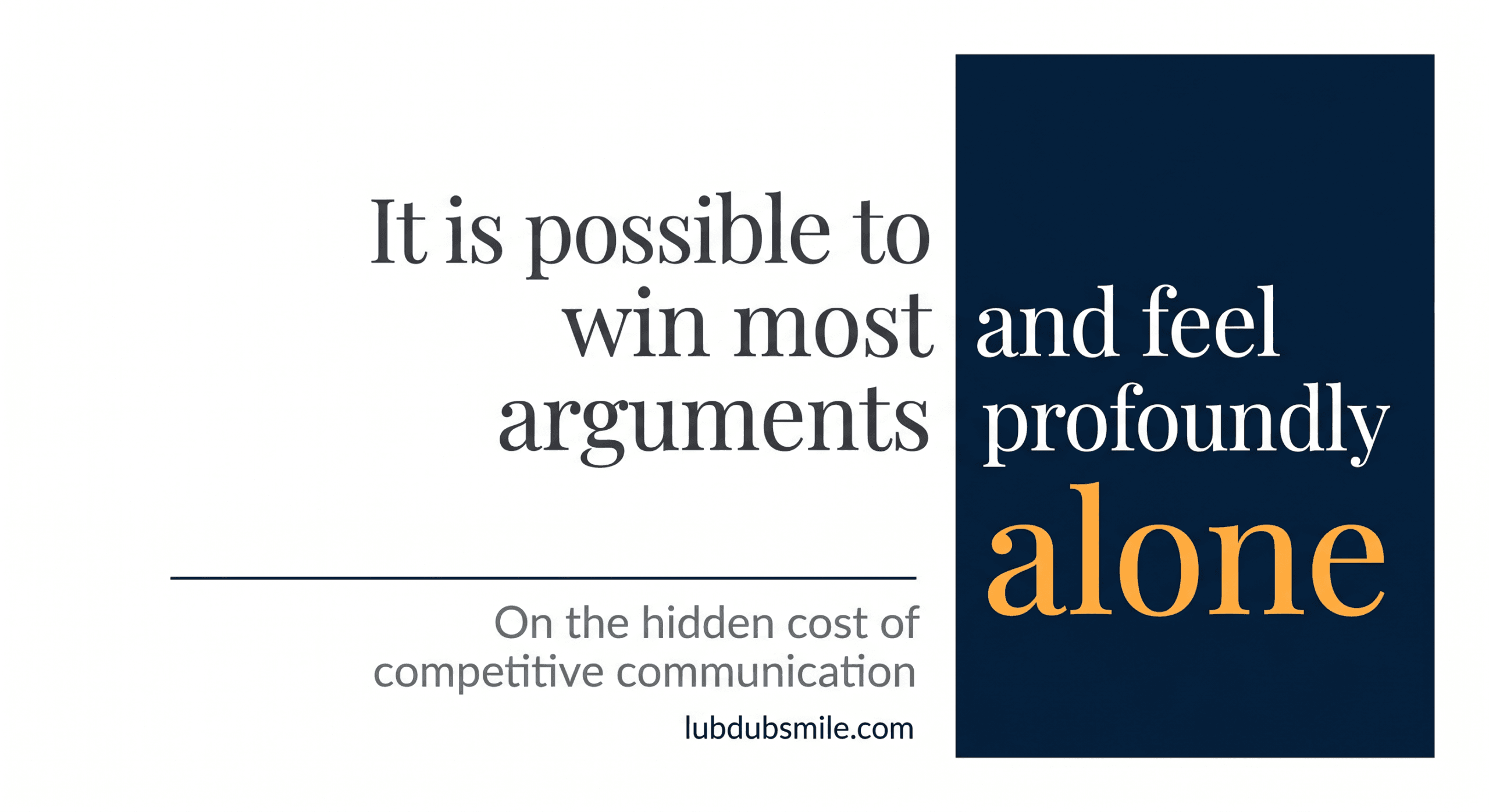
Perhaps the most quietly painful aspect of the competitive relationship dynamic: it’s possible to win most arguments and feel profoundly alone. Winning produces distance. Distance produces loneliness. The loneliness is real, even when the victories are consistent.
The Shift: From Winning to Understanding
Redefining What Success Looks Like in High Achieving Couples Communication
In professional contexts, a successful conversation produces agreement, decision, or action. In partnership, a successful conversation often looks like: both people feel heard, the relationship feels closer, and understanding increased even if the two of you decided nothing. This is a genuinely different definition that requires deliberate adoption. Transforming high achieving couples communication starts with this reframe.
Curiosity as the Alternative to Debate
The most practical alternative to dynamics where couples compete is specific, genuine curiosity about your partner’s experience. Not “I hear what you’re saying, but ” which signals that you’ve already processed their point and moved to your rebuttal. Actual questions: “What does this feel like for you?” “What would help?” “What am I missing about your experience here?”
Research the APA compiled on couples communication consistently identifies listening that centers on curiosity as one of the strongest predictors of relationship satisfaction and one of the skills that partners who compete most often underinvest in.
How to Stop Competing With Your Partner: The Conviction vs. Contempt Distinction
High achievers often maintain strong convictions and that’s not the problem. The problem is when conviction shades into contempt: when your partner’s different position isn’t just wrong but slightly absurd, when disagreement implies incompetence, when being right requires your partner to be not just incorrect but unreasonable. Conviction is directness with respect intact. Contempt is directness with respect removed. This distinction defines the line between healthy and harmful high achieving couples communication.
When to Advocate and When to Inquire
Not every conversation calls for the same communication mode. Reading which mode the moment requires is a skill that partnership demands. Decisions genuinely need to be made: advocate. Your partner is sharing something difficult: inquire. You’re in disagreement about something important: inquire first, then advocate ideally with their experience genuinely integrated into your position.
Staying With Your Partner’s Experience Before Offering Yours
This is the specific skill most high achievers need to develop: the ability to remain present with a partner’s experience without fixing, refuting, or redirecting long enough for them to feel genuinely heard. It’s not agreement, not capitulation, it’s the pause between receiving and responding that makes the response actually land.
Building emotional safety in relationships is the foundational work that makes this kind of presence possible and it develops through exactly the incremental practices this article describes.
Real-Time De-Escalation: What to Do When You’re Mid-Argument
High achieving couples communication needs strategies for the moment when competition takes over, not just for preventing it in advance. Three approaches that work in the heat of an argument:
Name it without blame: “I think we’ve both shifted into debate mode. Can we pause?” This interrupts the pattern without assigning fault and gives both partners a moment to step out of competition before the conversation continues.
Ask one genuine question: When you notice you’re building your case rather than listening, stop and ask one real question about your partner’s experience. “What’s the part of this that bothers you most?” One genuine question reorients the conversation more effectively than any rebuttal. Call a ten-minute break: Gottman research identifies physiological arousal heart rate above 100 beats per minute as a primary barrier to productive conversation. Taking ten minutes to genuinely calm down (not to rehearse arguments) and then returning to the conversation produces significantly better outcomes than pushing through when both partners are flooded.
Practical Communication Strategies for High Achieving Couples
The Listening Agreement: One Speaks, One Listens Without Preparing a Response
An agreement with clear structure: when one partner speaks, the other’s only job is to understand not to prepare their counterargument, not to identify logical inconsistencies, not to formulate their response. Then the speaker confirms whether they felt heard before roles switch. Keep this agreement simple because partners who compete often turn complex agreements into frameworks they then negotiate against each other.
Separating Information-Sharing from Problem-Solving
Many high achievers move immediately to solution mode when a partner shares a problem. This is efficient and well-intentioned and frequently something the partner didn’t want. A simple question changes the dynamic entirely: “Are you looking for input, or do you need me to just listen right now?” Asking creates permission. Assuming creates friction. This single practice transforms high achieving couples communication more consistently than most others.
Asking Questions Before Making Points
A concrete practice: in any difficult conversation, each partner commits to asking at least two genuine questions before making their first point. This isn’t a technique that someone designs to appear engaged before landing the argument. It’s a genuine attempt to understand before advocating and it changes the quality of the advocacy when it comes.
Naming the Dynamic in the Moment Without Blame
“I notice we’ve both been making our case for the last ten minutes without either of us acknowledging the other’s point. Can we try something different?” This kind of naming calm, non-accusatory, describing the pattern rather than assigning responsibility is one of the most powerful interventions available to couples who’ve identified the dynamic that drives their competition. It requires that at least one partner develop the ability to step outside the dynamic while inside it.
Scheduling Difficult Conversations Ahead of Time
Partners who tend to compete in conversation often have better discussions when they’re not ambushed by the topic. “I’d like to talk about how we’ve been handling finances can we find thirty minutes this weekend when we’re both not depleted?” gives both partners the opportunity to approach the conversation with collaboration rather than defensiveness. The impromptu difficult conversation rarely goes well when both partners carry high communication stakes.
The “What I Need Right Now” Check-In Before Hard Topics
Before a potentially difficult conversation: “I want to talk about something that’s been bothering me. What I need right now is to feel heard I’m not looking for solutions yet.” This briefing removes ambiguity about the conversation’s goal and gives the listening partner a clear, achievable task. For high achievers, unclear goals produce improvised strategies that often default to competition.
Applying the Gottman Antidotes to Competitive Patterns
Gottman research identifies specific antidotes to the Four Horsemen communication patterns that appear most in high achieving couples communication:
- Criticism → Gentle startup: Replace “You never listen” with “I feel unheard when our conversations turn into debates. Can we try a different approach?”
- Contempt → Appreciation: Actively name what you value in your partner before raising a concern. This isn’t a technique it’s a genuine reorientation toward the relationship rather than the argument.
- Defensiveness → Taking responsibility: Find the part of the complaint that has validity and acknowledge it directly, before explaining your perspective.
- Stonewalling → Self-soothing: When one partner shuts down, request a break explicitly and return when both partners can engage. Pushing through when someone is flooded produces worse outcomes than pausing.
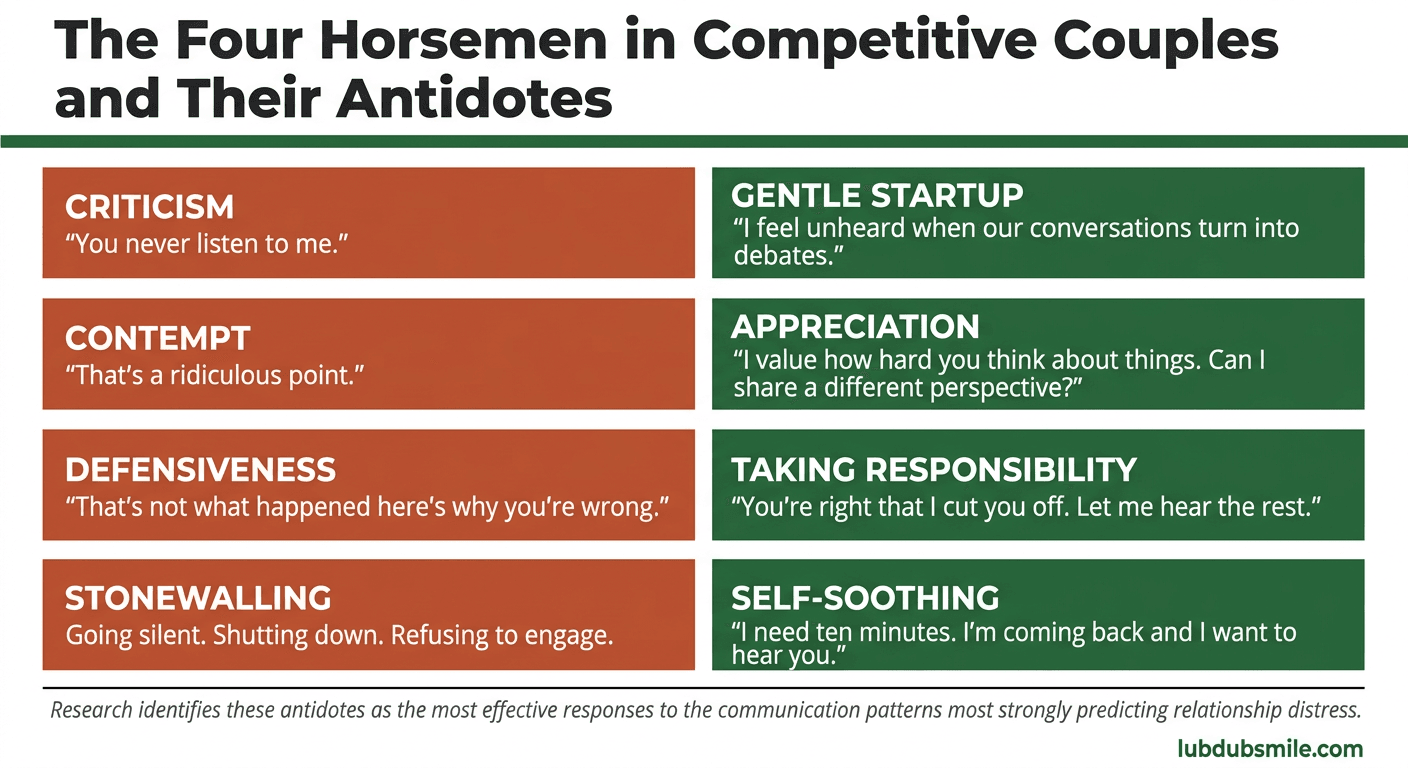
High achieving couples communication repair uses research-backed antidotes that replace competitive patterns with connection-building alternatives.
Navigating Power Dynamics in High-Achieving Couples
When Income Disparity Creates Implicit Power Imbalance
In many high-achieving couples, one partner’s income significantly exceeds the other’s at some point through career acceleration, field differences, or family decisions both partners made intentionally. Income disparity creates power dynamics that rarely receive explicit naming, but operate consistently in financial conversations, major decisions, and negotiations about domestic life.
The partner earning more may not consciously leverage this but the dynamic shapes whose judgment carries more weight, whose schedule the relationship accommodates, and whose preferences tend to prevail. Naming this dynamic directly and creating explicit agreements about financial decision-making is more effective than pretending the disparity doesn’t shape the relationship.
Research the Pew Research Center compiled consistently shows that domestic power dynamics and financial disparities affect relationship satisfaction in dual-career couples and that couples who address them explicitly report better outcomes than those who treat the subject as off-limits. Navigating financial disagreements in relationships offers practical frameworks for addressing the specific conversations that income disparity makes most difficult.
When One Partner’s Career Accelerates and the Other’s Plateaus
Career trajectories diverge. One partner gets promoted repeatedly; the other’s professional growth flattens. One achieves the recognition both sought; the other watches from what can feel like the sideline. This disparity affects identity, self-worth, and the dynamic that drives competition in the relationship. The partner whose career has slowed may compete more intensely in domestic and relational territory as a result not cynically, but because the need for recognition and competence doesn’t disappear when professional life stops meeting it.
Domestic Labor as a Topic Where Couples Compete
Domestic labor childcare, household management, logistics, the invisible operational complexity of family life becomes one of the most consistently contentious topics in high achieving couples communication. Both partners have legitimate cases to make about their contribution. Both cases can be simultaneously valid. The goal of these conversations needs to shift from establishing who contributes more to building systems that both partners find equitable.
Decision-Making: Whose Voice Carries More Weight and Why
In couples with clear power differentials income, professional status, personality dominance decision-making authority often concentrates without either partner deliberately choosing this. One partner’s preferences consistently prevail. The other partner’s input receives consideration but rarely changes outcomes. Over time, the partner with less decision-making authority either stops contributing genuine input or accumulates resentment that surfaces as competition elsewhere.
Making Space for Both Ambitions Simultaneously
High-achieving couples often approach ambition as a resource that needs rationing if your career is expanding, mine must contract. This framing creates competition by design. The more useful question: how do we structure our life so both ambitions get genuine space? This often requires explicit, creative problem-solving and the willingness to reject the assumption that one person’s professional growth necessarily requires the other’s sacrifice. Addressing ambition directly is one of the most important conversations in dual career couple communication.
When Directness Is a Strength
The Value High Achievers Bring to Relationship Communication
Directness, clarity, the willingness to name problems rather than let them fester, the capacity to engage with difficult topics without avoidance these qualities serve relationships genuinely. Many couples struggle with the opposite problem: conflict avoidance, passive resentment, the inability to raise issues directly. High achievers typically don’t have this problem, and that’s worth acknowledging. Strong high achieving couples communication builds on these strengths rather than dismantling them.
Healthy Directness vs. Dominance Through Competition
The distinction is relatively clear in practice: directness is clarity in service of both partners understanding each other. Dominance through competition is clarity in service of establishing superiority or achieving compliance. The words may be similar. The intent and the relational impact differs significantly.
When Clear Communication Is an Act of Respect
Telling a partner directly what you need, what bothers you, what you’re not willing to accept without contempt, without weaponizing, without making them feel inadequate for having missed it is among the most respectful things partners can do for each other. It treats the other person as capable of handling honesty and deserving of it. This is a high achiever strength worth preserving in high achieving couples communication.
Using Analytical Strengths in Service of Partnership
The same analytical capacity that builds cases against a partner can redirect toward the relationship’s actual problems: the scheduling systems that create friction, the financial structures that produce resentment, the patterns in your conflicts that neither of you has named yet. Strategic intelligence applied to understanding your partnership rather than winning within it is one of the most powerful advantages high achievers bring to relationship communication.
Integration: Keeping What Works While Adding What’s Missing
The goal isn’t to become a different person. It’s to expand your range. The directness stays. The follow-through stays. The willingness to engage with hard topics stays. What gets added is the capacity to enter conversations with curiosity rather than position, to stay with a partner’s experience before redirecting to your own, and to define conversational success as connection rather than conclusion.
Having the Meta-Conversation
Talking About How You Talk
The most important conversation many high-achieving couples haven’t had: a direct discussion, outside of any conflict, about the patterns in how they communicate. Not “you always do this” a description of the dynamic that both partners can recognize. “I’ve noticed that our difficult conversations often feel more like debates than discussions. Do you experience that?” Starting with your own observation rather than your partner’s behavior changes what’s possible. This meta-conversation is often the turning point in high achieving couples communication.
Naming Patterns Without Assigning Blame
The dynamic that drives competition in relationships involves both partners even when the contribution is uneven. Naming it productively requires describing the pattern rather than assigning responsibility: “We both tend to dig in when we disagree” rather than “you always have to win.” The former opens a problem that both partners share. The latter opens a new competition.

Creating Communication Agreements Together
Agreements that both partners design together perform better than changes that one partner decides to implement. “When one of us says ‘I just need you to hear this,’ the other commits to not offering solutions for at least ten minutes” is an agreement both partners can hold each other to. It also respects both partners’ intelligence this isn’t a technique one partner applies to the other; it’s a framework both designed together.
What to Do When the Meta-Conversation Becomes Competitive Too
It will, at some point. The conversation about the competitive dynamic will itself become competitive. One partner will start tracking who does it more. The other will defend their communication style. This is normal. It’s also information: the pattern runs deep enough that a single conversation won’t resolve it. Returning to repair, rather than relitigating who was right, is the practice.
Returning to Repair After Episodes Where Competition Takes Over
After a conversation that slipped into competition: “That didn’t go the way I wanted. I was more interested in making my point than hearing yours. Can we try again?” This return direct, non-dramatic, without requiring the other partner to validate your assessment first is what distinguishes couples who are changing the pattern from couples who are simply aware of it. Repair is the engine of genuine progress in high achieving couples communication.
When to Seek Professional Support
Signs the Pattern Needs Couples Therapy for High Achievers
When competition has become the default across most topics, when one partner feels the other consistently dismisses or dominates them, when awareness of the pattern hasn’t produced meaningful change, when power dynamics are creating genuine inequity that conversations keep circling without resolution these are signals that professional support would provide structure that self-directed effort alone isn’t producing. Learning to stop defensive behavior in conflict can help identify whether the pattern you’re experiencing points toward self-directed strategies or professional guidance.
What Good Couples Therapy Addresses in High-Achieving Pairs
A skilled couples therapist working with high-achieving couples typically addresses the pattern structurally helping both partners understand what drives it, not just what it looks like alongside specific communication skill development. Approaches that research validates, like the Gottman Method and Emotionally Focused Therapy, both carry strong evidence for improving communication patterns and relationship satisfaction.
Framing Couples Therapy for High Achievers as Partnership Investment
High achievers put resources into what they value: professional development, physical performance, financial strategy. A relationship that generates both partners’ support, genuine intimacy, and functional collaboration is among the highest-return commitments available. Approaching couples therapy with the same intentionality applied to other high-stakes commitments rather than as an admission of failure tends to produce better engagement from both partners.
What to Look for in a Therapist for High-Achieving Couples
Therapists who work effectively with high-achieving couples are typically comfortable with directness and intellectual engagement, use approaches that research validates, and can challenge dynamics where partners compete without avoiding the topic. Exploring therapy platforms can help identify practitioners with scheduling flexibility suited to demanding professional lives.
Frequently Asked Questions
Can both partners be strong and direct without competing with each other?
Yes and the most effective high-achieving couples demonstrate this consistently. Directness serves both partners understanding each other; competition serves establishing superiority. Both partners can maintain strong voices while orienting those voices toward understanding rather than winning. High achieving couples communication works best when directness and collaboration reinforce each other rather than pulling in opposite directions.
What if only one of us recognizes the competitive pattern?
This is common and genuinely difficult. One partner has identified the dynamic; the other experiences their communication style as simply direct and honest. If naming it in conversation produces the competitive response it’s describing, individual therapy for the partner who recognizes it can be a useful starting point. Knowing when to seek professional support helps clarify whether self-directed effort or professional guidance better fits your situation.
How do we handle real disagreements without pretending to agree?
Genuine disagreement doesn’t require competition for expression. “I see this differently, and I want to understand your position before I explain mine” honors both the disagreement and the partnership. The goal isn’t agreement that neither partner genuinely holds it’s disagreement that both partners navigate in a way that leaves each feeling respected. Some issues won’t resolve; couples who communicate well know how to manage ongoing differences without those differences becoming ongoing competitions.
Is some competition healthy in a relationship?
In specific, bounded contexts games, shared athletic pursuits, playful banter yes. The challenge for high-achieving couples is that the competitive dynamic tends to expand beyond those boundaries into emotional and relational territory where it causes damage. The question isn’t whether competition exists in your relationship; it’s whether it stays contained to contexts where it energizes rather than contexts where it creates distance.
How long does it take to change communication patterns?
Longer than most high achievers expect, and shorter than it sometimes feels mid-process. Relationship researchers generally suggest that meaningful communication pattern change takes consistent effort over several months and that returning to old patterns is normal rather than indicative of failure. The metric isn’t whether you slip back into competition; it’s whether you recognize it faster and return to repair more efficiently over time.
Why does high achieving couples communication specifically turn competitive?
Because achievement-oriented psychology rewards the exact skills that damage intimate communication: building arguments, persuading under pressure, maintaining positions when challenged, and centering on outcomes. These skills don’t simply switch off when partners come home. They migrate into the relationship and apply to conversations where they produce the opposite of their intended effect. Recognizing this isn’t a criticism of high achievers it’s an explanation of a specific, predictable pattern with a specific, learnable solution.
How do I stop competing with my partner when I don’t realize I’m doing it?</strong>
Start by identifying your physical signals the moment when you feel the urge to jump in, the tightening in your chest when you disagree, the sense of pressure to make your point. These physical cues arrive before the competitive behavior does. Building the habit of pausing when you notice them asking one question rather than making one point interrupts the automatic pattern before it takes over the conversation. Over time, the pause becomes shorter and the recognition becomes faster.
Partnership as the Highest-Stakes Collaboration
What Relationship Success Actually Requires
Teams that perform at the highest level don’t fill their rosters with people who compete against each other they fill them with people who compete together against the problem. Your relationship is your most significant long-term collaboration. It deserves the same strategic intelligence you apply to your most complex professional challenges with one critical reorientation: the goal is both partners understanding each other, not one partner achieving victory.
The Skills Worth Developing for Both Partners
Genuine listening without simultaneously building your response. Staying present with your partner’s experience before redirecting to your own. Naming patterns without assigning blame. Returning to repair without requiring your partner to validate your assessment first. These aren’t soft skills that contradict your professional capabilities they’re sophisticated competencies that the most effective partners in high-achieving couples develop deliberately. Strong high achieving couples communication requires exactly this kind of deliberate skill-building.
When to Seek Professional Guidance
If dynamics where you compete against each other are producing consistent relationship distress, if one partner feels the other chronically dismisses or dominates them, or if awareness of the pattern hasn’t produced meaningful change despite genuine effort couples therapy provides what self-directed effort cannot: professional pattern assessment, skill development that has structure, and facilitated conversations that don’t default to competition.
High achieving couples communication turns competitive when the skills that build exceptional careers building arguments, persuading under pressure, maintaining positions when challenged migrate into a relationship that requires a fundamentally different approach: genuine curiosity, listening that centers on understanding, and defining success as both partners feeling heard rather than one partner winning.
This article provides frameworks for understanding and improving communication in high-achieving couples. It is not a substitute for professional couples therapy.
This content is for educational purposes and does not substitute for professional psychological or therapeutic help.