


Here is the text exactly as provided:
CBT Worksheets for Anxiety: Comparing Digital and Printable Resources
When anxiety feels overwhelming racing thoughts before sleep, anticipatory dread before social situations, spiraling “what if” worries you want tools that work, not vague advice to “just relax.” Cognitive Behavioral Therapy (CBT) worksheets offer structured frameworks for identifying anxious thoughts, challenging catastrophic predictions, and building practical coping skills. This CBT worksheets for anxiety guide compares the best digital and printable resources to help you choose what works for your needs and learning style.
But when you search for CBT worksheets for anxiety, you’re met with hundreds of options: free printables, paid subscriptions, mobile apps, government-funded workbooks, and everything in between. The question isn’t just “Where can I find CBT worksheets?” It’s “Which ones are actually legitimate and evidence-based?” and “Should I use printable PDFs or digital tools?” and “Are the free options as good as the paid ones?”
This CBT worksheets for anxiety comparison examines the best digital and printable resources, explains how to use them effectively, and helps you build a personalized anxiety workbook that fits your learning style and daily routine.
What Are CBT Worksheets and How Do They Help with Anxiety?
The Evidence Base: What Research Says About CBT for Anxiety
Cognitive Behavioral Therapy is one of the most extensively researched and empirically supported treatments for anxiety disorders. According to research from the American Psychological Association on CBT effectiveness, CBT has been shown to effectively reduce symptoms of generalized anxiety disorder, panic disorder, social anxiety disorder, and specific phobias. Meta-analyses published in journals like Behaviour Research and Therapy consistently show that CBT produces moderate to large reductions in anxiety symptoms. Effects often persist long after treatment ends.
CBT works by targeting the relationship between thoughts, feelings, and behaviors. It teaches you to recognize automatic anxious thoughts (like “Something terrible will happen”), evaluate whether those thoughts are accurate or distorted, and practice behaviors that contradict the anxiety (like gradually facing feared situations).
How Worksheets Fit Into Cognitive Behavioral Therapy
In traditional CBT therapy, worksheets are homework tools. Your therapist might assign a thought record to track anxious thoughts between sessions. Or an exposure hierarchy to plan gradual steps toward facing a fear. Worksheets provide structure for practicing skills outside the therapy hour.
When used for self-guided anxiety management, CBT worksheets for anxiety serve a similar function. They give you a framework for applying CBT principles on your own. A thought record, for example, guides you through identifying a triggering situation. You notice the anxious thought, examine evidence for and against it, and generate a more balanced perspective.
Worksheets don’t replace the personalized assessment, feedback, and support a therapist provides. But they can be effective tools for building self-awareness and practicing skills especially for mild to moderate anxiety. This connects to broader patterns discussed in building emotional regulation skills daily.
What to Expect: Realistic Outcomes from Self-Guided Worksheet Use
Research on self-guided CBT (often called “bibliotherapy” or “self-help CBT”) shows modest but meaningful benefits for anxiety. This holds particularly true when users are consistent and motivated. A review published in the Cochrane Database of Systematic Reviews found that self-help interventions based on CBT principles can reduce anxiety symptoms. Effects tend to be smaller than therapist-guided treatment.
Realistic expectations include:
- Increased awareness of anxious thought patterns
- Greater ability to recognize cognitive distortions (catastrophizing, overgeneralizing, mind-reading)
- Gradual reduction in avoidance behaviors
- Improved ability to tolerate discomfort and uncertainty
CBT worksheets for anxiety are not quick fixes. Consistent use over weeks or months, combined with behavioral practice (like exposure exercises), produces the most benefit.
When Worksheets Work Best (and When You Need More Support)
CBT worksheets for anxiety work best when:
- Your anxiety is mild to moderate and not interfering significantly with daily functioning
- You’re motivated and able to practice consistently
- You’re using worksheets alongside other supports (therapy, support groups, healthy routines)
- You’re willing to challenge yourself (worksheets require honest self-reflection and behavioral change)
Worksheets alone are generally not sufficient when:
- Your anxiety is severe, persistent, or worsening
- You’re experiencing panic attacks, agoraphobia, or debilitating social anxiety
- Your anxiety is related to trauma, abuse, or complex PTSD
- You’re having thoughts of self-harm or suicide
- You’ve tried self-help approaches without improvement
If any of these apply, working with a qualified therapist or healthcare provider should be your primary approach. Worksheets can serve a complementary role. For professional support options, review therapy cost comparison resources.
Digital vs. Printable: Which Format Works Better?
Benefits of Printable Worksheets
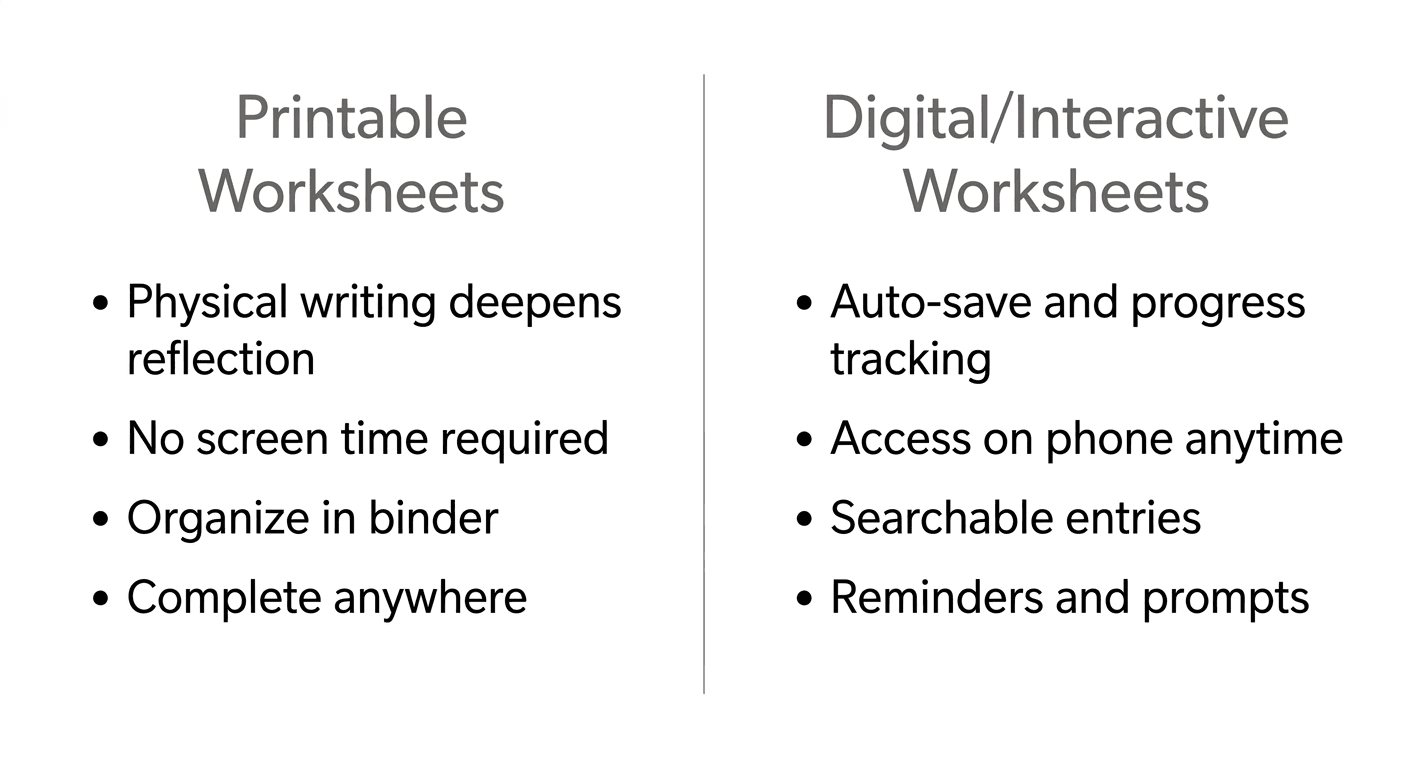
Printable worksheets offer tangible, physical engagement. Many people find that writing by hand slows down their thinking and deepens reflection. Printables can be organized in a binder, creating a visible record of progress. They don’t require screens, which can be helpful if you’re trying to reduce screen time or if digital devices increase your anxiety.
Printables also offer flexibility. You can complete them anywhere, annotate freely, and revisit them without needing internet access or battery life.
Benefits of Digital/Interactive Worksheets
Digital worksheets and apps offer convenience, portability, and often interactive features like auto-saving, progress tracking, and reminders. You can complete a thought record on your phone during a lunch break, and it saves automatically. Apps designed for CBT may offer guided prompts, mood tracking, and integration with other wellness tools.
Digital formats are also searchable. This makes it easy to review past entries for patterns. For people who prefer typing to handwriting, digital worksheets can feel faster and more accessible.
Hybrid Approaches: Using Both Formats
Many people benefit from combining both in this CBT worksheets for anxiety approach. You might use a printable thought record when you’re at home and have time to sit and reflect. Then use a mobile app for quick anxiety check-ins during the day. You can also print digital worksheets, complete them by hand, and scan or photograph them for digital storage.
How to Choose Based on Your Learning Style and Lifestyle
Consider:
- If you process best through writing by hand: Printables
- If you’re frequently on-the-go: Digital apps
- If you want a physical binder to track progress: Printables
- If you prefer typing and digital organization: Digital/fillable PDFs
- If you want reminders and tracking features: Apps
- If you’re trying to reduce screen time: Printables
There’s no objectively superior format. Choose based on what you’ll actually use consistently. This aligns with principles discussed in emotional hygiene daily habits that protect your peace.
Best Free Printable CBT Worksheets for Anxiety

Therapist Aid: Versatile, Professional-Grade Printable Worksheets
What’s available and why it’s trusted:
Therapist Aid (therapistaid.com) is one of the most widely used free worksheet resources among mental health professionals. Created by licensed therapists, the site offers hundreds of printable worksheets, guides, and exercises covering anxiety, depression, anger, trauma, and more.
For anxiety specifically, Therapist Aid offers:
- Thought records (multiple variations)
- Cognitive distortions worksheets
- Exposure hierarchy templates
- Worry postponement logs
- Relaxation and grounding exercises
- Behavioral activation planners
Worksheets are well-designed, clearly written, and appropriate for both self-guided use and therapy homework.
Best worksheets for anxiety beginners:
- Challenging Negative Thoughts: A simplified thought record that walks you through identifying anxious thoughts and generating alternatives
- Cognitive Distortions: A checklist of common thinking errors (catastrophizing, black-and-white thinking, fortune-telling) with examples
- Exposure Hierarchy: A structured template for listing feared situations and rating them by difficulty, used to plan gradual exposure
How to access and organize:
All worksheets are free to download as PDFs. You can print individual worksheets as needed or download multiple at once to build a custom workbook. Create a binder organized by skill type (thought challenging, exposure, relaxation) or by anxiety trigger (social anxiety, health anxiety, etc.).
Free vs. premium tier differences:
Therapist Aid offers a free tier (individual worksheet downloads) and a premium subscription (~$60/year for therapists). For personal use, the free tier is usually sufficient. Premium adds features like customizable worksheets and bulk downloads. These are primarily useful for therapists working with multiple clients.
Centre for Clinical Interventions (CCI): Comprehensive Anxiety Workbooks
Government-backed, evidence-based workbooks:
The Centre for Clinical Interventions, part of the Western Australia government health department, offers some of the most comprehensive free CBT workbooks available. These are not just worksheets they’re full self-help manuals. Professionally written, evidence-based, and structured like guided courses.
“Worry and Rumination” module overview:
The Worry and Rumination workbook addresses generalized anxiety and chronic worry. It includes:
- Education on the difference between productive problem-solving and unproductive rumination
- Worksheets for identifying worry triggers
- Exercises for scheduling “worry time” (a technique to contain rumination)
- Cognitive strategies for challenging “what if” thinking
- Behavioral experiments to test anxious predictions
This workbook is approximately 60 pages. It’s designed to be worked through sequentially over several weeks.
“Panic Stations” module for panic anxiety:
The Panic Stations workbook targets panic attacks and panic disorder. It covers:
- Understanding the physiology of panic (why it feels so intense but isn’t dangerous)
- Identifying catastrophic misinterpretations of bodily sensations
- Interoceptive exposure (deliberately creating physical sensations to reduce fear of them)
- Breathing retraining and grounding techniques
This module is particularly valuable if you experience panic attacks or intense physical anxiety symptoms. Understanding anxiety vs overwhelm differences can help you identify which workbook best fits your needs.
How to use workbook format effectively:
CCI workbooks are designed to be read and completed chapter by chapter. Print the entire workbook or work through it digitally. Set aside dedicated time each week to complete a section. Track your progress in a journal or by annotating the workbook itself.
Because these are comprehensive modules, they require more commitment than single worksheets. However, they offer more complete skill-building.
Get Self Help: Minimalist, Ink-Efficient Printable Tools
Simple, practical worksheet designs:
Get Self Help, created by a UK-based clinical psychologist, offers minimalist, one-page worksheets designed for repeated use. The designs are intentionally simple often black-and-white, low on graphics to save printer ink and emphasize clarity over aesthetics.
Best for quick reference and repeated use:
Get Self Help’s worksheets are ideal if you want something you can print multiple copies of and fill out regularly. Examples include:
- One-page thought records
- “5 Areas” model (connecting situations, thoughts, emotions, physical sensations, and behaviors)
- Brief behavioral activation planners
- Quick CBT formulation templates
Thought record variations:
Get Self Help offers several thought record formats. From very simple (three columns: situation, thought, alternative) to more detailed versions that include evidence evaluation and rating belief in thoughts before and after challenging them.
Organizing printed worksheets in a binder:
Create a binder with dividers for different worksheet types (thought records, exposure logs, relaxation exercises). Print several blank copies of your most-used worksheets. Keep them in sheet protectors or loose in the binder for easy access. This creates a reusable “anxiety toolkit” you can grab whenever you need structured reflection.
Best Digital and Interactive CBT Worksheets for Anxiety

MindShift CBT App: Mobile-Friendly Interactive Tools
Anxiety Canada’s evidence-based app:
MindShift CBT is a free mobile app developed by Anxiety Canada, a nonprofit organization dedicated to anxiety education and treatment. The app is grounded in CBT principles. It’s designed specifically for anxiety management (not general mental health).
Interactive thought journals and coping cards:
MindShift includes digital thought records (called “Thought Journals”). These guide you through identifying anxious thoughts, examining evidence, and reframing. The app also offers “Coping Cards” personalized reminders you can create and access quickly when anxiety spikes (e.g., “My anxiety is temporary. I’ve handled this before.”).
Digital fear ladder and exposure planning:
One of MindShift’s strongest features is its interactive fear ladder (exposure hierarchy). You can list feared situations, rate them by difficulty, and track your progress as you practice facing them. The app prompts you to reflect on what you learned after each exposure, reinforcing skill-building.
Best features for on-the-go anxiety management:
MindShift includes quick relief tools (breathing exercises, grounding techniques). It offers specific modules for different anxiety types (social anxiety, test anxiety, perfectionism, panic). You can complete brief check-ins during the day and review your patterns over time through the app’s tracking features.
MindShift is completely free with no ads or premium upsells. This makes it one of the best value digital resources available.
Therapist Aid Fillable PDFs: Type-Then-Print Option
Digital completion before printing:
Therapist Aid offers many worksheets as fillable PDFs. You can type directly into the form fields on your computer or tablet before printing. This is ideal if you prefer typing to handwriting but still want a physical copy for your binder.
Benefits for those who prefer typing:
Typing can be faster, more legible, and easier to edit than handwriting. You can complete a thought record on your laptop, save it as a PDF, and print it for your records. Or keep it entirely digital in a folder organized by date or topic.
How to save and track progress digitally:
Save completed fillable PDFs with clear file names (e.g., “ThoughtRecord_2026-01-15”). Store them in a dedicated folder on your computer or cloud storage. This creates a searchable, date-stamped record of your anxiety work. You can review it to identify patterns or measure progress over time.
Other Digital Worksheet Options
Sanvello, CBT Thought Record Diary apps:
- Sanvello: A mental health app offering CBT-based mood tracking, thought records, and guided journaling. Free tier available; premium subscription adds more features.
- CBT Thought Record Diary: A simple, dedicated app for completing thought records on your phone. Minimal interface, focused solely on cognitive restructuring.
When apps complement traditional worksheets:
Apps work well for daily check-ins, quick thought records, and on-the-go anxiety management. They complement printable worksheets by offering convenience and tracking. You might use an app during the week and complete more reflective, in-depth worksheets (like CCI workbooks) on weekends. This connects to broader wellness strategies in micro-moments of calm and everyday mindfulness.
Premium Option: Psychology Tools for Advanced Users
What Psychology Tools Offers
Psychology Tools is a subscription-based platform offering professionally designed, therapist-grade worksheets, guides, and assessment tools. The library includes hundreds of resources covering CBT, DBT, ACT, and other evidence-based therapies. It has a significant focus on anxiety.
Premium features include:
- Extensive worksheet library (more variety than free sites)
- Customizable worksheets (edit text, add your own instructions)
- Multi-language options
- Clinical guides and formulation templates
Who Benefits Most from a Paid Subscription
Psychology Tools is designed primarily for therapists. It can be useful for individuals who:
- Want highly specialized worksheets (e.g., targeting specific phobias, health anxiety, OCD-related anxiety)
- Prefer polished, aesthetically refined designs
- Need multi-language resources
- Are working intensively on anxiety management and want maximum variety
Cost Comparison: Is It Worth It for Personal Use?
Psychology Tools costs approximately $6–$10/month (pricing varies by region and subscription length). For most individuals using CBT worksheets for anxiety for personal management, free resources like Therapist Aid, CCI, and MindShift provide equivalent or superior value.
Psychology Tools is worth considering if you’ve exhausted free resources and need very specific tools. Or if you’re a mental health professional working with clients. For general anxiety self-help, the free options are professional-grade and sufficient.
Free Alternatives That Provide Similar Value
- Therapist Aid offers comparable worksheet quality for free
- CCI workbooks provide more comprehensive content than most paid platforms
- MindShift CBT offers interactive digital tools at no cost
Unless you have highly specific needs, start with free resources. You can always upgrade later if needed.
Essential Anxiety Worksheets Every Beginner Should Try
Thought Records: Identifying and Challenging Anxious Thoughts
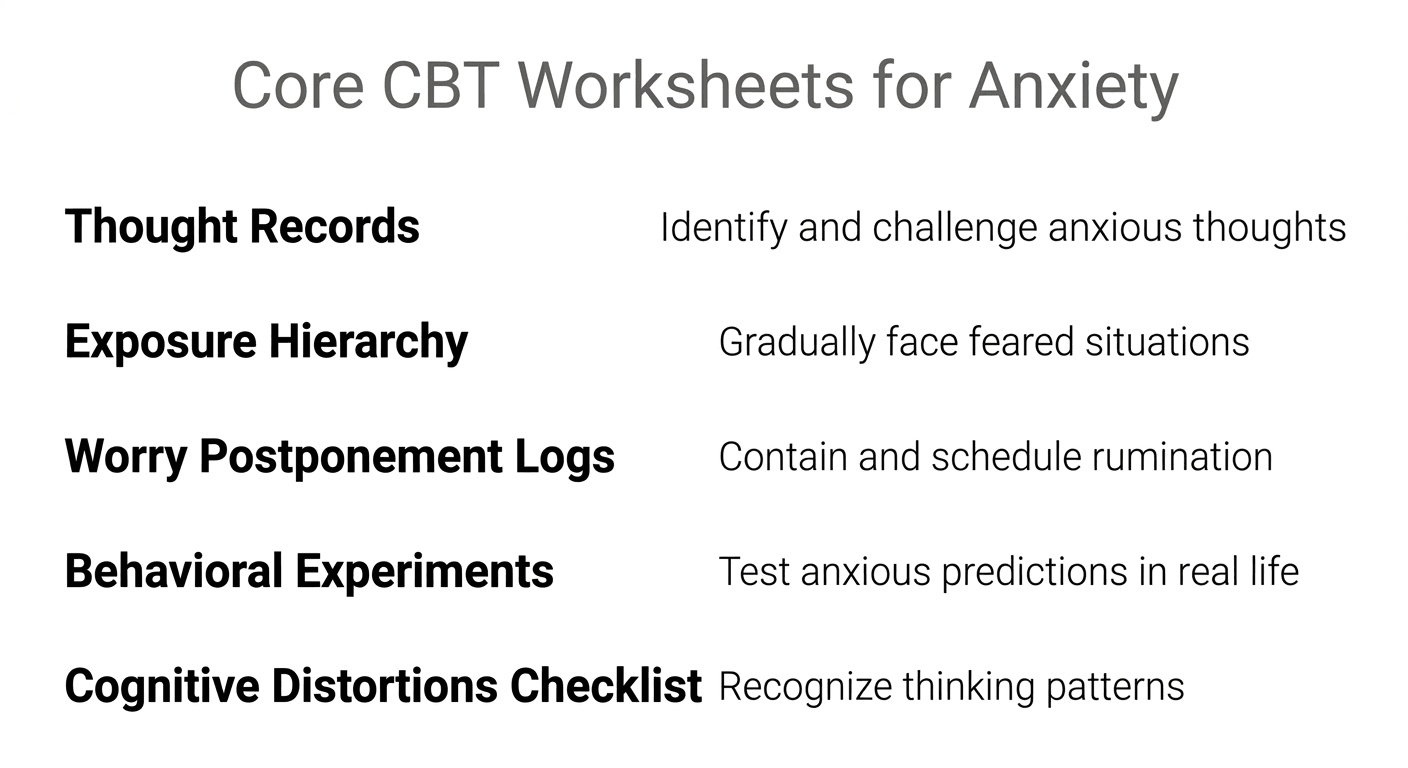
Thought records are the cornerstone of CBT for anxiety. They guide you through:
- Identifying the situation that triggered anxiety
- Noticing the automatic anxious thought (e.g., “I’ll embarrass myself”)
- Examining evidence for and against that thought
- Generating a more balanced, realistic thought
- Rating your belief in the original thought before and after challenging it
Start with a simple three-column format (situation, anxious thought, alternative thought). Progress to more detailed versions as you become comfortable with the process.
Recommended source: Therapist Aid’s “Challenging Negative Thoughts” worksheet
Exposure Hierarchy: Gradually Facing Fears
An exposure hierarchy (also called a fear ladder) helps you list feared situations in order of difficulty. You plan gradual steps to face them. For example, if you have social anxiety, your hierarchy might range from “saying hello to a coworker” (lower difficulty) to “giving a presentation” (higher difficulty).
The goal is to practice lower-difficulty exposures first, build confidence, and gradually work up the ladder. Research shows that gradual exposure is one of the most effective treatments for anxiety.
Recommended source: Therapist Aid’s “Exposure Hierarchy” template or MindShift CBT’s interactive fear ladder
Worry Postponement Logs: Managing Rumination
Worry postponement is a technique where you designate a specific “worry time” each day (e.g., 15 minutes at 6 PM). You practice noticing worries throughout the day without engaging with them. When a worry arises, you write it down briefly. Tell yourself, “I’ll think about this during worry time.”
This technique helps contain rumination. It proves that you can delay worry without catastrophe.
Recommended source: CCI’s “Worry and Rumination” workbook or Therapist Aid’s worry postponement worksheet
Behavioral Experiments: Testing Anxious Predictions
Behavioral experiments involve testing the accuracy of anxious predictions through real-world action. For example, if you believe “If I speak up in a meeting, everyone will think I’m foolish,” a behavioral experiment might be: speak up once, observe what actually happens, and compare it to your prediction.
This builds evidence against anxious thoughts in a way that cognitive challenging alone cannot.
Recommended source: Therapist Aid’s “Behavioral Experiments” worksheet
Cognitive Distortions Checklist: Recognizing Thinking Patterns
Cognitive distortions are habitual thinking errors that fuel anxiety: catastrophizing (imagining the worst), black-and-white thinking (seeing situations as all-good or all-bad), mind-reading (assuming you know what others think), fortune-telling (predicting negative futures).
A cognitive distortions checklist helps you identify which distortions you use most often. This makes it easier to catch them in real time.
Recommended source: Therapist Aid’s “Cognitive Distortions” worksheet or Get Self Help’s distortions list
How to Use CBT Worksheets Effectively
Creating a Consistent Practice Routine
Consistency matters more than intensity. Completing one thought record three times a week will produce more benefit than completing ten in one sitting and then abandoning the practice.
Set a specific time for worksheet practice Sunday evenings, lunch breaks, before bed. Treat it like any other wellness routine (exercise, meditation). Even 10–15 minutes of focused reflection can be valuable.
Organizing Worksheets: Physical Binder vs. Digital Folders
Physical binder approach:
- Use a three-ring binder with dividers (Thought Records, Exposure Logs, Relaxation, etc.)
- Print blank worksheets in bulk and keep them in sheet protectors or loose
- File completed worksheets by date or topic
- Keep the binder visible as a reminder to practice
Digital folder approach:
- Create a folder structure on your computer or cloud storage (Google Drive, Dropbox)
- Organize by worksheet type or date
- Name files clearly (e.g., “ThoughtRecord_2026-01-20_WorkAnxiety”)
- Consider password-protecting the folder for privacy
Some people prefer hybrid: complete worksheets digitally, then print and organize in a binder for review.
Tracking Progress Over Time
Review your completed worksheets weekly or monthly to identify patterns:
- Are the same triggers appearing repeatedly?
- Are your alternative thoughts becoming more balanced over time?
- Are you noticing the same cognitive distortions?
- Is your anxiety intensity decreasing for situations you’ve faced multiple times?
Tracking progress reinforces learning. It helps you see improvement that might feel slow in the moment.
When to Bring Worksheets to Therapy Sessions
If you’re working with a therapist, bring completed worksheets to sessions. They provide concrete examples of your thought patterns, triggers, and progress. Your therapist can help you identify stuck points, refine your alternative thoughts, or suggest new worksheets to try.
Even if your therapist doesn’t assign worksheets, most will welcome your initiative. They’ll use them to inform treatment.
Common Mistakes and How to Avoid Them
Mistake: Completing worksheets mechanically without genuine reflection
Solution: Slow down. Spend time on each question. Write in full sentences, not shorthand.
Mistake: Only completing worksheets when calm, avoiding them during acute anxiety
Solution: Practice completing worksheets during anxious moments, even if it’s difficult. That’s when the skill-building happens.
Mistake: Expecting immediate anxiety relief after one worksheet
Solution: CBT worksheets for anxiety build skills over time. Anxiety may not decrease immediately, but your ability to manage it will improve with practice.
Mistake: Giving up if a worksheet doesn’t “work” the first time
Solution: CBT is a skill. Like learning an instrument, it requires repeated practice. Try different worksheet formats if one doesn’t resonate.
Building Your Personal Anxiety Workbook
Recommended Starter Pack (Free Resources)
If you’re starting from scratch, download and print these foundational worksheets:
From Therapist Aid:
- Challenging Negative Thoughts (thought record)
- Cognitive Distortions (checklist)
- Exposure Hierarchy (fear ladder)
From CCI:
- Worry and Rumination workbook (if generalized anxiety/worry is primary)
- Panic Stations workbook (if panic symptoms are primary)
Digital:
- MindShift CBT app (for on-the-go practice and tracking)
This starter pack provides core CBT tools without overwhelming you with options.
Organizing Printed Worksheets by Anxiety Type or Skill
Create dividers labeled:
- Thought Challenging (thought records, cognitive distortions)
- Exposure (fear ladders, exposure logs, behavioral experiments)
- Worry Management (worry postponement, problem-solving)
- Relaxation & Grounding (breathing exercises, body scans)
- Progress Tracking (weekly reviews, mood logs)
File completed worksheets in the appropriate section. This makes it easy to find the right tool when you need it.
Supplies That Help: Binders, Journals, and Organization Tools
Consider:
- Three-ring binder (1–2 inches) for printed worksheets
- Dividers with tabs for organization
- Sheet protectors to keep blank templates reusable
- Journal or notebook for freeform reflection alongside structured worksheets
- Pens you enjoy using (sounds small, but it matters for consistent practice)
These are optional but can make the practice feel more intentional and sustainable.
Creating a Worksheet Rotation Schedule
Rotate through different worksheet types to build well-rounded skills:
- Monday: Thought record (challenge one anxious thought)
- Wednesday: Exposure practice (face one feared situation)
- Friday: Worry postponement log (practice delaying rumination)
- Sunday: Weekly review (look back at completed worksheets, identify patterns)
Adjust based on your needs and schedule. The goal is consistent, varied practice.
Frequently Asked Questions About CBT Worksheets for Anxiety
Are free worksheets as effective as paid ones?
Yes. Many of the best CBT worksheets for anxiety available Therapist Aid, CCI workbooks, MindShift CBT are completely free. They’re professionally developed by licensed clinicians or government health departments. Paid resources offer more variety and customization options. They aren’t inherently more effective. For most people, free resources are entirely sufficient.
Can I use these without a therapist?
Yes, though effectiveness varies. Self-guided CBT can be helpful for mild to moderate anxiety. This holds especially true if you’re motivated and consistent. However, working with a therapist adds personalized assessment, feedback, accountability, and support. Worksheets alone can’t provide these. If your anxiety is moderate to severe, or if self-guided practice isn’t helping after several weeks, consider seeking professional support.
How many worksheets should I complete per week?
Quality over quantity. Three thoughtfully completed worksheets per week (e.g., one thought record, one exposure practice, one worry log) is far more valuable than ten rushed worksheets. Start with one or two per week. Increase as the practice becomes habitual.
What if the worksheets don’t seem to help?
Several possibilities:
- You may need more time skills take weeks to build
- You may need professional guidance to use worksheets effectively
- Your anxiety may be more severe than worksheets alone can address
- You may need a different therapeutic approach (e.g., ACT, DBT, trauma-focused therapy)
If you’ve practiced consistently for 6–8 weeks without improvement, consult a mental health professional.
Should I share my completed worksheets with anyone?
That’s entirely your choice. Sharing with a therapist can enhance treatment. Sharing with a trusted friend or partner may provide support and accountability. But worksheets are personal. You’re not obligated to share them. Protect your privacy. Share only when it feels safe and helpful.
Can I use these for anxiety disorders like OCD or panic disorder?
CBT is effective for OCD and panic disorder. These conditions often require specialized approaches (Exposure and Response Prevention for OCD, interoceptive exposure for panic disorder). General anxiety worksheets can be helpful. However, you’ll likely benefit more from disorder-specific resources. Working with a therapist trained in treating your particular condition is often most effective.
CCI’s Panic Stations workbook is excellent for panic. For OCD, look for specialized resources from the International OCD Foundation. Work with an OCD specialist.
Final Considerations and Important Information
Making the Most of Worksheet Practice
CBT worksheets for anxiety are most effective when you:
- Use them consistently over time (weeks and months, not days)
- Practice during anxious moments, not just when calm
- Reflect genuinely rather than completing them mechanically
- Review past worksheets to identify patterns and progress
- Combine cognitive work (thought records) with behavioral practice (exposure)
- Seek support when needed rather than struggling alone indefinitely
When to Seek Professional Support Beyond Worksheets
CBT worksheets for anxiety are educational tools that can support anxiety management. They are not substitutes for professional mental health care. Please consult a qualified therapist or healthcare provider if:
- Your anxiety is severe, persistent, or worsening
- Anxiety interferes significantly with work, relationships, or daily functioning
- You’re experiencing panic attacks, agoraphobia, or debilitating avoidance
- Your anxiety is related to trauma, abuse, or PTSD
- You’re having thoughts of self-harm or suicide
- You’ve practiced consistently for several weeks without improvement
If you’re in crisis, contact the 988 Suicide and Crisis Lifeline (call or text 988) or go to your nearest emergency room.
Understanding the Role and Limits of Self-Help Tools
These worksheets help you explore thought patterns and anxiety triggers. They are not diagnostic instruments. Only qualified mental health professionals can diagnose anxiety disorders.
CBT worksheets for anxiety are most effective when used consistently and, ideally, with professional guidance. They provide frameworks for understanding anxiety. They cannot address complex trauma, severe disorders, or crisis situations.
Decisions about managing anxiety should consider many factors symptom severity, life circumstances, access to care, and personal preferences. When in doubt, consult with a therapist or healthcare provider.
This content is for educational purposes and does not substitute for professional psychological or therapeutic help.