

Emotional Intimacy in Marriage: How Chronic Busyness Erodes It and What to Do
Emotional intimacy in marriage doesn’t require a crisis to disappear it requires only enough consecutive days of insufficient attention. You’ve had dinner together most nights this week. You’ve discussed the renovation, the kids’ schedules, the performance review, the weekend logistics. Somewhere in there, you realize you haven’t asked your partner a single question about how they’re actually doing and neither have they.
What causes emotional intimacy to erode in marriage? Emotional intimacy in marriage erodes not through crisis but through accumulated absences: efficient conversations that replace emotional ones, connection bids that go unnoticed, vulnerabilities that have nowhere to land, and repair that keeps deferring until distance feels normal. High-achieving couples are specifically vulnerable because achievement orientation rewards precisely the habits that undermine presence efficiency, optimization, and the perpetual deferral of what can wait.
Nobody is unhappy, exactly. Nobody is being unkind. The marriage functions. And yet something has quietly thinned, and you’re not entirely sure when it started or how far it’s gone.
Understanding how emotional intimacy in marriage erodes specifically, mechanically, in the actual texture of busy lives is the first step toward doing something about it. This isn’t a troubled marriage. It’s an increasingly hollow one. And the difference matters because the path back is different from the path out of a troubled marriage.
At LubDubSmile, we cover emotional intimacy in marriage not as a romantic ideal to aspire toward but as a measurable relational condition that either receives investment or quietly degrades. The couples we write for are not failing at their marriages. They are succeeding at everything else so thoroughly that the marriage has become the one domain that runs on assumption rather than attention. Our editorial position on this is straightforward: what doesn’t receive conscious investment in a busy life doesn’t maintain itself. That applies to physical health, to sleep, to nutrition, and it applies with equal force to the quality of emotional connection between two people who chose each other. This article treats the drift as what it is: a predictable outcome of specific conditions, not a verdict on the relationship.
The Slow Disappearance: How Emotional Intimacy in
Marriage Erodes Without Anyone Noticing
Why Intimacy Doesn’t End in a Moment It Fades in Accumulated Absences
Emotional intimacy in marriage doesn’t require a crisis to erode. It requires only enough consecutive days of insufficient attention. There’s no moment you can point to, no argument that changed everything, no clear before and after. There’s just the gradual accumulation of interactions that were efficient rather than present, conversations that covered logistics rather than inner life, and evenings that ended without either partner having genuinely reached toward the other.
This gradual quality is part of what makes it so easy to miss and so easy to defer. Nothing dramatic is happening. The marriage is functioning. There’s always something more urgent than the quiet distance between two people who love each other.
The Gradual Shift from Partners to Co-Managers
The shift typically begins with a demanding phase new baby, career acceleration, significant project, family health crisis where relational maintenance gets suspended because there genuinely isn’t capacity. Both partners understand. Both partners agree to reconnect when things settle. Things don’t settle. The temporary operating mode becomes permanent. Partners who shared genuine emotional intimacy in marriage become highly effective co-managers of a shared life, and the shift is so gradual that neither quite notices when the transition completed.

When “We’ll Connect When Things Slow Down” Becomes a Permanent Deferral
“When the project wraps up.” “When the kids are a bit older.” “When we get through this quarter.” High achievers are fluent in deferred gratification it’s part of what built their careers. Applied to marriage, it becomes a mechanism for perpetually postponing what the relationship actually needs. The future moment of reconnection keeps receding. The present moment of disconnection keeps accumulating. Emotional intimacy in marriage doesn’t survive indefinite deferral.
Why High Achievers Are Specifically Vulnerable to This Pattern
Several dynamics converge. High achievers have genuine demands on their time and attention that aren’t imaginary. Their environments reward them financially, professionally, socially for prioritizing performance over presence. They’ve developed high tolerance for discomfort, which means the low-grade loneliness of marital distance doesn’t produce the alarm that would prompt action. And they’re skilled at optimization, which is precisely the wrong tool for emotional intimacy in marriage a domain that resists efficiency and requires something closer to its opposite.
Understanding communication patterns in high-achieving marriages helps explain why the skills that make high achievers successful professionally are often the same skills that create distance at home.
The Functional Marriage That’s Quietly Lonely
Someone asks how your marriage is doing and you say “great” without thinking then pause, because you’re not certain when you last actually felt that. Everything works. You’re good parents. You’re financially stable. You respect each other. But there’s a private experience of loneliness within the marriage that neither partner has named, possibly because naming it feels like ingratitude or catastrophizing, and possibly because you’ve both been too busy to sit with it long enough to find words. This private loneliness is one of the quietest symptoms of eroded emotional intimacy in marriage.
What Emotional Intimacy in Marriage Actually Requires (That Busyness Systematically Eliminates)
Presence vs. Physical Proximity: The Critical Difference
Being in the same room isn’t the same as being present with someone. Presence requires available attention not just physical location. High-achieving couples often have physical proximity and minimal genuine presence: two people in the same bed, on their phones at 10:30pm, not because they don’t love each other, but because this is the first moment of the day that hasn’t required anything, and the thought of initiating real connection feels like one more demand on depleted resources.
Research the APA compiled on couples communication consistently identifies emotional availability not physical proximity as the primary driver of relationship satisfaction over time. Emotional intimacy in marriage requires the former, not merely the latter.
Emotional Intimacy vs. Physical Intimacy: An Important Distinction
Emotional intimacy in marriage and physical intimacy are distinct but deeply interconnected. Physical intimacy sexual connection, touch, affection is one expression of closeness. Emotional intimacy is the foundation beneath it: the sense of being genuinely known, valued, and seen by another person. When emotional intimacy in marriage erodes, physical intimacy typically follows not immediately, but inevitably. Partners can maintain physical connection while experiencing profound emotional distance. The reverse, however, is less common: sustained emotional intimacy in marriage tends to support physical connection naturally, without effort.
Curiosity About Each Other’s Inner World
Genuine emotional intimacy in marriage is sustained by ongoing curiosity about who your partner is becoming not just what they’re doing. What are they afraid of right now? What’s exciting them? What are they questioning about themselves or their work? These questions don’t get asked in logistics conversations. They require time, genuine interest, and the belief that the answers matter. Chronic busyness eliminates the space where this curiosity lives.
Vulnerability: The Element That Requires Safety and Time
Vulnerability sharing fear, uncertainty, disappointment, aspiration requires both emotional safety and unhurried time. It can’t be delivered efficiently. It unfolds when people feel genuinely held by another person’s attention, not when they’re competing for airtime between two packed schedules.
Emotional safety in relationships is the foundational requirement for the kind of vulnerability that sustains emotional intimacy in marriage and chronic busyness systematically undermines the conditions that produce it.
Emotional Bids and the Cost of Missing Them
Research from the Gottman Institute found that couples in stable marriages respond positively to emotional bids approximately 86% of the time, compared to 33% in couples heading toward divorce a finding that shows why the small moments matter as much as grand gestures. Emotional bids are easy to miss even with attentive presence. In chronic busyness, they get missed almost systematically not through indifference, but through divided attention and depleted capacity. Missing emotional bids is one of the most direct mechanisms through which busyness erodes emotional intimacy in marriage.
Recognizing emotional bids is a skill that applies across the entire arc of a relationship, and our look at green flags in early relationships shows how the same attentiveness that signals health during dating is precisely what sustains emotional intimacy in marriage over decades.
Repair and Reconnection After Conflict or Distance
Repair after conflict or disconnection requires presence and intentional effort. High-achieving couples under chronic time pressure often skip repair not because they don’t care about each other, but because repair requires sitting in discomfort long enough to work through it, and there’s always something else pressing.
Understanding defensive behavior in conflict is essential here because the pattern that prevents repair often isn’t busyness alone but the defensive responses that busyness and depletion make more likely.
Shared Meaning Beyond Shared Logistics
Couples who maintain emotional intimacy in marriage over time share more than a household and a calendar they share ongoing meaning-making: what this life is for, what they’re building together, what they value beyond achievement. Chronic busyness reduces shared experience to operational content. The deeper layer who we are together, what this means, where we’re going beyond the next quarter stops receiving attention.
How Chronic Busyness Erodes Emotional Intimacy in Marriage
When Every Interaction Is Efficient Rather Than Present
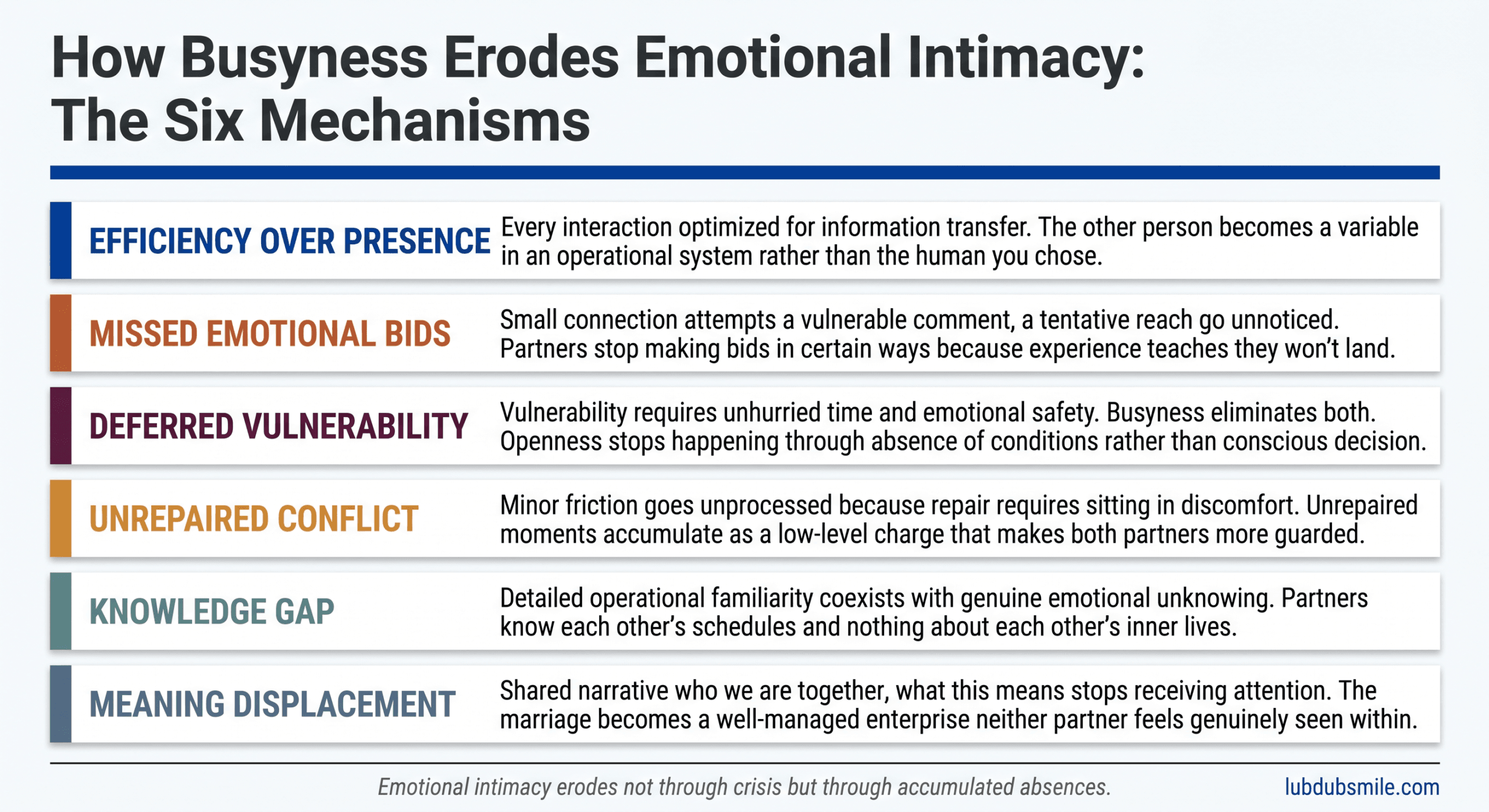
Efficiency is the enemy of emotional intimacy in marriage. Not because it’s bad, but because intimacy operates on a different timeline and requires a different quality of attention than efficiency allows. When your only mental mode is task-completion, conversations get compressed, feelings get routed around, and the other person in the room becomes a variable in your operational system rather than the human you chose.
When You Know Each Other’s Schedules but Not Each Other’s Inner Lives
You can recite your partner’s week from memory and you know which meetings are stressful, which client is difficult, which project is at risk. You know nothing about what your partner is questioning about themselves right now, what’s exciting them, what they’re privately afraid of. This is the specific knowledge gap that chronic busyness creates detailed operational familiarity coexisting with genuine emotional unknowing. Emotional intimacy in marriage requires the second kind of knowledge, not the first.
When Vulnerability Requires Time You’ve Stopped Making
Vulnerability can’t fit into a fifteen-minute window between the kids’ bedtime and your next email. It emerges when conditions are right when both people are unhurried, when the space feels safe, when there’s nowhere else either person needs to be. Chronic busyness eliminates these conditions. Vulnerability stops happening not through conscious decision but through the gradual disappearance of its prerequisites.
When Emotional Bids Are Missed Because One Partner Is Always Elsewhere
Your partner says something that’s an opening a small vulnerability, a tentative connection-seeking and you’re already thinking about tomorrow’s meeting. You respond functionally. The bid goes unrecognized. This happens once, twenty times, two hundred times. Your partner stops making bids in certain ways because experience has taught them they won’t land. The relational repertoire quietly contracts, and emotional intimacy in marriage narrows with it.
When Conflict Goes Unrepaired Because Repair Requires Presence
A minor conflict happens Tuesday. You’re both busy. You move forward without explicitly repairing because there isn’t time, and it wasn’t that bad. Another one happens Thursday. Same. The relationship accumulates a low-level charge of unprocessed friction that neither partner can quite name. Both become slightly more guarded. Vulnerability decreases. Distance increases.
Healthy conflict patterns in marriage require the kind of repair that chronic busyness most often prevents making the conflict pattern and the busyness pattern mutually reinforcing drivers of intimacy erosion.
When Your Shared Identity Is Logistics, Not Meaning
At some point, “us” stops meaning anything beyond the operational system you run together. There’s no shared story actively unfolding, no ongoing conversation about what you’re building or why it matters. The marriage has become a well-managed enterprise that both partners serve without either partner feeling genuinely seen within it. Emotional intimacy in marriage requires a shared narrative, not just a shared calendar.
Emotional Intimacy in Marriage: The High-Achieving Couple’s Specific Dynamics
When Both Partners’ Professional Identities Compete for Central Position
In dual-career marriages, both partners have strong professional identities that require significant resources attention, time, emotional bandwidth, status within the relationship. When both activate simultaneously, the relationship becomes the context in which two professional selves operate rather than the thing that both selves are actively building. Emotional intimacy in marriage gets squeezed into whatever space the professional identities leave, which is often insufficient.
When Achievement Orientation Enters the Relationship Itself
High achievers can inadvertently bring achievement orientation into the relationship measuring, optimizing, evaluating. Is this marriage performing at the level it should? Are we doing enough reconnection activities? Did that date night produce the outcome expected? This analytical frame is genuinely counterproductive for emotional intimacy in marriage, which requires presence and acceptance rather than performance and evaluation.
The Mental Load Imbalance That Busyness Conceals
Chronic busyness frequently conceals significant mental load imbalance one partner carrying disproportionate cognitive and emotional weight for the family’s operational management. This imbalance affects emotional intimacy in marriage directly: the partner carrying more load has less emotional availability, and frequently harbors resentment that poisons the connection they do have. Busyness makes this imbalance harder to see and easier to avoid addressing.
When Busyness Becomes Mutual Avoidance (Without Either Partner Naming It)
This is the harder truth some couples eventually recognize: the busyness isn’t only external. At some point, the schedules and demands become, partially, a mutual agreement to avoid the discomfort of genuine intimacy the vulnerability, the unresolved tensions, the questions about whether you’re still deeply known by each other. Neither partner names this. Neither partner may consciously recognize it. But the busyness serves a function beyond its practical necessity.
The busyness-as-avoidance dynamic described in this section deserves more candor than it typically receives in couples literature. Most relationship guides treat busyness as purely external, a circumstantial obstacle to be managed with better scheduling. The more uncomfortable truth, one that research on couples communication and attachment behavior consistently supports, is that sustained relational distance often reflects an implicit mutual agreement. Neither partner has consciously chosen distance. But both partners have, repeatedly and understandably, chosen the thing that didn’t require them to sit with vulnerability, uncertainty, or the possibility that the conversation they’re avoiding might reveal something they’re not ready to address. That is not a moral failure. It is an attachment response. Naming it as such shifts the question from “why are we so busy” to “what are we protecting ourselves from,” which is the more useful question for any couple serious about rebuilding genuine emotional intimacy in marriage.
The Competence Trap: Efficient at Everything Except Emotional Presence
High achievers are competent across demanding domains. Emotional presence doesn’t respond to competence it responds to availability, which is precisely what competence-oriented people struggle to offer. The partner who executes brilliantly in every professional context and manages the household efficiently may be genuinely limited in the slower, less goal-directed mode that emotional intimacy in marriage requires. This isn’t a character failure it’s a skill gap that the professional environment never required addressing.
Emotional maturity in long-term marriage specifically addresses how high achievers can develop the emotional capacities that professional success doesn’t cultivate the ones that emotional intimacy in marriage actually requires.
When Children’s Schedules Consume All Available Relational Space
Children, particularly in the intensive parenting years, create genuine time scarcity. But the specific dynamic in high-achieving families often goes further: children’s activities, development, and wellbeing become the shared project that organizes all relational energy, and the couple’s relationship drops from priority to assumption. The marriage becomes the stable foundation on which intensive parenting builds, rather than something that receives investment in its own right. Foundations, tended indefinitely without maintenance, eventually develop cracks.
Recognizing the Pattern in Your Own Marriage
Signs That Emotional Intimacy in Marriage Has Been Eroding
Not all of these apply to every couple experiencing this pattern, but several may be recognizable:
- Conversations that consistently stay at the logistical surface
- Decreased interest in each other’s inner experiences
- Physical intimacy that functions but lacks emotional connection
- Increased irritability or sensitivity to small things
- A sense of loneliness that feels strange to name given that you’re married
- Emotional openness with friends or colleagues that isn’t present at home
- Difficulty remembering the last time you asked your partner a question you genuinely didn’t know the answer to
- A vague sense that you know your partner’s schedule better than their inner world
The Conversations You’re Not Having
The clearest indicator is often negative space what you’re not discussing. The questions you haven’t asked. The things happening in your inner life that your partner doesn’t know about. The concerns about the relationship itself that you’ve thought but haven’t raised because there hasn’t been a right moment, or because you’re not sure how it would land, or because you’re too tired to manage the conversation that would follow. These absences define the current state of emotional intimacy in marriage more accurately than what is present.
When You Can’t Remember the Last Time You Were Genuinely Curious About Your Partner
Not when you last asked about logistics. When you last asked a question you genuinely didn’t know the answer to about what they’re thinking, feeling, questioning, or hoping for. The absence of this curiosity is one of the quieter signals that emotional intimacy in marriage has eroded significantly.
The Irritability That’s Actually Loneliness
A specific pattern worth naming: increased irritability toward a partner disproportionate frustration with small things, reduced tolerance for their ordinary imperfections that is, underneath, unexpressed loneliness. The emotional need for connection, unmet and unacknowledged, surfaces as friction. Recognizing this reframes both the irritability and its source, and points toward emotional intimacy in marriage as the actual need rather than behavior change as the solution.

When You’re More Emotionally Open With Colleagues or Friends Than Your Spouse
This is worth sitting with honestly. If your most genuine emotional exchange today happened with a work colleague, a friend, or even an assistant, rather than with your spouse not because anything is wrong with those relationships, but because the conditions for it don’t currently exist at home that’s information about where emotional intimacy in marriage is actually living in your life.
Distinguishing Normal Busy-Phase Distance from Entrenched Pattern
Some distance during genuinely demanding life phases is normal new babies, health crises, intense professional periods create temporary contraction. The question is whether the contraction has become structural rather than temporary. If the demanding phase has ended but the distance remained, or if you can’t remember a recent period when it was different, the pattern has likely moved from situational to entrenched. The long-term arc that aging as a couple describes shows that emotional intimacy in marriage is something long-term couples actively build rather than passively maintain.
The Busyness Audit: Examining What You’re Actually Choosing
Necessary vs. Self-Perpetuating Busyness
Some busyness is genuinely non-negotiable. Some is self-perpetuating sustained by habit, identity, avoidance of slower moments, or the belief that slowing down would be irresponsible. Distinguishing between these categories requires honest examination. Which commitments would actually collapse if they received less? Which sustain because they’re necessary, and which because busyness is comfortable? Emotional intimacy in marriage competes with both kinds of busyness, but the self-perpetuating kind is where change is most available.
When Busyness Protects You from Intimacy (The Avoidance Function)
For some couples, honest examination reveals that busyness serves a protective function keeping both partners at a distance from conversations that feel risky, from vulnerability that feels unsafe, from questions about the relationship that neither is certain they want answered. This isn’t a moral failure; it’s a human response to perceived threat. But naming it honestly is necessary before anything can change. Emotional intimacy in marriage requires walking toward those conversations rather than around them.
What “Too Busy for Our Marriage” Actually Prioritizes
This question is worth sitting with without defensiveness: the marriage isn’t failing to receive investment because there’s no time. It’s receiving less investment than other priorities. That’s a choice often an understandable one, sometimes a necessary one, always worth being honest about rather than attributing entirely to external circumstances. Emotional intimacy in marriage doesn’t improve through circumstances; it improves through choices.
Whose Busyness Gets Protected and Whose Gets Sacrificed
In many dual-career marriages, one partner’s busyness is treated as more structurally immovable than the other’s. Career demands, scheduling, availability for family needs these often distribute unevenly in ways that both partners sense but haven’t explicitly examined. Whose professional time is protected first when scheduling conflicts arise? Whose social commitments drop when something has to give? The answers reveal implicit power dynamics worth naming, and often reveal the structural conditions that prevent emotional intimacy in marriage from receiving equitable investment.
The Honest Question: What Would Have to Change?
Not theoretically. Specifically. What would actually have to change in schedule, in commitments, in how each partner understands their role for the marriage to receive adequate investment? For many high achievers, engaging honestly with this question surfaces the real obstacle: not time management, but priority ranking and identity investment in busyness itself.
Rebuilding Emotional Intimacy in Marriage Within Real Constraints
Emotional Intimacy Exercises for Couples: Where to Start
Rebuilding emotional intimacy in marriage doesn’t require dramatic schedule restructuring it requires changing the quality of presence in the time that already exists. Emotional intimacy exercises for couples don’t need to be elaborate: a daily check-in question asked with genuine interest, a weekly protected conversation that explicitly excludes logistics, a ritual of turning toward rather than away when a partner makes a bid.
The most effective emotional intimacy exercises for couples share one characteristic: they are small enough to be consistent. Attachment research consistently shows that emotional intimacy in marriage builds through small, consistent moments of genuine connection not occasional large investments. Ten minutes of genuine, unhurried attention most evenings outperforms a weekend retreat that both partners approach while still depleted.
How Long Does It Take to Rebuild Emotional Intimacy in Marriage?
This is one of the most common questions couples ask and one of the most honest to answer. Meaningful shifts in emotional intimacy in marriage typically become noticeable within four to six weeks of consistent practice: daily bids acknowledged, protected conversations maintained, genuine curiosity expressed regularly. Full recalibration where emotional intimacy in marriage feels stable and mutual typically takes several months of consistent effort. For patterns entrenched over years, professional support with a couples therapist often accelerates the process significantly. The variable isn’t the timeline; it’s whether both partners are genuinely engaged, consistently, over time.
Turning Toward Rather Than Away: The Daily Practice
Gottman’s research on emotional bids suggests that turning toward noticing and responding to small connection bids is among the most powerful predictors of relationship satisfaction over time. A partner who shares something about their day is making a bid. A partner who notices something and comments on it is making a bid. Responding genuinely, attentively, even briefly is the practice. Missing it, consistently, is the pattern that erodes emotional intimacy in marriage.
Couple communication that heals offers specific frameworks for this kind of turning-toward practice the daily conversation habits that sustain emotional intimacy in marriage without requiring schedule restructuring.
Protected Conversations That Aren’t About Logistics

A specific structural commitment: conversations with your partner that carry an explicit agreement not to include logistics. Not what needs to happen this week. Not the kids’ schedules or the renovation or the performance review. What are you thinking about? What’s exciting or worrying you? What are you noticing about yourself? Even twenty minutes of this kind of exchange, consistently, recalibrates the relational register and actively rebuilds emotional intimacy in marriage.
Curiosity as Intimacy Practice
Treating genuine curiosity about your partner as a practice something you actually do rather than assume you feel can reopen emotional intimacy in marriage that has narrowed. Specific, open questions asked with actual interest: “What’s been the hardest part of this week for you not logistically, but personally?” “Is there something you’ve been thinking about that you haven’t had a chance to say yet?” These questions signal that the inner world matters, which is itself a form of intimacy.
Creating Transition Rituals Between Work and Home
A specific and practical intervention: creating a brief but intentional transition between professional mode and relational mode. This might be a short walk, a few minutes of decompression alone before engaging with family, or a brief check-in ritual with a partner not a logistics exchange, but a genuine “how are you” with space for a real answer. The goal is arriving home present rather than simply relocating. Presence is the prerequisite for emotional intimacy in marriage; the transition ritual creates it.
The Check-In That Takes Ten Minutes and Changes Everything
A check-in that many couples therapists recommend: partners ask each other, with genuine attention, two or three open questions each evening or several times weekly. Not “how was your day” a question that invites a summary. Something more specific: “What was the moment today that you most needed someone?” or “What’s on your mind that isn’t on the calendar?” The structure is simple; the consistency is what restores emotional intimacy in marriage.
Rebuilding Emotional Intimacy in Marriage: The Conversation You Need to Have
Naming the Distance Without Blame
Starting from your own experience rather than your partner’s behavior: “I’ve been feeling more distant from you lately, and I don’t think it’s either of our faults I think we’ve both been in a kind of survival mode that’s cost us something important.” This frames the distance as a shared condition rather than something one partner has done or failed to do. Framing emotional intimacy in marriage as a shared project rather than an individual failure changes what kind of conversation becomes possible.
Sharing Your Experience Without Making It an Accusation
The difference between “I miss feeling close to you” and “you’re never present anymore” is enormous not just in how it lands, but in what it invites. The first opens a shared problem. The second opens a defense. High achievers are often more comfortable with the direct assessment than with the vulnerable disclosure but the vulnerable disclosure is what makes genuine conversation about emotional intimacy in marriage possible.
Why honest talk is hard in marriage addresses the specific dynamics that make these conversations difficult and what makes them possible despite the difficulty.
What You Need vs. What’s Wrong With Them
Leading with what you need rather than what your partner is failing to provide changes the conversation’s entire dynamic. “I need more time when we’re genuinely just talking not planning anything, just connecting” is a request. “You’re always distracted and never fully present” is an indictment. The request can receive a response; the indictment produces defense. Emotional intimacy in marriage rebuilds through requests, not indictments.
When One Partner Recognizes the Pattern and the Other Doesn’t
This is common and genuinely difficult. One partner has named the distance; the other experiences the marriage as basically fine. This discrepancy doesn’t necessarily mean one partner is right and the other is in denial it may mean they experience and need emotional intimacy in marriage differently. What matters is that the partner experiencing distance has their experience taken seriously, not debated.
Making the Conversation About “Us” Not “You”
Framing the conversation as a shared challenge rather than an assessment of one partner’s performance keeps both people in collaborative mode rather than defensive mode. “I think we’ve both let the relationship slide into management mode what do you think is driving that?” invites shared analysis. The high achiever’s analytical capacity, directed at the relationship rather than the partner, becomes an asset for rebuilding emotional intimacy in marriage.
When to Seek Professional Support

When the Distance Feels Too Entrenched for Self-Guided Reconnection
When both partners recognize the pattern, want to change it, and haven’t been able to or when one partner’s recognition isn’t shared by the other couples therapy provides structure, shared language, and professional facilitation that self-directed effort alone often cannot produce. The entrenched pattern typically has roots that conversation guides and reconnection practices don’t reach. Emotional intimacy in marriage that has eroded over years often requires professional support to restore.
When Busyness May Be Masking Deeper Relationship Concerns
Sometimes what presents as busyness-driven distance is also masking or amplifying other relationship dynamics: unprocessed conflict, fundamental values misalignment, trust erosion, or attachment injuries that predate the current busy phase. A skilled couples therapist can help distinguish what’s driving the distance and address the actual sources rather than only the surface pattern.
What Good Couples Therapy Addresses for High-Achieving Pairs
Evidence-based couples therapy including Gottman Method and Emotionally Focused Therapy addresses the specific patterns most relevant here: emotional attunement, bid-turning, repair cycles, intimacy-building practices, and the underlying attachment dynamics that affect how partners connect and disconnect. The American Association for Marriage and Family Therapy maintains resources and referral tools for finding therapists specializing in couples work. For high-achieving couples specifically, skilled therapists can work within the intellectual frameworks these clients respond to while addressing the emotional dimensions that emotional intimacy in marriage requires.
Framing Therapy as Relationship Investment, Not Relationship Failure
High achievers invest seriously in what they value: professional development, physical performance, financial growth. A marriage that generates genuine mutual support, emotional intimacy, and meaningful partnership is among the highest-return investments available. Approaching couples therapy with the same intentionality applied to other significant investments rather than as admission of failure tends to produce better engagement and better outcomes. Exploring therapy options can help identify practitioners with scheduling flexibility suited to demanding professional lives.
Frequently Asked Questions
How do you rebuild emotional intimacy in marriage?
Rebuilding emotional intimacy in marriage starts with consistency in small moments rather than occasional grand gestures. Turn toward your partner’s emotional bids daily even briefly. Protect at least one conversation per week that explicitly excludes logistics. Ask specific, open questions that invite inner-life disclosure rather than schedule summaries. Notice and name the distance without blame. If self-directed efforts haven’t produced meaningful change after several weeks of genuine consistency, couples therapy provides the structure and professional facilitation that accelerates recovery of emotional intimacy in marriage.
What causes loss of emotional intimacy in marriage?
Loss of emotional intimacy in marriage most often traces to accumulated absences rather than dramatic events: conversations that consistently stay logistical, emotional bids that go unnoticed because one or both partners operate with divided attention, vulnerability that has nowhere to land because there’s never unhurried time, and repair after conflict that keeps deferring until disconnection feels normal. High-achieving couples are specifically vulnerable because achievement orientation efficiency, optimization, performance rewards precisely the habits that undermine emotional intimacy in marriage.
How do we reconnect when we’re both genuinely exhausted?
Start smaller than feels meaningful. Exhaustion makes grand reconnection gestures impossible and often unnecessary. Five minutes of genuine, unhurried attention is more valuable than a weekend away that both partners approach while still depleted. The entry point is not restoring everything at once; it’s restoring the habit of turning toward, which accumulates. Emotional intimacy in marriage rebuilds through small, consistent moments more reliably than through large intermittent investments.
What if only one of us thinks this is a problem?
This discrepancy is itself important information. One partner’s experience of significant distance deserves serious attention, even if the other partner experiences the marriage as functional. It’s worth exploring genuinely, without defensiveness why partners are experiencing the same relationship so differently, and what each partner actually needs. If direct conversation produces only defense, couples therapy can create the conditions for this exploration.
Is some level of distance normal in long-term marriages?
Yes. Long-term marriages move through phases of greater and lesser closeness, and some contraction during demanding life periods is normal rather than concerning. The question is whether the distance is temporary and contextual or has become structural and sustained and whether both partners feel the relationship retains its foundation of genuine caring and respect. Emotional intimacy in marriage ebbs and flows; the concern is when ebbing becomes the permanent state.
What are signs of lack of emotional intimacy in marriage?
The most recognizable signs of reduced emotional intimacy in marriage include: conversations that consistently stay at the logistical surface; a sense of knowing your partner’s schedule better than their inner world; physical intimacy that functions but feels emotionally disconnected; increased irritability that, underneath, is unexpressed loneliness; greater emotional openness with colleagues or friends than with your spouse; and difficulty remembering the last time you felt genuinely curious about your partner rather than informed about their calendar.
How much connection is “enough”?
There’s no universal answer, and comparison with other couples is less useful than understanding what you and your partner actually experience and need. The more useful question: does each partner feel genuinely known, valued, and emotionally present to the other on a regular basis? If the honest answer is no for either partner, “enough” hasn’t been reached regardless of the hours spent together. Emotional intimacy in marriage is about quality of presence, not quantity of time.
The Partnership Deserves What Everything Else Gets
What You’re Actually Optimizing For
At some point in a quiet moment, which may be rare the question worth sitting with is: what is all of this for? The professional success, the efficient household, the well-managed life. If the relationship at the center of it is quietly hollowing out, the optimization is producing diminishing returns on its most important output. Emotional intimacy in marriage isn’t a soft variable it’s the foundation that makes everything else feel meaningful rather than hollow.
The Return on Relational Investment
What sustained emotional intimacy in marriage actually produces: a partner who genuinely knows you and whom you genuinely know. A relationship that provides the kind of support that external success cannot. A foundation that makes the inevitable harder phases health challenges, career reversals, loss navigable rather than isolating. The return is real and compounding. It just doesn’t appear on the metrics most high achievers are measuring.
Resources That May Help
The Seven Principles for Making Marriage Work by John Gottman offers research-grounded frameworks for intimacy maintenance that apply directly to the patterns this article describes. Hold Me Tight by Sue Johnson addresses the emotional attunement and attachment dimensions of intimacy erosion. The New Rules of Marriage by Terrence Real engages specifically with high-achieving couple dynamics and emotional intimacy in marriage.
Takeaway Summary
Emotional intimacy in marriage erodes not through crisis but through accumulated absences conversations that stayed logistical, bids that went unnoticed, vulnerabilities that had nowhere to land, and repair that kept deferring until distance felt normal and rebuilding it requires honest recognition of what the marriage currently receives, genuine curiosity about your partner’s inner life, and consistent small investments in presence rather than occasional grand gestures.
This content provides frameworks for understanding intimacy erosion in high-achieving marriages and is not a substitute for professional couples therapy. If emotional distance feels significant or connects to deeper relationship concerns, support from a licensed couples therapist can provide personalized assessment and guidance.
This content is for educational purposes and does not substitute for professional psychological or therapeutic help.