

Concierge Medicine vs. Traditional Primary Care: Is the Annual Fee Worth It for High Earners?
Concierge medicine vs. traditional primary care is a question more high earners are asking seriously and for good reason. Your primary care physician has a three-week wait for non-urgent appointments, fifteen-minute slots that rarely feel sufficient, and a panel of 2,000 or more patients who compete for the same access. You carry good insurance, reasonable health, and an increasingly clear sense that the math between what you’re paying in premiums and what you’re actually receiving in primary care relationship quality doesn’t add up.
Concierge medicine promises to fix that equation for a fee. Annual memberships typically range from $2,000 to $50,000 or more depending on the program, and the pitch is compelling: same-day appointments, direct physician access by phone or text, unhurried visits, thorough health assessments, and a doctor who actually knows your name, your history, and your health goals.
But is it genuinely worth it? That depends on questions more specific than your income bracket. This article provides an honest analytical framework not a pitch for evaluating whether concierge medicine vs. traditional primary care makes sense for your specific circumstances, what the evidence actually supports, where the marketing outpaces the science, and what alternatives deserve consideration before you commit to a significant annual fee.
What Concierge Medicine Actually Is (Beyond the Marketing)
Defining the Models
The term “concierge medicine” describes several distinct healthcare models that differ meaningfully in what they provide and how they structure services.
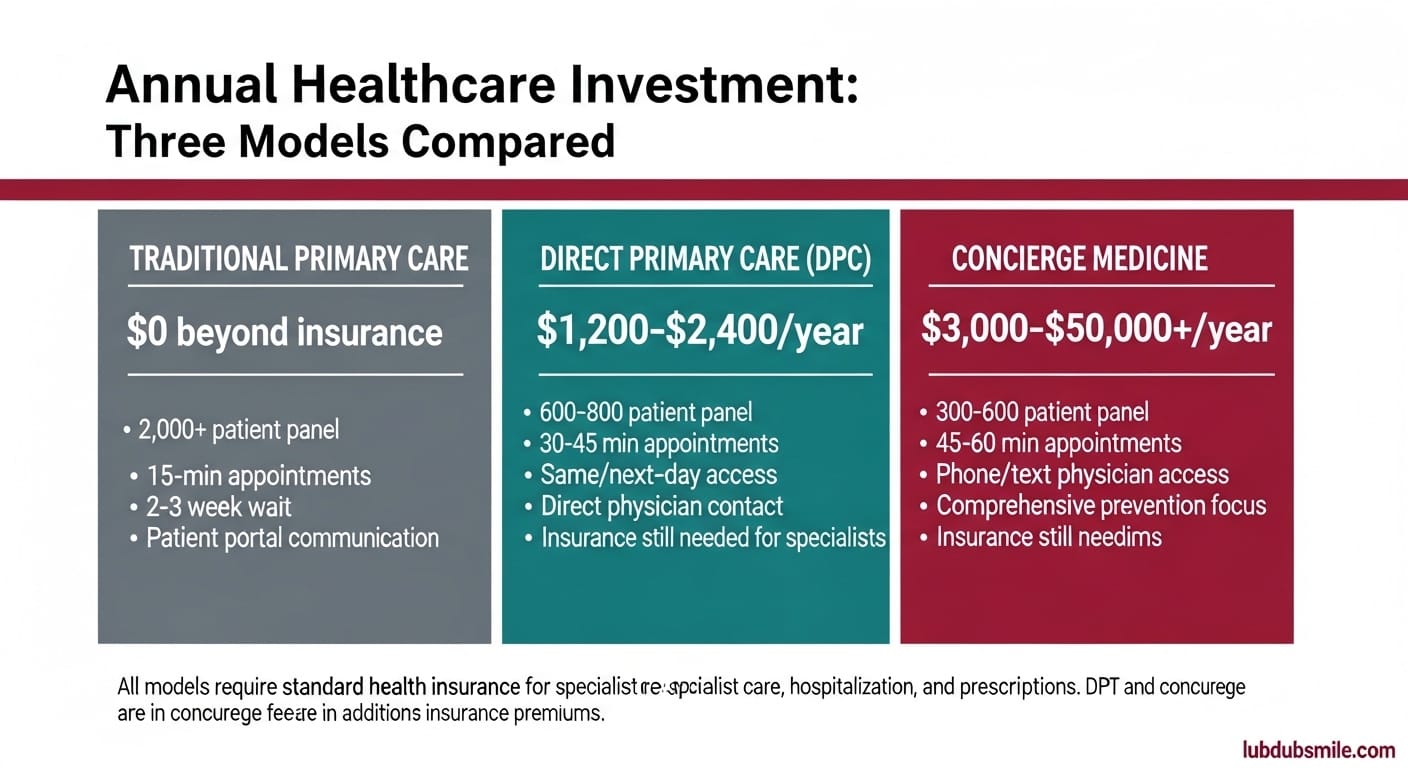
Traditional concierge medicine involves paying an annual retainer fee directly to a physician practice, which dramatically reduces the physician’s patient panel typically from 2,000+ patients in traditional primary care to 300–600 patients. In exchange, members receive better access, longer appointments, direct communication, and more thorough health services that focus on prevention. These practices still bill insurance for clinical services; the retainer pays for access and relationship, not medical care itself.
Direct Primary Care (DPC) is a related but distinct model where patients pay a monthly membership fee (typically $50–$200 per month) that covers most primary care services directly, without billing insurance for those services. DPC practices don’t bill insurance at all, typically maintain smaller panels, and provide direct access similar to concierge medicine at significantly lower cost. DPC combined with a high-deductible insurance plan for catastrophic coverage represents a legitimate alternative worth examining in any concierge medicine vs. traditional comparison.
Executive health programs at institutions like Mayo Clinic, Cleveland Clinic, or Johns Hopkins represent yet another category annual physical programs lasting one to two days, providing thorough evaluation and specialist review. These are one-time or annual assessments rather than ongoing primary care relationships, typically ranging from $3,000 to $10,000+ per visit.
Understanding which model you’re actually evaluating matters enormously, as the value propositions, costs, and appropriate use cases differ significantly across these options.
What the Annual Fee Actually Buys
In a traditional concierge practice, the annual retainer typically purchases:
- Access: Same-day or next-day appointments, often with your specific physician rather than a nurse practitioner or physician assistant
- Time: Appointments of 30–60 minutes rather than the standard 15-minute slot
- Direct communication: Personal phone, text, or email access to your physician, including after-hours for genuine concerns
- Prevention focus: More thorough annual assessments, proactive health management, and coordination of age-appropriate screenings
- Coordination: Active management of specialist referrals, test results, and communication between your various providers
- Continuity: A physician who knows your history thoroughly rather than reviewing your chart for three minutes before you enter the room
What the fee does not typically purchase: specialist visits, hospitalizations, testing that identifies conditions, prescription medications, or emergency care. Regular health insurance remains necessary alongside any concierge membership for full coverage.
What Concierge Medicine Is Not
Concierge medicine is not a substitute for insurance. It is not a guarantee of better clinical outcomes. It is not a replacement for the specialist relationships that many patients with complex conditions depend on most. The industry lacks standardization the quality, depth, and genuine value of concierge practices vary enormously. Evaluating concierge medicine vs. traditional primary care requires recognizing these distinctions clearly before making any decision.
What Traditional Primary Care Provides (Honestly Assessed)

Where Traditional Primary Care Genuinely Falls Short
Intellectual honesty requires acknowledging what traditional primary care often fails to deliver in the current healthcare environment.
Primary care physicians in traditional practices typically carry patient panels of 1,500–2,500 people, see 20–25 patients daily, and work within 15-minute appointment windows that make thorough health conversations structurally impossible. Research JAMA Internal Medicine published found that primary care physicians would need approximately 27 hours per day to provide all the care guidelines recommend for prevention, chronic disease, and acute concerns across a standard patient panel an obvious impossibility that explains why something routinely gives way.
What gives way is typically time, depth, and the kind of longitudinal relationship where your physician notices that your energy has declined over eighteen months, your sleep has worsened, and your stress has increased and connects those observations into a meaningful clinical picture. That kind of care requires knowing you, and knowing you requires time that panel sizes don’t allow.
Wait times for non-urgent appointments averaging two to three weeks in many markets create another genuine problem: by the time you see your physician, the concern has either resolved or worsened. The practical result for many patients is emergency room use for issues that attentive primary care would have managed, or simply neglecting concerns that don’t feel urgent enough to pursue through weeks of administrative friction.
Where Traditional Primary Care Performs Well
Honest assessment requires acknowledging the other side equally. When traditional primary care works well when a patient has a relationship with an internist or family physician who pays close attention, has adequate time, and brings genuine clinical depth the care quality does not fall short of concierge medicine.
The clinical skills that excellent primary care requires don’t change with panel size. A physician who has mastered primary care, knows your history, manages your conditions thoughtfully, and coordinates your care effectively practices excellent medicine. Evidence does not support the claim that concierge medicine produces inherently superior clinical decision-making or medical judgment.
The problems with traditional primary care are structural and systemic payment models that fall short and force high volume, appointment lengths that don’t allow depth, administrative burden not clinical. This distinction matters in any concierge medicine vs. traditional comparison because it means the concierge premium purchases structural advantages (time, access, relationship depth) rather than superior medical knowledge.
For many high earners with good insurance and crucially good access to an engaged primary care physician they see consistently, the honest assessment may be that their current care is adequate and the concierge premium doesn’t solve a problem they actually have.
The Actual Differences: Access, Service, and Time
Physician Panel Size and What It Means in Concierge Medicine vs. Traditional Care
The most concrete difference in any concierge medicine vs. traditional comparison is panel size. When a physician carries 300–600 patients instead of 2,000+, the mathematical implications are significant:
- Same-day or next-day appointments become structurally possible rather than exceptional
- Appointment slots can run 45–60 minutes rather than 15 minutes
- The physician has capacity to review your history before you arrive
- Follow-up and care coordination can happen proactively rather than reactively
- Direct communication becomes sustainable rather than impossible
For time-conscious high earners, this access difference has genuine financial value. If you earn $400–$500 per hour and a concierge practice eliminates four to six hours of annual healthcare friction scheduling delays, waiting room time, rushed appointments requiring follow-up visits the $4,000–$6,000 annual fee breaks approximately even before any health value enters the calculation.
Direct Physician Communication
The ability to text or call your physician directly for genuine questions not a nurse line, not a patient portal with a 48-hour response window, not a system that routes around physician time carries meaningful value in ways that don’t always show up in formal outcome data.

Patients with direct physician access ask questions they wouldn’t otherwise ask. They flag concerning symptoms earlier. They get medication questions answered in hours rather than days. For people managing complex health situations, travel schedules, or family health emergencies, this access has practical value that’s difficult to quantify but real. This represents one of the most compelling practical arguments in concierge medicine vs. traditional comparisons.
Thorough Health Assessment That Focuses on Prevention
Concierge practices typically conduct more thorough annual assessments than traditional primary care can afford time for: extended health history reviews, laboratory panels that cover a wide range of markers, discussion of screenings that suit your age and risk factors, cardiovascular risk assessment, and genuine conversation about health goals, lifestyle factors, and long-term planning.
For high earners in their 40s and 50s approaching the decades where this kind of investment pays the highest dividends, this depth of engagement may represent the clearest clinical value in the concierge medicine vs. traditional primary care distinction. Understanding which preventive health screenings matter by age can help you assess whether your current care adequately addresses these priorities.
What the Evidence Actually Shows About Outcomes
What Studies Document: Access and Satisfaction
Research on concierge medicine covers a growing but still narrow scope and short duration compared to traditional care research. What studies consistently document is what you’d expect given the structural differences: concierge medicine patients experience significantly better access, shorter wait times, longer appointments, and higher satisfaction with their healthcare relationships.
Research the Annals of Internal Medicine published found that concierge physicians spent significantly more time with patients, conducted more thorough discussions aimed at prevention, and reported substantially higher professional satisfaction than their traditional primary care counterparts. Physician satisfaction in concierge models is consistently higher concierge physicians report greater ability to practice thorough, relationship-based medicine, lower burnout rates, and more professional fulfillment.
Whether physician satisfaction translates to better patient outcomes is plausible but researchers have not definitively established this connection in current literature. That gap is important to understand when evaluating concierge medicine vs. traditional primary care.
Where Evidence Falls Short: Long-Term Health Outcomes
Here the honest assessment diverges from much concierge medicine marketing. Evidence that concierge medicine produces measurably better long-term health outcomes lower rates of serious illness, longer lifespan, fewer hospitalizations researchers have not robustly established.
This is partly a research methodology challenge. Patients who choose concierge medicine differ systematically from those who don’t: they tend to be wealthier, more focused on their health, more educated, and already more engaged with care that aims at prevention. Separating the effect of concierge medicine from these characteristics in outcome studies is genuinely difficult.
Long time horizons compound the challenge. The benefits of care that focuses on prevention often take decades to manifest in outcome data, and concierge medicine hasn’t existed at scale long enough for definitive research.
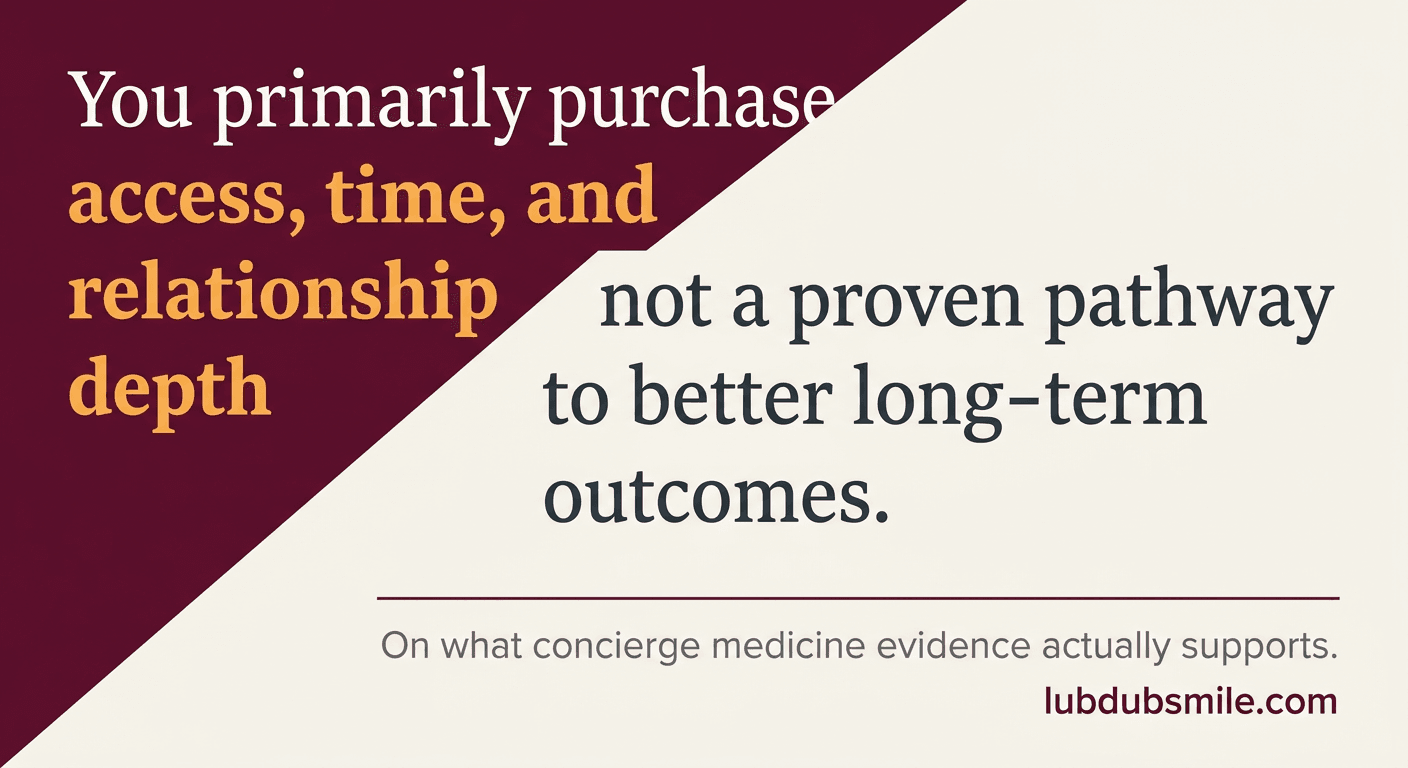
The honest framing in any concierge medicine vs. traditional comparison is this: you primarily purchase access, time, relationship depth, and engagement that focuses on prevention not a proven pathway to meaningfully better long-term health outcomes. The access advantages may produce better outcomes over time, and the logic is plausible, but approach marketing that presents superior outcomes as fact that research has confirmed with appropriate skepticism.
Cost Analysis: What Are You Actually Paying?
The Full Cost Picture in Concierge Medicine vs. Traditional Care
Concierge medicine fees range dramatically. Basic direct primary care practices may charge $100–$200 monthly ($1,200–$2,400 annually). Mid-tier concierge practices typically range from $3,000–$10,000 annually. Health programs at premium institutions that cover many areas may cost $15,000–$50,000 or more.
These fees come in addition to not instead of regular health insurance premiums, which remain necessary for specialist care, hospitalizations, testing that identifies conditions, and prescription coverage. The true annual cost is your existing insurance costs plus the concierge fee, which changes the ROI calculation significantly.
If you currently pay $18,000 annually in family health insurance premiums, adding a $6,000 concierge fee brings your total healthcare investment to $24,000 annually. For someone earning $500,000 annually, that’s less than 5% of income for full healthcare access. For someone earning $200,000, it’s a more meaningful 12%. These are different decisions.
Direct Primary Care as an Alternative
Before committing to premium concierge fees, DPC deserves genuine consideration in any concierge medicine vs. traditional evaluation. Monthly fees of $75–$150 for an individual provide panel sizes, access, and physician relationships similar to concierge medicine, often without the premium pricing.
The American Academy of Family Physicians documents that DPC practices typically maintain panels of 600–800 patients compared to 2,000+ in traditional practices, delivering access improvements similar to concierge medicine at a fraction of the cost. The DPC plus high-deductible insurance model paying for primary care directly while maintaining catastrophic coverage can deliver most of the access benefits of concierge medicine at significantly lower total cost.
For high earners whose primary frustration is primary care access rather than thorough executive health services, DPC is worth seriously evaluating before assuming concierge medicine is the right solution.
Tax and Financial Considerations
Concierge medicine fee deductibility is genuinely complex and varies by situation. Whether fees qualify as medical expense deductions depends on how the practice structures its fees (access fees vs. services), whether you itemize deductions, the 7.5% AGI threshold for medical expense deductions, and your specific tax situation. HSA eligibility for concierge fees similarly depends on practice structure some qualify, some don’t.
The financial implications require consultation with a qualified tax professional who understands your specific situation. Do not make financial decisions about concierge medicine vs. traditional primary care based on general claims about deductibility the rules are nuanced, variable, and consequential enough to warrant professional guidance.
Executive Health Programs: A Brief Note
Annual physicals at institutions like Mayo Clinic or Cleveland Clinic serve a different purpose than ongoing concierge membership. These one-to-two day programs provide exceptional depth in identifying conditions, specialist review, and thorough health assessment that even strong concierge practices may not replicate. They’re not ongoing primary care relationships they’re annual investments in thorough evaluation, typically ranging from $3,000–$10,000+.
For some high earners, the right answer may be maintaining quality traditional primary care (or DPC) for ongoing needs while investing in an annual thorough executive physical for depth and specialist access. This hybrid approach may deliver more value than premium ongoing concierge membership for people whose primary need is thorough annual assessment rather than frequent primary care access. Understanding healthy aging priorities in your 40s can help clarify what your specific needs actually are.
When Concierge Medicine Makes Sense
Rather than prescribing who should join concierge practices, honest analysis identifies the circumstances where the value proposition is strongest in concierge medicine vs. traditional primary care.
High time value combined with genuine access problems
If your primary care experience involves chronic wait times, rushed appointments, and difficulty reaching your physician when needed and your time carries significant financial value the access premium has ROI you can calculate. Run the math honestly: how many hours annually does healthcare friction cost you, and what is that time worth?
Complex medical history requiring active coordination
Patients managing multiple conditions, seeing several specialists, or navigating ongoing health complexity benefit substantially from a physician who has time to actively coordinate their care, review all incoming information, and maintain a thorough clinical picture across providers. This represents one of the strongest arguments for concierge medicine vs. traditional primary care.
Midlife prioritization of care that focuses on prevention
Adults in their mid-40s to late-50s building serious approaches to health managing cardiovascular risk, monitoring metabolic health, making informed decisions about age-appropriate screenings benefit from the depth of engagement that concierge medicine enables more readily than traditional primary care allows. The connection between midlife health investment and long-term cellular outcomes, explored in our cellular health after 40 overview, reinforces why this life stage matters for these decisions.
Geographic location with poor primary care access
In markets where quality primary care physicians have two-to-four week wait times, few open appointments, and high patient loads, the concierge premium may be the only way to have an actual primary care relationship rather than a transactional one.
Frequent international travel or complex logistics
The ability to reach a physician directly regardless of time zone, receive documentation quickly for international medical situations, and maintain care continuity across complex scheduling has genuine value for certain professional situations.
When Concierge Medicine Probably Isn’t Worth It
Intellectual honesty requires equal emphasis on circumstances where the premium isn’t justified in concierge medicine vs. traditional comparisons.
You have excellent existing primary care access. If you have a trusted internist or family physician you see consistently, who knows your history and stays reasonably accessible when needed, the problem concierge medicine solves may not be your problem. Don’t fix what isn’t broken.

Your primary ongoing care relationships are with specialists. Many adults with specific health conditions cardiovascular disease, conditions that affect hormones, oncological histories receive most of their meaningful healthcare from specialists rather than primary care physicians. If your internist primarily manages referrals and acute concerns while cardiologists and endocrinologists manage your actual health, the concierge premium for primary care enhancement may not serve you well.
You have low healthcare utilization and excellent health. If you’re genuinely healthy, rarely need medical care, and already receive your annual care that focuses on prevention, you may be paying significantly for access you won’t use. Assess your actual healthcare utilization before assuming better access has value for your specific situation.
The financial tradeoff doesn’t justify the premium. For some income levels and financial situations, $8,000–$12,000 annually represents a meaningful decision with real opportunity costs. If that investment would genuinely strain your financial priorities, the access benefits however real may not represent the highest-value use of those resources.
DPC provides what you actually need at lower cost. If your primary dissatisfaction with traditional care is access and appointment time rather than thorough executive health services, DPC may deliver 80% of the benefit at 30–50% of the cost. This is the most under-examined option in most concierge medicine vs. traditional discussions.
How to Evaluate Concierge Practices (If You Decide to Explore)
Quality and value vary enormously across practices. Some questions worth asking before committing to any concierge medicine vs. traditional primary care switch:
What is the physician’s panel size, and what is the maximum? A concierge practice with 500 patients delivers different access than one with 900. Get the specific number.
What does the fee explicitly include and exclude? Request a thorough written description of services, direct access parameters, what happens after hours, how care coordination actually works, and what requires additional insurance billing.
What are the contract terms? Understand minimum commitment periods, cancellation policies, what happens if your physician leaves the practice, and how the practice handles fee increases.
What are the physician’s credentials, training, and specific experience with your health needs? Concierge medicine creates structural conditions where clinical excellence can better express itself physician quality matters as much in concierge as in traditional practice.

What is the genuine track record with patients similar to you? Patient references, reviews from members who have stayed long-term, and transparent discussion of what the practice does and doesn’t do well are reasonable to request.
Are there red flags in the marketing? Concierge practices that promise outcome improvements that research has not confirmed, guarantee specific health results, or heavily emphasize luxury positioning over clinical substance deserve skepticism in any concierge medicine vs. traditional evaluation.
Frequently Asked Questions
Is the concierge medicine fee tax-deductible?
This depends on practice structure, how you file taxes, and your specific financial situation. Some fees may qualify as medical expense deductions if you itemize and your medical expenses exceed 7.5% of your adjusted gross income. HSA eligibility depends on whether the fee covers services or access and how the practice structures its fees. Consult a qualified tax professional before assuming deductibility.
Do I still need regular health insurance with concierge medicine?
Yes. Concierge medicine does not replace insurance for specialist visits, hospitalizations, testing that identifies conditions, prescription medications, or emergency care. Health insurance remains essential alongside any concierge membership. Understanding your mental health parity rights and broader insurance benefits becomes even more important when managing multiple healthcare costs.
What happens if my concierge physician retires or leaves?
This is a genuine risk worth understanding before joining. Ask practices specifically how the practice handles patient
transitions, what notice patients receive, whether the practice prorates fees, and how the practice manages care continuity during transitions. Raise this topic during evaluation the answer reveals a great deal about how practices actually operate.
Can I use HSA funds for concierge medicine fees?
Possibly, but not universally. Whether concierge medicine fees qualify for HSA use depends on how the practice structures its fees and services. Some practices have obtained specific guidance on this question; ask the practice directly and confirm with your tax advisor before contributing HSA funds toward any fee.
Is concierge medicine worth it if I’m healthy and rarely see a doctor?
<p>The honest answer is probably not, unless your primary value is same-day access when you do need care and genuinely thorough annual health assessment. For generally healthy adults with low utilization, you primarily pay for access you may rarely use. A thorough annual executive physical might deliver more value at lower total cost.
What’s the most important question to ask myself before joining?
What specific problem with my current primary care am I trying to solve? If the answer is access and appointment time, consider DPC first. Or if the answer is thorough health engagement and physician relationship depth, concierge medicine may be appropriate. If your current care is genuinely adequate, examine whether you’re solving a real problem or responding to aspirational marketing.
Important Disclaimers and Professional Guidance
Healthcare Decision Considerations
This article provides educational information for evaluating concierge medicine vs. traditional primary care as a healthcare option. It is not medical advice. Decisions about your healthcare structure should involve your current providers, consideration of your specific medical needs, your current coverage, and your health history. Whether concierge medicine represents care that suits your situation depends on individual factors this article cannot assess.
Financial and Tax Guidance Requirements
Annual concierge medicine fees, tax deductibility, HSA eligibility, and financial planning implications vary by practice structure, your specific financial situation, and tax law that currently applies. Consult a qualified tax professional and financial advisor before making decisions based on financial implications of concierge medicine vs. traditional primary care.
Evidence Limitations
Evidence comparing health outcomes between concierge and traditional primary care covers a narrow scope and continues to evolve. Access, satisfaction, and care that focuses on prevention show better documentation than long-term health outcome differences. Be appropriately skeptical of marketing claims that present superior outcomes as fact that research has confirmed the evidence is more nuanced than that framing suggests.
Questions to Answer for Your Own Situation
Rather than prescribing a recommendation, consider these questions honestly before making any concierge medicine vs. traditional primary care decision:
- What specific problems do I have with my current primary care that concierge medicine would solve?
- Have I genuinely explored whether DPC provides what I need at lower cost?
- What is my time worth, and does the access premium justify the fee at my income level?
- What is my actual healthcare utilization, and would I use better access meaningfully?
- Am I solving a genuine healthcare access problem, or responding to marketing that appeals to my professional identity?
- Have I consulted a tax professional about the financial implications for my situation?
- Have I evaluated specific practices carefully rather than assuming the model uniformly delivers its promises?
The answers to these questions matter more than your income bracket in determining whether concierge medicine vs. traditional primary care represents genuine value for your specific circumstances.
Concierge medicine vs. traditional primary care comes down to one question: do you have a genuine access problem that the annual fee solves, and is your time valuable enough to justify the cost?
This article provides educational information for evaluating concierge medicine vs. traditional primary care as a healthcare option. It is not medical advice. Consult qualified healthcare and financial professionals before making decisions about your healthcare structure or the financial implications of concierge medicine membership.
This content is for educational purposes and does not substitute for professional psychological or therapeutic help.