
NAD+ and Cellular Energy: What the Research Actually Shows About Decline and Support
NAD+ and cellular energy research has moved from the margins of biochemistry into one of the most actively studied areas in aging science over the past two decades. Nicotinamide adenine dinucleotide NAD+ has been known to biochemists since the early twentieth century. Its discovery as a fermentation cofactor dates to 1906, and its role in cellular respiration was characterized decades before aging research became a serious scientific discipline. What changed dramatically in the past fifteen to twenty years is the recognition that NAD+ sits at the intersection of energy metabolism, DNA repair, and cellular maintenance in ways that make it directly relevant to how cells function as they age.
This is not a wellness trend emerging from supplement marketing. It is a maturing research area attracting serious investment from academic institutions, government-funded research programs, and peer-reviewed scientific journals. Popular interest has in some areas outpaced scientific consensus a gap worth acknowledging at the outset. The evidence is genuinely interesting. It is not yet complete.
At LubDubSmile, we apply the same editorial standard to longevity science that we apply to every other area we cover: we follow what the evidence actually shows, not what the supplement industry needs it to say and not what a reflexively skeptical dismissal would suggest either. NAD+ research sits in genuinely interesting territory, where the underlying biology is well-established, the animal data is compelling, and the human clinical literature is real but early. Our job in this article is to hold that tension honestly, giving readers enough scientific grounding to evaluate claims they will encounter elsewhere without overstating what current research can support.
This article examines three questions: what NAD+ is and what it does at the cellular level, what research has documented about how NAD+ changes with age, and what studies are investigating regarding the support of NAD+ and cellular energy levels through precursors and lifestyle factors. For broader context on the cellular mechanisms that make this research relevant, our overview of cellular health after 40 provides the foundational framework within which NAD+ research sits.
What NAD+ Actually Is and What It Does
A Coenzyme Present in Every Living Cell
Nicotinamide adenine dinucleotide is a coenzyme a small molecule that assists enzymes in carrying out biochemical reactions present in every living cell across every species researchers have studied. It exists in two interconvertible forms: NAD+, the oxidized form, and NADH, the reduced form. Cells maintain a carefully regulated ratio between these two forms, and that ratio reflects the metabolic state of the cell at any given moment.
NAD+ is not a hormone, not a pharmaceutical compound, and not a foreign substance. The body synthesizes it from dietary precursors and recycles it through what researchers call the salvage pathway. Understanding this distinction matters: NAD+ and cellular energy research studies the manipulation of an endogenous biological system, not the introduction of an external agent.
NAD+’s Central Role in Cellular Energy Metabolism

NAD+ is essential to cellular respiration the process by which cells convert nutrients into adenosine triphosphate (ATP), the molecule powering virtually every cellular function. During glycolysis and the Krebs cycle, NAD+ accepts electrons from the breakdown of glucose and other fuel molecules, becoming NADH. That NADH then donates electrons to the mitochondrial electron transport chain, driving ATP production through oxidative phosphorylation.
Without adequate NAD+, this process becomes less efficient. Cells cannot generate ATP at the rate required for normal function. The consequences of reduced ATP availability vary by tissue but are particularly significant in high-energy-demand cells: cardiac muscle, neurons, skeletal muscle fibers, and liver cells. NAD+ and cellular energy availability link directly a connection central to understanding why researchers study this molecule in the context of aging.
Sirtuin Activation: How NAD+ Extends Beyond Energy Production
Beyond its role as an electron carrier, NAD+ functions as a required substrate for a family of enzymes researchers designate SIRT1 through SIRT7 in mammals commonly called sirtuins. Popular literature sometimes describes these as “longevity proteins,” a characterization that oversimplifies genuinely complex biology but reflects their involvement in processes central to cellular maintenance.
Sirtuin enzymes regulate DNA repair, gene expression, inflammatory responses, and mitochondrial biogenesis, among other functions. Critically, each sirtuin requires NAD+ to function consuming it as part of enzymatic activity. When NAD+ availability declines, sirtuin activity becomes constrained not because the sirtuins themselves are damaged but because their essential substrate is less available. Research published in Cell helped establish this connection between NAD+ availability and sirtuin function in the context of aging, and it remains one of the most studied relationships in longevity biology.
PARP Enzymes, DNA Repair, and NAD+ Competition
NAD+ is also consumed by a family of enzymes researchers call poly-ADP-ribose polymerases PARPs which activate in response to DNA damage and play critical roles in repair processes. Every time a DNA strand breaks from oxidative damage, radiation, or replication errors, PARP enzymes recruit to the site and consume NAD+ as part of the repair response.
DNA damage accumulates with age, and the frequency of DNA repair events increases accordingly. More repair activity means more NAD+ consumption through PARP activation. This creates a competing demand: the same NAD+ pool that sirtuin enzymes and energy metabolism depend on increasingly draws toward DNA repair. Research has demonstrated that this competition between PARP and sirtuin activity for available NAD+ may represent one mechanism through which aging-related NAD+ and cellular energy decline affects cellular function a finding that continues to shape how researchers think about multiple pathways consuming the same finite resource.
CD38: A Third Major NAD+ Consumer Worth Understanding
A third significant consumer of NAD+ that has attracted increasing research attention is CD38, an enzyme immune cells and various other cell types express on their surfaces. CD38 breaks down NAD+ as part of calcium signaling and immune regulation processes.
CD38 is particularly relevant to NAD+ and cellular energy research because its expression and activity increase with age a process connecting to the chronic low-grade inflammation our cellular health article examines in depth. As inflammatory signaling accumulates with age, CD38 activity rises, consuming progressively more NAD+. Research in mouse models has identified CD38 as a significant driver of age-related NAD+ decline, with CD38-deficient mice maintaining higher NAD+ levels with age. Whether identical mechanisms operate in humans remains an active area of investigation.
NAD+ and Cellular Energy Decline: What Research Shows
The Evidence for Age-Related Decline
The most consistently replicated finding in NAD+ aging research is straightforward: NAD+ levels decline measurably with age across multiple tissues in multiple species, including humans. This is not a contested finding it is one of the more robust observations in the field.
Research published in Cell Reports measuring NAD+ in human skin biopsies found that NAD+ levels in individuals over 60 were approximately 50 percent lower than in individuals under 30. Parallel research documented NAD+ decline across multiple tissues muscle, liver, adipose tissue in aging mouse models, with comparable observations in human tissue samples. Additional work established the mechanistic connection between declining NAD+ and reduced sirtuin activity across aging tissues.
The decline is not uniform across all tissues or all individuals. Metabolically active tissues skeletal muscle, cardiac muscle, brain appear particularly affected. Genetic factors, lifestyle, and health status all influence the rate of decline between individuals.
How Consistent Is This Finding?
The pattern of NAD+ and cellular energy decline with age has emerged across independent research groups using different measurement methodologies in different populations. That consistency adds confidence to the finding itself. What varies is the magnitude: estimates of the percentage decline differ between studies depending on the tissue measured, the age ranges compared, and the analytical methods researchers used.
Acknowledging methodological variation is important for research literacy. NAD+ measurement in human tissues is technically demanding, and standardization across laboratories is still developing. The directional finding that NAD+ levels are lower in older tissues than younger ones carries strong support. The precise magnitude of that decline in any specific individual is less certain.
What Drives NAD+ and Cellular Energy Decline
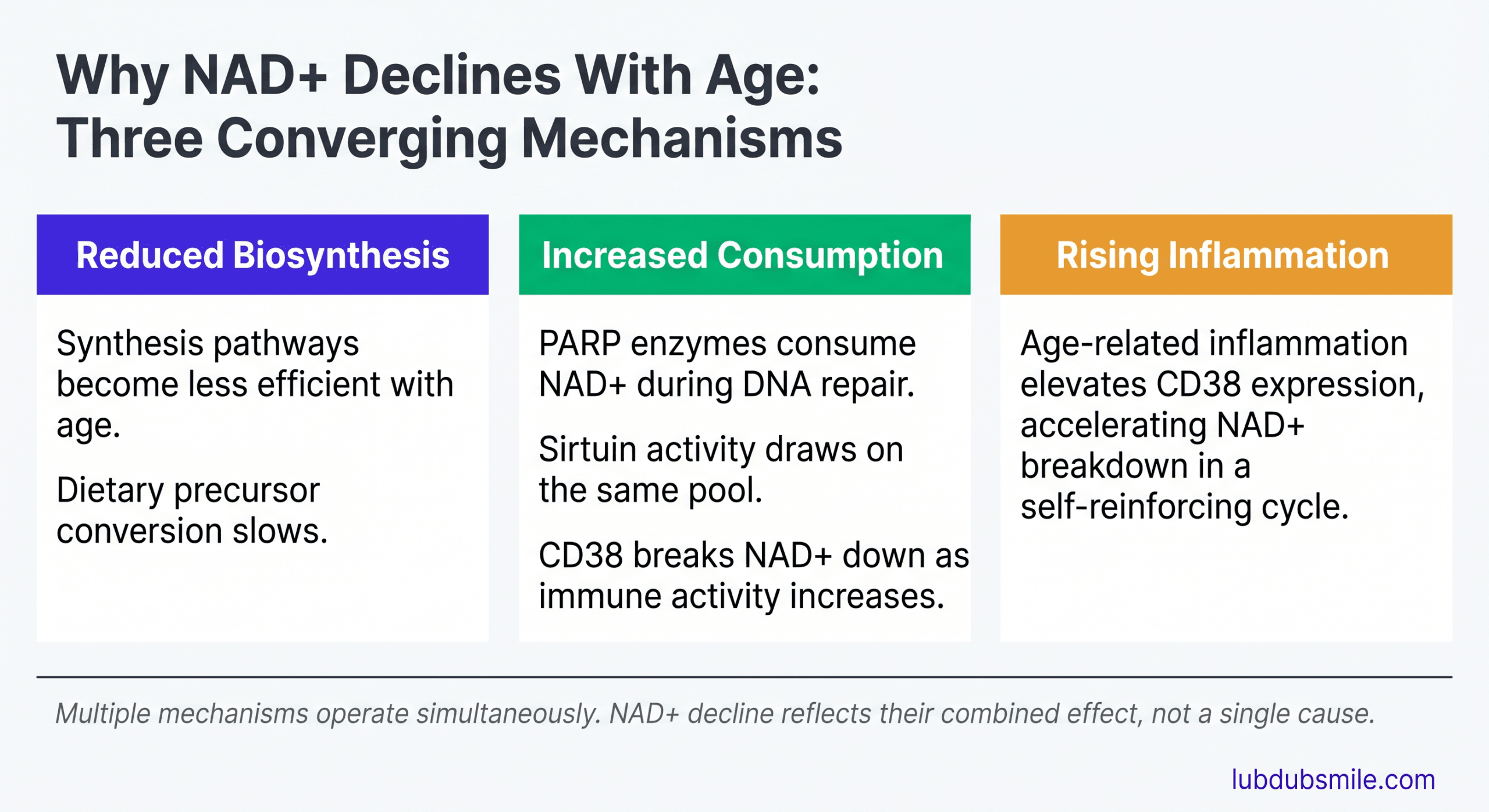
NAD+ decline with age does not stem from a single cause. Research has identified multiple contributing mechanisms operating simultaneously.
Reduced biosynthesis plays a role: the enzymatic pathways synthesizing NAD+ from dietary precursors appear to become less efficient with age. Increased consumption compounds this CD38 activity rises with age-related inflammation, PARP enzymes respond to accumulating DNA damage, and sirtuin activity continues drawing on available NAD+.
Lifestyle factors also matter significantly. Sedentary behavior, poor sleep quality, alcohol consumption, and diets low in NAD+ precursors all appear to negatively affect NAD+ metabolism. NAD+ and cellular energy decline is therefore not simply an inevitable consequence of chronological age modifiable factors influence it throughout life.
Chronic inflammation creates a self-reinforcing problem. Inflammation drives CD38 activity, which depletes NAD+. Lower NAD+ means reduced sirtuin activity, which carries anti-inflammatory properties. Reduced anti-inflammatory signaling allows inflammation to persist or worsen. This interplay between NAD+ metabolism and inflammatory status is one reason researchers examining NAD+ and cellular energy inevitably encounter the broader context of aging biology.
Why Cellular Function Suffers When NAD+ Declines
Lower NAD+ availability affects multiple cellular systems simultaneously. Energy metabolism efficiency declines as electron transport capacity becomes constrained. Sirtuin activity reduces, affecting DNA repair, gene expression regulation, and mitochondrial biogenesis. The DNA repair response, while still operational, works with fewer resources.
Maintaining appropriate caution about causal language matters here. Maintaining appropriate caution about causal language matters here, and readers who want to understand the broader landscape of biological change across this life stage will find our evidence guide to healthy aging in your 40s a useful reference for placing NAD+ findings within a wider context.
Research has established correlations between NAD+ decline and reduced cellular function across these domains. Establishing that NAD+ decline causes the functional decline rather than both representing parallel consequences of other aging processes requires the kind of long-term human intervention data that is still accumulating. The mechanisms are plausible and animal research supports them. The human causal chain remains under investigation.
Significant Uncertainties That Remain
The evidence for NAD+ and cellular energy decline is strong. What remains less clear is the full significance of that decline and how to interpret it for any individual’s health.
Established reference ranges for “optimal” NAD+ levels at different ages do not exist. A person’s NAD+ measurement cannot currently offer confident interpretation as meaningful deficiency or normal age-related variation the field lacks the standardized thresholds that exist for vitamin D or iron levels.
Whether the observed decline causes aging-related functional changes, whether it results from other aging processes, or whether both operate simultaneously remains a genuinely open question. Most mechanistic research has occurred in animal models, particularly mice and the roundworm C. elegans. These organisms provided crucial insights but are imperfect proxies for human aging biology. Translation from animal findings to human applications requires direct human research, which is now accumulating but remains earlier in development than the animal literature.
There is a pattern worth naming in how NAD+ research gets communicated to general audiences. The animal data, which is genuinely strong, frequently travels ahead of the human data in popular coverage, creating an impression of clinical certainty that the human trial literature does not yet support. This is not a criticism of the researchers. Translational science moves at a pace determined by methodology, ethics review, funding cycles, and the simple reality that meaningful long-term human trials take years to complete. The gap between what mouse studies show and what we can confidently claim for human health outcomes is not evidence of fraud or failure. It is how science actually works. For adults making real decisions about supplementation, that distinction between “the mechanism is plausible and animal research supports it” and “this has been shown to improve long-term human health outcomes” is not a minor technical footnote. It is the most important sentence in this article.
Supporting NAD+ and Cellular Energy: What Research Investigates
How NAD+ Precursors Work
The body synthesizes NAD+ from several precursor molecules through distinct biosynthetic pathways. The de novo pathway uses the amino acid tryptophan as a starting material a long, multi-step process that is metabolically expensive. The Preiss-Handler pathway uses nicotinic acid (niacin). The salvage pathway accounting for the majority of NAD+ production recycles nicotinamide and other breakdown products back into NAD+.
Nicotinamide mononucleotide (NMN) and nicotinamide riboside (NR) are direct precursors entering the salvage pathway at different points, both ultimately increasing substrate available for NAD+ synthesis. The premise of precursor supplementation is straightforward: if the body has more raw material available, it can produce more NAD+. Whether that increased production translates to meaningful changes in cellular function is the question human research is now working to answer in the context of NAD+ and cellular energy support.
NMN Research: What Human Studies Have Found
NMN has been the subject of substantial animal research demonstrating that supplementation can restore NAD+ levels in aged tissues and produce improvements in metabolic markers, exercise capacity, and mitochondrial function. Landmark research showed that NMN administration in aging mice produced wide-ranging improvements in energy metabolism, physical activity, insulin sensitivity, and eye function without apparent toxicity.

Human clinical trials are now published and accumulating. A randomized controlled trial published in Science (2021) examined 250 mg daily NMN supplementation in older men and found measurable increases in muscle NAD+ levels alongside improvements in some markers of physical performance specifically, muscle oxygen utilization during exercise. This is a meaningful finding: it demonstrates not only that oral NMN raises NAD+ in human tissue but that the elevation corresponds to a measurable functional change relevant to NAD+ and cellular energy research.
A separate randomized trial examined NMN at 600 mg daily in older adults and found increases in blood NAD+ levels and improvements in some physical function markers over 60 days. Reported side effects in published trials to date have been minimal.
What human NMN research has not yet established is whether measurable changes in NAD+ levels and short-term functional markers translate to meaningful long-term health outcomes. Existing trials follow participants for weeks or months. Whether sustained NMN supplementation over years produces health benefits in humans requires longer follow-up than published research currently provides.
NR Research: What Human Studies Have Found
Nicotinamide riboside carries a comparable mechanistic rationale to NMN and has been the subject of its own body of human research. Studies found that NR supplementation in healthy middle-aged and older adults raised blood NAD+ levels significantly within two weeks of initiation, with a dose-dependent response observed.
Subsequent NR trials have examined effects on cardiovascular function markers, metabolic parameters, and physical performance, with variable but generally directionally positive results in short-term studies. The direct comparison between NMN and NR efficacy in humans which raises NAD+ and cellular energy markers more efficiently, which produces better functional outcomes, whether they have different tissue distribution profiles remains an active and unresolved research question. Both are under investigation; neither has established definitive superiority in human trials.
Lifestyle Factors That Influence NAD+ and Cellular Energy Metabolism
Exercise Effects on NAD+
Physical exercise activates AMP-activated protein kinase (AMPK), an energy-sensing enzyme stimulating NAD+ biosynthesis as part of its response to increased cellular energy demand. Research has found that regular physical activity associates with higher NAD+ levels in skeletal muscle, and that exercise-induced sirtuin activation depends in part on the NAD+ elevation exercise produces.
Aerobic exercise and resistance training both appear relevant to NAD+ and cellular energy metabolism through somewhat different pathways. This carries a practical implication research literature consistently supports: lifestyle factors may be as significant as supplementation in influencing NAD+ status.
Dietary Contributions to NAD+ Precursors
NAD+ precursors are present in dietary sources: meat, poultry, fish, and dairy contain nicotinamide and other precursors; some vegetables contain smaller amounts.
Dietary intake contributes to salvage pathway substrate availability, though the amounts from typical diets are modest compared to supplementation doses researchers study, and balancing nutrition for sustained energy remains a foundational consideration that operates alongside rather than in competition with NAD+ precursor research.
Animal research has long associated caloric restriction with activation of NAD+-dependent pathways, likely through increased AMPK activity and reduced NAD+ consumption. Intermittent fasting research suggests similar pathway activation may occur with time-restricted eating, though human data on NAD+ effects of specific dietary patterns remains limited and preliminary.
Sleep, Circadian Rhythm, and NAD+ Metabolism
NAD+ biosynthesis and consumption are not constant across the day. Research has established that NAD+ metabolism follows circadian rhythms, with synthesis and consumption varying predictably across the 24-hour cycle. Disruption of circadian rhythms through irregular sleep patterns, shift work, or chronic sleep deprivation appears to affect NAD+ biosynthesis pathways, potentially contributing to lower NAD+ levels over time.

This connection between sleep and NAD+ and cellular energy metabolism is preliminary and mechanistically complex. But it reinforces a broader point consistent across cellular health research: foundational lifestyle factors sleep quality, physical activity, nutritional adequacy influence the cellular systems that supplementation researchers are working to understand and support. Understanding how sleep hygiene and restorative rest support these systems provides useful context for anyone building a comprehensive approach to cellular health, particularly given how directly circadian disruption appears to affect NAD+ biosynthesis pathways.
What NAD+ and Cellular Energy Research Doesn’t Yet Tell Us
Long-Term Outcome Data Remains Absent
The most important limitation of current NAD+ and cellular energy research is the absence of long-term human outcome data. Published human trials have followed participants for weeks to months enough time to measure changes in NAD+ levels and short-term biomarkers, but not enough to evaluate whether sustained NAD+ elevation over years produces meaningful changes in health outcomes, disease incidence, or functional longevity.
Animal research particularly in mice has demonstrated lifespan and healthspan effects from NAD+ precursor supplementation. These findings inform research directions but do not directly predict human outcomes. Mice live two to three years; metabolic timescales are compressed relative to humans; and the relationship between NAD+ status and aging may operate differently across species. The translation gap between compelling animal data and proven human benefit is one the field is actively working to close, but has not yet closed.
Optimal Levels and Dosing Remain Unknown
Researchers do not currently know what NAD+ levels to target through supplementation, whether higher NAD+ is always preferable to lower, or how dosing should adjust for different individuals, ages, or health contexts. Published human trials have used doses ranging from 250 mg to over 1,000 mg of NMN daily, with different outcomes reported across studies. Dose-response relationships in humans are still under characterization in NAD+ and cellular energy research.
Individual variation in response to NAD+ precursor supplementation appears substantial but remains unpredictable from available biomarkers. Genetics, gut microbiome composition, baseline NAD+ status, and other factors researchers do not yet fully understand all appear to contribute to this variation.
Long-Term Safety Data Is Unavailable
Short-term safety profiles for NMN and NR in published human trials have been generally favorable, with minimal adverse events reported. However, long-term safety data in humans simply does not exist yet the human research is too recent to support conclusions about risks emerging from years or decades of supplementation.
This is not a reason to assume risk exists, but it is an honest acknowledgment of what the evidence can and cannot currently support. Professional consultation before initiating supplementation is prudent particularly for those with health conditions, on medications, or with specific metabolic considerations.
Connecting NAD+ and Cellular Energy Research to Practical Decisions
Understanding Where This Research Fits
The science of NAD+ and cellular energy doesn’t exist in isolation from the broader cellular health picture. The mechanisms NAD+ supports energy metabolism, DNA repair, inflammatory regulation, mitochondrial function are the same mechanisms our foundational overview of cellular aging examines across the full landscape of age-related cellular change. Reading that article alongside this one helps clarify where NAD+ fits within a larger and more complex biological story.
For those considering whether this research warrants supplementation, our investigation into the supplement stacking problem examines the practical challenges of addressing multiple cellular mechanisms through individually sourced supplementation including the cost, compliance, and quality variance challenges that arise when sourcing compounds like NMN separately.
For those interested in how NAD+ precursors fit within a consolidated longevity formulation that has met our institutional evaluation criteria, our DoNotAge All-In-One structured review evaluates one such product against the same research standards this article applies.
When to Consult a Healthcare Professional
Anyone considering NAD+ precursor supplementation should discuss this with a qualified healthcare provider before proceeding. This matters particularly for specific groups:
- People taking prescription medications should be aware that NAD+ metabolism intersects with pathways relevant to certain drug classes, and interactions are not fully characterized
- People with liver or kidney conditions warrant particular attention, as these organs are central to NAD+ metabolism
- Older adults managing multiple health considerations should involve their physicians given the complexity of interactions involved
A productive conversation with a healthcare provider should cover current health status and specific goals, existing medications and potential interactions, whether baseline NAD+ testing is meaningful in your clinical context, and what monitoring approach would help assess whether any intervention produces the intended effect.
For those who want to understand how a structured supplementation protocol might be organized around NAD+ and related longevity compounds before that conversation, our review of a longevity supplement protocol provides a practical framework grounded in the same evidence standards this article applies.
NAD+ is essential to cellular energy production and multiple cellular maintenance processes. Its levels decline measurably with age and multiple tissues. Precursor supplementation with NMN and NR has demonstrated the capacity to raise NAD+ levels in human tissue.
This content is for educational purposes and does not substitute for professional psychological or therapeutic help.