

Executive Therapy Programs vs. Coaching: What to Include in Your Evaluation
Executive therapy programs represent one of the most consequential and least clearly explained investments senior leaders make in their professional and personal wellbeing. The terminology surrounding executive mental health support is deliberately sophisticated and deliberately ambiguous. “Executive therapy.” “High-performance coaching.” “Leadership psychology.” “C-suite wellness programs.” These phrases appear in premium program marketing, on LinkedIn profiles, and in board-level conversations about leadership effectiveness often interchangeable in usage, often meaning entirely different things, and occasionally masking a substantial gap between what a program promises and what its practitioners qualify to deliver.
What do executive therapy programs actually include and how do they differ from coaching? Executive therapy programs that practitioners who hold clinical licenses deliver include clinical assessment, methods that research validates, and HIPAA-protected confidentiality. Coaching programs that practitioners without clinical licenses deliver include performance frameworks, behavioral skill development, and contractual confidentiality only. Choosing between them or choosing the wrong one has real consequences for senior leaders who need genuine clinical support.
For a CFO managing board-level pressure and private burnout simultaneously, or a CEO whose psychological patterns are visibly affecting organizational culture, choosing the wrong type of support however premium the packaging isn’t just an expensive mistake. It may delay access to clinical care that the situation requires, or provide sophisticated-sounding intervention that lacks the clinical training to safely address what’s beneath the surface.
This article provides the analytical framework high-performing professionals deserve when evaluating executive therapy programs and coaching programs: what they actually include, how they differ, what the evidence shows, how to verify credentials, and how to determine which type of support your situation actually requires.
What Executive Therapy Programs Actually Mean
The Four Categories of Executive Mental Health Support
The term “executive therapy” is not a regulated clinical designation. Executive therapy programs actually describe four distinct service categories that vary dramatically in training requirements, regulatory oversight, and clinical scope:
Clinicians who hold state licenses and specialize in executive work: A psychologist who holds a PhD or PsyD license, a professional counselor who holds an LPC license, or a clinical social worker who holds an LCSW license and who has developed expertise working with senior leaders. These practitioners hold clinical licenses that states regulate, operate under HIPAA protections, and can address both clinical mental health conditions and leadership-related concerns. This is the most clinically robust category of executive therapy programs.
Executive coaching with psychological framing: A coaching practitioner who may or may not hold clinical licenses offering support that centers on performance using psychological language and frameworks. Some of these practitioners bring genuine expertise and credentialing that fits the work; others hold certifications that require no clinical training. The regulatory status and clinical scope differ fundamentally from therapy.
Hybrid integrated programs: Organizations or individual practitioners offering programs that explicitly combine therapy from clinicians with coaching, often through a multi-provider team or a single practitioner who holds both clinical licensure and coaching credentials.
Intensive residential programs: Multi-day or multi-week programs at facilities that focus exclusively on this work, sometimes including clinical psychiatric evaluation, psychological assessment, therapy, and coaching components with quality varying enormously depending on who delivers what.
Understanding which category a program belongs to is the necessary starting point for any evaluation of executive therapy programs.
Licensed Therapy vs. Executive Coaching: The Most Important Distinction
This distinction is the most important framework for evaluating any executive therapy programs, and the industry has strong commercial incentive to blur it.
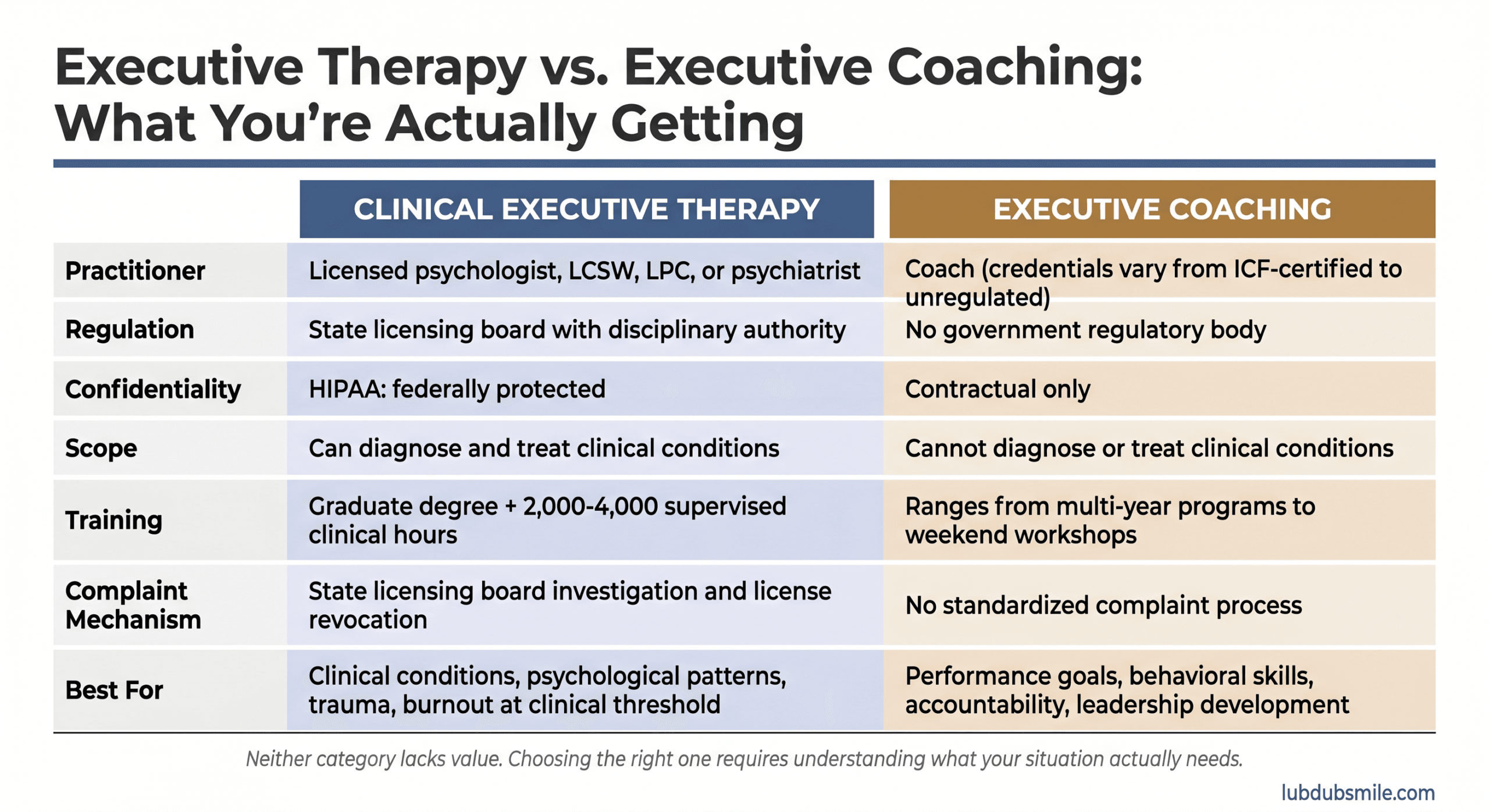
Neither category lacks value. But choosing between them or knowing which you actually need requires understanding this distinction clearly when evaluating executive therapy programs.
The Hybrid Model: Therapist-Coaches and Integrated Programs
Some of the most sophisticated executive support comes from practitioners who hold both clinical licenses and coaching credentials. A psychologist who holds a state license and has completed coach training from a program ICF has accredited brings clinical assessment capability alongside a methodology that centers on performance a genuinely powerful combination for senior leaders whose challenges cross clinical and professional domains.
When evaluating hybrid practitioners within executive therapy programs:
- Verify the clinical license independently through the state licensing board
- Verify coaching credentials through the credentialing body
- Understand in which mode the practitioner operates during sessions are they providing clinical therapy (with HIPAA protections) or coaching (without them)?
- Understand whether they maintain boundaries between clinical and coaching roles that suit the work
The hybrid model exists legitimately and can provide excellent support. But the label “therapist-coach” is also used by practitioners with coaching certifications and no clinical license. The credential verification process distinguishes between them.
Why Executive Therapy Programs Use Clinical Language Without Clinical Liability
The executive coaching and premium wellness industry has substantial commercial incentive to use clinical language without clinical liability. Terms like “psychological safety,” “deep transformation,” “trauma-informed leadership,” and “therapeutic approach” appear in coaching marketing because they signal depth and sophistication and because they function as marketing language rather than clinical descriptions.
This creates a risk for executives evaluating executive therapy programs: you may enter a coaching engagement expecting the depth and safety of clinical therapy, share information that warrants clinical intervention, and receive support from someone without the training or license to provide it. The territory that senior leaders need to navigate shame about performance struggles, family-of-origin patterns affecting leadership, complex grief, burnout that has crossed into clinical depression often requires clinical training to address safely.

Premium pricing amplifies this risk. The more expensive a coaching program, the more likely its marketing language will approximate clinical sophistication. Evaluating credentials rather than marketing copy is the only reliable protection when researching executive therapy programs.
What Regulatory Status Means for Your Protection
Regulatory status determines what protections you actually have as a client:
Practitioner who holds a clinical license: State licensing board regulation applies. If the therapist violates professional standards, a complaint mechanism exists that can result in license suspension or revocation. HIPAA provides legal protection for your health information. Malpractice insurance provides recourse if negligence occurs. Mandatory reporting obligations exist in law and receive disclosure at intake.
Coach without regulatory oversight: No licensing board exists to receive complaints if the relationship is mishandled. Confidentiality is only as strong as the contractual agreement between you and the coach. If a coach misuses your information or provides advice that harms you, civil litigation is your recourse, not professional regulatory action.
For executives sharing sensitive material performance failures, relationship patterns, substance use concerns, experiences of shame regulatory status matters practically and substantially in any decision about executive therapy programs.
Understanding mental health parity rights and insurance coverage can help you assess what your insurance plan covers for executive therapy before committing to any program.
What Genuine Executive Therapy Programs Include
Clinical Assessment and Psychological Evaluation
Genuine executive therapy programs begin with clinical assessment evaluation that a clinician who holds a license conducts to understand psychological functioning, history, and presenting concerns.
For executive populations, quality clinical assessment typically includes:
Psychological history: Developmental history, family patterns, formative life experiences, prior mental health treatment, and current psychological functioning.
Leadership-specific assessment: Understanding how psychological patterns manifest in professional contexts conflict avoidance, perfectionism, imposter syndrome, difficulty delegating, emotional dysregulation under pressure, or rigidity in leadership style.
Standardized measures: Psychological instruments that researchers have validated for assessing personality, depression, anxiety, trauma exposure, burnout, and other relevant clinical domains. These provide baseline measures and data for treatment planning.
Neuropsychological considerations: For executives experiencing cognitive concerns difficulty with concentration, memory, or complex decision-making assessment may include evaluation for contributing factors (sleep disorders, depression, early cognitive changes).
Risk assessment: Clinical assessment includes evaluation of safety suicidal ideation, substance use severity, and other clinical risk factors that influence treatment planning.
This clinical assessment component is what distinguishes genuine executive therapy programs from coaching that begins with strengths-based profiling and goal-setting. Assessment creates a clinical formulation a working understanding of what’s actually driving the presenting challenges and what approaches are most suitable.
Evidence-Based Therapeutic Modalities in Executive Therapy Programs
Quality executive therapy programs deliver interventions that clinical approaches whose effectiveness research supports not motivational frameworks or personal development methodologies, but methods that researchers have validated across studies that peers have reviewed.
Cognitive Behavioral Therapy (CBT): The most extensively researched psychotherapy, CBT addresses the relationship between thoughts, emotions, and behavior. For executives, CBT-based work may target catastrophic thinking about failure, perfectionism-driven decision paralysis, or anxiety-based avoidance of difficult conversations. The APA’s clinical practice guidelines document CBT’s evidence base across multiple conditions relevant to executive populations.
Acceptance and Commitment Therapy (ACT): A third-wave behavioral therapy with robust evidence for high-achieving populations. ACT focuses on flexibility in the face of difficulty the ability to pursue action that aligns with values even when difficult thoughts and emotions are present. Highly relevant for executives who need to make clear decisions amid uncertainty and pressure.
Psychodynamic approaches: Particularly relevant for executives whose leadership challenges root in patterns from earlier relational experiences. Psychodynamic work explores how early experiences with authority, attachment, and identity shape current leadership behavior often providing insight that purely behavioral approaches don’t reach.
Schema Therapy: Useful for executives with patterns that have become features of personality lifelong perfectionism, ongoing need for approval, difficulty with vulnerability that coaching alone cannot reliably shift.
Mindfulness-Based Cognitive Therapy (MBCT): Research documents this approach for recurrent depression and stress management; it is highly compatible with high-performance contexts.
The presence of named methods that research validates delivered by practitioners who have training in them is a meaningful quality indicator in executive therapy programs. Generic “therapeutic approaches” or “transformational methods” without clinical detail are not.
Leadership Psychology Integration in Executive Therapy Programs
Genuine executive therapy programs don’t treat leadership as incidental to psychological work they treat leadership context as the primary domain through which psychological patterns manifest and must be addressed.
Quality programs integrate:
Emotional intelligence development: Not as a workshop framework, but as clinical work addressing the emotional regulation capacities that determine leadership effectiveness under pressure.
Leadership-specific psychological formulation: Understanding how attachment patterns, perfectionism, shame tolerance, and anxiety regulation show up in leadership behaviors micromanagement, conflict avoidance, explosivity under stress, difficulty with succession planning.
360-degree perspective integration: Clinicians working with executives often review multi-rater feedback, board concerns, or data from organizational assessments as clinical material understanding what others observe as a window into psychological patterns the executive may not see clearly.
Understanding emotional agility and resilience in high-performing professionals provides useful context for the kind of psychological work that executive therapy programs at the clinical level address.
Confidentiality Structure in Executive Therapy Programs
Premium executives have confidentiality requirements that quality programs address explicitly:
Legal confidentiality (practitioners who hold clinical licenses only): HIPAA provides legal protection for health information in therapy contexts. Records cannot transfer to others without authorization you provide in writing except in exceptions that law defines. This protection has legal enforcement behind it, not just marketing promise.
Contractual confidentiality (coaching): Coaches offer confidentiality through contract terms, which civil law enforces but which don’t carry HIPAA’s regulatory weight. The strength of contractual confidentiality depends on contract quality and the legal jurisdiction.
Organizational separation: When employers sponsor executive support, quality programs establish clear organizational separation the provider communicates nothing to the organization except confirmation of participation (and only with client consent).
Discrete access: Quality executive therapy programs understand that executives may prefer discrete access separate office entrances, no receptionist acknowledgment by name, encrypted digital communication, and minimal paper trail. These operational confidentiality measures are legitimate and should be discussed at intake.
Session Frequency, Format, and Duration
Executive therapy programs vary considerably in structure:
Weekly individual sessions: The standard format for ongoing executive therapy typically 50–60 minute sessions with a clinician, weekly or bi-weekly.
Extended sessions: Some executive therapy programs offer 90-minute or 2-hour sessions to allow deeper work without the time pressure that standard therapy sessions create for busy executives.
Intensive formats: Multi-day concentrated therapy experiences (sometimes called “therapeutic intensives”) that compress several months of therapy into a focused week, useful for executives who travel frequently or want concentrated intervention.
Concurrent modalities: Combining individual therapy with executive coaching, couples therapy (when relationship factors affect professional performance), or group formats for peer leadership learning.
Telehealth executive therapy programs: A growing category of executive therapy programs delivers sessions via secure video platforms. Telehealth executive therapy programs offer the same clinical depth as in-person sessions with greater scheduling flexibility a substantial advantage for executives managing complex travel schedules across time zones.
What High-Performance Coaching Includes (And Doesn’t)
Goal-Setting and Performance Framework Development
Coaching’s strength is goal achievement with clear structure. Quality executive coaching within or alongside executive therapy programs provides:
Goal clarification and priority-setting: Working with executives to identify measurable leadership and performance goals often the clarity work that gets lost in operational demands.
Performance framework development: Creating frameworks for decision-making, prioritization, and leadership behavior that align with organizational objectives and personal values.
Accountability structure: Regular review of progress against goals that the two of you define, honest assessment of obstacles, and adaptive planning when goals require revision.
For executives with clear performance goals that don’t involve clinical mental health concerns, coaching provides legitimate and evidence-supported value in these areas.
Behavioral and Communication Skills Development
Executive coaching has reasonably strong research support for skill development in specific areas:
Communication effectiveness: Presenting to boards, managing difficult conversations, giving feedback, building executive presence in formal settings.
Influencing and negotiation: Developing sophisticated influencing strategies that fit senior leadership contexts.
Conflict navigation: Building skills for productive engagement with board members, peers, and direct reports in high-stakes disagreements.
Listening and inquiry skills: Coaching often reveals that senior leaders have under-developed listening skills a pattern that coaching methodology can address.
A 2019 review in the Journal of Applied Psychology found ongoing coaching effects on goal achievement, leadership self-awareness, and 360-degree feedback ratings. These are meaningful outcomes in the domains coaching targets.
What Coaching Cannot Address (And When Executive Therapy Programs Are Required)
Competent coaches recognize and maintain the boundaries of their scope. Coaching is not suitable for and should not attempt to address clinical mental health conditions including:
- Clinical depression or bipolar disorder
- Anxiety disorders (generalized anxiety, panic disorder, OCD, PTSD)
- Active substance use disorders
- Personality disorders
- Trauma responses that require clinical processing
- Suicidal ideation or self-harm
- Psychosis or any condition requiring psychiatric evaluation
Responsible coaches refer clients to clinicians when clinical concerns arise. This referral is a professional competency, not a failure. Coaches who continue to work with clients presenting clinical symptoms without referral are practicing outside their scope a concern when evaluating executive therapy programs versus coaching programs.
When burnout reaches clinical thresholds, executive therapy programs that clinicians deliver are the suitable intervention not coaching alone.
When Coaching Refers Out to Executive Therapy Programs
Quality coaching programs have explicit protocols for clinical referral. During an initial consultation or early sessions, a competent coach should:
- Conduct explicit inquiry into current mental health functioning and history
- Ask whether the client is currently in therapy or has previously been in treatment
- Maintain referral relationships with clinicians for situations requiring clinical care
- Explain clearly at intake that coaching does not address clinical mental health conditions
If a coach doesn’t raise these questions during initial consultation, that represents a meaningful red flag about professional competency and ethical awareness in executive therapy programs evaluation.
The Executive Coaching Industry: What the Evidence Actually Shows
Where Evidence for Coaching Is Reasonably Strong
The coaching industry’s evidence base is more substantial than critics suggest and more limited than industry marketing implies. Research shows ongoing, meaningful effects in specific areas:
Leadership self-awareness: Coaching reliably improves leader self-awareness as congruence between self-assessment and 360-degree feedback reflects. This is one of the most replicated findings in coaching research.
Goal achievement: Studies show coaching improves goal attainment compared to control conditions. The effect is real coaching creates accountability structures that improve follow-through.
Behavioral skill development: Communication, feedback delivery, conflict navigation, and similar competencies show improvement with coaching intervention.
Wellbeing and resilience: Some coaching approaches show improvement in wellbeing that participants report and in stress management though methodological limitations complicate interpretation.
A 2016 meta-analysis by Jones, Woods, and Guillaume in the Journal of Occupational and Organizational Psychology found a moderate positive effect of coaching on individual and organizational outcomes meaningful evidence that coaching, in aggregate, produces real benefits in the domains it targets.
Where ROI Claims Outpace the Research
The executive coaching industry frequently cites ROI figures “10x return on coaching investment,” “23% increase in productivity” that rigorous research does not support.
These claims typically derive from:
- Satisfaction surveys that participants self-report with no control group
- Studies that coaching organizations with commercial interest funded
- Anecdotal case studies that appear as representative data
- Extrapolation from small samples without comparison conditions
Evaluate ROI claims proportionally to the quality of evidence provided when researching executive therapy programs and coaching programs. Financial multipliers should prompt requests for the underlying study design and independent replication.
Is Executive Coaching Worth It? What the Research Shows
“Is executive coaching worth it?” is the question most executives ask before investing in premium support. The honest, research-based answer: coaching produces meaningful effects on goal achievement, self-awareness, and behavioral skills when the presenting needs suit coaching and clinical conditions are not driving the presenting challenges.
When clinical mental health conditions are the primary driver mood changes that continue over time, anxiety affecting decision-making, burnout that doesn’t respond to rest executive therapy programs that clinicians with active licenses deliver produce meaningfully better outcomes than coaching alone. Distinguishing which type of support your situation requires is the most valuable question to answer before committing to any program.
Credential Variation: From ICF-Certified to Weekend Workshop Graduates
The most important practical reality about the coaching credential landscape: anyone can call themselves an executive coach. No government body regulates the title or the practice. The credential variation is enormous:
ICF Credentialing (International Coaching Federation):
The ICF is the most widely recognized coaching credentialing body and offers three credential levels:
- ACC (Associate Certified Coach): 60+ hours of coach-specific training, 100+ hours of coaching experience, mentor coaching
- PCC (Professional Certified Coach): 125+ hours of coach-specific training, 500+ hours of coaching experience
- MCC (Master Certified Coach): 200+ hours of training, 2,500+ hours of experience
ICF credentialing is rigorous within the coaching field. However, even MCC credentials require no clinical mental health training they reflect coaching competency, not clinical competency.
BCC (Board Certified Coach): The Center for Credentialing & Education offers this credential. It requires a relevant college degree, coach training, and experience. Similarly focused on coaching competency without clinical training requirement.
Evaluating Executive Therapy Programs: Credential Verification
Credentials That Matter for Executive Therapy Programs
For executive therapy programs addressing psychological functioning, leadership patterns that root in history, burnout crossing clinical thresholds, or any mental health concern, verify credentials through state licensing board databases not through the practitioner’s website or marketing materials.

How to verify:
- Psychologists (PhD/PsyD): Search your state’s psychology licensing board database
- LCSWs: Search your state’s social work licensing board
- LPCs: Search your state’s counseling licensing board
- Psychiatrists (MD/DO): Search your state’s medical licensing board
All state licensing board databases are publicly accessible. Verification takes approximately five minutes and confirms active license status, license type, and any disciplinary history.
What you’re looking for:
- Active, unrestricted license status
- License type matching what the practitioner represents
- No disciplinary actions (licensing boards make these publicly available)
- License in the state where you’re receiving services (telehealth rules vary; verify)
Coaching Credentials: ICF, BCC, and What They Mean
Verify coaching credentials through the credentialing body directly:
ICF verification: The ICF maintains a public directory of coaches who hold credentials at coachingfederation.org. Search by name to verify credential level and status.
BCC verification: Verify through the Center for Credentialing & Education at cce-global.org.
What coaching credentials confirm: That the practitioner has completed training that coaching bodies have reviewed and approved, accumulated coaching hours that supervisors oversee, and passed competency assessment in coaching methodology.
What coaching credentials do not confirm: Clinical training, mental health assessment capability, capacity to treat clinical conditions, or any form of HIPAA-regulated confidentiality.
For executives evaluating executive therapy programs, this distinction is non-negotiable.
Red Flags in Executive Therapy Programs Marketing
Watch for these red flags in executive therapy programs marketing:
Credentials that don’t verify: Certifications from proprietary programs with no external credentialing body, certifications with names that sound impressive but don’t correspond to any recognized organization, or credentials that no independent body can verify.
Clinical language from practitioners who lack clinical licenses: Programs using terms like “trauma-informed,” “therapeutic intervention,” or “clinical transformation” that practitioners without clinical licenses deliver.
Testimonials as the only evidence: Programs whose evidence base consists entirely of client testimonials without data from studies that researchers have reviewed.
Resistance to credential verification: Any practitioner who is evasive or resistant when asked to verify their credentials or who suggests that verification reflects distrust presents a concern.
Guaranteed outcomes: No legitimate program guarantees therapeutic or coaching outcomes. Any guarantee of results is a marketing claim, not a clinical or coaching standard.
How to Independently Verify Any Practitioner’s Credentials
Before committing to any executive therapy programs or coaching program, complete this verification sequence:
- Request full credential information in writing: Specific degrees, license types and numbers, coaching certifications, state of licensure
- Verify licenses through state licensing board databases (5 minutes per license)
- Verify coaching credentials through credentialing body databases
- Check disciplinary history through licensing board records (boards make these publicly available)
- Verify professional liability insurance: Therapy requires it; coaching should carry it
- Request references from executives at comparable levels with permission to contact
Questions to Ask Before Signing Any Contract for Executive Therapy Programs
Essential due diligence questions before program commitment:
- “What are your specific credentials, license numbers, and licensing states?”
- “Do you hold a clinical license, and if so, in which states?”
- “Does HIPAA cover this engagement, or is confidentiality contractual only?”
- “What happens if clinical mental health concerns emerge during our work?”
- “Do you maintain clinical supervision or consultation?”
- “What is your evidence base for the methods you use?”
- “What are the outcomes you measure and how does the program measure them?”
- “What does the contract specify about confidentiality, data storage, and information sharing?”
- “If my company is paying, what do they receive access to?”
A practitioner who responds to these questions with defensiveness, evasion, or pressure to sign quickly is demonstrating concerning professional conduct regarding executive therapy programs.
How Much Do Executive Therapy Programs Cost?
Program Structures and What They Include
Understanding fee structures helps contextualize quality evaluation of executive therapy programs:
Individual sessions with clinicians who specialize in executives: $200–$500+ per session, depending on location, credentials, and specialization.
Executive coaches with experience at the senior level: $300–$1,000+ per session; some charge hourly, others per program.
Premium or boutique executive programs: $5,000–$50,000+ for multi-month engagements.
Intensive residential programs: $15,000–$100,000+ per engagement.
Intensive Residential Executive Therapy Programs
Intensive residential executive therapy programs typically offer concentrated multi-day or multi-week experiences at facilities that focus on this work. Quality programs include:
Clinical components:
- Psychiatric evaluation and assessment
- Individual therapy with clinicians who hold licenses
- Psychological testing and formulation
- Medication consultation where the situation indicates it
Performance and coaching components:
- Executive coaching sessions
- Leadership assessment tools
- Communication and skill development
Wellness components:
- Sleep assessment and optimization
- Physical health evaluation
- Nutrition and exercise integration
- Mindfulness and stress regulation practices
Quality residential executive therapy programs employ psychiatrists, psychologists, and therapists who hold active licenses alongside executive coaches with clear role separation between clinical and coaching functions. Programs that don’t clearly specify who holds licenses and who coaches, or that use clinical language without clinical practitioners, warrant scrutiny.
Understanding employee mental health benefits can help you assess whether your employer’s EAP or benefits structure covers any component of executive therapy programs before paying out of pocket.
Ongoing Monthly Retainer Models
Many executive coaches and therapists work on monthly retainer structures providing ongoing access:
Typical retainer components:
- Regular weekly or bi-weekly sessions (60–90 minutes)
- Between-session messaging or call availability
- Periodic assessments or reviews
- Resources and tools relevant to the work
Pricing range: $2,000–$10,000+ per month depending on practitioner credentials, experience, and program depth.
Organization-Sponsored Executive Coaching
Organizations frequently sponsor executive coaching for senior leaders as a development investment. This structure creates specific confidentiality considerations:
What organizations typically receive:
- Confirmation that coaching is occurring
- High-level developmental focus areas (only with executive’s consent)
- General progress updates (only with consent that the executive provides explicitly)
What organizations should not receive:
- Session content
- Psychological assessment results
- Personal disclosure information
- Concerns the executive shared privately
If your organization sponsors coaching or therapy, establish written agreement about information flow before beginning. Ensure the contract specifies precisely what the organization can access and under what circumstances.
What Fees Reflect in Executive Therapy Programs
What fees reflect: Market positioning, location, practitioner experience and reputation, and sometimes credential sophistication. Premium pricing in a market without regulation (coaching) requires additional scrutiny high fees in the coaching space reflect demand and marketing success, not quality that regulation ensures.
What fees don’t reflect: In coaching, clinical quality or clinical suitability. A practitioner who charges $500/session without clinical credentials is not more clinically capable than a clinician who charges $300/session. In executive therapy programs, premium pricing should reflect clinical depth that practitioners who hold licenses provide verify credentials before assuming it does.
Confidentiality in Executive Therapy Programs
What HIPAA Means for Executive Therapy Programs
Practitioners who hold clinical licenses are covered entities under HIPAA. This means:
- Your health information has protections that federal law enforces
- Your therapist cannot share information without authorization you provide in writing except in exceptions that law defines
- You have the right to access your records
- Violations carry regulatory and civil penalties
- Your electronic health records receive protection from access that the holder has not authorized
HIPAA confidentiality is a legal protection, not a marketing promise. The HHS Office for Civil Rights enforces it. Executive therapy programs that practitioners who hold clinical licenses deliver carry this protection; coaching programs do not.
What Confidentiality Means for Coaches Without Clinical Licenses
Coaches are not covered entities under HIPAA. Confidentiality in coaching is:
- Contractual based on what the agreement specifies
- Civilly enforceable (if the contract is violated, civil legal recourse is available)
- Not regulatory (no government body oversees coach confidentiality compliance)
- Variable based on contract quality
Before beginning any coaching engagement within executive therapy programs, review the confidentiality provisions of the contract carefully. Ask specifically:
- “What information from our sessions gets stored?”
- “Who has access to notes or records from our work?”
- “Under what circumstances would you share information about our work with anyone?”
- “How do you store and protect my data?”
Organization-Sponsored Programs: Who Can Access What
When your employer sponsors executive support therapy or coaching the confidentiality picture becomes more complex. Key principles:
In therapy: HIPAA protections apply to your clinical information regardless of who pays. Your organization cannot access clinical records without authorization you provide in writing.
In coaching: Confidentiality is governed by the contract between the coach, the organization, and you. Three-party coaching agreements often specify what can be shared and with whom. Review this carefully before entering any executive therapy programs with organizational sponsorship.
Mandatory Reporting Exceptions All Clients Should Understand
All practitioners who hold clinical licenses have mandatory reporting obligations regardless of executive status:
Child abuse or neglect: If disclosure indicates child abuse, therapists must report to child protective services.
Dependent adult or elder abuse: Similar mandatory reporting obligations apply.
Duty to warn: If threats of serious harm to identifiable individuals arise and carry credibility, therapists may have a legal obligation to warn potential victims and/or notify authorities (varies by state).
Court orders: Valid court orders can require disclosure of clinical records.
Imminent safety risk: If you present suicidal intent with means and plan, therapists may take action to protect you.
These exceptions are narrow. They exist to protect safety. For the vast majority of executives in executive therapy programs discussing leadership challenges, performance concerns, relationship difficulties, and burnout, these exceptions are not relevant to their sessions.
When Executive Therapy Programs Are the Right Level of Care

Executive Burnout Therapy: Clinical Threshold vs. Lifestyle Adjustment
Executive burnout exists on a spectrum. Understanding where on that spectrum a given presentation sits determines whether executive therapy programs or coaching is the suitable level of care:
Lifestyle adjustment level: High workload, recovery time that has shrunk, declining engagement coaching, structural changes, and wellness practices can address this.
Subclinical burnout: Exhaustion, cynicism, and efficacy that has declined without crossing a clinical threshold coaching plus enhanced wellbeing practices, possibly brief therapy, can help here.
Clinical threshold burnout: Burnout that has crossed into clinical depression, anxiety disorders, or substantial somatic symptoms executive therapy programs that clinicians deliver are suitable, psychiatric evaluation may be necessary, and coaching alone is not adequate.
Executives who present with sleep disruption that continues over time, anhedonia, hopelessness, or physical symptoms should undergo clinical evaluation before entering a coaching-only program.
Executive Therapy for Anxiety, Depression, and C-Suite Mental Health
Several clinical presentations are particularly common in executive populations and require the clinical depth that genuine executive therapy programs provide:
Executive therapy for anxiety: Anxiety in executives who function at a high level often presents as perfectionism, over-preparation, difficulty delegating, or catastrophic thinking about organizational outcomes. CBT and ACT that clinicians deliver in quality executive therapy programs address these patterns at their clinical root.
Executive therapy for depression: Depression in senior leaders often appears as emotional flatness, creative capacity that has declined, or cynicism rather than classic low mood presentations. Clinical assessment within executive therapy programs identifies depression that leaders themselves often fail to recognize.
C-suite mental health broadly: The pressures that senior leadership creates isolation, accountability without peers, identity that has fused with organizational outcomes, high-stakes decision-making that continues without rest create mental health vulnerabilities that coaching frameworks alone cannot safely address.
Recognizing when to seek professional support for anxiety provides useful frameworks for executives assessing whether their presenting concerns warrant executive therapy programs or coaching support.
Performance Patterns That Root in Psychological History
Some leadership patterns are behavioral expressions of earlier psychological experiences. Coaching approaches these as behaviors to change; therapy understands them as expressions of underlying patterns to process.
Examples:
- Ongoing avoidance of difficult conversations (may reflect early experiences of conflict as dangerous)
- Difficulty trusting direct reports with autonomy (may reflect experiences of dependence as vulnerable)
- Overwork that goes beyond what strategy requires (may reflect worth that depends on performance)
- Difficulty with succession planning (may involve complex identity and mortality psychology)
Behavioral coaching can modify surface behavior. Clinical therapy in quality executive therapy programs addresses the psychological patterns from which the behavior emerges. For patterns that appear across roles and relationships, the clinical approach produces change that holds over time.
When You Need a Psychiatrist, Not a Coach
Certain presentations require psychiatric evaluation and possibly medication as part of the treatment picture:
- Major depression that doesn’t respond to therapy
- Bipolar disorder or mood instability affecting leadership and judgment

Executive therapy programs sometimes require psychiatric evaluation not coaching when symptoms meet clinical thresholds. - Anxiety disorders that interfere substantially with functioning
- Executive ADHD that substantially impairs performance
- Substance use disorders requiring medical intervention
- Sleep disorders requiring medical evaluation
Psychiatry and therapy can work in combination with coaching but the clinical foundation must come first. Entering a premium coaching program while an untreated clinical condition drives the presenting challenges is an expensive path to incomplete resolution. Quality executive therapy programs integrate psychiatric evaluation when presentations indicate it.
For executives whose sleep doesn’t improve with lifestyle changes, sleep hygiene that supports professionals who struggle with anxiety offers starting points while noting when clinical evaluation is the suitable next step.
When Executive Coaching Is the Right Level of Support
Communication and Leadership Style Development
Coaching is the suitable primary intervention for developing communication effectiveness, executive presence, and leadership style when the presenting challenges are genuinely behavioral rather than psychological:
- Improving clarity and impact in board presentations
- Developing direct, clear feedback delivery
- Building executive presence in formal settings
- Improving listening and inquiry skills in leadership conversations
When these behavioral challenges are the primary issue not expressions of deeper psychological patterns coaching methodology, applied by competent coaches, is the approach that evidence supports. Executive therapy programs are not required when the primary presenting concern suits coaching.
Performance Accountability and Goal Achievement
Coaching structures accountability in ways that are genuinely valuable for high performers who have moved beyond external accountability structures. Senior leaders often lack the performance feedback that earlier career stages provided. Executive coaching replaces this through:
- Regular goal review and progress assessment
- Reflection on leadership decisions and outcomes that the coach facilitates
- Accountability for behavioral change commitments
- Candid, sophisticated feedback from an informed outside perspective
When Coaching Complements Executive Therapy Programs
Coaching and therapy are not mutually exclusive and often work powerfully in combination within comprehensive executive therapy programs:
- Therapy addresses psychological history and patterns; coaching addresses current behavioral performance
- Therapy provides a container for emotional processing; coaching provides a structure for behavioral implementation
- Therapy helps the executive understand why patterns exist; coaching helps implement new behaviors despite them
When an executive is in ongoing therapy and also works with an executive coach, coordinating the work (with releases that the executive provides) can produce outcomes that neither approach alone achieves. This requires practitioners who respect each other’s roles and scope.
Exploring therapy platforms can help identify practitioners with executive specialization and scheduling flexibility that demanding professional lives require a starting point for executives ready to engage executive therapy programs alongside coaching.
How to Find Executive Therapy Programs That Suit Your Needs

Starting With Credential Verification, Not Marketing
The single most important principle for finding quality executive therapy programs: begin with credential verification, not program marketing. The most polished website, the most extensive client list, and the most favorable testimonials tell you nothing about whether the practitioner qualifies to do what they’re proposing.
Verification sequence:
- Identify the credentials of the practitioner specifically (not firm/program credentials individual practitioner credentials)
- Verify through licensing board or credentialing body
- Check disciplinary history
- Then, and only then, evaluate the program structure and approach
Questions to Ask When Evaluating Executive Therapy Programs
A quality initial consultation should include the practitioner asking about your presenting concerns, clinical history, and what you’re hoping for from the work. It should not function as a sales pitch. Questions to ask:
- “What specifically is your training and credential background?”
- “How do you distinguish what coaching can address from what requires clinical care?”
- “What does a typical engagement with an executive at my level look like?”
- “How does the program measure progress and outcomes?”
- “What happens if my needs exceed the scope of your work?”
- “Can you explain the confidentiality structure of our work specifically?”
Red Flags in Executive Therapy Programs Marketing
Walk away from executive therapy programs or coaching programs that:
- Promise ROI percentages without rigorous evidence
- Use clinical language without practitioners who hold clinical licenses
- Resist credential verification or treat it as offensive
- Create urgency or scarcity pressure around commitment
- Can’t clearly explain what’s included and what outcomes the program measures
- Combine coaching and therapy language without clarity about who does what
- Guarantee outcomes or transformation without suitable caveats
- Don’t address confidentiality proactively and clearly
How Initial Sessions in Executive Therapy Programs Should Feel
Regardless of modality (therapy or coaching), quality initial sessions in executive therapy programs should feel:
- Curious and assessment-oriented: The practitioner is genuinely learning about your situation before proposing intervention
- Safe for honest disclosure: You feel sufficiently secure to share what’s actually happening, not just the professional surface
- Clear about scope: Clear about what the work is, what it isn’t, and how the practitioner makes decisions
- Non-pressured: No urgency to commit before you’ve evaluated fit
- Genuinely challenging: Quality practitioners ask questions that provoke genuine reflection, not just agreement
If an initial session feels like a sales conversion experience rather than the beginning of genuine clinical or coaching inquiry, that’s information about what the ongoing work will be.
Using Professional Networks for Verified Referrals
The most reliable pathway to quality executive therapy programs is a verified referral from a peer who has direct personal experience with a practitioner. When seeking referrals:
- Ask specifically whether the referrer worked directly with this practitioner (not just their organization)
- Ask what the practitioner’s credentials are and what type of work they do
- Ask what outcomes were meaningful in the referrer’s experience
- Still complete independent credential verification regardless of referral source
Psychiatrists, neurologists, and primary care physicians who work with executive populations are also excellent referral sources for clinicians they typically have informed referral networks and understand the clinical suitability question in the context of executive therapy programs.
Frequently Asked Questions About Executive Therapy Programs
Are executive therapy programs covered by insurance or HSA?
Health insurance generally covers executive therapy programs that practitioners who hold clinical licenses deliver, and sessions may qualify for HSA/FSA use. Executive coaching that coaches without clinical licenses deliver is generally not covered by health insurance.
Intensive residential programs vary by clinical components and credentials of practitioners delivering them. Your insurer’s behavioral health department can clarify what components of a program may qualify for coverage. Consult your financial advisor for HSA/FSA eligibility questions.
Can my company pay for executive therapy without compromising confidentiality?
Yes, with appropriate protections in place. A clinician’s HIPAA obligations remain regardless of who pays the fee. The organization should receive confirmation of participation only not clinical content. A three-party agreement should explicitly specify what the organization receives access to, and you should review and consent to any information sharing before it occurs.
The funding source does not change HIPAA protections when a practitioner who holds a clinical license is the provider. However, confidentiality protections depend heavily on contract terms when coaching (not therapy) is the engagement.
What is executive therapy? How does it differ from regular therapy?
Executive therapy is mental health support that a psychologist, therapist, or psychiatrist who holds an active clinical license provides to senior leaders and executives. It differs from standard therapy in its integration of leadership context clinical formulation includes how psychological patterns manifest in board dynamics, organizational culture, and leadership behavior. Executive therapy programs that practitioners design for this population address both clinical conditions and the pressures that senior leadership roles create.
How long do executive therapy programs typically last?
Ongoing therapy with a clinician typically runs months to years, depending on presenting concerns. Some executives engage in therapy for years as an ongoing investment in wellbeing and leadership effectiveness. Coaching engagements typically run 3–12 months. Intensive residential executive therapy programs run days to weeks, followed by ongoing individual support to integrate what was addressed. Clinical need and individual goals determine duration not program marketing timelines.
What if I need both therapy and coaching?
This is a common situation and is entirely workable within comprehensive executive therapy programs. Many senior leaders benefit from concurrent therapy (addressing psychological patterns and clinical concerns) and coaching (addressing behavioral performance and leadership development). Both practitioners should know you’re working with the other (with your consent), roles should clearly differentiate, and neither practitioner should work at the boundary of the other’s domain without appropriate handoff.
Are there executive therapy programs that address both clinical and performance needs?
Yes. The most sophisticated executive therapy programs employ teams that include practitioners across disciplines psychologists and therapists who hold active licenses, executive coaches, psychiatrists (for evaluation and medication management when indicated), and sometimes specialists in related areas (sleep medicine, nutrition, physical performance). Quality programs clearly specify which team members hold which credentials, explicitly define which components are clinical (that HIPAA protects) and which are coaching, and maintain clear protocols for clinical concerns that emerge in coaching contexts. Credential verification of each team member is essential.
Is executive coaching worth it for C-suite mental health concerns?
When clinical mental health conditions are the primary driver mood changes that continue without resolution, anxiety affecting decision-making, burnout that doesn’t respond to rest executive therapy programs that clinicians with active licenses deliver produce meaningfully better outcomes than coaching alone. Coaching produces meaningful effects on goal achievement, self-awareness, and behavioral skills when the presenting needs suit coaching. The key question before any investment: is this primarily a performance challenge or a clinical mental health concern? If uncertain, a clinical assessment that a psychologist conducts can clarify which type of support your situation requires.
What credentials should I look for in an executive coach or therapist?
For executive therapy programs with clinical components, look for active state licenses (PhD, PsyD, LCSW, LPC, or MD for psychiatry) and verify these through state licensing board databases. Coaching, look for ICF credentialing at the PCC or MCC level these require meaningful hours of training and coaching experience that supervisors oversee. For any practitioner who blends both, verify each credential independently. No marketing claim substitutes for verification through official licensing boards or credentialing body databases.
Making an Informed Investment Decision About Executive Therapy Programs
The Due Diligence Framework Before Committing
Apply the same rigor to this decision that you apply to substantial business investments:
Credential verification (non-negotiable): Verify every practitioner’s credentials through official licensing boards or credentialing bodies before any financial commitment.
Evidence assessment: What does the research say about the methods this program proposes? Not the program’s testimonials research from studies that peers have reviewed.
Confidentiality verification: What legal or contractual protections govern your information? Verify this in writing, not through verbal assurance.
Clinical suitability assessment: Does the type of support match what you actually need? Coaching for needs that suit coaching; therapy from clinicians for clinical needs.
Outcome specification: What outcomes are you seeking, how will the program measure them, and over what timeline?
Reference verification: Peers at comparable levels with direct personal experience of this practitioner.
Understanding What You’re Actually Buying in Executive Therapy Programs
Before committing to any executive therapy programs, you should be able to answer:
- “Who is providing this service, and what are their credentials?”
- “Is this clinical therapy, coaching, or a combination and which components are which?”
- “What protections govern each component?”
- “What are the methods the program uses, and what does research show about them?”
- “What happens if my needs exceed the scope of this program?”
- “What are the outcomes and how does the program measure them?”
If you cannot answer these questions after an initial consultation, the program has not provided the transparency that justifies the investment.
When to Consult Additional Professionals
Before committing to executive mental health programs at substantial investment levels:
- Medical evaluation: If clinical mental health concerns are present, consult your physician or a psychiatrist before entering any program
- Financial advisor: For programs at $25,000+ annually, understand tax treatment and appropriate budgeting
- Legal review: For programs with complex contracts, organizational sponsorship, or confidentiality provisions that concern you, employment or healthcare attorney review is appropriate
The investment financial, temporal, and psychological justifies thorough due diligence. Practitioners and programs worthy of executive engagement welcome it. For executives building a broader approach to health optimization alongside mental health investment, understanding how to pursue healthy aging without optimization anxiety provides a useful counterweight to the optimization culture that premium wellness programs often inhabit.
Takeaway Summary
Executive therapy programs that genuinely serve senior leaders combine clinical assessment from practitioners who hold active licenses, methods that research validates, and HIPAA-protected confidentiality and verifying every practitioner’s credentials through official licensing boards before committing is the single most important step any executive can take.
This article provides educational information to support informed evaluation of executive mental health programs. For guidance, consult practitioners who hold clinical licenses, healthcare attorneys, financial advisors, and other qualified professionals as appropriate.
This content is for educational purposes and does not substitute for professional psychological, medical, or legal advice.