Why Summer Disrupts Your Sleep and Energy (And How to Stabilize Both)
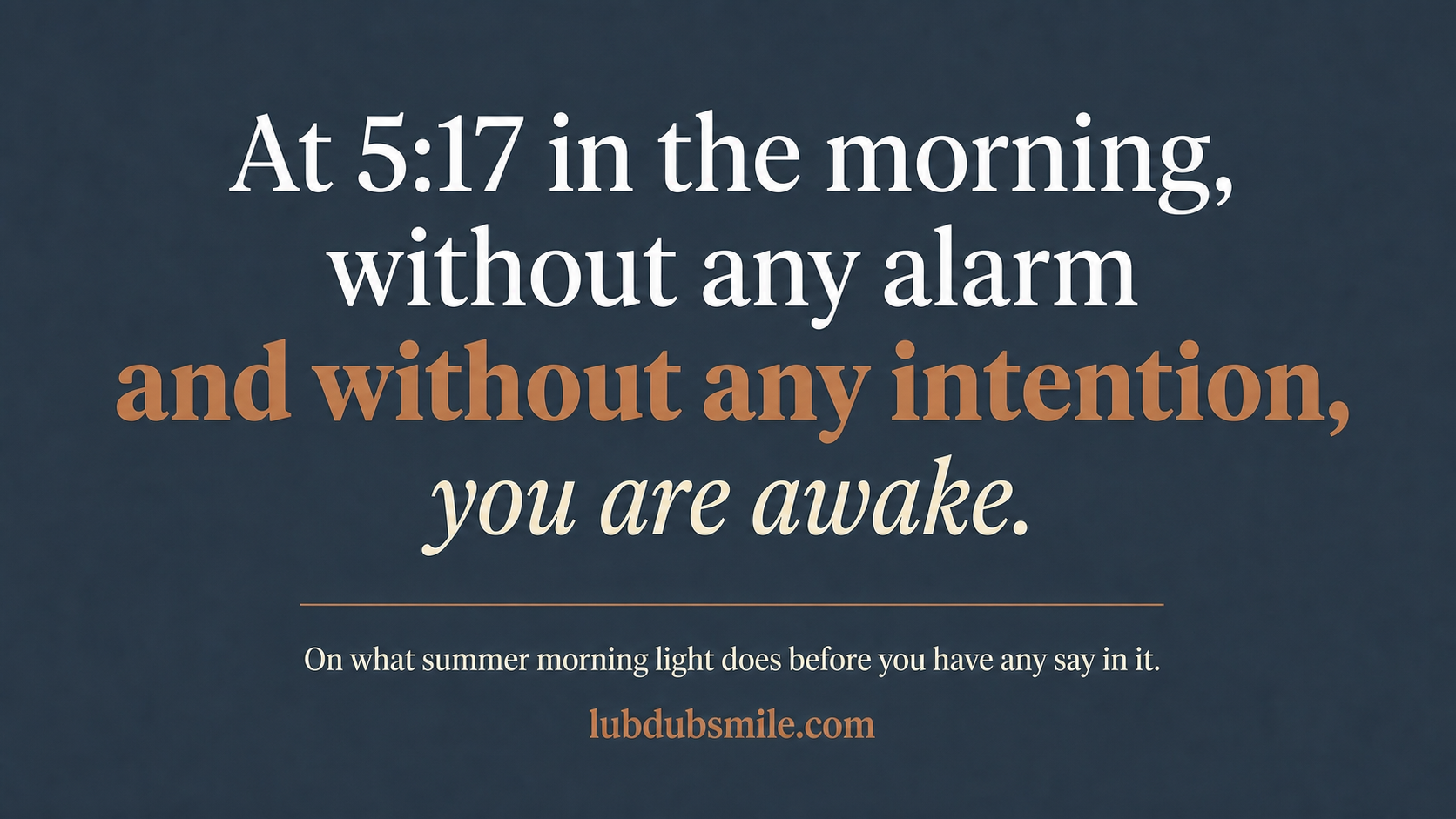
It is 9:45 on a Tuesday evening in late June. The sky outside is still holding that particular shade of blue that belongs to late afternoon. You are tired, genuinely tired, the kind that built steadily since mid-morning, but something in you will not settle. Your body feels alert in a way that seems disconnected from the hour, from the day you just had, from the sleep you know you need. An hour later, you finally get into bed. An hour after that, you are asleep. At 5:17 in the morning, without any alarm and without any intention, you are awake.
This is not insomnia. It is not aging poorly. It is not your phone, your stress, or your evening glass of wine, though any of those may add to it. Sleep problems in summer trace back to your circadian system doing exactly what it was designed to do, and to summer doing exactly what summer does to it. That distinction matters more than most people realize, because the interventions that work are aimed at the mechanism, not the symptom.
What Summer Light Actually Does to Your Body Clock
Your circadian system runs on a cluster of roughly 20,000 neurons in the hypothalamus called the suprachiasmatic nucleus. This structure functions as the body’s master clock, and it is exquisitely sensitive to one signal above all others: light. Specifically, it reads light through specialized photoreceptor cells in the retina that respond most strongly to short-wavelength blue light, the precise wavelength that dominates the sky during daylight hours and, critically, during summer’s extended evenings.
How Does Your Circadian System Read Summer Light Differently?
In winter, darkness arrives by 5pm across much of the Northern Hemisphere. The suprachiasmatic nucleus registers diminishing light, initiates the cascade that produces melatonin, and the body begins its biological preparation for sleep at an hour that aligns reasonably with most adults’ social and professional schedules. Summer inverts this entirely. The same biological clock that registered darkness at 6pm in December now receives full light signals until 8, 9, or even 10pm depending on latitude, and it responds accordingly.
Research from Charles Czeisler’s group at Harvard Medical School has demonstrated that evening light exposure ranks among the most potent signals for delaying circadian phase, with the body clock drifting later in direct response to light at hours it previously associated with night. Summer does not break your sleep. It systematically moves it later by using your own circadian machinery against the schedule you need to keep. For adults already navigating the compressed recovery windows that midlife tends to produce, understanding this mechanism is where managing summer sleep disruption actually begins.
Why Do Long Summer Days Push Your Sleep Window Later Than You Intend?
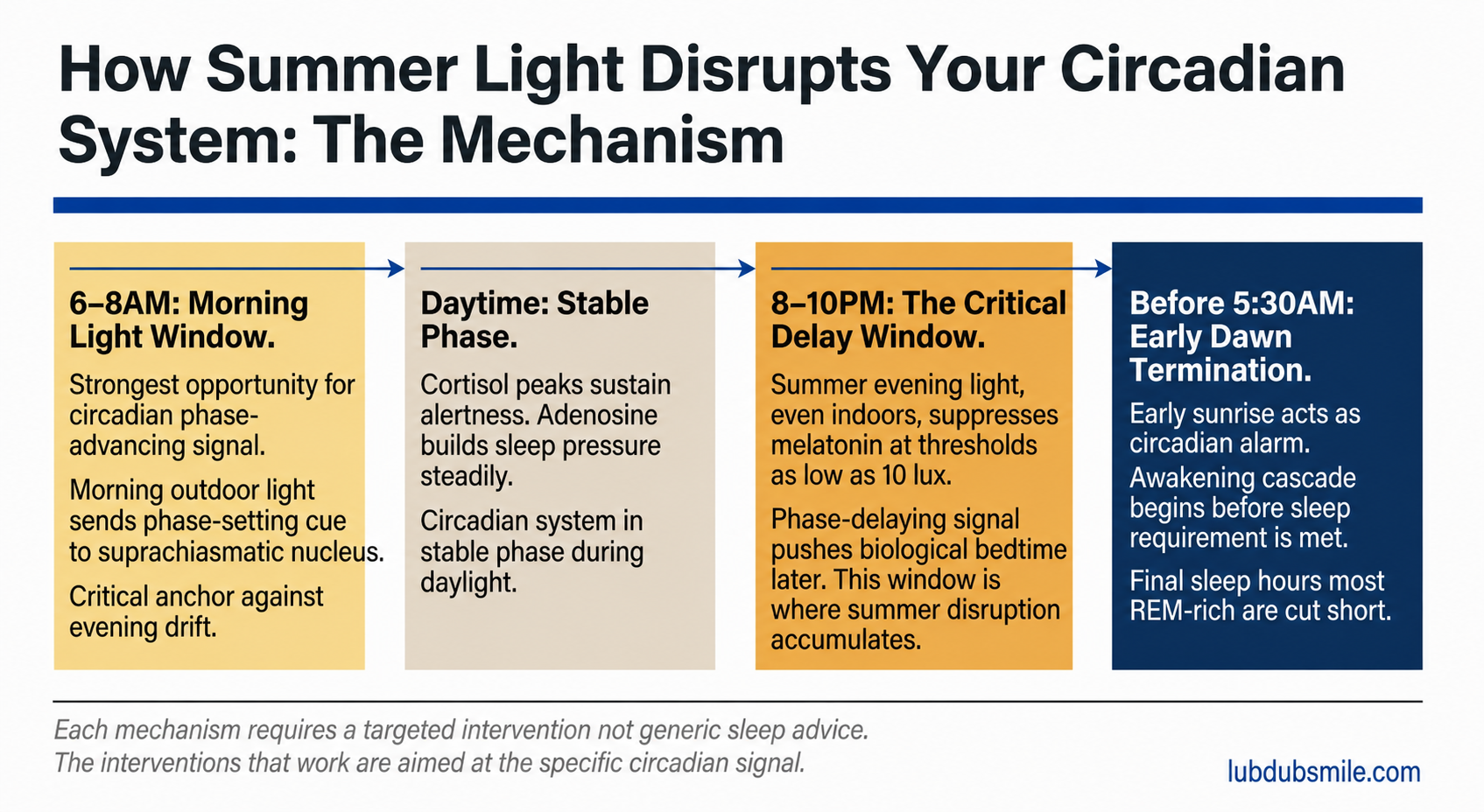
Light exposure suppresses melatonin production at threshold levels far lower than most people expect. As little as 10 lux, roughly equivalent to a dimly lit room, suffices to blunt melatonin onset in some individuals. Summer evenings, even indoors with windows present, routinely exceed this threshold by significant margins.
The consequence is a delayed dim-light melatonin onset. The point at which the body begins producing sleep-signaling melatonin shifts later, sometimes by one to two hours across a summer, pulling the entire sleep window with it. Research from the Salk Institute on light and circadian entrainment confirms that this delay accumulates across weeks of exposure rather than resolving after a single disrupted night, which explains why June feels manageable and August feels genuinely depleting. This cumulative drift is one of the most underrecognized features of sleep problems in summer, and understanding it reframes the August fatigue that most adults chalk up to busyness. The pattern connects directly to the broader challenge of maintaining emotional steadiness through sustained fatigue, which summer circadian pressure reliably tests.
Why Adults Over 40 Feel This More
Why Has Your Buffer Against Summer Light Shrunk Since Your 30s?
Melatonin production peaks in early childhood and declines progressively across adulthood. By the mid-40s, the amplitude of the nightly melatonin signal, the height of the peak that moves the body into sleep, diminishes measurably compared to younger decades. NIH research on sleep architecture and aging documents this decline clearly, noting that older adults produce lower melatonin concentrations and experience a narrower window of peak production than younger adults.
The practical consequence in summer is specific. The melatonin signal that previously overcame light suppression from a bright evening sky now has less amplitude to work with. The buffer that allowed a 30-year-old to fall asleep at a reasonable hour despite a luminous 9pm sky is smaller at 48 and smaller still at 56. The summer disruption that felt manageable at 32 is not imagined as more difficult now. It is physiologically more difficult, for a measurable biological reason. Adults who want a broader picture of what changes across this decade, and what remains within their influence, will find the evidence grounded in healthy aging research for the 40s useful context here.
The Midlife Summer Sleep Trap: Fixed Mornings, Drifting Evenings
A younger adult experiencing summer circadian drift can partially compensate by sleeping later. A midlife professional with a 6:45am obligation, school-aged children, or an early commute cannot. The body clock drifts later under summer light pressure. The morning schedule does not drift with it.
The result is the specific summer sleep pattern most common in this life stage: a progressively narrowing sleep window, with bedtime moving later due to circadian push while wake time stays fixed by external anchors. Over weeks, this produces a chronic reduction in sleep that accumulates without any single night feeling catastrophically short, and a daytime energy profile that most adults attribute incorrectly to stress, age, or simply the nature of summer busyness. The problem is structural and seasonal, not personal. If you have noticed your energy feeling less reliable in July than it did in May despite no major changes in your schedule, this narrowing window is the most likely explanation. The cumulative weight of that pattern, sustained across weeks, produces the kind of depletion that burnout recovery research identifies as qualitatively different from ordinary tiredness.
Recognizing the Patterns Summer Creates
Summer sleep disruption arrives in recognizable patterns. Naming them accurately matters because each pattern has a specific circadian mechanism behind it, and the behavioral interventions that work target that mechanism directly, not generic sleep advice applied indiscriminately. This is the interpretive distinction that most coverage of summer sleep skips entirely: the same behavioral toolkit applied without understanding which mechanism drives the problem will produce inconsistent results.
The Evening Second Wind: Why Your Body Feels Most Alert at the Wrong Time
At 10pm on a summer night, many adults over 40 experience what feels like a second wind, a return of alertness and mental engagement at exactly the time they should be winding down. This is not a caffeine problem or a screen problem, though both can compound it. It is the circadian system doing what light has instructed it to do: registering that it is still functionally afternoon and upregulating alertness accordingly.
The extended photoperiod shifts the body’s cortisol and temperature rhythms later in tandem with the delayed melatonin signal, meaning the biological peak of evening wakefulness arrives an hour or two later than it did in January. The tiredness is real, sleep pressure has been building all day, but it competes with a circadian system that the summer sky has convinced is not ready to sleep. Recognizing this as a light-mediated circadian event rather than poor self-regulation is the first step toward addressing it with the right intervention. The same principle applies to the anxious alertness that many adults experience at night, and the overlap between summer sleep problems and anxiety-adjacent wakefulness is worth understanding through the lens of sleep hygiene strategies designed for anxious adults.
The Early Dawn Problem: Light as an Alarm You Did Not Set
At the other end of the night, a sunrise occurring before 5:30am in high summer acts as a circadian alarm. The same photoreceptors that delay sleep onset in the evening now register the morning light signal and begin the awakening cascade, rising cortisol, declining melatonin, increasing core body temperature, well before the body has fulfilled its sleep requirement.
For adults already operating on a reduced sleep window from later-than-intended bedtimes, this early light termination compounds the deficit. The result is not refreshing early rising. It is truncated sleep that cuts short the deep and REM phases that the final hours of sleep disproportionately contain. These are the phases most responsible for emotional regulation, memory consolidation, and physical recovery. Their loss registers throughout the following day in ways that a later bedtime alone cannot compensate for. How summer sleep problems accumulate into relational friction, particularly the short-fuse reactivity that follows disrupted REM, connects directly to the patterns examined in communication and conflict research for couples.
Summer Fatigue That Sleep Does Not Fix
By late July or August, many adults report a specific kind of fatigue that adequate weekend sleep does not resolve. This pattern of sleep problems in summer reflects the consequence of sustained circadian misalignment: the body’s biological clock running consistently out of phase with the sleep schedule the social and professional environment imposes.
The problem is not that the body gets insufficient sleep in a purely quantitative sense. It is that the timing of sleep has drifted far enough from the body’s biological window that the sleep it gets is less restorative than it should be. This is a circadian problem, and it responds to circadian interventions rather than to simply spending more hours in bed. That distinction is consequential. Additional rest without correcting the timing addresses the symptom without touching the mechanism.

The Behavioral Interventions With the Strongest Evidence
Every behavioral intervention for summer sleep disruption works through the same underlying principle: providing the circadian system with clearer, stronger, more precisely timed light signals that counteract the phase-delaying pressure of summer’s extended evenings. These are not generic sleep hygiene suggestions. They are targeted applications of circadian science to the specific mechanisms that summer activates.
Adults managing diagnosed sleep disorders, using light-sensitive medications, or experiencing sleep disruption that does not respond to behavioral strategies should consult a healthcare provider before implementing light-based interventions.
Morning Light Anchoring: The Strongest Behavioral Tool Against Summer Sleep Problems
Morning light exposure is the primary circadian anchor. Research on light-based circadian intervention, including work from Czeisler’s laboratory and subsequent chronobiology studies, consistently identifies timed morning light as the most effective behavioral approach to stabilizing circadian phase against drift pressure. The mechanism is direct: early morning light sends a strong phase-advancing signal to the suprachiasmatic nucleus, communicating that the biological day has begun and counteracting the phase-delaying pressure of the previous evening’s extended light.

For a midlife adult with fixed morning obligations, this ranks among the most practically accessible interventions available. Ten to twenty minutes of outdoor light exposure within thirty to forty-five minutes of waking, even on a cloudy morning since outdoor light intensity far exceeds indoor lighting, provides a stabilizing circadian signal strong enough to partially offset evening drift. The timing relative to waking matters more than duration. This is not a walk for exercise, though exercise compounds the benefit. It is a targeted circadian signal delivered at the moment the system is most receptive to phase-advancing input. Pairing this morning anchor with the kind of structured daily rhythm that micro-mindfulness and calm-building practices support can reinforce the stabilizing effect beyond the light signal alone.
Evening Light Management: What to Reduce, When, and Why Timing Matters More Than Amount
Evening light management is not about achieving total darkness. It is about reducing the intensity and blue-wavelength content of light during the two hours before intended sleep, when the suprachiasmatic nucleus is most sensitive to phase-delaying signals.

Practical steps that reduce circadian delay without requiring a rigid protocol include shifting overhead lighting to warmer-spectrum lamps after 8pm, applying blue-light filtering on screens for those who cannot avoid evening screen use, and closing blinds or curtains to reduce the ambient brightness that summer evenings sustain through windows even after direct sun has lowered. Blackout curtains address the early morning light problem specifically and deliver genuine results for that purpose. They do not address evening light suppression, which requires earlier management. Both interventions serve different points in the summer sleep disruption cycle and work best together.
Why Consistent Wake Timing Matters More Than Bedtime in Summer
Consistent wake timing works by giving the circadian system a reliable anchor against which to calibrate its daily cycle. In winter, the social schedule and the light environment often align naturally. Darkness arrives at a reasonable hour and reinforces the intended sleep timing. In summer, that environmental reinforcement disappears, and the circadian system has nothing to prevent drift except the behavioral consistency of the schedule itself.
Maintaining a consistent wake time, even on weekends, even after a poor night, even when the schedule might allow sleeping later, provides the strongest behavioral anchor against cumulative circadian drift. Wake time consistency stabilizes the circadian system more effectively than consistent bedtime, because the morning light exposure that follows a consistent wake time delivers the phase-setting signal. Protecting that anchor through summer is the single most sustainable behavioral commitment available to adults managing seasonal sleep disruption. This is the same stabilizing logic that underlies the broader evidence on morning routines and well-being without requiring an unrealistic overhaul of the waking hours.
Protecting Daytime Energy When Summer Has Already Shifted Your Clock
Working With Your Ultradian Rhythm When Circadian Drift Has Flattened Your Day
The circadian system does not simply determine when you sleep. It orchestrates a daily cycle of cognitive performance, alertness, and physical function throughout waking hours. Superimposed on this are ultradian rhythms, approximately 90-minute cycles of higher and lower neural arousal that continue across the waking day. When summer circadian drift reduces or shifts sleep, these cycles grow more pronounced, producing sharper cognitive peaks and deeper troughs than a well-rested adult would experience.
Working with rather than against this rhythm means scheduling cognitively demanding tasks during the morning and mid-morning window, when cortisol naturally peaks and alertness follows. It also means accepting rather than fighting the early-to-mid-afternoon trough that most adults experience. That dip is physiologically reliable, and brief rest addresses it more effectively than stimulants do.
What Circadian Research Says About Caffeine Timing in a Summer-Disrupted Day
Caffeine works by blocking adenosine receptors, adenosine being the sleep-pressure compound that accumulates throughout the day and produces the physiological drive to sleep. Strategic caffeine timing in a summer-disrupted day means consuming it early enough to support morning performance without the delayed half-life suppressing the evening sleep drive that already competes against circadian delay.
Consuming caffeine after early afternoon, roughly the 2pm threshold that chronobiology research commonly references, can extend adenosine suppression into the evening and compound the difficulty of sleeping at an already-delayed circadian phase. If the goal is restoring sleep quality across a disrupted season, caffeine management in summer requires slightly more discipline than in winter months, when the evening sleep drive carries more circadian support behind it. This is a small, practical adjustment with disproportionate return on summer nights.
Summer as a Season to Manage, Not a Problem to Solve
What Level of Summer Sleep Variation Is Normal and What Warrants a Closer Look
Some degree of summer circadian variability is biologically normal. Human circadian systems evolved in environments with genuine seasonal variation in photoperiod, and the circadian clock accommodates those changes within a range. Sleeping thirty to forty-five minutes later in peak summer than in midwinter, experiencing somewhat reduced sleep pressure during long evenings, and noticing different energy patterns across seasons all fall within the range of normal seasonal variation for most adults.
What warrants closer attention is disruption that significantly impairs daytime functioning despite several weeks of consistent behavioral effort. Persistent fatigue unresponsive to improved sleep timing, mood changes accompanying summer sleep disruption, or disturbance severe enough to affect professional performance or safety are signals to bring to a healthcare provider or sleep specialist. Summer sleep pressure can reveal underlying conditions, including insomnia disorder, sleep apnea, or mood disorders, rather than cause them. That distinction matters when deciding whether behavioral adjustment suffices or whether professional evaluation is the more appropriate next step.
Managing Summer Sleep the Way You Manage Any Other Seasonal Demand
Informed adaptation rather than perfect control defines the most durable approach to summer sleep problems. The goal is not to replicate December’s sleep quality in July. It is to use the available behavioral tools, morning light anchoring, evening light management, consistent wake timing, and disciplined caffeine use, to narrow the gap between what summer light pressure pushes the circadian system toward and what the schedule and functioning of an adult at midlife actually require.
This is a seasonal practice, not a daily optimization project. The interventions that matter most are the ones that can be sustained across three months without becoming another source of vigilance in an already full adult life.
Your Summer Sleep Is Responding to the Season Here Is What to Do With That
The sleep problems in summer that most adults over 40 experience are not evidence of deteriorating health, accumulating stress, or a body that no longer functions as it should. They are the predictable output of a light-sensitive biological clock responding to a season that delivers light well past the hour the schedule requires sleep, doing so through exactly the mechanisms it was designed to use.
Understanding that mechanism does not make 5am any easier. But it does replace the low-level self-blame of “I should be sleeping better” with the more actionable recognition that the circadian system is behaving correctly and that targeted behavioral input can guide it toward a pattern that fits the life built around it. Morning light, evening dimming, and a consistent wake time are not elaborate interventions. They are precisely aimed signals that reach a system built to read them. In a season defined by light, that precision is what makes the difference between summer sleep that slowly erodes and summer sleep that holds.
This content is for educational and informational purposes only and does not substitute for advice from a qualified medical, psychological, therapeutic, or legal professional.