

How Wealth Changes Who You Think You Are (And Who You Actually Become)
Wealth and identity refers to the psychological relationship between financial standing and self-concept how accumulating significant wealth gradually reshapes how you see yourself, how you relate to others, and what you believe you deserve.
Wealth and identity are more entangled than most people examine and the entanglement deepens quietly, without announcement or conscious decision. You catch yourself dismissing a friend’s financial concern something you would have understood viscerally five years ago and you’re not sure when your reference points shifted so completely, you didn’t decide to change. You didn’t notice it happening. Does money change who you are? Research suggests it does gradually, largely unconsciously, and in ways that are genuinely difficult to detect from the inside.
The psychological effects of becoming wealthy are among the least examined phenomena in contemporary life not because they’re rare but because examining them is socially forbidden. The cultural permission structure around money allows for either celebration or complaint, but not genuine inquiry. And so the experience complex, documented, genuinely significant goes largely unexamined by the people most affected by it.
This article examines what wealth and identity research actually finds, why these psychological effects go unexamined, and what honest engagement with them makes possible. One necessary acknowledgment before proceeding: exploring the psychological complexity of wealth and identity is not the same as suggesting that wealthy people’s experiences are equivalent to the material hardship of financial insecurity. Within that acknowledgment, these effects are real, documented, and worth examining because examined lives are more deliberately lived.
Psychological research on wealth tends to get discussed in two registers: academic papers that stay safely distant from lived experience, and popular commentary that moralizes rather than examines. This article takes a different approach. The findings here are real, the mechanisms are documented, and the people they describe are not cautionary tales. They are adults navigating a genuinely complex psychological terrain with very little honest guidance available to them.
The Conversation Nobody Gives You Permission to Have

Why Wealth’s Psychological Effects Are Rarely Discussed Honestly
The silence around wealth and identity complexity gets maintained by pressures from multiple directions. From outside: the expectation of gratitude that forecloses authentic examination and the awareness that raising these questions sounds like complaining about good fortune, which produces preemptive self-censorship. From both directions: the absence of social vocabulary for these experiences, because they’re so rarely named.
The result is that significant psychological territory the identity shifts, the relationship changes, the values questions, the disorientation of first-generation wealth gets navigated largely alone, often without language, frequently without the benefit of others’ honest experience. People manage the psychological complexity of wealth and identity in isolation, which tends to produce less conscious management than honest examination would.
Does money change who you are? Research suggests it does gradually, largely unconsciously, and in ways that are difficult to detect from the inside. That’s precisely why naming the mechanisms matters.
What This Examination Is (And Isn’t)
Examining wealth and identity is not an exercise in wealthy guilt production. It’s not an argument that wealth is wrong or that successful people are worse than others. It’s not a suggestion that wealthy people’s psychological struggles are equivalent to the difficulties produced by poverty.
Awareness of how wealth tends to affect identity creates the possibility of conscious engagement with those effects which is more useful than either ignoring them or feeling guilty about them. The goal of this examination is not judgment. It’s intentionality.
How Wealth Actually Changes Identity (What Research Finds)
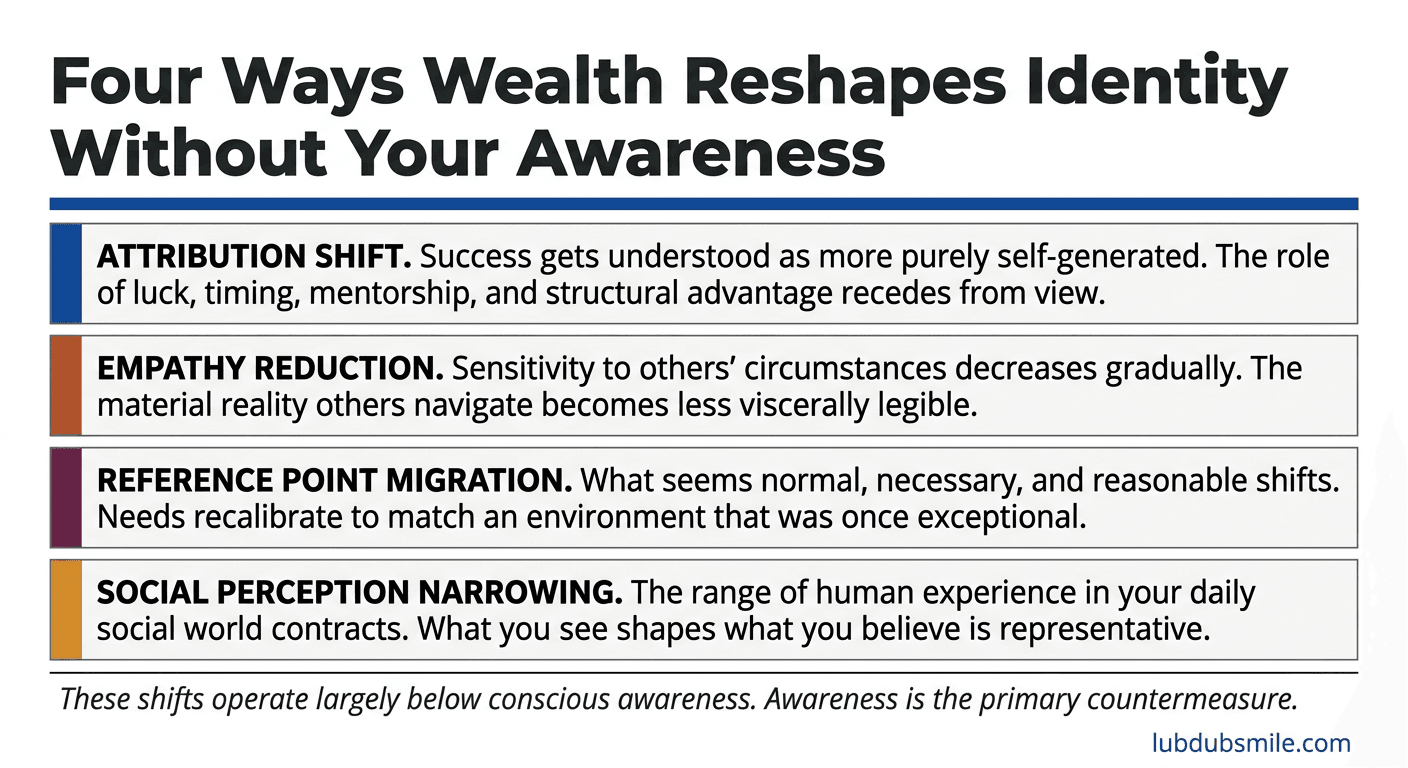
The psychological effects of becoming wealthy are documented, specific, and largely invisible to those experiencing them. Researchers have identified four primary mechanisms through which wealth and identity shift together:
- Attribution shift: success gets understood as more purely self-generated
- Empathy reduction: sensitivity to others’ circumstances decreases
- Reference point migration: what seems normal, necessary, and reasonable changes
- Social perception narrowing: the range of human experience in your social world contracts
Understanding these mechanisms is the starting point for conscious engagement with how wealth and mental health intersect and for recognizing which shifts are happening by default rather than by choice.
Does Money Actually Change Your Personality?
UC Berkeley psychologist Paul Piff’s research on socioeconomic status and social behavior found, across multiple studies, that higher socioeconomic status correlated with reduced empathy, increased sense of entitlement, and greater tendency toward unethical behavior in controlled conditions. These are population-level tendencies documented through experimental methods not individual destiny or moral verdict. The research is worth taking seriously precisely because it describes something that operates largely below conscious awareness which means awareness is the primary countermeasure.
Research by psychologists Michael Kraus and Dacher Keltner at Yale found that people with higher class standing tend to rely more heavily on internal attributions for success skill, intelligence, individual effort and less on external factors like luck, context, inherited advantage, or the work of others. Psychologists sometimes call this pattern hedonic adaptation the way people normalize new circumstances so thoroughly that the circumstances stop feeling exceptional. This attribution shift happens gradually and often unconsciously. It changes how success gets understood, which changes how others’ circumstances get understood, which changes behavior. Wealth and identity shift together through exactly this mechanism.
The attribution shift finding deserves particular attention because it describes something that looks, from the inside, exactly like accurate self-knowledge. People who have worked genuinely hard and made genuinely good decisions naturally attribute their success to those things. The research does not dispute that the effort and judgment were real. What it identifies is the selective pruning that accompanies success: the gradual de-emphasis of timing, luck, access, and others’ contributions that were equally real but become less cognitively available as wealth accumulates. The shift is not dishonesty. It is a predictable perceptual narrowing, and naming it as such makes it addressable in a way that moral framing does not.
Does Wealth Make You Believe Your Success Is Entirely Self-Made?

You worked for this. You made intelligent decisions under real pressure. And research suggests that believing your success is entirely self-made may itself be one of the effects of having achieved it.
This is one of the more uncomfortable findings in wealth and identity psychology. The belief that success is purely self-generated is itself, partially, a product of success. Successful people are not wrong to recognize their effort, skill, and judgment those are real. The cognitive shift toward emphasizing internal factors and de-emphasizing external ones is itself documented as a consequence of wealth accumulation, not only an accurate reading of how wealth happened.
Understanding this shift doesn’t require abandoning the accurate recognition of genuine competence. It requires adding to that recognition an honest accounting of luck, timing, mentorship, structural advantage, and the work of others the full picture that the attribution shift tends to selectively omit. Net worth and self-worth are different measures but wealth and identity research consistently finds that people conflate them more as financial standing increases.
Where Research Is Nuanced and Where Popular Claims Overstate It
Population-level research tendencies don’t determine individual outcomes. Many wealthy individuals demonstrate exceptional empathy, genuine humility about the role of external factors in their success, and prosocial behavior that exceeds what their resources would require. These individuals exist often because they’ve engaged in deliberate cultivation of what wealth tends, without cultivation, to reduce.
The wealth and identity research findings are starting points for examination, not predictions for any individual. Their value lies in identifying psychological tendencies that operate without awareness making awareness the relevant response.
Identity Before and After: The Psychological Gap
The Self-Concept You Built in Scarcity or Modesty
Most self-concepts are built in conditions of constraint. The identity formed while working toward financial security self-reliant, resourceful, aware of limitation, connected to others through shared material reality doesn’t automatically update when the material reality changes. The person who earned the wealth often carries the self-concept of the person who needed to earn it, now in conditions where that self-concept no longer accurately maps to circumstances.
How does wealth affect your sense of self when your internal identity lags behind your external reality? It produces a particular kind of dissonance: the internal experience of a person navigating scarcity while the external reality is abundance. Old financial anxieties persist long after they’re materially justified. Spending freely feels difficult even when constraint is no longer real. Identity still defines itself through working-toward rather than having-arrived, because the self-concept predates the arrival. The process of reclaiming identity after major life transitions shares this quality the self constructed under one set of conditions persisting into conditions that have fundamentally changed.
First-Generation Wealth: Navigating Identity Between Worlds
You grew up in a home where money was scarce and difficult. Now you have more than you ever imagined possible. And somewhere in you, you feel like a stranger in both worlds.

First-generation wealth identity problems are among the most underacknowledged psychological challenges of wealth accumulation. The displacement from the world of origin combined with incomplete integration into the world arrived at creates a specific kind of double estrangement. The cultural fluency, social vocabulary, and habitual assumptions of wealth are learned, not inherited and the learning is ongoing, often uncertain, sometimes humiliating.
The world of origin may feel increasingly foreign as lifestyle, concerns, and reference points diverge. The world of wealth may feel like a performance rather than a belonging a place visited rather than inhabited. The emotional register of this transition is typically complex: grief for connection lost, guilt about distance from family and community, gratitude for the opportunity, pride in the achievement, and a particular loneliness of being between worlds that feel closed in different ways.
Imposter Wealth: The Feeling You Don’t Deserve or Belong Here
Imposter syndrome is well-documented in high-achieving professional contexts. Its wealth equivalent the persistent sense that financial success is temporary, undeserved, or belonging to someone else is less commonly named but widely experienced, particularly by first-generation wealthy individuals navigating wealth and identity simultaneously.
The feeling produces paradoxical behavior: wealth that can’t be spent freely because it might disappear; status that can’t be fully inhabited because it feels borrowed; relationships with peers that feel like infiltration rather than belonging. Understanding this as a psychological pattern rather than accurate assessment of whether success is deserved is part of what honest wealth and identity examination makes possible.
The Specific Ways Wealth Reshapes How You See Yourself
What Happens When Wealth Becomes Your Core Identity?
When financial success becomes the primary organizer of self-concept when wealth is not something you have but something you are identity becomes fragile in specific ways. Market fluctuations become existential threats. Business setbacks become identity crises. The loss of wealth, when it comes, becomes the loss of self.
Identity built on wealth is particularly vulnerable because wealth is genuinely variable. Self-concepts organized around what you produce, what you value, how you treat people, and what you’re building toward are more stable precisely because they’re less dependent on external conditions that aren’t entirely controllable. The wealth and identity relationship becomes most dangerous when the financial and the existential merge without examination. Understanding the work of redefining strength beyond external markers can offer a more durable framework for self-concept that wealth can inform without defining.
Does Money Actually Make You Feel Safer?
Wealth creates genuine capacity to manage risk and buffer adversity the security of good healthcare, safe housing, legal representation, access to opportunity. It also creates a specific cognitive distortion: the belief that enough money produces genuine immunity from the fundamental uncertainties of human life.
Cancer, divorce, children’s struggles, loss, accident, cognitive decline, death none of these become optional with sufficient financial resources. The illusion that they do, which wealth and identity fusion can produce, is a particular kind of vulnerability. It sets up collision with inevitable uncertainty in ways that can produce psychological catastrophe when what failed was believed to have been purchased away.
The Generosity Self-Concept vs. Actual Giving Behavior
Someone assumes you’re generous because you’re wealthy. You know the gap between the generosity you believe yourself to be and what you actually give and that gap has become something you think about.
The gap between self-perceived generosity and actual prosocial behavior warrants honest examination. Research on wealth and charitable giving shows complex patterns: wealthy individuals give, on average, a smaller percentage of income than lower-income individuals, even while giving larger absolute amounts. Self-concept around generosity often precedes the behavior, allowing the belief without the practice.
This isn’t a verdict on wealthy individuals’ character it’s an observation about the cognitive ease of substituting identity for behavior. Examining the gap honestly is more productive than defending the self-concept. Affluenza the cultural tendency to prioritize wealth accumulation over meaningful engagement with its effects operates most powerfully through exactly this substitution. Building emotional regulation as a daily practice provides a foundation for the honest self-examination that closes this gap over time.
What Wealth Does to Your Social World (And Therefore to You)
How Do You Know Who Likes You vs. What You Have?
Wealth introduces a specific uncertainty into relationships: the difficulty of distinguishing genuine connection from instrumental interest. This isn’t paranoia it’s a real epistemological problem. When you have significant resources, the motivation of people who want your company becomes genuinely harder to read.
The result, for many people navigating wealth and identity questions, is a narrowing of authentic social experience. Trust requires evidence that’s harder to obtain. New relationships carry an additional layer of interpretive complexity. Existing relationships may change in ways that are ambiguous people more available, more agreeable, more interested in ways that could reflect genuine connection or instrumental calculation.
This uncertainty tends to produce one of two responses: hypervigilance about others’ motives (which produces isolation and cynicism) or willful naivety (which produces exploitation). Neither satisfies. The honest middle requires accepting the uncertainty while developing criteria for trust that don’t require certainty. The social fitness research on relationship quality consistently finds that authentic connection not proximity or availability determines relationship wellbeing over time.
Class Transition: Leaving One World Without Full Entry Into Another
You’re in a room with people who have the same financial profile as you, and you realize you have less in common with them than you do with people you left behind and you’re not sure what to do with that.
Wealth and relationships authenticity becomes hardest to maintain during class transition the bidirectional displacement that rarely gets named clearly. The world of origin becomes harder to inhabit as reference points, concerns, and available experiences diverge. The world of wealth doesn’t fully absorb first-generation arrivals, who may lack the cultural fluency, habitual assumptions, and shared history of those who grew up within it.
The loneliness of this position belonging fully in neither world is genuine and underacknowledged in wealth and identity discussions. It doesn’t resolve cleanly. It does tend to become more navigable with deliberate attention to which relationships and communities genuinely reflect who you are, regardless of which world they formally inhabit.
The Values Question: Have You Changed, or Just Revealed?
Does Getting Rich Change Your Values?
One of the more genuinely interesting questions in wealth and identity psychology is whether wealth changes values or surfaces values that were already present but constrained. Scarcity limits expression you can’t be extravagant without resources, you can’t be broadly generous without surplus. Does getting rich change what you value, or does it remove the constraints that prevented pre-existing values from fully expressing?
The honest answer is probably both, in different proportions for different people. Wealth creates conditions that make certain values easier to enact and others easier to abandon. What those conditions reveal and what they produce are both worth examining because the examination creates the possibility of conscious engagement rather than default drift.
When Values Drift Without Conscious Choice
Values drift is particularly characteristic of wealth and identity accumulation because the drift is slow, each step seems small, and the direction consistently moves toward whatever is most comfortable in the current context. The reference group shifts upward. Normal spending increases. Concerns that once felt pressing recede. Perspectives that once seemed obviously correct become less obvious as social world narrows toward peers whose experiences confirm particular worldviews.
What does first-generation wealth actually feel like when values start to drift? It often feels like nothing at all because drift by definition lacks a single noticeable moment of departure. Each individual step seems reasonable. The cumulative direction becomes visible only in retrospect, or when someone from the world of origin reflects it back.
This drift doesn’t require bad intentions. It requires only the absence of deliberate counter-practice. The examined wealthy life one that maintains values through intentional practice rather than relying on circumstances to enforce them looks deliberately different from the unexamined one. Building emotional maturity in long-term relationships requires similar deliberate practice against comfortable drift the same discipline applies to wealth and identity maintenance.
Examining Generosity, Fairness, and Empathy Honestly
The values worth examining most carefully are those that wealth most consistently puts pressure on: empathy for those with fewer resources, accurate understanding of how systems affect opportunity, generosity that exceeds what feels comfortable, and fairness in evaluating what different people deserve based on what they have.
Can wealth make you lose empathy? Research suggests it can gradually and without conscious decision. The examined response is not guilt but deliberate counter-practice: maintaining genuine exposure to different circumstances, giving in ways that require real engagement rather than financial delegation, and regularly examining whether stated values appear in actual behavior.
This examination isn’t about producing guilt. It’s about asking honestly whether the values claimed reflect actual behavior and if the gap between them is significant, deciding what to do about it.
First-Generation Wealth: A Specific Identity Challenge
Guilt, Grief, and Gratitude: The Complex Emotional Register
First-generation wealth involves emotional terrain that rarely receives its full complexity. Gratitude for what the financial security enables is real. Pride in the achievement is legitimate. Alongside these: guilt about distance from family and community who haven’t followed the same path; grief for the shared reality that wealth disrupts; discomfort with the class shift that feels like a kind of disloyalty; and the complicated experience of having wanted exactly this and finding it more psychologically complex than anticipated.
What does first-generation wealth actually feel like emotionally? For most people, it feels like several contradictory things simultaneously which is precisely why the experience is so rarely described accurately. Gratitude and grief coexist. Pride and guilt occupy the same moment. These emotional registers coexist in the wealth and identity experience of first-generation wealth, and honoring all of them is more psychologically honest than resolving them prematurely into either simple celebration or simple guilt. The emotional agility research consistently finds that holding complexity without forcing premature resolution produces more sustainable wellbeing than collapsing it into simpler emotional narratives.
When Your Family of Origin Can’t Follow Where You’ve Gone
Your children are growing up with everything you didn’t have. You wanted that for them. And you’re starting to wonder what else you’ve given them that you didn’t intend to.
The relationship changes that wealth produces within families of origin are among the most emotionally loaded dimensions of first-generation wealth and identity experience. The divergence of circumstances and reference points can make authentic connection harder even when the relationships remain nominally intact. Financial asymmetry within families produces complex dynamics: obligation, resentment, dependence, and the difficulty of relating across a material gap that didn’t previously exist.
None of these dynamics have simple resolutions. They benefit from acknowledgment rather than management through either financial support that substitutes for connection or pretending the gap doesn’t exist. Financial disagreements and money dynamics in relationships often surface exactly these tensions whether the financial gap exists between partners or between family members at different wealth levels.
Wealth and Parenting: The Identity You’re Passing On
What Children Absorb About Identity and Money
Children absorb their relationship with wealth and identity from what they observe, not primarily from what they’re told. A parent who talks about the importance of earning money while modeling that wealth makes effort optional teaches the second lesson more effectively than the first. A parent who espouses values of fairness while living in a world that demonstrates none teaches the demonstrated lesson.

What your children absorb about identity and money is substantially determined by what your wealth and identity actually express not the version you aspire to, but the version present in daily life, in how effort gets discussed, in how other people’s circumstances get described, in what gets treated as necessary versus chosen.
How do wealthy people see themselves differently and what do children learn from watching that? They learn that the way their parents relate to money, effort, and other people’s circumstances is normal. That lesson shapes their relationship with wealth and identity more than any conversation about values.
The Entitlement Risk and How Intentional Parenting Addresses It
Raising children with wealth without entitlement is one of the most practically challenging dimensions of wealth and identity and one of the most consequential. Children who grow up with significant resources without meaningful experience of constraint, contribution, or consequence can develop expectations about the world that don’t serve them and don’t serve others.
Intentional parenting in wealthy contexts isn’t about artificially imposing hardship. It’s about ensuring that children develop genuine competence, real understanding of effort’s relationship to outcome, authentic empathy for different circumstances, and identity that isn’t organized primarily around what they have. This requires deliberate structure rather than default because the default in wealthy environments tends toward the opposite. Self-care for parents in high-resource contexts involves attending to what you model alongside what you intend your own wealth and identity relationship shapes your children’s more directly than any conversation about money.
Toward a More Intentional Relationship With Wealth and Identity
The Examined Wealthy Life: What It Requires
The examined wealth and identity relationship actively engages the effects of wealth on identity rather than passively absorbing them. How do you stay grounded when you become wealthy? The people who navigate wealth and identity accumulation with integrity tend to share five specific practices:
- Seek honest feedback from people whose honesty isn’t constrained by financial relationship with you
- Maintain genuine relationships outside the wealth context not as social obligation but as epistemic necessity
- Examine behavior regularly whether actual choices reflect stated values, not whether stated values feel sincere
- Acknowledge external factors honestly luck, timing, mentorship, structural advantage, and others’ contribution to your success
- Engage deliberately with the full range of human experience rather than allowing wealth to narrow it
None of these practices happen automatically. All of them are possible with intention. Together, they produce something more sustainable than unexamined accumulation: identity that isn’t fragile because it isn’t built only on financial standing.
Maintaining Connection to Your Pre-Wealth Self
The aspects of self that formed before significant wealth accumulation the values and perspectives shaped by earlier circumstances, the relationships that predated financial success, the understanding of life built in conditions that most people inhabit are worth actively preserving. Not because earlier circumstances were better, but because the perspectives they generated are genuinely valuable and genuinely at risk of erosion through the reference point shift that wealth and identity drift produces.
This doesn’t mean performing poverty or denying legitimate change. It means maintaining conscious connection to a broader range of human experience than wealthy social worlds tend to provide. Healthy aging and long-term wellbeing research consistently finds that connection to a broad and authentic social world not wealth accumulation predicts sustained wellbeing across decades.
Giving as Identity Practice (Not Just Tax Strategy)
Can giving actually change your relationship with wealth? Research on prosocial behavior and wellbeing suggests it can but only when giving involves genuine engagement rather than financial delegation.

Giving organized primarily around tax optimization is a different practice than giving organized around genuine engagement with where resources are most needed and most useful. The latter requires actually understanding something about what different communities and causes need which requires genuine engagement rather than financial delegation.
Giving as identity practice oriented toward genuine impact rather than maximizing charitable deduction tends to produce connection to a broader range of human experience and more honest engagement with how resources affect outcomes. It also produces a more stable sense of meaning than the alternative. Wealth and identity become most integrated when resources actively serve values rather than merely accumulate alongside them. Thriving beyond material success consistently points toward the same finding: purpose-organized lives outperform achievement-organized ones in terms of sustainable meaning regardless of financial standing.
When to Seek Professional Support
Wealth Psychology: A Specialized Therapeutic Field
Wealth psychology is a recognized specialization within therapeutic practice, addressing the specific psychological terrain of significant wealth accumulation, inheritance, inter-generational wealth, and the identity questions these circumstances produce. Therapists specializing in this area work with high-net-worth individuals on identity integration, family dynamics around money, values alignment, and the particular relationship challenges that wealth and identity questions create.
Wealth and mental health intersect in ways that general therapy may not be equipped to address because the specific psychological territory of significant wealth requires experience with its particular dynamics. For wealth-related psychological distress that significantly affects wellbeing persistent identity dissonance, relationship conflict organized around money, anxiety about wealth’s effects on children, or the specific loneliness of between-worlds experience specialized support provides what general therapy often cannot. Executive therapy programs often address exactly these wealth and identity questions in high-achieving professionals navigating the psychological complexity of significant financial success.
When Identity Distress Around Wealth Warrants Professional Support
Consider professional support when wealth and identity concerns produce any of the following:
- Persistent distress that self-reflection alone doesn’t resolve
- Relationship conflicts organized around money that significantly affect important relationships
- Consuming anxiety about wealth’s effects on children or the next generation
- First-generation between-worlds loneliness that feels genuinely overwhelming
- Identity organized around wealth facing circumstantial threats that feel existentially destabilizing
Professional support in this context is an investment in the intentional wealth and identity relationship this article advocates structured support for examination that’s harder to do alone. Telehealth therapy options provide flexible access across state lines for professionals whose schedules and locations make traditional therapy access difficult.
Frequently Asked Questions
Has wealth actually changed me, or am I the same person with more options?
Almost certainly both. Research on wealth and identity is clear that wealth creates psychological tendencies in attribution, in empathy, in risk tolerance, in social perception that change people at population levels without individual determination. You are also genuinely continuous with the person you were before, carrying the same core history, relationships, and values-as-formed. The question isn’t whether change has occurred it has but which changes were conscious and which were absorbed by default, and what you want to do with that information going forward.
How do I maintain authentic friendships when money creates asymmetry?
With honesty rather than management. Asymmetric relationships survive wealth and identity gaps when both parties can be honest about the asymmetry and its effects when financial imbalance can be named, when different capacities can be acknowledged, when the relationship can adapt to changed circumstances without pretending the change hasn’t happened. What tends to damage friendships around wealth is not the asymmetry itself but the failure to engage honestly with it: one-sided resentment that’s never voiced, one-sided guilt that produces either avoidance or patronizing generosity, and the pretense that everything is the same when both parties can see that it isn’t.
Is wealth guilt productive or just self-punishment?
Both, depending on what it produces. Guilt that prompts honest examination of whether behavior reflects values, that motivates genuine prosocial action, and that maintains accurate understanding of privilege is productive it’s doing something useful. Guilt produces only self-criticism without driving behavioral change, substitutes for real engagement with the implications of wealth and identity, or gets displayed instead of acted upon—turning it into self-punishment that serves no one. The useful question is not whether to feel guilty but what the guilt points toward and what honest response to that pointing looks like in actual behavior.
How do I talk to my children about family wealth without damaging their development?
Honestly, age-appropriately, and with genuine attention to what you model alongside what you say. Children need to understand that financial security is a form of privilege with responsibility attached not an indication of inherent superiority or entitlement. They need genuine experience of effort, consequence, and contribution not artificially imposed but genuinely real. They need parents who demonstrate through actual behavior that wealth is a resource for living well and contributing meaningfully, not an identity or a license. The conversation isn’t a single talk. It’s the accumulation of daily modeling about how to live in circumstances of financial security without being diminished by those circumstances.
When does wealth-related identity distress warrant professional support?
When self-reflection stops producing movement. If wealth and identity concerns produce persistent distress that examination alone doesn’t resolve if relationship conflicts around money significantly affect important relationships, if first-generation between-worlds loneliness feels genuinely overwhelming, or if identity organized around wealth faces circumstantial threats that feel existentially destabilizing professional support is appropriate. Wealth psychology is a recognized therapeutic specialization precisely because this territory is real, specific, and harder to navigate without experienced support.
The Examined Wealthy Life
Wealth examined becomes resource. Wealth unexamined becomes identity and identity built on wealth is fragile in ways that become visible at the worst moments. The market drops. The business fails. The health situation changes. The children disappoint. And what was believed to be purchased security, status, meaning, immunity turns out not to have been available for purchase.
The goal of this examination is not to produce guilt about wealth and identity or nostalgia for less. It’s to support the kind of intentional engagement with wealth’s psychological effects that produces something more stable than unexamined accumulation: identity that wealth informs but doesn’t define, relationships that exist because of genuine connection rather than financial calculation, values expressed in actual behavior rather than only in self-concept, and a relationship with financial security that serves something larger than itself.
The wealthiest lives, in terms of meaning, tend to be those where money genuinely serves something values, relationships, impact, purpose rather than being the thing itself. That orientation doesn’t happen by default. It requires the kind of honest examination that this article has tried to support.
Takeaway
Wealth and identity shift together gradually and largely unconsciously and honest examination of that shift is how the relationship becomes intentional rather than default.
This article provides psychological frameworks for understanding wealth’s effects on identity. It is not a substitute for professional mental health support or financial advice. If wealth-related psychological concerns significantly affect your wellbeing, consulting a therapist experienced with high-net-worth clients can provide personalized support.
This examination fully acknowledges wealth’s extraordinary privilege relative to financial insecurity. Examining wealthy individuals’ psychological experiences is not equivalent to suggesting their challenges compare to the material hardship of poverty.
This content is for educational purposes and does not substitute for professional psychological or therapeutic help.